
The best reptile heat lamp is the one that produces your species’ required basking temperature in your actual enclosure while leaving a cooler area for retreat. Choose from the animal’s care requirements first, then select a compatible heat source and verify the result with thermometers. Wattage printed on a bulb is only a starting point; enclosure size, lamp height, ventilation, room temperature and basking surface all change the temperature your reptile experiences.
Heat and ultraviolet-B (UVB) are separate jobs unless a specific, verified combination product is designed to provide both. An ordinary incandescent basking bulb supplies heat and visible light, but not UVB. This guide shows how to choose, install and test a setup without relying on guesswork.
As an Amazon Associate I earn from qualifying purchases.
Start with the reptile, not the bulb
Every species has its own preferred temperatures, humidity and UV exposure. A temperature that suits one reptile can be unsafe for another, and requirements can change with life stage, health and enclosure design. Find a current care reference for the exact species and record three pieces of information before shopping:
The Tool Desk
Outbyte PC Repair FREEClear out junk files and repair common Windows errorsFree Scan →Outbyte Driver Updater FREEFix the driver behind crashes, sound loss and screen glitchesFind Drivers →- the desired basking temperature or surface-temperature range;
- the acceptable temperature at the cooler end of the enclosure; and
- whether the species needs UVB, and what UVB exposure pattern is appropriate.
Do not transfer a bearded dragon temperature range to a gecko, snake, tortoise or amphibian. The UC Davis School of Veterinary Medicine’s Bearded Dragon Care page, accessed in 2026, gives an example for that species: a daytime tank temperature of 80–85°F and a basking spot of 88–95°F. Those figures illustrate how a gradient is described; they are not a general recommendation for reptiles.
#1 Best Overall

- Simulated Sunlight: Most amphibians and reptiles are poikilotherms, whose body temperature changes with their environment. Therefore, sunlight and temperature affect the growth, development and reproduction of reptiles. The REPTI HOME reptile heat lamp is able to simulate sunlight, and create an area for reptiles to bask in the sun, which provide a comfortable habitat for your reptile pet
- Rapid Heating Up: REPTI HOME Reptile heating bulb uses an advanced shape design and mature technology, allows light and heat to concentrate below the bulb, greatly reducing heat loss. More efficient and faster to heat than regular bulbs. After a few seconds of opening, you can feel the temperature rise, and after a few minutes the temperature can reach the temperature that amphibians need.
- Suitable for Various Reptiles: Reptile heat lamp bulbs can create a living environment closer to nature, suitable for various reptiles or amphibians, including bearded dragons, tortoises, turtles, lizards, snakes, iguanas, geckos, chameleons, frogs, toads, chickens, puppies, hedgehog, hermit crabs, etc
- Standard of Use: Each product includes 2 pack 100 watt reptile heat light in one box, the other bulb can be used as a spare or replacement, and the heating bulb can be used for 2,000 to 3,000 hours. And heat light are recommended to be used 4-6 hours a day and replaced every 3 months. Keep at least 30 cm away from reptiles and keep the surface of the bulb dry and away from water
- Note: When using this reptile heat lamp, avoid splashing water onto the basking bulb and do not use it with dimmers, thermostats, or rheostats. Do not turn on the heating bulb immediately after it is turned off, and do not turn on andoff the bulb freouently. This will shorten the lifespan of the light bulb. Do not use it when the voltage is unstable.
If your species’ care guidance conflicts between sources, ask an exotic-animal veterinarian to resolve the difference, especially for a juvenile, an elderly animal or one with illness.
What a heat lamp must accomplish
Create a usable basking area
A heat source should warm an area where the reptile can adopt its normal basking posture, not just create a hot dot that the animal cannot comfortably occupy. The beam or heated surface must be large enough for the animal to use while still leaving room to move away.
Preserve a cooler retreat
Reptiles regulate body temperature behaviorally. Put the lamp over one end of the enclosure so the opposite end remains cooler. The animal should be able to choose among temperatures without escaping the enclosure. A uniformly hot habitat removes that choice, while a uniformly cool habitat may prevent normal thermoregulation.
Deliver the result in your enclosure
The same nominal bulb can produce different temperatures in two habitats. Enclosure length and height, screen or solid construction, ventilation, room temperature, basking-surface material, lamp distance and furniture placement all affect the outcome. Select a bulb as a starting point, then test the installed habitat.
Heat and UVB are not interchangeable
Brightness is not evidence of UVB output. UC Davis and veterinary lighting references distinguish an ordinary incandescent basking bulb from a UVB lamp: the incandescent bulb provides heat and visible light, but not UVB. If your species needs UVB, plan that equipment separately unless the particular product has verified combined heat-and-UVB output and its instructions specify safe placement.
Rank #2

- Enhances UVB & Light Reflection: The reptile light fixture focuses the light emitted by the bulb, ensuring even distribution across the entire illumination area. The polished interior surface greatly enhances light reflection, minimizing losses of both light and UVB. This reflective effect optimizes the efficiency of the light source, promoting the health and growth of reptiles
- Max 160W: Each socket can accommodate 160W reptile heat lamps, suitable for ceramic heat bulbs, UVB bulbs, solar bulbs, and other reptile lighting
- Independent Switches: The power cord of the bearded dragon light fixture is equipped with two independent switches, allowing you to control the heat lamp and UVB lamp as needed, providing a comfortable temperature and lighting environment for reptiles
- High-Temperature Label: When the surface temperature of the reptile heat lamp exceeds 113°F, the triangular warning label on the lamp will turn red. This label can also be used to verify if the ceramic heat lamp is functioning properly
- Quick Heat Dissipation: The reptile heat lamp features multiple ventilation holes on the top for effective heat dissipation, preventing bulb damage from overheating and reducing the frequency of bulb replacements, thereby saving replacement costs
The 2016 paper describing the UV-Tool assigned 254 species to four UV-exposure zones in the version discussed in that article. That number describes that published version, not necessarily the current database. The tool’s approach is species-based: it considers natural history, measures lamp gradients and uses maps to help establish a safe UV range. Use species-specific UV guidance rather than judging exposure by how bright the enclosure looks.
Keep the heat plan and UVB plan on separate checklists:
- Heat: basking temperature, cool-end temperature, heat-source position and thermostat or monitoring arrangements where appropriate.
- UVB: species need, lamp type, distance, unobstructed exposure, replacement schedule and any manufacturer testing or instructions.
A UVB lamp is not automatically a heat lamp, and a hot bulb is not automatically a UVB lamp.
Choose the lamp by a measured outcome
1. Measure the enclosure before buying
Record the enclosure’s inside length, width and height, the distance from the planned lamp position to the basking surface, and the room’s usual temperature. Note whether the top is screened, how much ventilation it has, and whether the basking platform can be moved. These details explain why a wattage chart cannot guarantee a safe result.
2. Select the heat function
For a daytime basking area, a directional heat bulb is commonly used to warm one end. A heat-only source may be appropriate when UVB is supplied by separate equipment. A product marketed as a combination source should be treated as combined only when its specifications and testing support both functions.
Rank #3

- 【Newly Upgraded Bell-Mouth Design】 :This newly upgraded heating lamp with a TFNN bell-mouth design provides a wider range of UVA/B ultraviolet rays compared to the design of ordinary models. It can simultaneously heat and illuminate multiple reptiles. The light is adjustable, making it suitable for different seasons and various reptiles, and it is extremely convenient to use.
- 【Upgrade Timer】:The reptile heat lamp offers three timing cycle modes (3H/6H/12H), enabling all-night cyclic timing with automatic on/off functions. Additionally, it has three adjustable heating brightness levels. You can use the "+/-" buttons to adjust the temperature to find the most suitable setting for your pet, which is more conducive to heating and supplementing calcium for your pet. It provides more direct sunlight and higher UVA/B turtle basking light, simulating natural sunlight and promoting the pet's appetite and calcium absorption.
- 【360°Rotatable Swan Neck 】 : This heating lamp is made with a 15.8-inch swan neck. The independently rotating head is constructed from stainless steel tubing, capable of rotating 360 degrees. It allows for flexible control of the light's distance and angle without deformation, ensuring a wider coverage of the light. It can simultaneously provide heating and supplementary lighting for multiple tanks and pets, and can be applied to small habitats of various sizes such as pet boxes, turtle tanks, glass ball boxes, enclosures, aquariums.
- 【Upgraded Quality Material】 :The reptile heat lamp clip, lamp tube and lampshade are made of high-quality metal, featuring heat resistance. The clip has a stronger gripping force. It can be firmly and easily installed in any position and fixed effectively. It has two built-in electroplated bulbs, with power ratings of 50W and 75W respectively. The silver-plating process is adopted to ensure anti-oxidation and explosion-proof performance, and the vacuum glass tube extends the lifespan of each bulb. These bulbs simulate the solar spectrum and increase the temperature to achieve the best health condition for pets.
- 【Wide Use】 : This TFNN bell-mouth heating lamp is suitable for most amphibians, reptiles, and plants, including turtles, bearded dragons, lizards, geckos, frogs, toads, snakes, chickens, birds, and even fish and plants.
Compare products on function rather than marketing language:
What’s actually slowing this PC down?
Pick the symptom - the matching free tool is one click away.
| Question | What to verify |
|---|---|
| Does it provide heat? | It must produce the species’ target basking conditions in your enclosure after installation. |
| Does it provide UVB? | Assume no UVB for an ordinary incandescent basking bulb. Confirm combined output only from the product’s technical instructions. |
| Where does it heat? | Look for a practical basking area with a cooler retreat, not merely the highest possible surface temperature. |
| Will it fit? | Check socket type, fixture rating, wattage limit, guard requirements and the manufacturer’s clearance instructions. |
| Can you maintain it? | Make sure you can monitor temperatures and follow any separate UVB replacement and positioning instructions. |
3. Treat wattage as a starting choice
Higher wattage does not automatically mean better heating. It can overheat a small habitat, while a lower-wattage bulb may fail to establish the needed basking area in a large or cool room. Choose a reasonable starting source that is compatible with the fixture, install it safely, and adjust the setup based on measurements.
4. Position the source over one end
Place the lamp so the animal cannot touch the bulb or hot fixture and so the beam does not heat every part of the enclosure equally. Follow the bulb and fixture instructions for minimum distance, socket type, maximum wattage and guarding. There is no single safe clearance that applies to every bulb, fixture, reptile or enclosure.
Build and test the thermal gradient
- Prepare the enclosure. Install the basking platform, hides and other furniture in their intended positions. Furniture changes airflow and the surfaces available for warming.
- Install the fixture. Use the specified socket and fixture, respect the fixture’s wattage limit, and add a guard if required. Keep flammable or heat-sensitive materials away from the source.
- Warm the habitat before introducing the reptile. Allow the lamp to run long enough for temperatures to stabilize under normal daytime room conditions.
- Measure the basking area. Take a surface reading at the place where the reptile’s body will rest. A temperature gun can provide a surface reading; aim at the actual basking surface rather than the bulb or air above it.
- Measure the air temperatures. Use habitat thermometers at the warm end and cool end, positioned where the animal spends time. Record the readings rather than relying on touch.
- Compare with the species’ care target. If the basking area is too cool, adjust the source or its position only within the manufacturer’s instructions. If it is too hot, increase distance or reduce the heat output only in a way the fixture permits.
- Recheck after every change. Moving a platform, changing ventilation, replacing a bulb or altering the room temperature can change the gradient. Measure again before assuming the previous readings still apply.
- Observe access and behavior. Confirm that the reptile can reach the basking area without contacting the lamp and can leave it for a cooler retreat. Behavioral observations supplement, but do not replace, thermometer readings.
The Maine Department of Inland Fisheries and Wildlife’s 2012 standards specifically caution that a temperature gradient cannot be judged by feel. A surface that feels warm to your hand may be unsuitable for a reptile, and your hand cannot tell you whether the cool end is cool enough.
How to measure accurately enough for decisions
Use more than one measurement point
At minimum, check the basking surface, the warm-end air and the cool-end air. A single thermometer placed near the lamp cannot describe the habitat. Record readings at the same times of day so you can identify normal variation.
Free tools Windows power users keep installed
One-click scans. No signup required.
Rank #4

- The Light Dome with heat resistant ceramic socket can accommodate either reptile heat lamp or reptile basking bulb and ceramic heat emitter (Max. 150W).
- The Reptile Dome has an extra deep aluminum reflector dome that increases light, UVA output.
- The light can be easily turned on and off by the On/Off switch, mounted on the extra long power cord (180 cm/6 ft).
- This Reptile Light Fixture fits kinds of bulbs incl.; Daylight Basking Spot, Daytime/Night Time Heat Bulb, Natural Light, Reptile ceramic heat emitter.
- UL Listed Ceramic Socket with E26 Interface. ReptiKing Reptile Dome is warranted to be free for replacement if any damage or deformation. No hesitate to contact us if you need any support.
Distinguish surface and air readings
A temperature gun measures the surface it is aimed at. A habitat thermometer tracks air temperature at its probe. Both can be useful, but they answer different questions. Measure the surface the reptile actually rests on and place air probes where the animal spends time.
Test under normal conditions
Close the enclosure as it is normally used, operate the usual ventilation and use the room’s ordinary temperature. Testing with the top open, the furniture removed or an unusually cold room can produce a misleading result. Recheck after the habitat has run through a normal day/night cycle if your equipment or care plan changes temperatures overnight.
Common setup problems and fixes
| Symptom | Likely cause | Corrective path |
|---|---|---|
| Basking surface is below the species target | Lamp is too far away, the source is underpowered for the enclosure, room temperature is low or the basking surface absorbs little heat. | Verify the reading and fixture compatibility, then adjust height or source within the instructions. Re-measure after the habitat stabilizes. |
| Basking surface is above the target | Lamp is too close, output is excessive for the enclosure or ventilation is insufficient. | Increase distance or reduce output only within the fixture’s permitted setup. Improve safe ventilation if appropriate and test again. |
| Warm and cool ends read almost the same | The source is centered, the enclosure is too small for the layout, or heat is spreading through insufficiently controlled airflow. | Move the source to one end, create a clear retreat and reassess furniture and ventilation. |
| Animal cannot use the basking area comfortably | Platform is too small, unstable or positioned where the animal can touch the source. | Replace or reposition the platform and guard the hot equipment. Confirm the animal can move away. |
| Temperatures change sharply after a bulb replacement | The new bulb has different output or beam distribution, even if its printed wattage is similar. | Treat every replacement as a new setup: measure basking, warm-end and cool-end temperatures again. |
| Keeper assumes UVB is present because the bulb is bright or hot | Visible light and heat have been confused with UVB. | Check the product’s verified function and provide separate, species-appropriate UVB equipment when required. |
Installation and fire-safety essentials
- Use the socket and fixture type specified for the bulb.
- Never exceed the fixture’s maximum wattage.
- Prevent the reptile from touching the bulb, reflector or any heated guard.
- Keep bedding, décor and other combustible materials from contacting hot equipment.
- Secure the fixture so it cannot fall into the enclosure or be moved by the animal.
- Follow the manufacturer’s stated clearance and guarding requirements; do not substitute a universal distance.
- Inspect cords, sockets and guards for damage whenever you clean the enclosure or replace a lamp.
The cited husbandry standards support preventing direct contact and following equipment instructions, but they do not establish one clearance or fixture rating for every product. The product’s own specification controls those details.
A practical example: setting up heat for a bearded dragon
Suppose you are preparing a bearded dragon enclosure. Start with the UC Davis example of 80–85°F for daytime tank temperature and 88–95°F at the basking spot, then confirm that those figures remain current for your animal and care plan. Place a heat source over one end, create a stable basking platform and leave the opposite end cooler.
Before introducing the dragon, measure the basking surface, warm-end air and cool-end air. If the basking surface reads below 88°F, adjust the lamp position or output within the instructions and test again. If it exceeds 95°F, make the opposite adjustment. The final arrangement should provide access to the basking area without contact with the lamp and an unobstructed route to the cooler end.
Best Value
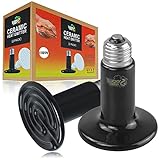
- 🦎No Light Emitted - The heat lamp bulb only generates heat during use, and does not emit light. It provides sufficient heat for your pets so that they can feel the warmth you made for it in a cold environment. Especially when it is used at night, it will not affect the pet's sleep.
- 🦎Heating UP Fast - After turning on the reptile ceramic heat bulb for 10 seconds, you can clearly feel the rapid rise in temperature, and it only takes 4 minutes for the reptile heat lamp to reach the rated temperature.
- 🦎Sturdy - LUCKY HERP reptile heat emitter is made of thick special ceramic material, and the heat light bulb shell is stronger and more durable than ordinary heating lamps. Our reptile light bulbs last up to 10,000 hours. Use in standard E26 lamp base, 120 volts and easy to install.
- 🦎Safety Instructions - You must use good quality ceramic lamp holders. When using the reptile basking bulb, keep a distance of more than 30cm from reptiles. Do not turn on the chicken heat lamp immediately after turning it off, and do not turn the bulb on and off frequently.
Bearded dragons also require appropriate UVB. A heat bulb that reaches the target temperature does not satisfy that need unless the particular product is verified to provide UVB. Select and position the UVB equipment separately according to species guidance and its instructions.
Maintenance after the initial setup
Recheck after changes
Measure again whenever you change the bulb, lamp height, fixture, basking platform, ventilation, enclosure furniture or room location. Seasonal room-temperature changes can also alter the habitat even when the equipment has not moved.
Keep a simple log
Record the date, bulb or fixture change, basking reading, warm-end reading and cool-end reading. A log helps identify gradual drift and shows whether a replacement restored or changed the gradient.
Quick wins for a faster PC:
Scan for outdated or missing drivers - takes under a minuteDriver Scan →Clear out junk files and repair common Windows errorsFree Scan →Maintain separate UVB equipment
Follow the selected UVB lamp’s placement, testing and replacement instructions. Do not infer remaining UVB output from visible brightness. A lamp can still look bright while no longer delivering the intended UVB exposure.
When a veterinarian should be involved
Consult a qualified exotic-animal veterinarian when you cannot establish the species’ targets, when credible care sources disagree, or when the reptile shows illness, abnormal appetite, weakness or persistent avoidance of both the basking and cooler areas. A veterinarian can interpret temperature needs alongside hydration, diet, age and medical status.
Quick Recap
Beginner’s decision checklist
- I have identified the exact species and life stage.
- I know the target basking and cool-end temperatures from a reliable species-specific source.
- I have measured my enclosure and noted room temperature, ventilation and lamp distance.
- I have chosen a heat source and fixture that are compatible.
- I have planned UVB separately unless a verified combination product is being used.
- The lamp heats one end and leaves a cooler retreat.
- The animal cannot touch the hot source or fixture.
- I have measured the basking surface, warm-end air and cool-end air.
- I will recheck temperatures after every equipment or enclosure change.
Product prices and availability are accurate as of the date/time indicated and are subject to change. Any price and availability information displayed on Amazon at the time of purchase will apply.





Leave a Reply