
Some links on this page are affiliate links: if you buy through them we may earn a commission, at no extra cost to you.
Yes, barn monitoring can reduce insurance risk when it detects a developing hazard early and someone responds, but no evidence establishes a universal reduction in claims or premiums. The strongest insurance-linked example is continuous electrical monitoring: sensors can flag overheating or other abnormal electrical conditions before they become a fire, equipment failure or interruption.
Whether that monitoring earns a discount—or is required—depends on the insurer, the structure’s risk assessment, the approved vendor list and the policy wording. A Canadian program currently advertises savings of up to 10% per monitored structure, but that is a program offer, not a market-wide result.
As an Amazon Associate I earn from qualifying purchases.
Recommended Free Tools
What barn monitoring actually changes
A sensor does not prevent a loss by itself. It changes the time available to act. A useful system measures a condition continuously or at defined intervals, recognizes an abnormal reading, sends an actionable alert and gives a person enough time to investigate, repair or isolate the problem.
For a barn, the chain usually looks like this:
- Measure: sensors track an electrical current, temperature, smoke level, water presence or another condition.
- Detect: software identifies a reading outside the configured range or a sudden change.
- Alert: a notification reaches the farmer or a designated responder by the system’s available communication method.
- Respond: someone inspects the equipment, calls a licensed contractor, shuts down a circuit, moves animals or takes another corrective action.
If the alert is ignored, connectivity is lost or nobody can reach the barn, the risk-management benefit is greatly reduced. Insurance recognition therefore tends to focus on the complete monitoring arrangement—not merely the presence of a sensor.
Popular on Amazon

- Supports Multiple Industry-Standard Communication Protocols: Modbus TCP, SNMP, BACnet, and MQTT. Our system is compatible with all these protocols and can deliver data in multiple formats simultaneously. Comprehensive support for SNMP v1/v2/v3 and SNMP Trap v2c/v3 with high security level.
- Can be integrated to AWS/Azure/Tuya loT cloud directly with low cost. Can be directly integrated into Home Assistant
- Proactive Alerts – Instant email notifications when thresholds are exceeded (fully customizable triggers). IFTTT Automation – Trigger smart actions (e.g., activate HVAC, log to Google Sheets, or Telegram alerts) via Webhook integration.
- PoE power supply: Centralized power supply: Simply provide uninterrupted power supply at the PoE switch to ensure power supply to the sensor.
- Easy to use: A graphical interface configuration tool supporting Windows, Linux, and macOS platforms with online remote upgrade capability for simplified product deployment and maintenance.
Why electrical monitoring is the clearest insurance use
Electrical faults are a direct barn-fire concern, and continuous monitoring can reveal deterioration that a periodic visual inspection may miss. Ken Worsley, chief operating officer of Nova Mutual Insurance Company, described barn electrical monitors as tracking the system’s health “at the milliamp level.” In his explanation, an abnormal reading can identify a problem while it is still suitable for scheduled maintenance.
That mechanism can interrupt a chain such as a loose connection or overloaded component producing excess heat, followed by insulation damage, ignition and a fire. Monitoring may also identify conditions that would otherwise cause equipment to fail and stop ventilation, feeding or other essential operations. Worsley said the value is not limited to insurance: a farmer can schedule maintenance before a breakdown shuts down the work being done in the barn.
The Tool Desk
Outbyte PC Repair FREERepair Windows errors before they cause bigger problemsFix Now →Outbyte Driver Updater FREEFix the driver behind crashes, sound loss and screen glitchesFind Drivers →This is expert commentary about how the technology is intended to work, not a controlled estimate of avoided claims. Neither the commentary nor the available insurer material establishes that a particular sensor prevents a stated percentage of fires.
What one Canadian insurer’s program says
The Co-operators’ Farm Defender information, current as of October 2026, is a concrete example of insurer recognition. It says farmers can save up to 10% on premiums for each monitored structure when they install monitors from PrevTech or another approved vendor. The page also says that when the insurer considers a barn to have higher electrical-fire risk, an approved monitoring system is required.
Those terms apply to that Canadian insurer’s program. They do not create a standard requirement for farms insured elsewhere, and “up to” is not an average saving or a guaranteed rate for every policyholder. Eligibility, the structures that qualify, accepted equipment and policy conditions must be confirmed directly with the insurer before installation.
Also popular on Amazon
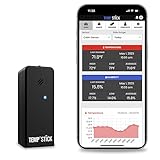
- NO MORE SUBSCRIPTIONS! Temp Stick is the Best Pick for Remote WiFi Temperature and Humidity Monitoring from Anywhere, Anytime. Temp Stick gives you peace of mind and avoids years of cellular subscription costs. Stay up-to-date with fantastic new features thanks to free over-the-air software updates. Works on 2.4 Ghz WiFi only, does not support 5Ghz wifi. (Not for use with public or guest wifi networks at rv parks, campgrounds, coffee shops, hotels etc)
- INSTANT, REAL-TIME ALERTS: Constantly monitors conditions every second. Be cautious of competitors promising unlimited EMAILS yet restricting TEXT alerts – a concern! How will you catch email notifications when you're asleep or doing other tasks? Only Temp Stick provides unlimited text alerts. Imagine the peace of mind knowing you won't run out of alerts when you need them most. Take advantage of Temp Stick's exclusive ability to set mutliple alerts at many different thresholds.
- BATTERY LIFE 1-2 YEARS: Set it and forget it. Low power chip technology. No need for the constant hassle of retrieval for recharging – Temp Stick operates reliably on 2xAA batteries for years. No gateways or unwieldy wires are required. Stay in control from anywhere, anytime, using your mobile, tablet, or PC. Seamlessly connected to your WiFi, Temp Stick diligently monitors temperature and humidity in your Home, RV, Camper, Refrigerator/Freezer, Walk-In, etc. On/Off switch for RV and travel use.
- DATA LOGGING & FEATURES : Attain precise 24/7 condition monitoring. Temp Stick's data recording remains active if temporarily offline, uploading up to one month of stored data upon reconnection. Streamline record-keeping with AUTOMATED EMAIL REPORTS (daily, weekly, and monthly). Free API access for developers. Compatible with ALEXA and IFTTT for home automation. multiple user access, alert scheduler to arm and disarm alerts whenever you want, anti false alarm and more for years, courtesy of free software updates.
- MADE IN AMERICA: Designed, developed and made right here in the USA. Our Temp Stick Support team answers your calls 7 days a week! Expect swift and knowledgeable assistance from our experts, we are located in Utah. We take pride in being Made in the USA, thank you for supporting American manufacturing and ingenuity.
The same Farm Defender information lists a water-leak detector among possible loss-prevention measures for farm dwellings. That illustrates an important distinction: a measure can be useful to a property-risk program without producing the same discount, requirement or underwriting treatment as an electrical monitor installed in a barn.
Monitoring options and their limits
Different devices address different hazards. Comparing them by name alone can lead to an expensive system that does not solve the farm’s principal risk.
| Monitoring category | What it can detect or collect | How it may help operations | Insurance evidence and limits |
|---|---|---|---|
| Electrical monitoring | Overheating, abnormal current or other changes in electrical-system health; some systems also report power outages | Prompts inspection, repair or shutdown before fire, equipment failure or interruption | Most directly linked to an insurer program; acceptance is vendor- and policy-specific |
| Smoke and fire sensors | Smoke or fire indicators in barns, silos or other structures | Provides earlier warning for evacuation, fire response or suppression | A 2025 systematic review describes this as an insurance-prevention mechanism, but gives no barn-specific claim-reduction percentage |
| Thermal or FLIR systems | Heat differences and abnormal hot spots | Supports inspection and can identify heat that is difficult to see directly | Industry commentary presents thermal systems as potentially useful; a handheld camera is not continuous monitoring, and detection is not automatic suppression |
| Water and moisture sensors | Leaks, moisture or water presence | Limits damage to buildings, feed, equipment or dwelling areas when someone responds | May be included in a loss-prevention program; no general barn-insurance discount is established |
| Barn-environment monitoring | Climate, air quality, water, litter and animal behavior | Supports ventilation, animal care and operating decisions | A 2023 study of three commercial dairy farms illustrates these uses but does not establish insurance savings |
| GPS livestock tracking | Animal location and movement | Helps locate livestock and identify unusual movement | Included as an agricultural example in the 2025 review; no barn-premium result is established |
Canadian Underwriter coverage also discusses forward-looking infrared systems and a system Worsley described as capable of spraying water on a fire. A heat-sensing inspection camera, a permanently installed thermal monitor and an automatic suppression system are different capabilities. Confirm exactly which function a quoted product provides.
How to decide whether a system is worth installing
1. Start with the hazard and the structure
List the barn’s electrical service, high-load equipment, heating sources, dusty or damp areas, water lines and communications coverage. Ask which loss would be most severe: an electrical fire, a frozen or burst line, a ventilation failure, smoke, equipment downtime or animal-health deterioration. The answer determines the sensor category.
2. Ask the insurer before buying equipment
Request the current requirements in writing. Ask whether the barn is classified as higher electrical-fire risk, whether monitoring is mandatory, which vendors and models are approved, whether installation must be performed by a specified professional, how alerts must be transmitted and what documentation is needed for underwriting or renewal.
Quick wins for a faster PC:
Clear out junk files and repair common Windows errorsFree Scan →Scan for outdated or missing drivers - takes under a minuteDriver Scan →Repair Windows errors before they cause bigger problemsFix Now →Also popular on Amazon

- SEE IT AT A GLANCE, NO PHONE NEEDED - When you walk past the basement or the greenhouse you just want to know it's fine without digging out your phone, so this indoor thermometer and hygrometer puts a bright color screen right on the hub that shows the current temperature and humidity, recent trends, the local weather and the time at a glance - so anyone in the house can read it, not just whoever has the app.
- AN ALARM LOUD ENOUGH TO CATCH YOU IN THE NEXT ROOM - A cold snap or a failed heater can ruin a wine cellar, a room of instruments or a greenhouse of seedlings before you ever check your phone, so this remote temperature monitor sounds a 95 dB alarm on the hub and pushes app and email alerts the instant a high or low limit is crossed - with iOS Critical Alerts that sound even on silent, an alert delay that cuts false alarms, remote mute once you've seen it, and a heads-up when a sensor's battery runs low.
- PUT THE SENSOR WHERE WIFI AND OUTLETS DON'T REACH - The one spot you most need to watch - a basement corner, a wine room, a greenhouse across the yard, a far room at the other end of a large house - is often far from the router, has no WiFi, and has no outlet nearby, so this long-range temperature and humidity monitor links its wireless battery sensor back to the hub from up to 2000 ft (line of sight), so the sensor needs neither WiFi nor power where it sits.
- WIRE THE HUB IN WHEN WIFI ISN'T ENOUGH - In a basement or a garage the WiFi is often the weakest link in the whole setup, and a monitor that keeps dropping offline stops protecting you, so this monitoring hub takes a wired Ethernet (LAN) connection as well as 2.4 GHz WiFi - a steadier link than a WiFi-only system for a spot you plan to leave watching for the long haul.
- DEW POINT AND VPD, NOT JUST A NUMBER - A plain temperature and humidity reading can't tell a grower whether mold or tip-burn is coming, or a cigar or wine keeper whether the air is truly right, so this monitor also works out dew point and VPD (vapor pressure deficit) in the app - a professional climate reference most basic monitors and app-only rivals simply don't give you.
Do not assume that a product accepted for a dwelling is accepted for a livestock barn. Approval can depend on the structure, location, policy form and monitoring configuration.
3. Verify what “continuous” means
Find out the sampling interval, alert threshold, power backup and communication path. A system that checks only when a person opens an app is not equivalent to one that continuously watches the electrical system. Ask what happens during an internet or cellular outage and whether an outage itself generates a notification.
4. Define the response plan
Every alert needs an owner and a time target. For an electrical warning, the plan may be to keep people and animals clear, isolate a circuit if safe, contact a licensed electrical contractor and preserve the alert history. For a water alert, it may involve shutting a valve and checking nearby electrical equipment. If nobody is on site overnight, arrange an alternate responder.
5. Document installation and maintenance
Keep the model, serial number, installation date, installer credentials, sensor locations, alert contacts, test results and service records. Insurers may ask for proof that an approved configuration remains operational. Schedule periodic tests and replace batteries or communications hardware according to the manufacturer’s instructions.
Free tools Windows power users keep installed
One-click scans. No signup required.
What the evidence does—and does not—show
A 2025 systematic review of Internet-of-Things prevention and insurance describes hazard monitoring and alert-triggered responses across insurance settings. Its agricultural examples include smoke and fire sensors for silos and other structures, moisture alerts and GPS livestock tracking. The review also warns that apparent improvements can be influenced by self-selection: lower-risk operators may be more likely to adopt monitoring in the first place.
Also popular on Amazon

- What’s Included: This package includes 1 YoLink Hub and 1 Sensor—2 items total. The “Number of Items: 2 Pack” refers to the 2 individual products in the package, not 2 sensors.
- DON'T TRY THIS WITH WiFi! Our unique LoRa-based sensors are different from WiFi, Zigbee, Z-Wave and most other wireless smart sensors in that they are extreme long-range (up to 2,034 ft open-air), low-power (years between battery changes), and work outdoors*, on other floors, and even in a metal box (like a fridge or mailbox)!
- MONITOR & MANAGE your temperature and humidity concerns, whether it's a fridge, a barn or bedroom, a chicken coop or a dog kennel, a plant nursery or your child's nursery - anywhere! *Consider one of our weatherproof sensors, designed for outdoor use
- ECONOMICAL SMART FRIDGE! Save thousands when you make ANY fridge smart (or smarter) with YoLink smart sensors. Start with temperature sensors, then add door/lid sensors, leak sensors and a Power Fail Alarm.
- IFTTT & Alexa Integration: trigger IFTTT applets based on high or low temperature set points reached (when device alerts). Voice query Alexa for the temperature (only; humidity not supported at this time). Triggering Alexa routines is not supported at this time.
That cross-sector finding cannot be converted into a barn-specific percentage. The available material does not establish how many barn fires, claims or premium dollars monitoring prevents.
A 2023 study examined a monitoring setup on three commercial dairy farms, collecting climate, air-quality, water, litter and cow-behavior information. It demonstrates that farm monitoring can support animal and facility management, but it did not measure insurance discounts or claim outcomes.
Industry commentary similarly discusses potential risk mitigation without reporting a controlled barn-loss comparison. Treat statements about “catching problems early” as an explanation of the intended pathway, not as proof of a guaranteed financial result.
Installation, connectivity and operating pitfalls
- Wrong hazard: An environmental sensor cannot substitute for electrical monitoring when the insurer’s concern is an electrical-fire risk.
- Unattended alerts: Notifications that go to a former employee or a phone with poor reception are not an effective response system.
- Power dependence: A monitor connected to the same failed circuit it is supposed to watch may stop reporting during an outage. Ask about independent backup power and outage alerts.
- False alarms: Poorly configured thresholds can cause alert fatigue. Have the installer document normal operating ranges and review repeated alarms rather than simply silencing them.
- Seasonal changes: Heating loads, ventilation schedules and livestock occupancy change through the year. Recheck thresholds after major equipment or management changes.
- Assumed approval: An online listing or a recommendation from another farm does not prove that the model is approved for your policy.
- Confusing inspection with monitoring: A periodic electrical inspection remains valuable, but it does not provide the same continuous warning as an installed monitor.
- Overpromising suppression: Detection, notification and automatic water application are separate functions. Confirm which one is included.
A practical pre-renewal checklist
- Obtain the insurer’s written position on the specific barn and hazard.
- Confirm the approved vendor and exact model or configuration.
- Record where every sensor is installed and what condition triggers an alert.
- Test notifications with the primary and backup responders.
- Verify power, battery backup and communications during an outage.
- Keep inspection, repair, test and service records together with the policy file.
- Report material changes—new high-load equipment, a remodeled barn or a change in use—to the insurer.
- At renewal, ask whether the discount, requirement and approved-vendor list have changed.
Bottom line for farm owners
Barn monitoring can reduce insurance risk when it provides early, reliable detection and the farm has a practiced response. Continuous electrical monitoring has the clearest connection to barn-fire underwriting, and one Canadian insurer currently advertises up to 10% savings per monitored structure under specific conditions. That figure is not a universal benchmark. Choose the system around the hazard, obtain insurer approval first and maintain the alert-and-response process that turns data into prevention.





Leave a Reply