
Quick wins for a faster PC:
Repair Windows errors before they cause bigger problemsFix Now →Scan for outdated or missing drivers - takes under a minuteDriver Scan →Clear out junk files and repair common Windows errorsFree Scan →Yes. Cats can favor one forepaw, just as Annie did during training at Best Friends Animal Society. “Left-handed cat” is an easy phrase, but paw preference is more accurate: it describes a cat’s tendency to use one front paw more often for a particular action. Some cats show a consistent preference, while others use both paws about equally. The best available pooled estimate found almost even shares of right-pawed and left-pawed cats, not a universal feline preference for one side.
What “left-handed” means in a cat
In people, handedness usually refers to a broad preference for one hand across many tasks. A cat’s paw preference is narrower and more task-dependent. A cat may lead with one forepaw when reaching for food, stepping over an object, touching a target or batting a toy, yet use the other paw in a different situation. Researchers therefore look for a repeated tendency rather than treating a single reach as proof.
As an Amazon Associate I earn from qualifying purchases.
A cat can fall into one of three practical categories:
The Tool Desk
Outbyte PC Repair FREERepair Windows errors before they cause bigger problemsFix Now →Outbyte Driver Updater FREEScan for outdated or missing drivers - takes under a minuteDriver Scan →- Left-paw preference: the left forepaw is used more often in a repeated task.
- Right-paw preference: the right forepaw is used more often.
- No clear preference: neither paw is used consistently enough to classify the cat.
These labels describe observed behavior, not intelligence, personality or a medical diagnosis. They also do not mean a cat is incapable of using the other paw.
#1 Best Overall
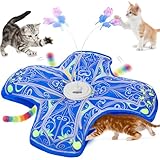
- Top-Tier Dual Interactive Fun: Qraxond's new indoor cat toy has dual motors, controlling random rotation of butterfly and plush tail swing rod accessories, bringing fun, exciting play for kittens and adult cats. Hide-and-Seek: The animal tail-shaped plush hides under the cover cloth, rotating irregularly to appear/disappear, creating a hide-and-seek game. It mimics real prey, bringing unpredictable chases to stimulate the cat's brain and senses. Irregular Rotating Butterfly: The top has an auto-rotating butterfly that rotates, pauses or swings to simulate real flight, keeping the cat engaged. Various interactions ensure the cat gets enough exercise to avoid obesity
- 3 Adjustable Speed Modes: Customize the excitement with separate buttons for the butterfly and tail. Choose from 3 settings: Steady (Blue Light), Active (Purple Light), and Random (Yellow Light). Suitable for high-energy cats to burn off steam or for calm cats to enjoy gentle play. Keep your feline entertained and prevent boredom, especially when they are home alone
- Touch-Sensitive Activation: Your Cat's in Control! With smart touch-sensor technology, just tap the device to fire up the fun mode, it will kick off a 5-minute automatic play session instantly. Right after the play session ends, it switches directly to touch-sensitive standby mode, where the purple indicator light flashes every 20 seconds. Simply tap again to reactivate it for another 5-minute cycle. This smart loop ensures your cat gets sufficient exercise and prevents overstimulation
- Large Rechargeable Battery: Enjoy long-lasting play with the built-in 2500mAh battery. It charges fully in just 2.5 hours via the included USB cable (use a 5V adapter only). The efficient auto on/off cycle extends battery life, making it convenient for busy pet owners while ensuring your cat gets healthy, moderate exercise
- Realistic Bird Chirping: Elevate the hunt with lifelike sound. The built-in speaker emits authentic bird chirps to attract your cat's attention and stimulate their prey drive. Combined with the random motions of the butterfly and tail, it creates an irresistible and engaging play experience that keeps your cat happily chasing even when they're by themselves
Annie’s left-pawed training story
How the caregivers met Annie
Best Friends Animal Society’s Christelle L. Del Prete described Annie in an account published May 26, 2015. Annie was a tan-and-black tabby who had been declawed before arriving at the sanctuary. She was quick to swat at people. The account says caregivers could not tell whether declawing was one reason for that behavior; it does not establish that declawing caused her swatting.
From hand targeting to a high-five
Caregivers refreshed Annie’s clicker-training and hand-targeting skills. The sequence was straightforward: a click marked the behavior the trainer wanted, and a cat treat followed immediately. With that foundation, they taught Annie to slap a trainer’s palm with a paw, first as a low-five and then as a high-five.
During those repetitions, the team noticed that Annie was mainly “left-pawed.” In other words, her left forepaw appeared more often in the trained paw behavior. She also learned a head-butt cue and was working toward a two-paw “double five.”
What the story says training changed
Best Friends reported that keeping Annie’s paws occupied in positive training sessions made her gentler with human friends and helped her build better relationships. Those are outcomes described in that individual account, not results from a controlled behavior study. Annie is useful as an example of an individual cat with a noticeable preference; she cannot establish how common left-paw preference is among cats.
Rank #2

- A NEW CHOICE FOR INDOOR ENTERTAINMENT: Endless fun for your cat! Designed for indoor environments, this interactive toy ball rolls quickly across the carpet and emits an appealing cat-attracting chittering sound. Not only does it stimulate your cat's hunting instincts, it also allows them to enjoy outdoor chasing indoors while reducing the risk of furniture scratching
- INTELLIGENT INTERACTION AND FUN: This automatic cat toy is your pet's new playmate. It has two modes: ① Normal mode (green light), which runs for five minutes and then automatically shuts off. ② Intelligent mode (blue light), after running for five minutes the exercise ball automatically enters the dormant mode, when your cat touches it again, the exerciser will interact with your cat again. So whether it's a long game or a short interaction, this interactive cat ball meets the needs of both you and your pet, allowing your pet to entertain itself while you're busy
- TWO SPEEDS FREELY SWITCHING: The BABORUI interactive cat toy offers two speeds, fast and slow, which can be freely switched at any time. Even if your cat is cute and short-legged, it can still keep up with the pace of the exercise ball
- TRIPLE FUN, TRIPLE HAPPINESS: This cat toys for indoor cats comes with three fun tails that provide your cat with triple the fun. They can have endless fun chasing and catching the ball, while the sound of the bells on the tails will further stimulate their curiosity and desire to chase
- SAFE MATERIAL, LASTING AND DURABLE: We understand that your pet's safety is of utmost importance to you. The shell of this kitten toys is made of safe silicone material, so you don't need to worry even if your pet chews it. The durable design means it can withstand daily wear and tear, providing long-lasting companionship for you and your pet
What the larger analysis found
A 2019 Psychology Today explainer by Sebastian Ocklenburg, Ph.D., summarized a meta-analysis by Ocklenburg, Isparta, Peterburs and Papadatou-Pastou. The pooled analysis combined 32 studies involving 1,484 cats. Its reported figures are the broadest estimate in the material available here, but they still depend on the tasks and classification rules used in those underlying studies.
| Observed category | Share in the pooled summary | What it means |
|---|---|---|
| Right-pawed | 39% | More frequent use of the right forepaw in the tested behaviors |
| Left-pawed | 36% | More frequent use of the left forepaw in the tested behaviors |
| No preference | 25% | No consistent side advantage in the tested behaviors |
In that summary, 75% of cats showed a preference for one paw and 25% did not. The difference between 39% right and 36% left was not a significant overall right-side bias. The practical answer is therefore not “most cats are right-pawed” or “most cats are left-pawed,” but rather that individual preferences are common while population-level left and right shares are close.
Why individual studies do not always agree
Earlier paw-preference studies often used small samples and produced inconsistent findings, according to Ocklenburg’s 2019 explanation. Results can change when researchers change any of the following:
Do these 3 things before closing this tab:
1Scan for outdated or missing drivers - takes under a minute2Clear out junk files and repair common Windows errors3Fix the driver behind crashes, sound loss and screen glitches- Sample size: a small group can give an unstable estimate of the wider cat population.
- Task: reaching into a tube, stepping over an obstacle and touching a target require different movements.
- Number of trials: a preference is easier to distinguish after repeated opportunities than after one or two attempts.
- Classification threshold: investigators must decide how much more often one paw must be used before calling the cat left- or right-pawed.
- Testing conditions: motivation, food placement, posture, surface and the cat’s comfort can influence which paw moves first.
For that reason, figures from one experiment should not be treated as directly interchangeable with the pooled estimate. A meta-analysis combines studies, but it does not erase the differences in how those studies elicited and counted paw use.
Rank #3

- [Trending Interactive Entertainment]: Potaroma's new indoor cat toys provide an engaging, stimulating play experience for kittens and older cats alike. This automated toy features a rotating butterfly on the top, a removable cover, an enticing feather wand hidden under the cover, consisting a hide-and-seek game. This interactive toy is a great birthday gift for enriching your pet's daily life. Even when left at home alone, your cat can play by itself independently like having a party
- [Advanced Electronic Irregular Motion]: Powered by a smart motorized system, this electric cat toys deliver irregular movements to keep your cat entertained. The play experience includes spinning, chasing, and hunting elements that mimic real-life prey, especially the chasing feather that pops out unpredictably, stimulating your kitty's brain and senses
- [Multi Modes for Indoor Fun]: Features a range of captivating movement modes that stimulate cat's natural instincts to chase, pounce, and play. 3 rotating modes of chasing feather; Simultaneous or seperate working of chasing feather and spinning butterlfy; What's more, the cover can be removed to expose the chasing feather completely for more fun. The diverse play options ensure your cat gets the mental and physical stimulation and enough exercise to eliminate boredom
- [Durable]: Built to withstand even the most aggressive play sessions, thanks to its durable design and high-quality materials. The motors inside the toy are designed to move smoothly and resist wear and tear. Whether your cat loves to chew, scratch, or paw at their toys, Potaroma's cat toy can handle it all. Experience the magic of Potaroma's interactive cat toy, making it a must-have for cat owners seeking a durable and entertaining option for their pets
- [Rechargeable & Large Capacity Battery]: Provide hours of fun for your furry friend. With a built-in rechargeable battery that offers a long-lasting charge, your kitten can enjoy uninterrupted self playtime for up to several days. No need for frequent recharging, making it a convenient choice for busy pet owners. Keep your cat entertained and happy with our innovative cat toys, featuring a battery that's as powerful as your cat's curiosity
A historical example: the 1955 tube test
The Guardian’s 2015 “From the archive” account of a 1955 experiment by Cole illustrates why methods matter. Cats reached for food placed in a glass tube. A cat counted as showing “handedness” when it used the same paw in more than 75% of trials.
| Result in Cole’s 1955 account | Number of cats |
|---|---|
| Left-pawed | 23 |
| Right-pawed | 12 |
| Ambidextrous | 25 |
| Total | 60 |
Those numbers come from a 60-cat sample and a specific tube-reaching task with a 75% cutoff. They are not a current prevalence estimate and should not be read as contradicting the later pooled summary. They show how a different task, sample and threshold can produce a different distribution.
Do male and female cats favor different paws?
The 2019 summary reported a sex-associated pattern in a subset of the studies. Among female cats in that subset, 52.0% were right-paw preferring, 27.1% left-paw preferring and 20.9% showed no preference. Among male cats, 52.3% were left-paw preferring, 30.8% right-paw preferring and 16.9% showed no preference.
What’s actually slowing this PC down?
Pick the symptom - the matching free tool is one click away.
| Subset reported in the 2019 explainer | Right preference | Left preference | No preference |
|---|---|---|---|
| Female cats | 52.0% | 27.1% | 20.9% |
| Male cats | 30.8% | 52.3% | 16.9% |
The author says the reason is unknown and mentions sex hormones only as a possible factor. These group percentages cannot predict an individual cat. A female cat can be left-pawed, a male cat can be right-pawed, and either can show no consistent preference.
Rank #4

- 🐱 Trigger Natural Hunting Instincts - Concealed feather wand mimics real prey with unpredictable pop-up motion + realistic mouse squeak. Satisfies your cat's predator drive even when you're away
- 🤖 3 Smart Modes for Every Personality - Normal/Active/Interactive modes adapt to lazy loungers or energy balls. Motion sensor auto-activates on touch; auto-sleep saves battery
- Beat Boredom & Anxiety - Mental stimulation + physical exercise in one. Reduces destructive scratching, over-grooming, and midnight zoomies. Perfect for solo play while you work
- ⚡ 2-Hour Charge = Weeks of Fun - Built-in 1200mAh battery eliminates disposable battery costs. USB-C charging (cable included) - eco-friendly & travel-ready
- 🛡️ Built for Rough Play - Thickened padded mat withstands pouncing & clawing. Replaceable feather wand extends toy lifespan. Rounded edges protect paws
How to observe your own cat’s paw preference
There is no validated home diagnostic protocol in the cited sources. You can still make a careful, low-pressure observation by looking for a pattern across ordinary opportunities rather than labeling your cat from one reach.
- Choose a safe, familiar activity. Use a toy, a treat placed where the cat can reach comfortably, or a target the cat already knows. Do not force a paw into position.
- Keep the setup consistent. Place the object at the same height and distance when possible. Changing its position can change the cat’s body angle and the paw that moves first.
- Record each first reach. Note left, right or an attempt in which both paws move together. Include refusals rather than silently excluding them.
- Repeat on separate occasions. Spread observations over multiple short sessions when the cat is relaxed. A single excited or awkward reach is weak evidence.
- Look for a clear majority. If one paw repeatedly leads across similar opportunities, describe the cat as showing a tendency. If the counts remain close, “no clear preference” is the more honest label.
- Stop if the cat becomes frustrated. Paw preference is not worth creating stress, guarding behavior or competition around food.
This approach is an informal observation, not a scientific test. It also cannot tell you whether your cat would choose the same paw in every context.
Independent reader supportYour contribution helps us test, update, and keep practical guides available for everyone.Could training reveal a preference?
Training can make paw use easier to notice because it creates repeated, visible opportunities. In Annie’s case, caregivers used a click immediately after the desired response and then delivered a treat. They shaped a palm touch into low-five and high-five behaviors, which gave them many occasions to see which paw she offered.
Free tools Windows power users keep installed
One-click scans. No signup required.
A clicker is optional. The essential principle is precise positive reinforcement: mark the behavior at the moment it happens, then reward it. A verbal marker can replace a click if it is consistent. The goal should be a comfortable cue, not making the cat perform until tired or withholding food to force a response.
Best Value

- Ball Cat Toy: Multi-level cat toy with 3 tiers and 6 spinning balls—keeps indoor cats active, curious, and entertained
- Enrichment: Encourages batting, swatting, and chasing to satisfy hunting instincts and enhance everyday enrichment
- Durable & Safe: Sturdy, non-slip base and a secure safety bar for hours of safe independent play
- Feline Favorite: Designed for older kittens and adult cats alike; great for multi-cat homes or gifting; not recommended for kittens under 12 weeks
- Expandable: Enjoy on its own or pair with Catstages Topper Toys (sold separately) for even more interactive chaos
- Begin with a behavior the cat already offers, such as looking toward or touching a hand target.
- Reward calm participation and keep sessions brief.
- Present the target in a neutral position so you are not mechanically steering the cat toward one side.
- Do not pull, bend or trap a paw, especially in a cat with a history of declawing, pain or handling sensitivity.
- End on an easy success and allow the cat to walk away.
Annie’s account also describes a head-butt cue and work toward a two-paw “double five.” Those behaviors underline an important point: a cat that favors one paw can still use both paws when a task calls for it.
What paw preference can—and cannot—tell you
It can describe a behavioral tendency
Repeated observations may show that your cat commonly initiates a movement with one forepaw. That can help you choose how to present a target or interpret a trained trick. It is a small piece of information about motor behavior.
It cannot diagnose a problem by itself
A sudden change in paw use is different from a stable preference. If a cat that normally bears weight on both forepaws starts avoiding one, limps, licks a paw, drops objects or resists touch, seek veterinary advice. Pain, injury or another medical issue should be considered before assuming the change reflects handedness.
Recommended Free Tools
It does not measure temperament or ability
Being left-pawed does not make a cat more aggressive, clever, friendly or trainable. Annie’s gentler interactions were attributed by Best Friends to the positive training relationship described in its story, not to her left-paw preference.
How to interpret the evidence responsibly
Keep the levels of evidence separate. Annie is a documented individual case from a sanctuary training account. The 32-study, 1,484-cat estimate is a pooled research summary. Cole’s 1955 figures are a historical experiment using a glass tube and a 75% threshold. Each answers a slightly different question.
If you explain paw preference to another cat owner, a precise summary is: cats can favor one forepaw; about one quarter of cats in the 2019 pooled summary showed no clear preference; and the remaining left- and right-paw shares were nearly even. Sex-associated percentages were reported in a subset, but their cause is unknown and they are not a prediction tool for an individual animal.
Bottom line for cat owners
Yes, a cat can be “left-handed” in the everyday sense. The accurate term is a left-paw preference, and it should be based on repeated behavior rather than one dramatic swat. Annie’s low-five training made her mainly left-pawed, while the broader evidence indicates that left and right preferences occur in similar proportions and that some cats show no stable side at all. Observe gently, reward cooperation and treat the result as an interesting tendency—not a label that explains your cat’s whole personality.
Quick Recap
Product prices and availability are accurate as of the date/time indicated and are subject to change. Any price and availability information displayed on Amazon at the time of purchase will apply.





Leave a Reply