
Do these 3 things before closing this tab:
1Fix the driver behind crashes, sound loss and screen glitches2Clear out junk files and repair common Windows errors3Scan for outdated or missing drivers - takes under a minuteSome links on this page are affiliate links: if you buy through them we may earn a commission, at no extra cost to you.
Do not put Sevin dust on a cat unless a veterinarian has confirmed that the exact product is labeled for cats of that age and weight. “Sevin” is a brand name used on different formulations. EPA records show that some older Sevin 5% dust registrations contained 5% carbaryl and historically listed cats as an animal treatment site, but that does not prove that every Sevin product sold today is labeled for cats or for cat fleas. A listing for flea beetles is not a listing for cat fleas.
If your cat has already contacted Sevin dust, move the cat away from the product, prevent further grooming if you can do so safely, keep the package or a photograph of its label, and call a veterinarian or animal poison-control service promptly. ASPCA Poison Control lists (888) 426-4435 and says its service is available 24 hours a day, seven days a week.
As an Amazon Associate I earn from qualifying purchases.
Quick wins for a faster PC:
Repair Windows errors before they cause bigger problemsFix Now →Scan for outdated or missing drivers - takes under a minuteDriver Scan →What Sevin dust is—and why the exact label matters
Sevin is not one single pesticide formula. The name has been used on products with different registrations, concentrations, packaging and approved uses. The EPA records identified for this question include products called Bonide Sevin 5% Dust and Miller’s Sevin 5% Dust. Both records identify carbaryl at 5%, but their label histories and listed uses are not interchangeable with every product carrying the Sevin name.
Carbaryl is a carbamate insecticide
Carbaryl belongs to the carbamate class of pesticides. Merck Veterinary Manual explains that carbamates inhibit acetylcholinesterase reversibly. In an exposed animal, disruption of this enzyme can cause excessive nerve stimulation. Possible signs include heavy salivation, gastrointestinal illness, breathing difficulty, small pupils, muscle fasciculations (twitching) and convulsions.
Popular on Amazon

- Protect your flowers and lawn from listed damaging pests
- Won't harm plants or blooms
- Kills by contact - over 150 listed insects
- Kills ants, Japanese beetles, whiteflies, aphids and many more pests
- Ready to use - simply shake to apply
Those are general toxicology findings, not a prediction that every cat touching a particular amount of dust will become ill. The actual hazard depends on the product, concentration, amount, route of exposure, duration, the cat’s size and health, and whether the cat licks particles from its fur. Because those details cannot be judged reliably from the brand name, the label and a veterinarian’s advice are essential.
“Dust” describes a formulation, not a safe dose
EPA says flea and tick products for pets can come as shampoos, collars, sprays, dusts and spot-on products. A dust can settle on fur, paws, bedding and floors, where a cat may ingest it while grooming. A product designed for plants or outdoor pests can therefore create a different exposure pattern from a veterinary product formulated and labeled for a cat.
What the EPA records actually establish
| EPA record | What it identifies | What it does not prove |
|---|---|---|
| Bonide Sevin 5% Dust Insecticide | Carbaryl at 5%; the historic registration record includes cats as an animal treatment site. | It does not establish that every current Sevin dust product has the same formula, label, directions or cat approval, nor that an unlabeled use is appropriate. |
| Miller’s Sevin 5% Dust Insecticide (802-442) | Carbaryl at 5%; the listed pests include flea beetles. | Flea beetles are plant pests, not cat fleas. This listing does not demonstrate efficacy against cat fleas or authorize application to a cat. |
A historical registration is evidence about that particular registered product and period. It is not a blanket authorization for a brand. Products can be discontinued, relabeled, reformulated or sold in different markets. Before considering any pesticide for a cat, read the current container label, including the “Directions for Use,” “Use on” or “Animal” section, species restrictions, age and weight limits, warnings and first-aid instructions.
Also popular on Amazon
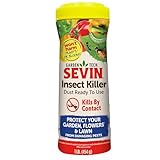
- Protect your flowers and lawn from listed damaging pests
- Won't harm plants or blooms
- Kills by contact - over 150 listed insects
- Kills ants, Japanese beetles, whiteflies, aphids and many more pests
- Ready to use - simply shake to apply
Does Sevin dust kill cat fleas?
The available records do not establish that an unspecified Sevin dust product is an effective or authorized treatment for cat fleas. One record names flea beetles, which are insects that attack plants. Cat fleas are a different pest with a different host and life cycle. Substituting the word “flea” from a flea-beetle listing for “cat flea” would be a factual error.
Even if a pesticide can kill some insects, that does not make it suitable for direct application to a cat. Efficacy, legal labeling and animal safety are separate questions. The only reliable way to determine whether a particular product may be used on a particular cat is to match the current label to the cat’s species, age, weight and condition, then confirm the choice with a veterinarian.
Why an incorrect application can make a cat sick
Likely exposure routes
- Direct application: Dust placed on the coat can remain on the skin and hair and can be swallowed during grooming.
- Powder inhalation: Fine particles can become airborne while a container is shaken or applied.
- Contaminated surfaces: A cat can walk through treated areas, transfer residue to its fur and ingest it later.
- Contact with another animal: Residue on a treated dog, person’s clothing or bedding can be transferred to the cat.
Signs that require urgent veterinary attention
Merck’s description of carbamate toxicosis includes excessive salivation, vomiting or diarrhea and other gastrointestinal signs, breathing difficulty, unusually small pupils, muscle fasciculations and convulsions. Weakness, collapse, severe agitation or any change in consciousness should also be treated as an emergency. Do not wait for a complete set of signs; a cat can worsen while appearing only mildly affected.
Also popular on Amazon

- Garden Tech Sevin 5% Dust Bug Killer Shaker Bottle 1lb
- It doesn't penetrate plant tissue and it is easily broken down by the environment
- Use throughout the growing season to kill insects, with short pre-harvest intervals for edibles Provides excellent control of leaf eating and sucking insects
- Gardentech sevin 5 percent dust bug killer
- Pack of 2
A 2022 study reviewed records from 39 cats with acute organophosphate or carbamate intoxication. It shows that these pesticide exposures occur in cats, but it is not a Sevin-specific case series and cannot provide a Sevin poisoning rate, a safe amount or a prediction for an individual cat.
How to check whether a flea product is appropriate
Use this checklist for any flea product, including one marketed as a dust. EPA advises using flea and tick products only on the animal species and size or weight specified on the label and recommends consulting a veterinarian.
| Check | What to verify | Why it matters |
|---|---|---|
| Species | The current label explicitly says cats or kittens, not merely “pets,” dogs or household insects. | Some pesticides are suitable for one species but dangerous to another. |
| Age | The cat or kitten meets the minimum age; newborns and debilitated animals may be excluded. | Young, ill or underweight animals may handle pesticides differently. |
| Weight | The cat falls within the label’s stated weight range. | Amount and exposure limits are often weight-dependent. |
| Formulation | The label identifies the exact formulation—dust, spray, shampoo, collar or spot-on—and gives directions for that formulation. | Different formulations produce different exposure patterns. |
| Target pest | The directions address cat fleas or the specific pest affecting the cat. | A plant-pest claim, such as flea beetles, is not a cat-flea claim. |
| Veterinary advice | Your veterinarian has reviewed the product, the cat’s health and any other medicines or flea products being used. | Concurrent products and medical conditions can change risk. |
A practical label-checking sequence
- Write down the complete product name, EPA registration number if shown, active ingredient and concentration.
- Read the current label’s animal-use section rather than relying on a retailer description, an old photograph or a memory of a similar package.
- Confirm that cats are named as an approved species and that the cat meets every age and weight restriction.
- Confirm that the directions cover the pest you are trying to control. “Flea beetle” does not mean “cat flea.”
- Show the label to your veterinarian, especially if the cat is a kitten, elderly, pregnant, nursing, ill or taking other medicines.
What to do if Sevin dust got on your cat
- Stop the exposure. Move the cat away from the container, treated area or contaminated animal. Do not create a cloud of dust while relocating the cat.
- Prevent additional licking when possible. Keep the cat under direct supervision and separate it from other pets. Do not use force that could cause injury.
- Call for professional guidance immediately. Contact your veterinarian, an emergency veterinary clinic or ASPCA Poison Control at (888) 426-4435. ASPCA states that its poison service is available 24/7.
- Have the product information ready. Provide the exact name, active ingredient, concentration, EPA registration number if present, time of exposure, estimated amount, route of exposure and the cat’s age and weight. Bring the package or a clear label photograph.
- Watch for worsening signs while help is arranged. Salivation, vomiting, diarrhea, breathing changes, small pupils, twitching, weakness or seizures require emergency care.
Do not induce vomiting, give a home antidote, apply another pesticide or begin a decontamination procedure unless a veterinarian or poison specialist specifically directs you. Advice can differ with the formulation and exposure route, so the exact label is more useful than a brand name.
Also popular on Amazon

- EASY APPLICATION FOR LARGER AREAS|Just mix with water - treats 800 sq ft as spray, or 400 sq ft in steam carpet cleaner. With included half cup for convenient measuring of Dustmite and Flea Control powder.
- WHY IT WORKS| Dust mites are one of the most common allergy and asthma triggers. These invisible bugs can quickly create an unpleasant environment for anyone sensitive to their allergens. DustmiteX kills the dust mite and is the answer for safe and effective removal.
- HOW IS IT DIFFERENT| Unlike products claiming to remove only dust mite waste or simple allergens, this product kills the dust mite which is the source. No dust mites= no dust mite allergies
- MULTI-SURFACE SPRAY| Use our dust mite remover spray on a variety of surfaces including mattresses and pillows, fabrics, furniture, upholstery, hard surfaces, and pet beds. Colorless & odorless, the solution will not stain or leave residue behind
- STOPS THE ALLERGY CYCLE| The first step requires the dust mite be removed and only EPA approved and registered products do this. Once removed, one can then treat residual dust mite waste allergens with our Allergy Solution to maintain an allergy free home.
Choosing a flea-control plan with your veterinarian
Flea control usually involves more than killing visible adult fleas. Ask the veterinarian to address the cat, other animals in the home and the environment as appropriate. EPA lists several product forms—shampoos, collars, sprays, dusts and spot-ons—but does not identify one form as best for every cat.
Questions to bring to the appointment
- Which products are specifically labeled for this cat’s species, age and weight?
- Is the cat’s health status compatible with the proposed active ingredient and formulation?
- How should treatment be coordinated if another pet already received a flea product?
- What household cleaning or environmental measures are appropriate?
- Which symptoms should trigger an emergency visit rather than routine follow-up?
Use only the schedule and amount on the chosen product’s label. Never combine flea products or use a dog-labeled product on a cat unless a veterinarian explicitly directs you to do so.
Independent reader supportYour contribution helps us test, update, and keep practical guides available for everyone.Common misunderstandings
“An old label listed cats, so any Sevin dust is fine.”
No. The historic Bonide record applies to that registration. It does not establish the label or formulation of an unspecified product currently in a garage, shed or store.
Also popular on Amazon

- POWERFUL CRAWLING INSECT KILLER : Effectively kills a wide range of crawling insects including ants, bed bugs, cockroaches, fleas, earwigs, silverfish, and spiders. A natural solution for indoor and outdoor pest control without harsh chemicals.
- 100% DIATOMACEOUS EARTH WITH NO ADDITIVES : Made from pure freshwater diatomaceous earth, this powder is non-toxic, pet-friendly (when used as directed), and safe for use around kids and animals. A trusted choice for eco-conscious households.
- KILLS INSECTS MECHANICALLY, NOT CHEMICALLY : Works by dehydrating insects on contact through physical abrasion. Insects walk through the powder and the fine particles damage their exoskeleton, leading to rapid dehydration and death.
- LONG-LASTING INDOOR & OUTDOOR PROTECTION : Remains effective as long as the powder stays dry. Use in basements, attics, gardens, garages, and entry points to create a barrier against future infestations.
- EPA REGISTERED - Registered with the Environmental Protection Agency (No. 3-18)
“The label says flea beetles, so it treats cat fleas.”
No. Flea beetles and cat fleas are different pests. A flea-beetle listing is not evidence of cat-flea efficacy or permission to apply the product to an animal.
“It is only dust, so a small amount cannot hurt.”
Dust can be inhaled, spread to surfaces and swallowed during grooming. Carbamate toxicosis can involve serious neurologic and respiratory signs, and the safe response depends on the exact exposure.
What’s actually slowing this PC down?
Pick the symptom - the matching free tool is one click away.
“My cat looks normal, so I can wait.”
Potential pesticide exposure warrants prompt professional advice even before signs appear. Early guidance allows the veterinarian or poison specialist to assess the product, amount and timing while options are most useful.
Bottom line
Do not use Sevin dust on a cat based on the brand name, an old label or a flea-beetle claim. Check the current product label for cat-specific authorization, age and weight limits and the target pest, then obtain veterinary advice. If exposure has already occurred, contact a veterinarian or ASPCA Poison Control at (888) 426-4435 without delay.





Leave a Reply