
Free tools Windows power users keep installed
One-click scans. No signup required.
Some links on this page are affiliate links: if you buy through them we may earn a commission, at no extra cost to you.
Helping an overweight dog lose weight starts with a veterinary assessment, not a trendy ingredient or an abrupt reduction in meals. The safe plan uses the dog’s ideal weight, measured calories from every source, nutritionally adequate food, appropriate activity, and regular rechecks of weight, body condition, and muscle.
Here is how to turn that principle into a daily routine while avoiding the mistakes that make canine weight loss unsafe or unsustainable.
As an Amazon Associate I earn from qualifying purchases.
Quick wins for a faster PC:
Fix the driver behind crashes, sound loss and screen glitchesFind Drivers →Repair Windows errors before they cause bigger problemsFix Now →Why canine obesity needs more than a smaller bowl
Body weight is only one part of the picture. The American Animal Hospital Association (AAHA) recommends a nutritional screening at every examination that considers diet history, environment, activity, body weight, body condition score (BCS), muscle condition score (MCS), and the physical examination. Its guideline states that a nutritional assessment including BCS and MCS should ideally be performed at every examination (AAHA 2021 Nutrition and Weight Management Guidelines).
BCS and MCS answer different questions. BCS estimates body fat; MCS looks for loss of muscle. A dog can carry excess fat while also losing lean tissue, so changing food without checking muscle condition can miss an important health problem. A veterinarian can also look for pain, mobility limits, endocrine disease, medication effects, or other issues that change the plan.
Popular on Amazon

- Real turkey as the first ingredient, dog food for weight management helps your dog maintain a healthy weight
- Healthy Weight Support: Dog kibble for weight management uses real turkey as the first ingredient for a high-protein dog food for weight management that offers lean muscle support.
- Fiber-Rich Formula: Dog food to help dogs lose weight with a fiber-rich formula that helps keep them full and supports an ideal body condition for adult dog food dry feeding.
- Complete Nutrition: This complete and balanced nutrition dog food delivers 100 percent complete nutrition with no fillers, plus omega-6 fatty acids for healthy skin and coat.
- Taste and Texture: Purina ONE dog food for healthy weight features the right combination of taste and texture that dogs love.
Use the nine-point BCS as a conversation tool
AAHA’s 2021 screening table relates BCS to estimated excess weight:
| BCS | Estimated excess weight in the AAHA table | How to use the figure |
|---|---|---|
| 6/9 | 10% overweight | Assessment relationship, not an individual prescription |
| 7/9 | 20% overweight | Assessment relationship, not an individual prescription |
| 8/9 | 30% overweight | Assessment relationship, not an individual prescription |
| 9/9 | 40% overweight | Assessment relationship, not an individual prescription |
These percentages help explain why the veterinarian is setting a target based on ideal weight rather than simply aiming for an arbitrary number on the scale. They do not replace an examination or account for every dog’s frame, age, disease status, or muscle mass.
Do these 3 things before closing this tab:
1Repair Windows errors before they cause bigger problems2Scan for outdated or missing drivers - takes under a minute3Clear out junk files and repair common Windows errorsBuild a complete intake record before changing food
Write down everything the dog eats for several typical days. The history should include meals, treats, chews, table food, supplements, and food used to give medication. AAHA’s screening guidance emphasizes that these extras belong in the calorie accounting; leaving them out can make a prescribed ration appear ineffective.
Record amounts, not just names
- Weigh or measure each meal portion with the method your veterinary team recommends.
- Record the number and size of treats, dental chews, scraps, and training rewards.
- Note supplements and pill pockets or other foods used to administer medicine.
- List every person who feeds the dog and the times feeding occurs.
A single household record prevents “double feeding” when one person does not know what another has already given. The World Small Animal Veterinary Association (WSAVA) nutrition resources include diet-history forms, body-condition charts, muscle-condition charts, and calorie resources that veterinary teams can use with you.
Set a calorie target from ideal weight, not guesswork
Weight-loss calories are individualized. AAHA directs clinicians to base calculations on the dog’s ideal weight and then adjust for the patient’s current intake, lifestyle, health, and response. Do not copy a number from another dog, a bag label, or an online calculator as a universal prescription.
Understand the formulas without self-prescribing
AAHA describes resting energy requirement (RER) as:
Also popular on Amazon
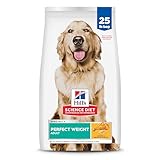
- Breakthrough formula made to positively impact the unique cell function of overweight pets, and support healthy metabolism and body weight
- Safe and effective weight loss with visible results within 10 weeks
- Made with natural ingredients
- Made in the USA with global ingredients you can trust
- Hill's Pet Nutrition is the US Veterinarians' #1 recommended brand
RER = body weight in kilograms0.75 × 70
A life-stage factor is then used when estimating maintenance needs. Weight-loss planning is different: the guideline’s framework uses ideal weight and individual adjustment rather than treating a maintenance estimate as the final diet. Your veterinarian may start with a calculated amount, compare it with the dog’s existing intake, and change it after observing real weight and condition trends.
What the published average does—and does not—mean
AAHA’s 2021 guideline reports a mean intake of 63 ± 10.2 kcal/kg0.75 in dogs over a 12-week weight-loss period. That is a group average from the guideline, not an allowance for your dog. Individual requirements vary, and the veterinary team should decide the starting amount and any subsequent adjustment.
Do not skip meals, impose a severe cut, or keep reducing food without professional review. If the planned portion seems too small, the dog is persistently hungry, energy falls, or weight does not change, contact the clinic rather than improvising.
Choose food for nutrient adequacy and practical success
The central dietary requirement is a measured energy intake that still supplies complete, appropriate nutrition for the dog’s life stage and medical needs. AAHA discusses therapeutic weight-management diets fortified for dogs that must eat fewer calories. Its guideline summary also identifies higher protein as a possible aid to preserving lean mass during restriction, while protein and added fiber may improve satiety; added fiber can lower calorie density. These are diet-design considerations, not guarantees from a particular ingredient.
Outdated Drivers Are Slowing You Down
One free scan finds every outdated or missing driver and matches the right update for your exact hardware.Free scan · exact hardware matchPC Slower Than It Used to Be?
A free scan shows the junk files, broken settings and background clutter dragging Windows down - then fixes them in one click.Free scan · Windows 10 & 11Ordinary complete food versus a therapeutic weight-management diet
| Decision point | Ordinary complete diet | Therapeutic weight-management diet |
|---|---|---|
| Life stage and health fit | Must be complete and appropriate for the individual dog | Designed for weight management but still must match the dog’s life stage and conditions |
| Calorie density | Check how much food supplies the prescribed calories | May provide a larger, more satisfying portion at the prescribed calories; verify the label and veterinary instructions |
| Nutrients during restriction | Assess whether the reduced portion still meets requirements | Formulated to support nutrient adequacy when calories are restricted; protein and fiber features vary |
| Acceptance and sustainability | Existing preference may make adherence easier | Acceptance still matters; a diet the dog will not eat cannot work |
| Monitoring | Requires follow-up to confirm the plan is working | Also requires follow-up and adjustment; no formula suits every patient |
Ask the veterinarian to compare calorie density, ingredient and nutrient profile, portion size, cost, acceptance, and medical compatibility. The AAHA guideline is guidance rather than an exclusive protocol, so an individual dog may need a variation.
Turn the prescription into a feeding system
Measure every meal
Use one consistent measuring method and prepare the full day’s allowance before feeding when practical. Divide that allowance into the schedule your veterinarian recommends. Keep the written amount where every caregiver can see it, and update it whenever the clinic changes the plan.
Also popular on Amazon

- High-protein weight management dog food with real chicken to support lean muscle mass.
- Contains 15 percent less fat than Purina Pro Plan adult dog food for weight control.
- Fortified with dog probiotics to support digestive and immune health.
- Includes dog gut health probiotics for a balanced microbiome.
- Crunchy kibble and tender shredded pieces for texture dogs love.
Budget treats instead of adding them
Discuss how treats fit within the day’s calories; the reviewed guidance does not set one universal treat percentage for every dog. Remove an agreed amount from the daily food allowance when using food for training, or ask the clinic about lower-calorie options. Count chews, scraps, supplements, and medication foods exactly as you count meals.
Replace food-based affection with other interaction
AAHA recommends increasing non-food interactions. Walk together, play when appropriate, brush the coat, practice brief skills, or offer calm attention. This preserves rewarding contact without turning every social moment into another calorie event.
What’s actually slowing this PC down?
Pick the symptom - the matching free tool is one click away.
Make feeding tools fit the dog
Puzzle toys and automated feeders can help some owners deliver measured portions, control access, or occupy a dog between meals. They are implementation aids, not devices proven by the cited guidance to cause weight loss on their own.
| Tool | Useful when | Check before using |
|---|---|---|
| Puzzle feeder | The dog enjoys food-based problem solving and needs slower, structured access | Choose a safe difficulty, supervise initial use, and confirm the dog can use it comfortably |
| Automated feeder | Meals need consistent timing or several caregivers need portion control | Confirm accurate dispensing, secure access, easy cleaning, and that the dog cannot break into it |
Add activity at the dog’s current fitness level
Food management and activity are complementary parts of a weight-reduction plan. Start with movement the dog can perform comfortably and regularly, then progress only as the veterinary team advises. A deconditioned dog or one with pain, weakness, breathing difficulty, or mobility limitations may need an examination before activity increases; a rehabilitation practitioner can help design an appropriate program when indicated.
Build consistency before intensity
- Use a schedule the household can repeat on most days.
- Increase duration or difficulty gradually rather than making a sudden jump.
- Watch comfort, gait, breathing, enthusiasm, and recovery during and after activity.
- Stop and call the veterinary team for concerning pain, collapse, marked breathing problems, or a sudden decline.
Exercise should not be used to “earn” unrestricted treats. Keep the food allowance and activity plan coordinated with the clinic.
Independent reader supportYour contribution helps us test, update, and keep practical guides available for everyone.Recheck, measure, and adjust
Long-term monitoring and maintenance are often the hardest stages. AAHA recommends early contact after a plan begins and ongoing reassessment. At rechecks, the team can compare body weight, BCS, MCS, food intake, activity, and any symptoms, then adjust portions or the diet.
Also popular on Amazon

- REAL CHICKEN FIRST: Blue Buffalo dry dog food starts with real chicken as the first ingredient to help support healthy, lean muscles in adult dogs
- BALANCED NUTRITION TO HELP WEIGHT MANAGEMENT: This BLUE dog food provides the ideal caloric balance and complete daily nutrition for adult dogs with chicken for protein, wholesome carbohydrates for energy, and other natural ingredients
- EXPERT-LED NUTRITION: Designed to help your pet thrive from the inside out, Blue Buffalo dog food formulas are developed by a dedicated team of veterinarians and animal nutritionists
- COMPLETE NUTRITION: This BLUE dog food without grains provides balanced daily nutrition for adult dogs with chicken for protein, wholesome carbohydrates for energy, and other natural ingredients
- SUPPORTS IMMUNE SYSTEM HEALTH: BLUE Life Protection Formula grain free dog food features exclusive LifeSource Bits, a precise blend of antioxidants, vitamins, and minerals that are formed at a lower temperature to ensure optimal potency
Bring useful information to each review
- The written food and treat log, including missed or extra feedings.
- The current portion measurement and feeding schedule.
- Notes on appetite, energy, stool, mobility, and comfort.
- Questions about hunger, medication administration, or household adherence.
Never assume the starting calculation remains correct indefinitely. A change in ideal-weight estimate, activity, health, or observed trend can require a new portion.
Troubleshoot common obstacles
“The scale is not changing.”
Verify the actual intake first: recheck portions, treats, chews, scraps, supplements, and medication foods. Confirm that every caregiver is following the same plan, then contact the veterinary team for a reassessment rather than making a large unsupervised cut.
“The dog acts hungry.”
Tell the clinic how often hunger occurs and what the dog receives. The team may adjust meal timing, portion distribution, food type, or the use of fiber-containing therapeutic nutrition. Do not add unrecorded snacks.
“The dog refuses the new diet.”
Report poor acceptance. The veterinarian can discuss a suitable alternative that still meets calorie and nutrient goals. A theoretically ideal food is not useful if the dog will not eat it.
The Tool Desk
Outbyte PC Repair FREERepair Windows errors before they cause bigger problemsFix Now →Outbyte Driver Updater FREEFix the driver behind crashes, sound loss and screen glitchesFind Drivers →“Exercise is difficult.”
Ask whether pain, joint disease, respiratory limits, or deconditioning is involved. The appropriate response may be a modified activity plan or rehabilitation referral, not simply more strenuous exercise.
A practical first-week checklist
- Book a veterinary examination and request weight, BCS, MCS, diet, activity, and health screening.
- Record several days of complete intake before changing the ration.
- Agree on ideal weight, calorie target, food choice, portion measurement, treat budget, and recheck date.
- Prepare a written household feeding plan and remove unplanned food access.
- Begin the activity level approved for the dog’s fitness.
- Track portions, extras, appetite, comfort, and activity every day.
- Contact the veterinary team early if the dog refuses food, becomes unwell, develops pain, or the plan is difficult to follow.
This approach treats canine obesity as a manageable health condition: assess the whole dog, feed measured and nutritionally appropriate portions, build sustainable habits, and let objective follow-up guide every adjustment.





Leave a Reply