
Free tools Windows power users keep installed
One-click scans. No signup required.
A cat’s environment is the whole set of places, resources, choices, and relationships that shape daily life. It includes food and water stations, litter areas, resting and hiding places, scratching surfaces, opportunities to move away, and the way people and other cats approach the animal. A home can contain plenty of toys and still leave a cat feeling exposed or unable to control contact.
The 2021 AAHA/AAFP Feline Life Stage Guidelines recommend plentiful, thoughtfully distributed resources and an arrangement tailored to each cat’s preferences and life stage. Use the guide below to audit your home, read behavior in context, and recognize when a veterinarian should investigate a persistent change.
As an Amazon Associate I earn from qualifying purchases.
What “environmental needs” means for a cat
The 2013 AAFP/ISFM Feline Environmental Needs Guidelines define environmental needs broadly: they include the cat’s physical surroundings and its interactions, including how it responds to human contact. That definition matters because behavior is not separate from welfare. A cat that cannot retreat from handling, reach a quiet toilet area, or eat without being challenged by another cat is dealing with an environmental problem even if the room has attractive furniture.
Think in terms of choices and control. The cat should be able to select a comfortable place to rest, hide when it wants privacy, scratch an appropriate surface, obtain food and water, eliminate without being ambushed, and end an interaction. The AAHA/AAFP guideline puts this last point plainly: “The cat must have a way to tell people to ‘please stop’ or ‘I need a break.’” A cat’s signal may be a movement away, a change in posture, or a warning sound; it is not an invitation to continue.
#1 Best Overall

- A NEW CHOICE FOR INDOOR ENTERTAINMENT: Endless fun for your cat! Designed for indoor environments, this interactive toy ball rolls quickly across the carpet and emits an appealing cat-attracting chittering sound. Not only does it stimulate your cat's hunting instincts, it also allows them to enjoy outdoor chasing indoors while reducing the risk of furniture scratching
- INTELLIGENT INTERACTION AND FUN: This automatic cat toy is your pet's new playmate. It has two modes: ① Normal mode (green light), which runs for five minutes and then automatically shuts off. ② Intelligent mode (blue light), after running for five minutes the exercise ball automatically enters the dormant mode, when your cat touches it again, the exerciser will interact with your cat again. So whether it's a long game or a short interaction, this interactive cat ball meets the needs of both you and your pet, allowing your pet to entertain itself while you're busy
- TWO SPEEDS FREELY SWITCHING: The BABORUI interactive cat toy offers two speeds, fast and slow, which can be freely switched at any time. Even if your cat is cute and short-legged, it can still keep up with the pace of the exercise ball
- TRIPLE FUN, TRIPLE HAPPINESS: This cat toys for indoor cats comes with three fun tails that provide your cat with triple the fun. They can have endless fun chasing and catching the ball, while the sound of the bells on the tails will further stimulate their curiosity and desire to chase
- SAFE MATERIAL, LASTING AND DURABLE: We understand that your pet's safety is of utmost importance to you. The shell of this kitten toys is made of safe silicone material, so you don't need to worry even if your pet chews it. The durable design means it can withstand daily wear and tear, providing long-lasting companionship for you and your pet
Needs differ between individuals. One cat may feel secure on a high shelf, while another prefers a covered bed at floor level. Some cats seek frequent social contact; others are content with brief, predictable attention. Life stage, health, previous experience, and relationships with other animals all influence what a suitable setup looks like.
Start with a resource map, not a shopping list
Walk through the spaces your cat actually uses and mark every resource. The goal is not to collect equipment but to make essential activities accessible without competition or forced contact.
| Resource | Behavior it supports | Placement questions | What to observe |
|---|---|---|---|
| Feeding station | Eating calmly and predictably | Can the cat eat without another cat, a person, or a noisy appliance blocking escape? | Does the cat approach willingly, pause repeatedly, or abandon the meal? |
| Water source | Drinking and checking the surroundings | Is water easy to reach and separated from places where the cat feels threatened? | Does the cat use it comfortably, or avoid the area? |
| Litter box | Private, reliable toileting | Can the cat enter, turn, and leave without being cornered or interrupted? | Are there accidents, hesitation, or sudden changes in box use? |
| Resting place | Sleep and recovery | Is there a quiet location with a temperature and height the cat chooses? | Does the cat settle there, or keep relocating? |
| Hiding place | Withdrawal when overwhelmed | Is there a refuge that people and other pets cannot easily invade? | Does the cat emerge normally, or remain hidden and distressed? |
| Scratching surface | Scratching, stretching, and marking | Can the cat reach a stable surface near commonly used areas? | Which texture, orientation, and location the cat chooses to use |
Distribute resources thoughtfully rather than clustering everything in one corner. A cat may be able to see a bowl but still avoid it if reaching the bowl requires passing another cat, crossing a busy walkway, or entering a dead end. Separate locations create alternatives and reduce the chance that one animal can control access.
What’s actually slowing this PC down?
Pick the symptom - the matching free tool is one click away.
How to provide safe places to rest and hide
Offer both high and low options
The 2021 AAHA/AAFP guideline notes that hiding preferences vary. Some cats seek elevated positions from which they can monitor the room; others choose low, enclosed spaces. Provide options at the heights your cat uses rather than assuming a cat tree is automatically better than a box or covered bed.
Rank #2

- Doesn't every cat deserve an exciting chase? Your cats will love diving in and out of this tunnel, chasing each other and pouncing the dangling balls attached to both entrances. And they also can enjoy a variety of play experiences because the tunnel is available in round, S-shaped, or semi-circular shapes.
- Who wouldn't want a win-win tunnel for their cat? Our cat tunnel bed comes with 40 toys, keeping your baby happy and saving your time of shopping for more toys. It's not just a toy but also a stylish decor piece, as it can double as decor for modern, farmhouse and vintage styles.
- Which pet wouldn't want to nap on a cloud? Our 2-in-1 cat donut tunnel is not just a play zone, but also a cozy resting spot. The mat is filled with soft PP cotton, making your cat feel like lying on a fluffy cloud and drifting into sweet dreams. Even if you’re not home, it will cuddle with your kitten just like you do!
- Worried it might be too small? Don’t be! With a 10-inch diameter tunnel and a 15-inch mat, this product is perfect for pets under 30 pounds. It offers plenty of space for cats of all sizes to play and rest. Additionally, the product is foldable, and with just two simple steps, it can be easily set up or stored, saving space when not in use.
- What better way to show love than with a unique cat bed cave? Giving your fur baby with a special tunnel isn't just about enhancing playtime; it's your way of saying I love you. While they may not be able to say thank you, their joyful play is the happiest reply you could receive.
- High options can include a stable shelf or other secure platform with an easy route down.
- Low options can include a box, covered bed, or quiet nook that is not blocked by stored items.
- Keep a retreat available even when guests, children, or maintenance workers are present.
- Do not pull a hiding cat out to force social contact.
A hiding place is useful when it gives the cat control, not when it becomes an inaccessible location where illness or injury goes unnoticed. Check that the cat can leave safely, that the structure cannot tip, and that you can monitor normal eating, drinking, toileting, and movement without invading the refuge.
Make rest predictable
Resting areas should be placed away from sudden traffic and resources that attract conflict. Observe where the cat already sleeps and improve that location before moving it. A preferred bed that is repeatedly disturbed will not function as a safe resource, no matter how appealing it looks.
Food, water, toileting, and scratching: placement decisions
Feeding and water
Place feeding stations where the cat can see approaching people or animals and can leave without being trapped. In a multi-cat home, watch whether one cat waits nearby, stares, blocks a doorway, or rushes the other away. If that occurs, provide separate stations with enough distance and visual separation for each cat to eat at its own pace.
Water is another resource, not merely an accessory to the food bowl. Offer access in locations the cat already accepts, and watch whether the cat avoids a bowl because of traffic, noise, or another animal’s presence. The guidelines do not establish that any particular bowl, fountain, or design prevents stress; the relevant test is whether this individual cat uses the source comfortably.
Rank #3

- Interactive Level 2 Cat Puzzle Toy: 13" x 9.5" cat puzzle feeder that triggers hunting and foraging instincts. Level 2 adjustable difficulty for beginner to advanced cats.
- Indoor Cat Enrichment: Keeps indoor cats engaged, minimizes boredom, and delivers rewarding treat-finding play that supports daily stimulation.
- Level 2 Slow Feeder Puzzle: Holds 1/4 cup food or treats across 16 compartments. Promotes slower eating and positive feeding habits with adjustable challenge.
- Multiple Ways to Play (Level 2 Adjustable): Easy mode: treats in base compartments only. Hard mode: add treats into sliding cups via top holes so cats must push and move pieces to release rewards.
- Safe, Durable & Easy Clean: No removable parts. Made without BPA, PVC, lead, or phthalates. Wipes clean quickly for everyday use.
Litter boxes
A box should allow the cat to enter, turn, use it, and exit without feeling cornered. Place it where the cat can reach it reliably and where another pet cannot silently guard the approach. Sudden house-soiling, repeated trips, straining, or a change in box use warrants veterinary advice rather than a behavior label. Toileting changes can accompany medical problems, and body language alone cannot identify a cause.
Scratching posts and surfaces
Scratching posts are specifically named in the AAHA/AAFP guidance. Provide a stable surface that matches the behavior your cat performs: some cats scratch upright while stretching, while others prefer a horizontal surface. Location matters; a post near a commonly used resting or passage area may be more attractive than one hidden in a storage room. If the cat ignores a new surface, observe where and how it scratches before changing the texture, orientation, stability, or position.
Reading your cat’s signals without overinterpreting one sign
Stress and discomfort are best assessed as a cluster of changes in context, not diagnosed from a single posture. The 2021 AAHA/AAFP guideline lists possible distress cues including:
Recommended Free Tools
- a tense or flattened posture;
- crouching, freezing, or hiding;
- fleeing or trying to create distance;
- ears flattened or turned back;
- dilated pupils;
- defensive vocalization;
- a low or tucked tail.
One sign can have several explanations. A cat may crouch while watching prey, flatten its ears during a loud noise, or hide briefly after a visitor arrives. Look for combinations, repetition, and a meaningful change from that cat’s normal behavior. If the cat turns away, moves off, freezes, or vocalizes defensively during handling, stop and allow a break. Repeatedly overriding that signal teaches the cat that mild warnings do not work and can increase the chance of a stronger response.
Rank #4
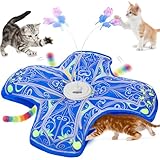
- Top-Tier Dual Interactive Fun: Qraxond's new indoor cat toy has dual motors, controlling random rotation of butterfly and plush tail swing rod accessories, bringing fun, exciting play for kittens and adult cats. Hide-and-Seek: The animal tail-shaped plush hides under the cover cloth, rotating irregularly to appear/disappear, creating a hide-and-seek game. It mimics real prey, bringing unpredictable chases to stimulate the cat's brain and senses. Irregular Rotating Butterfly: The top has an auto-rotating butterfly that rotates, pauses or swings to simulate real flight, keeping the cat engaged. Various interactions ensure the cat gets enough exercise to avoid obesity
- 3 Adjustable Speed Modes: Customize the excitement with separate buttons for the butterfly and tail. Choose from 3 settings: Steady (Blue Light), Active (Purple Light), and Random (Yellow Light). Suitable for high-energy cats to burn off steam or for calm cats to enjoy gentle play. Keep your feline entertained and prevent boredom, especially when they are home alone
- Touch-Sensitive Activation: Your Cat's in Control! With smart touch-sensor technology, just tap the device to fire up the fun mode, it will kick off a 5-minute automatic play session instantly. Right after the play session ends, it switches directly to touch-sensitive standby mode, where the purple indicator light flashes every 20 seconds. Simply tap again to reactivate it for another 5-minute cycle. This smart loop ensures your cat gets sufficient exercise and prevents overstimulation
- Large Rechargeable Battery: Enjoy long-lasting play with the built-in 2500mAh battery. It charges fully in just 2.5 hours via the included USB cable (use a 5V adapter only). The efficient auto on/off cycle extends battery life, making it convenient for busy pet owners while ensuring your cat gets healthy, moderate exercise
- Realistic Bird Chirping: Elevate the hunt with lifelike sound. The built-in speaker emits authentic bird chirps to attract your cat's attention and stimulate their prey drive. Combined with the random motions of the butterfly and tail, it creates an irresistible and engaging play experience that keeps your cat happily chasing even when they're by themselves
Track change over time
Write down when the behavior occurs, what happened immediately beforehand, where the cat was, which animals or people were present, and how long recovery took. This record helps distinguish a predictable response to a particular situation from a broader change that needs medical assessment. Persistent hiding, aggression, house-soiling, reduced eating or drinking, or a sudden shift in sociability should be discussed with a veterinarian.
Independent reader supportYour contribution helps us test, update, and keep practical guides available for everyone.Are cats in the same home actually comfortable together?
Shared space does not prove a social bond. Affiliative behavior can include allogrooming, nose touching, or sleeping in close contact. By contrast, hissing, swatting, chasing, blocking access, and passive avoidance may indicate tension even when people rarely see a dramatic fight.
Observe access, not just proximity
Watch doorways, stairs, feeding routes, litter-box approaches, and favorite resting places. A cat that waits until another leaves before eating, takes a long route around a room, or remains hidden when the other cat is active may be avoiding conflict. Do not label cats as friends simply because they occupy the same sofa at times, and do not assume that a quiet cat is comfortable because it never swats.
Crashes, No Sound, or Screen Glitches?
Random freezes, missing sound and display glitches usually trace back to one bad driver. Find and replace yours safely.Free scan · under a minuteWindows Errors? Fix Them Before They Spread
Repair common Windows errors and clear accumulated junk for a smoother, more stable PC - no reinstall needed.Free scan · no reinstallReduce competition
- Provide more than one route through important areas so a cat is not forced into a confrontation.
- Separate essential resources and avoid placing them where one cat can block the only approach.
- Give each cat a retreat that the other cannot easily invade.
- Supervise interactions that repeatedly escalate, and interrupt by creating distance rather than punishing either cat.
The aim is not to make every cat interact. A successful arrangement may be peaceful, predictable coexistence with each animal choosing when to engage.
Best Value

- Ball Cat Toy: Multi-level cat toy with 3 tiers and 6 spinning balls—keeps indoor cats active, curious, and entertained
- Enrichment: Encourages batting, swatting, and chasing to satisfy hunting instincts and enhance everyday enrichment
- Durable & Safe: Sturdy, non-slip base and a secure safety bar for hours of safe independent play
- Feline Favorite: Designed for older kittens and adult cats alike; great for multi-cat homes or gifting; not recommended for kittens under 12 weeks
- Expandable: Enjoy on its own or pair with Catstages Topper Toys (sold separately) for even more interactive chaos
Respect individual preferences and life stage
The AAHA/AAFP recommendations are organized by feline life stage because needs and abilities change. A kitten may investigate every new object, while an older cat may need easier access, quieter routes, and resting places that do not require a difficult jump. A cat recovering from illness or living with reduced mobility may prefer resources on one level. These are practical adjustments, not proof that one universal layout exists.
Use the cat’s behavior to refine the setup. If a resource is consistently ignored, ask whether the location, height, access, texture, noise, or social pressure is wrong. Change one factor at a time when possible, then observe use. Avoid moving all familiar resources simultaneously; abrupt changes can remove the cat’s established escape and rest patterns.
A five-minute environmental audit
- List the essentials. Identify every feeding station, water source, litter box, resting place, hiding place, and scratching surface.
- Mark conflict points. Note narrow hallways, dead ends, noisy appliances, doors, and places where another cat or person can block access.
- Check choice. Ask whether the cat can approach, use, and leave each resource without unwanted contact.
- Check height variety. Provide a safe high option and a safe low option when the cat’s preferences are unknown; then observe which it chooses.
- Observe relationships. Look for grooming, nose touching, and relaxed shared rest, but also hissing, swatting, blocking, chasing, and avoidance.
- Record changes. Compare current behavior with the cat’s normal pattern and document when a problem occurs.
- Escalate appropriately. Contact a veterinarian for persistent behavior changes, house-soiling, aggression, or signs that could reflect illness.
What the household statistics do—and do not—tell you
The 2021 AAHA/AAFP guideline reported that 25% of U.S. households had cats, with a mean of 1.8 cats per cat-owning household. That is a dated U.S. demographic figure attributed by the guideline to a cited source; it is not a current 2026 estimate and should not be generalized to other countries. The practical implication is simply that many homes need to consider relationships between cats as well as each cat’s relationship with people.
Do these 3 things before closing this tab:
1Clear out junk files and repair common Windows errors2Scan for outdated or missing drivers - takes under a minute3Repair Windows errors before they cause bigger problemsWhen home changes are not enough
Environmental improvements can remove a source of pressure, but they cannot diagnose pain, illness, or every behavior disorder. Arrange veterinary assessment when a change is sudden, persistent, or accompanied by altered appetite, drinking, elimination, movement, vocalization, or tolerance of touch. Bring your behavior notes and describe the home layout, resource locations, and interactions between animals. A veterinarian can determine whether medical evaluation is needed before behavior strategies are adjusted.
There is no product specification or tested furniture arrangement established by these guidelines as a guaranteed stress solution. Cat trees, shelves, boxes, litter boxes, feeding stations, water bowls or fountains, and scratching posts are tools; their value depends on whether they meet the relevant behavior, can be placed apart from competing resources, suit the cat’s preferred access and height, and are actually used comfortably.
Quick Recap
Product prices and availability are accurate as of the date/time indicated and are subject to change. Any price and availability information displayed on Amazon at the time of purchase will apply.





Leave a Reply