
The best ferret cage is the largest practical multi-level enclosure you can fit, move and clean. Choose one with platforms rather than just height, bar spacing no wider than 1 inch (2.5 cm), solid or securely covered floors and ramps, escape-resistant latches, and doors or trays that let you clean every level. A cage is a home base, not a substitute for exercise: plan supervised roaming outside it every day.
Start with the space your ferret will actually use
Cage shopping often begins with a quoted height, but height alone does not tell you how much living space a ferret has. A tall, narrow enclosure can provide less useful room than a slightly shorter cage with broad, stable platforms. Ferrets need separate places for sleeping, toileting, eating, playing and moving between levels, so the interior must accommodate equipment as well as the animal.
As an Amazon Associate I earn from qualifying purchases.
Think in terms of usable floor area on several levels. A platform that is wide enough for a litter box and a ferret to turn around is more useful than a thin shelf that can hold only a hammock. The cage should also leave clear routes between levels; crowded shelves, bowls and toys can make even a large enclosure difficult to navigate.
Free tools Windows power users keep installed
One-click scans. No signup required.
One ferret versus two
A single ferret may fit the minimum enclosure cited by a shelter, but that figure is a floor rather than an ideal permanent target. Two ferrets need room to move around each other, separate when they want to sleep and use more than one toilet area. If you are adopting a pair, choose the larger cage you can safely accommodate and furnish without blocking the pathways.
#1 Best Overall

- Two Story Double Unit Design: Spacious and durable cage with full middle floor and 1/2-inch wire spacing, allowing access between floors with ladder and featuring durable wrought iron construction that is easy to assemble
- Tight Wire Spacing and Chew-Free Construction: Features 1/2-inch wire spacing suitable for a wide variety of small animal critters to prevent escape and getting stuck, with all-metal construction that is chew-free
- Durable Double Front Doors with Safety Features: Two large hinged front doors measuring 21-inch x 15-inch high with improved safety lock, includes 2 metal wire platforms with paw safe fabric cover and 2 metal wire ramps with paw safe fabric cover
- Large Double Unit Dimensions: Measures 20.5-inch long, 20-inch wide, and 45-inch high when placed on the rolling stand
- Complete Accessories Included: Comes with 1 hammock with cage hook, 1 water bottle, and 1 food bowl for your pet's comfort and convenience
Do not rely on the cage for all exercise. The York County SPCA adoption guide recommends aiming for two to four hours of out-of-cage time daily as much as possible. That time should be supervised in a ferret-proofed area, with the cage available as a secure place to rest, eat and use the litter box.
The measurements that matter before you buy
Record the assembled dimensions from the current manufacturer listing, not only the shipping-box size. Measure the room where the cage will stand, every doorway on the route, and any elevator, stair landing or tight turn it must pass through. A cage that fits the room but cannot be carried through the home is not a workable choice.
Minimum enclosure size
The York County SPCA guide states: “A solo ferret can go smaller, but should still be in a cage size 30’ L x 18’ W x 18’ H at minimum.” The guide presents this as a minimum for one ferret. It is not a recommended target for a permanent multi-ferret setup, and it leaves little spare room for shelves, litter equipment, bedding and enrichment.
Use that minimum as a screening test for an unusually small temporary or single-ferret enclosure. For a long-term home, prioritize a substantially larger cage with multiple usable levels and enough open area to arrange supplies without forcing the ferret to climb over them.
Bar spacing
Keep the distance between bars at 1 inch (2.5 cm) or less. Small or young ferrets can push through gaps that look harmless when viewed from outside, and a head or limb caught between bars can cause injury. Check the spacing at every panel, door, corner and removable section; a cage can have safe main panels but a wider gap around a door or tray.
Measure or verify the manufacturer’s stated spacing before purchase. After assembly, inspect the cage at the ferret’s eye level and run your fingers around joints and attachment points. Look again after moving shelves or removing panels for cleaning, because a poorly seated section can create a new escape gap.
Rank #2
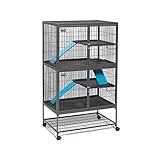
- Spacious Two-Level Habitat: Measures 36" x 25" x 62.5"; suited for multiple ferrets to climb, rest, and explore
- Full-Width Double Doors: Large access points on both levels with dual-locking latches; makes cleaning, feeding, and bonding easier
- Secure and Climbable: 0.5" vertical wire spacing allows pets to fulfill their natural instinct to climb and explore, while staying safely contained
- Durable and Mobile: Heavy-duty metal construction with locking casters; offers long-lasting use and easy repositioning
- Enrichment-Ready Design: Multiple attachment points for hammocks, toys, and tunnels; encourages natural behaviors and play
Footprint, level layout and clearance
A broad footprint generally gives you more useful room than an extremely narrow tower. Multiple levels are valuable when each level has stable, accessible floor space and the ramps are not so steep or slippery that the ferret avoids them. Leave enough headroom for normal movement and enough clearance to remove litter boxes and trays without dismantling the cage.
The Tool Desk
Outbyte PC Repair FREEClear out junk files and repair common Windows errorsFree Scan →Outbyte Driver Updater FREEFix the driver behind crashes, sound loss and screen glitchesFind Drivers →Floor and ramp safety
Solid, washable floors and ramps are preferable to exposed wire. Wire can place pressure on paws and may allow toes to catch, especially when a ferret is running or turning quickly. If the cage includes wire sections, cover them with fitted, secure liners or ramp covers designed for the cage dimensions.
A liner should lie flat, stay attached when the ferret digs and be removable for washing. Inspect seams, corners and fasteners for chewable edges. Replace any cover that curls upward, exposes wire or develops a hole large enough for a toe to enter. Avoid loose fabric that can wrap around a foot or become a source of swallowed threads.
Ramps need traction as well as coverage. Test each ramp with your hand before introducing the ferret: it should not flex excessively, slide at its attachments or leave a sharp edge at the top and bottom. Position shelves so a fall from one level cannot land on a hard corner, bowl or litter-box rim.
Security features that prevent escapes
Ferrets are persistent problem-solvers. A door that feels secure to a person may still be vulnerable to pushing, lifting or manipulating. Choose doors with latches that close positively and cannot be opened by nudging the panel from inside.
- Open and close every door repeatedly before adding equipment; verify that the latch engages without being held in a precise position.
- Check the gap beneath doors, around tray rails and where panels meet.
- Inspect wheel locks, shelf brackets and ramp clips for looseness.
- After deep cleaning, confirm that every panel and tray is fully seated before returning the ferret.
- Keep the cage away from curtains, cords, heaters and furniture that could give a determined climber leverage.
Do not assume a cage is escape-proof because another owner’s ferret stayed inside it. Individual animals differ in size, strength and persistence. Observe your own ferret during the first several days and recheck any place where it repeatedly paws, pushes or chews.
Rank #3

- Two Story Double Unit Design: Features 4-tiers durable frame cage with full middle floor and 1/2-inch wire spacing, allowing pets to access between floors with ladder and durable wrought iron construction that is easy to assemble
- Tight Horizontal Wire Spacing: Narrow 1/2-inch wire spacing recommended for a wide variety of small animal critters to prevent escape and getting stuck, while allowing pets to fulfill their instinct to climb and explore in a secure environment
- Durable Front Access Doors: Features double large hinged front doors measuring 15 inches by 18 inches with improved safety lock, top hook door for easy access from the top measuring 8 inches by 9 inches, and includes 2 easy adjustable washable solid platforms and 2 anti-slip solid ramps safe for small animals
- Large Spacious Dimensions: Measures 24-inches long, 17.5-inches wide, and 53.5-inches high when placed on the rolling stand, providing ample space for small animals to move and play
- Complete Accessories Package: Includes 1 hammock, 1 water bottle, and 1 food bowl to provide everything needed for your small pet's comfort and care
Cleaning should shape your choice
Daily spot cleaning and regular deep cleaning are unavoidable, so access matters as much as dimensions. Pull-out trays let you remove soiled bedding and litter without reaching through every level. Wide-opening doors make it easier to lift out shelves, wipe corners and secure a ferret elsewhere during cleaning.
Features that reduce cleaning time
- Pull-out floors or trays: useful for removing litter and spilled food quickly.
- Wide doors: give your hands and cleaning tools a direct path to the back corners.
- Removable shelves: allow a full wipe-down rather than cleaning around permanent brackets.
- Washable surfaces: tolerate repeated use of a ferret-safe cleaner and thorough drying.
- Accessible hardware: lets you inspect and tighten fasteners before they become escape points.
Before buying, imagine removing the dirtiest tray while the cage is in its final location. If you would have to move the entire enclosure or reach around a fixed shelf, cleaning will become harder and may be postponed. A slightly more expensive cage with better access can be easier to maintain consistently than a cheaper cage that requires disassembly.
Two established cage examples compared
The American Ferret Association guide describes two commonly considered models. The dimensions below are the assembled measurements reported in that guide; the page does not state a publication year for either listing.
Outdated Drivers Are Slowing You Down
One free scan finds every outdated or missing driver and matches the right update for your exact hardware.Free scan · exact hardware matchPC Slower Than It Used to Be?
A free scan shows the junk files, broken settings and background clutter dragging Windows down - then fixes them in one click.Free scan · Windows 10 & 11| Model | Assembled dimensions | Bar spacing | Construction or access details reported | Practical fit |
|---|---|---|---|---|
| Prevue Feisty Ferret Home 485 | 31 x 20 x 54 inches | 1 inch | Multi-level ferret enclosure; the guide lists the dimensions and spacing but does not state a wire gauge. | Smaller alternative when room is limited and the interior can still be arranged with safe, usable platforms. |
| MidWest Ferret Nation 182 Double | 36 x 25 x 63.25 inches | 1 inch | 12-gauge wire, pull-out floors and wide double doors. | Stronger default when you have the floor area, doorway clearance and budget for the larger enclosure. |
The larger model offers more room for separate sleeping, litter and enrichment zones while its pull-out floors and wide doors simplify access. The smaller model can work where the available footprint is tighter, but you must be more deliberate about shelf placement and avoid filling its levels so densely that movement is restricted. The guide does not provide current prices or inventory, so check the manufacturer’s live listing and your local retailer before ordering.
How to choose for your home: a decision path
- Count the ferrets and list their equipment. Include litter boxes, food and water dishes, sleeping areas, toys and any medication or quarantine space you may need.
- Measure the destination and delivery route. Note ceiling height, door widths, stair turns and elevator dimensions. Record the maximum footprint and height that can remain safely accessible for cleaning.
- Eliminate unsafe designs. Reject any option with bar spacing wider than the one-inch limit, unstable wire flooring, sharp exposed edges or latches that do not close positively.
- Compare usable levels, not advertised height alone. Look for broad platforms, sensible ramp routes and enough open floor to place litter and food without blocking movement.
- Test the cleaning workflow. Confirm that trays pull out where the cage will stand and that doors open wide enough to remove shelves and wipe the back corners.
- Budget for safety equipment. Add fitted floor and ramp covers, washable bedding, litter boxes and secure water and food containers. A cage price without these items understates the setup cost.
- Plan daily roaming space. Identify a room or pen that can be ferret-proofed before the cage arrives. The enclosure should connect to a routine of supervised exercise, not replace it.
Setting up the cage safely
1. Prepare the location
Place the cage on a level surface away from direct heat, drafts, dangling cords and curtains that can be pulled inside. Leave working space around doors and trays. If the cage has casters, engage the locks after positioning it and check that it does not rock when a door opens.
2. Cover floors and ramps
Install fitted, washable liners on every wire floor and ramp before the ferret enters. Secure the edges so they cannot be lifted for digging. Run your hand across each transition and remove anything rough, loose or sharp.
Rank #4

- SPACIOUS 2-STORY HABITAT: Measures 36 x 24 x 63 inches with two full levels of living space. The 1/2" horizontal wire spacing safely contains rats, chinchillas, ferrets, sugar gliders and degus while allowing natural climbing behavior.
- DURABLE CONSTRUCTION: Sturdy metal wire design with a gray quartz hammertone finish, Critter Nation resists everyday wear. Complete with 2 removable base pans, 3 textured ramps with covers, and 2 full-width resting shelves.
- CUSTOMIZE YOUR HABITAT: Height-adjustable design lets you customize the perfect setup for your pet, with 2 wide expanse shelves and 2 full-width plastic pan floors to maximize play space. Compatible with a wide range of accessories.
- BUILT FOR DAILY LIFE: Full-width double doors provide maximum accessibility, with a swing-up locking ramp that lets you separate pets or section off areas during cleaning and feeding. Bottom level shelf provides storage area for pet accessories.
- BECAUSE LIFE GOES BETTER WITH PETS: A family-owned business based in Indiana, MidWest Homes for Pets brings over 100 years of pet product expertise and a commitment to quality, rigorous safety testing, and excellent US-based customer service.
3. Arrange the basic zones
Use stable shelves to create clear routes between levels. Put litter equipment where the ferret naturally chooses to eliminate, while keeping food and sleeping areas separate. Provide several washable sleeping options so the ferret can choose a comfortable, shaded place without crowding the cage.
Do these 3 things before closing this tab:
1Fix the driver behind crashes, sound loss and screen glitches2Repair Windows errors before they cause bigger problems3Scan for outdated or missing drivers - takes under a minute4. Secure food, water and enrichment
Attach bowls or use heavy containers that cannot be tipped easily. Refill water and remove spoiled food during daily checks. Add washable toys and enrichment items only after inspecting them for parts that can be chewed off, swallowed or caught around a foot.
5. Perform an escape test
Close every door, pull gently on each latch and inspect the complete perimeter from inside and outside. Look behind trays, under ramps and at panel joins. Repeat the check after the first cleaning and whenever you change the layout.
Independent reader supportYour contribution helps us test, update, and keep practical guides available for everyone.Common mistakes and how to correct them
Buying to the minimum and stopping there
The 30 x 18 x 18-inch shelter figure can prevent an undersized purchase for one ferret, but it does not provide much flexibility for enrichment or a pair. If the cage feels crowded once the litter box and bedding are installed, upgrade to a larger enclosure or add a safely connected section rather than removing essential equipment.
Choosing a wire floor because it is easy to see through
Visibility does not compensate for uncomfortable footing. Cover wire with secure liners and inspect them often. If a liner cannot be kept flat and clean, select a cage with solid floors instead.
Ignoring the route into the room
Large cages may not pass through a narrow doorway or make a stair turn. Measure before ordering and confirm whether the unit arrives assembled or requires construction indoors. If it must be assembled in place, leave enough clearance to work safely and tighten every connection.
Best Value

- Spacious Space: This metal small animal cage features a multi-level layout that creates roomy activity areas. The non-slip ramp supports climbing, playing, and daily movement
- Secure Design: Our ferret cage is suitable for ferrets, chinchillas, kittens, and other small pets. Tight 0.55 in wire spacing and the secure door latch help reduce escape risks
- Solid Build: The small animal cage is built with thick square metal tubes for a stable structure. The evenly powder-coated surface resists rust for long-lasting use
- Easy Cleaning: This sugar glider cage has multiple openings, making cleaning easier from different sides. The pull-out bottom tray slides out smoothly and reduces paw scratches
- Easy Mobility: Our chinchilla cage comes with lockable swivel casters for easy movement indoors or outdoors. It lets pets get sunlight and fresh air more conveniently
Filling every level with accessories
Hammocks, toys and storage can consume the floor area that makes a multi-level cage useful. Keep a clear path between ramps, leave litter-box access unobstructed and rotate enrichment instead of adding everything at once.
Assuming cleaning access is optional
A cage that is difficult to clean encourages skipped tasks and lingering odor. Prioritize pull-out trays, wide doors and removable shelves even when another model has a slightly larger advertised height.
Forgetting the out-of-cage routine
A ferret may spend many hours resting, but it still needs supervised exploration and play. Prepare the exercise area, block escape routes and remove hazards before opening the cage. Keep the ferret within sight throughout the session.
What’s actually slowing this PC down?
Pick the symptom - the matching free tool is one click away.
Maintenance schedule after setup
- Every day: remove soiled litter and bedding, clean spills, check water, inspect latches and look for new chewing or escape attempts.
- Several times each week: wash litter equipment and rotate or launder sleeping fabrics according to how quickly they become soiled.
- During each deep clean: remove trays and shelves, wash and dry all surfaces, tighten hardware and inspect liners, ramps and attachment points.
- After any cage change: repeat the perimeter and latch test before returning the ferret.
Keep replacement liners and bedding available so a damaged or wet cover can be removed immediately. Dry surfaces completely before putting fabric or litter back; damp materials can become unpleasant and may discourage normal use of the litter area.
What “best” means in practice
For most homes, the best choice is the largest cage that fits through the home, leaves room for cleaning and can be furnished without blocking movement. The American Ferret Association’s dimensions make the 36 x 25 x 63.25-inch Ferret Nation 182 Double the stronger default when space and budget permit, while the 31 x 20 x 54-inch Feisty Ferret Home 485 is a smaller alternative. Whichever model you choose, verify the current listing, cover wire surfaces, test every latch and build daily supervised roaming into the care plan.
Quick Recap
Product prices and availability are accurate as of the date/time indicated and are subject to change. Any price and availability information displayed on Amazon at the time of purchase will apply.





Leave a Reply