Perucetus colossus was an extinct whale from Peru that was proposed in 2023 as a contender for the heaviest animal ever known. Later analyses produced much lower estimates, so it is not established as the largest or heaviest animal ever; the blue whale remains the leading candidate for the heaviest animal known.
The fossil is incomplete, and researchers estimate its size from bones and models rather than weighing a complete animal. Its unusually dense skeleton still makes Perucetus a remarkable Eocene whale.
What was Perucetus colossus?
Perucetus colossus was a basilosaurid whale from Peru’s middle Eocene rocks, dating to roughly 39 million years ago. The holotype, catalogued as MUSM 3248, consists mainly of part of the vertebral column and ribs. Its skull, limbs and much of the rest of the skeleton have not been recovered.
The name means roughly “colossal whale from Peru.” Its recovered bones are exceptionally thick and dense, giving it an unusually massive skeleton.
Crashes, No Sound, or Screen Glitches?
Random freezes, missing sound and display glitches usually trace back to one bad driver. Find and replace yours safely.Free scan · under a minuteWindows Errors? Fix Them Before They Spread
Repair common Windows errors and clear accumulated junk for a smoother, more stable PC - no reinstall needed.Free scan · no reinstall#1 Best Overall

- Meet Requena the Livyatan in a complete prehistoric whale display set: a 12.6-inch model, two transparent auxiliary stands, and an A3 Sci-Art poster.
- PNSO reconstructs Livyatan as a giant marine predator from about 12 million years ago, measuring 13.5 to 17.5 meters long and weighing up to 57 tons.
- Unlike modern sperm whales, Livyatan had large teeth in both its upper and lower jaws, with some teeth exceeding 30 cm in the living animal.
- The 32 x 8.7 x 8.5 cm hollow model is hand-painted on PVC and includes two transparent stands for stable long-term shelf display.
- Designed for ages 15+ and adult collectors, Requena combines a distinctive open-mouth marine predator reconstruction with scientific-art display context.
Why did the fossil appear capable of rivaling a blue whale?
The bones show pachyosteosclerosis, a condition in which bones become unusually dense and thick. In aquatic animals, dense bones can act as ballast and help control buoyancy. The 2023 study suggested that Perucetus may have been adapted to slow, shallow-water diving rather than fast, open-ocean swimming.
Researchers did not weigh a complete animal. They estimated total body mass using the fossil’s skeletal mass and relationships between skeletal and body mass in living mammals. They also reconstructed body proportions partly by scaling up the more complete basilosaurid Cynthiacetus peruvianus.
The 2023 study estimated a wide range:
- 85–340 metric tonnes for total body mass
- A central estimate of about 180 tonnes
Depending on the model, that range allowed Perucetus to rival or exceed the largest known blue whales. But the original paper called it a contender, not a proven record-holder, and the upper figure was an estimate from an incomplete skeleton.
How later studies changed the estimate
Later analyses used different reconstructions of body proportions and volume, producing substantially lower mass estimates.
Recommended Free Tools
Rank #2

- RECOGNIZABLE WHALE SHARK DESIGN — Distinctive spots and a textured body create a recognizable whale shark profile, forming a species-specific centerpiece instead of a generic shark shape.
- OCEAN-THEMED DISPLAY ACCENT — Bring a marine-life focal point to a bookshelf, coffee table, workspace, or coastal-style room. It can also complement an under-the-sea party table.
- 3D PRINTED PLA CONSTRUCTION — Made from PLA with connected body sections and a layered printed finish. The articulated structure allows careful repositioning while preserving the whale shark silhouette.
- A THOUGHTFUL GIFT FOR OCEAN FANS — Created for adult shark lovers, marine-life enthusiasts, collectors, and 3D-printing fans. The focused whale shark theme suits birthdays, holidays, or just-because gifting.
- Please note that these items are 3D printed from PLA and, while they are quite durable, they are not indestructible. Misuse may result in damage, which could pose a choking hazard for small children. Additionally, do not leave them in hot vehicles for extended periods.
| Study | Estimated size of Perucetus | Comparison |
|---|---|---|
| 2023 description | 85–340 tonnes; central estimate about 180 tonnes | Could rival or exceed the largest blue whales under the highest estimate |
| 2024 reanalysis | About 60–70 tonnes at 17 metres, or 98–114 tonnes at 20 metres | Below the study’s estimated 270-tonne, 33-metre blue whale |
| 2025 analysis | About 35–40 tonnes at 15–16 metres | Far below the largest blue whales |
Ryosuke Motani and Nicholas Pyenson’s 2024 reanalysis estimated that a 17-metre Perucetus would weigh about 60–70 tonnes, or 98–114 tonnes if it reached 20 metres. They compared those estimates with about 270 tonnes for a 33-metre blue whale.
Gregory Paul and Asier Larramendi’s 2025 analysis proposed a smaller animal, approximately 15–16 metres long and 35–40 tonnes in mass.
These are model-based estimates, not measurements of a complete animal. The disagreement reflects uncertainty about body length, shape, soft-tissue volume, skeletal-to-body-mass ratios and how well living whales serve as analogues for an extinct basilosaurid.
Why is estimating an extinct whale’s weight difficult?
Scientists cannot directly weigh Perucetus because the fossil is incomplete. Several uncertainties affect its estimated mass:
Rank #3
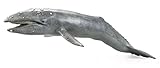
- 【Safety Material 】Made of handmade soft PVC.Non-toxic and durable soft rubber;This product has passed the test CPSC-accepted testing and is suitable for children under 12 years old.
- 【Play in Water or on Land】 Ideal for stage and puppet theater, storytelling, teaching, daycare, pre-school, pretend play, role-playing, presentations, games, party gifts and so on.
- 【Very Cool Theme Party】Throw a nautical party and decorate with this lifelike figurine.Highly realistic.Exact jaw and skin details make you feel the charm of Ocean Life! Exquisite design and hand paint process.
- 【Perfect Gift】 Highly detailed from each tooth to each gill, Compact and portable, you can take it everywhere you want. Ideal gift for boys kids and collectors.
- 【Entertainment Learning 】Inspire children to learn about the many creatures of the ocean! Ideal for education on Ocean species, environmental awareness, and natural history,Children can learn and understand about the Shark and Whale's types and habits more happily.
- Most of the skeleton is missing. Without a skull, limbs and complete vertebral column, its proportions are uncertain.
- Dense bones do not determine total mass by themselves. There is no fixed multiplier for converting skeletal mass into body mass; the relationship depends on body shape and lifestyle.
- Living comparisons are imperfect. Modern whales differ in body plan, swimming style and proportions from Eocene basilosaurids.
- Length affects volume. Estimates based on different body lengths can produce substantially different masses, even before body shape is considered.
The original 340-tonne figure was the upper end of one model, not a measured fact or an uncontested estimate.
Was it longer than a blue whale?
Probably not. Blue whales can exceed 30 metres, while later reconstructions place Perucetus at roughly 15–20 metres. The original claim about its possible mass came largely from its unusually heavy skeleton, not evidence that it was longer than a blue whale.
Length and weight are different measures: the longest animal is not automatically the heaviest, and dense bones can give an animal a different build from a long, relatively streamlined whale.
Independent reader supportYour contribution helps us test, update, and keep practical guides available for everyone.What can we safely say about this ancient whale?
- Perucetus colossus was a newly described Eocene whale from Peru.
- It had an exceptionally massive, dense skeleton and was probably adapted for shallow-water diving.
- It was probably among the largest animals known from the Eocene and one of the heaviest whales known from that period.
- The 2023 study estimated 85–340 tonnes, but later studies placed it substantially lower.
- The blue whale remains the leading candidate for the heaviest animal known.
The most defensible short description is: Perucetus colossus was a colossal ancient whale once proposed as a contender for the heaviest animal ever, but later studies substantially reduced its estimated size.
The Tool Desk
Outbyte Driver Updater FREEFix the driver behind crashes, sound loss and screen glitchesFind Drivers →Outbyte PC Repair FREERepair Windows errors before they cause bigger problemsFix Now →Rank #4

- 【Safe Materials】Made of handmade soft PVC. Non-toxic and durable soft rubber; This product has passed the test CPSC-accepted testing and is suitable for children under 12 years old.
- 【Play in Water or on Land】 Ideal for bath toys, storytelling, teaching, daycare, pre-school, pretend play, role-playing, presentations, games, party gifts, swimming pool and beach toys.
- 【Very Cool Theme Party】When throw a nautical party you can make a theme cake with this lifelike figurine .Highly realistic. Exact jaw and skin details make you feel the charm of Ocean Life! Exquisite design and hand paint process.
- 【Perfect Gift】 The whale replica is soft and sturdy enough that it won't hurt your kids. You can twist the jaw, the Fin and play it rough without any worries! Ideal gift for boys kids and collectors
- 【Entertainment Learning 】Inspire children to learn about the many creatures of the ocean! Ideal for education on Ocean species, environmental awareness, and natural history, Children can learn and understand about the Shark's types and habits more happily.
Sources and further reading
- Bianucci and colleagues, “A heavyweight early whale pushes the boundaries of vertebrate morphology,” Nature (2023)
- Motani and Pyenson, “Downsizing a heavyweight,” PeerJ (2024)
- Paul and Larramendi, “Further trimming down the marine heavyweights,” Palaeontologia Electronica (2025)
FAQ
Was Perucetus colossus the largest animal ever?
That has not been established. The 2023 study proposed it might rival or exceed a blue whale in mass, but later analyses estimated substantially lower masses. The blue whale remains the leading candidate for the heaviest animal known.
How much did Perucetus colossus weigh?
The 2023 study estimated 85–340 metric tonnes, with a central estimate of about 180 tonnes. A 2024 reanalysis estimated about 60–70 tonnes at 17 metres or 98–114 tonnes at 20 metres; a 2025 analysis estimated about 35–40 tonnes.
How long was Perucetus colossus?
Its length is uncertain because the fossil is incomplete. Later reconstructions proposed approximately 15–16 metres or 17–20 metres, shorter than the largest blue whales, which can exceed 30 metres.
Why were its bones so heavy?
Its bones were unusually thick and dense, a condition called pachyosteosclerosis. In aquatic animals, dense bones can provide ballast and help control buoyancy; the feature may indicate adaptation to slow, shallow-water diving.
The bottom line
Perucetus colossus was a remarkable ancient whale, but it was not proven to be the largest animal ever. Its original estimate of up to 340 tonnes depended on an incomplete skeleton and uncertain reconstruction. Later estimates were substantially lower, leaving the blue whale as the leading candidate for the heaviest animal known.
Quick Recap
Product prices and availability are accurate as of the date/time indicated and are subject to change. Any price and availability information displayed on Amazon at the time of purchase will apply.




