
Some links on this page are affiliate links: if you buy through them we may earn a commission, at no extra cost to you.
Copperheads are venomous pit vipers that can be recognized from a safe distance by their copper-to-tan coloring and dark, hourglass-shaped bands. Adults are usually 1.5 to 3 feet long. A suspected bite needs prompt emergency medical assessment, even when pain or swelling initially seems limited.
The claim that copperheads bite more Americans than any other snake is not established by current national surveillance. A historical sample of hospitalized patients contained more rattlesnake than copperhead cases, and that sample cannot rank all bites today.
As an Amazon Associate I earn from qualifying purchases.
What’s actually slowing this PC down?
Pick the symptom - the matching free tool is one click away.
What a copperhead looks like
Identification is useful only from a safe distance. Never approach, handle, corner, or try to capture a snake to confirm its species. A frightened copperhead may freeze in place, then strike when it feels threatened.
| Feature | What official guidance describes | How to use the feature safely |
|---|---|---|
| Body color | Reddish to golden tan, with coppery tones | Color can change with lighting, age, shedding, and background. Treat it as one clue, not proof. |
| Pattern | Typically dark, hourglass-shaped bands across the body | Look from where you are standing. Do not move closer for a clearer view. |
| Head and eyes | A deep facial pit lies between each eye and nostril | The pit is not a reason to inspect a live snake. A photograph taken from a safe distance may help professionals. |
| Adult length | About 1.5–3 feet | Length is difficult to judge in the field and should not be used to justify handling. |
Several snakes can look brown, reddish, or patterned, and a distant or poor-quality view may be misleading. Do not rely on a single marking, a remembered “head shape,” or an internet photo comparison to decide that a snake is harmless. If the animal is present, leave it alone and give it a clear route away.
Popular on Amazon

- 【First Aid Kit Survival Sets】Camping supplies comes with snake bite kit, bandage adhesive strips, scissors, emergency blanket, compass whistle and other multi-use items for any possible potential emergency, it’s a great emergency kit for basic supplies
- 【Durable First Aid Bag】It was made by high quality EVA bag, water resistant and shockproof and wear resistant. Thanks to its compact dimensions, it is ideal for taking with you when travelling, hiking, skiing, camping, in the car, backpack, handbag and outdoor adventures. Perfect for extended use
- 【Top Practical Stings Bites Survival Tools】Snake bite kit by WAEKIYTL is a sturdy, reliable First Aid tool for extracting subcutaneous venom from snake bites, bee stings, wasp stings, etc. Note, venom extractors work well to pull venom from just beneath the skin but not from within the muscle tissue. Effectiveness will vary depending upon where the bite/sting occurred and how deep it is. Always seek professional medical attention immediately
- 【Comprehensive First Aid Treatment】The first aid kit contains more than enough supply to treat a single family or a group of friends under emergency circumstances. A dainty first aid set ideal for home, travel, and on the go use. Perfect for any emergency needs. When outdoor travel in cold weather, when in the process of sports accidental falls, sprains, or when accidental burns at work, survival first aid kit can give the first time emergency treatment
- 【Multipurpose Emergency Blanket】Perfect for emergency situations where warmth or protection from all-weather conditions is required. Helps prevent hypothermia and shock by retaining of a user's body heat. our blankets can help block rain, snow, and moisture to keep you dry in damp, wet, cold, rainy environments
Use several clues, not one
Color, bands, approximate size, and location can help a professional make a provisional identification, but none is a field test. Lighting can make tan skin appear red or gray, shadows can hide the hourglass pattern, and a coiled snake can make length estimates unreliable. The facial pit is a specialized feature, yet trying to see it means moving close to the head—the part most likely to defend itself. Your goal is not a perfect identification; it is to recognize a possible venomous snake and create distance.
Do not interpret a snake’s stillness as permission to approach. A copperhead may remain motionless when alarmed, relying on camouflage. Someone who steps over a log, reaches into a leaf pile, or tries to move a “dead” snake can create the contact that leads to a bite.
Quick wins for a faster PC:
Clear out junk files and repair common Windows errorsFree Scan →Scan for outdated or missing drivers - takes under a minuteDriver Scan →Repair Windows errors before they cause bigger problemsFix Now →Where copperheads live and how they behave
Copperheads occur across Eastern states west to Texas. Their habitats include forests, rocky areas, swamps, and places near water. That range includes developed areas adjoining natural habitat, so seeing one is not limited to remote wilderness.
They are not usually aggressive. The practical safety issue is defensive behavior: a copperhead may remain motionless when frightened, making it easy for a person to overlook, step near, or reach toward it. If it feels threatened, it can strike. A motionless snake is not necessarily a safe snake.
Habitats can overlap with ordinary work and recreation. A woodpile, stone edge, brushy lot, stream bank, or yard beside a natural area may provide the kind of cover described by health authorities. The presence of a snake does not mean the animal is pursuing people. It does mean people should pause, keep others away, and avoid forcing it to defend itself.
If you see one
- Stop and back away without sudden movements.
- Keep children and other people away from the snake.
- Do not chase, poke, trap, kill, or pick it up.
- If identification matters, take a photograph only from a distance that does not alter the snake’s behavior.
- Allow the snake a route to leave. Contact local wildlife or animal-control authorities if it is in a place where people cannot safely avoid it.
Do not form a crowd around the animal or block both ends of its escape route. Tell anyone approaching where the snake is and ask them to stay back. If it is near a doorway, walkway, or worksite, restrict access rather than attempting amateur removal.
Are copperheads venomous?
Yes. Copperheads are venomous pit vipers. Their bites can inject venom, although effects vary widely. Poison Control reports that a bite may cause pain, swelling, redness, bruising, and blistering around the bite. Possible systemic effects include low blood pressure and bleeding. In some cases, a person has few or no immediate symptoms, and serious effects are uncommon—but the absence of early symptoms does not establish that a bite is harmless.
Also popular on Amazon

- 🐍COMPREHENSIVE OUTDOOR EMERGENCY KIT-This 40-piece emergency kit includes a compact extractor tool, CPR mask, tourniquet, razor, marker, sting relief pads, prep wipes, iodine wipes, bandages, cotton tips, gloves, whistle, tweezers, and carabiner—organized to support outdoor preparedness during unexpected emergencies.
- ✋EASY ONE-HAND OPERATION-Engineered for quick response. The included suction tool is designed for simple, one-hand use, making it easy to operate even when you’re alone or under pressure.
- 📘STAY ORGANIZED & INFORMED-Extra support in a compact package: This survival kit includes a step-by-step instruction manual and a marker for noting important details, all packed into a lightweight bag measuring just 5.5 × 4 × 2 inches and weighing only 6 oz—easy to carry in your backpack, car, or travel gear.
- 🎒YOUR ADVENTURE SAFETY COMPANION-Whether you’re camping under the stars, fishing by the lake, or hiking new trails, this compact first aid kit offers peace of mind in the outdoors. Perfect for hiking, camping, backpacking, fishing, and travel.
- 🛡️ALWAYS READY WHEN NEEDED-This snake bite kit is a sturdy, reliable outdoor first aid accessory designed for hikers, campers, and travelers. It comes with a compact suction tool, bandages, gloves, and other essentials to keep you prepared during outdoor activities. For best outcomes in any emergency, seek professional assistance right away.
General warning signs after a suspected venomous-snake bite can include nausea or vomiting, breathing or vision problems, a weak pulse or low blood pressure, and tingling. Symptoms may develop or worsen over time. Do not wait for a dramatic reaction before seeking professional advice.
Why symptoms differ
A bite does not produce an identical injury in every person. The amount of venom delivered, the bite location, how long the snake maintained contact, the person’s age and health, and how quickly care begins can all influence the result. A small puncture or modest early swelling therefore cannot tell you whether observation at home is safe.
Symptoms may be limited to the area around the bite, or they may include effects elsewhere in the body. Redness, bruising, and blistering can be important changes to report even when the person feels otherwise well. Record when symptoms began and whether swelling or discoloration is spreading while waiting for clinicians.
What to do after a suspected copperhead bite
Treat every suspected copperhead bite as an emergency. The priority is rapid medical evaluation, not identifying the snake perfectly or trying to remove venom at home.
- Move away from the snake. Get to a safe location without risking another bite. Do not attempt to catch or kill the animal.
- Call emergency services promptly. Tell the dispatcher that a venomous-snake bite is suspected and give the exact location. Emergency clinicians can determine whether antivenom or other treatment is needed.
- Do not drive yourself. Dizziness or fainting can occur. Have someone else drive only if emergency services direct that option and the person can be monitored; otherwise use an ambulance.
- Keep the person quiet and still. Limit walking and unnecessary movement while waiting for help.
- Position the bitten limb at heart level. Do not elevate it high above the heart or let it hang down.
- Remove constricting items. Take off rings, watches, bracelets, tight clothing, or footwear near the affected limb before swelling increases.
- Gently wash the area. Use soap and water if available. Do not scrub aggressively or apply chemicals.
- Record useful information without delaying care. Note the time of the bite, the body part involved, and changes in symptoms. A photograph of the snake from a safe distance may help clinicians, but never go back toward it.
- Follow medical and poison-specialist instructions. In the United States, Poison Control can be reached at 1-800-222-1222 for expert telephone guidance. This service does not replace urgent emergency care.
Emergency medical attention should begin as soon as possible to start antivenom if needed and stop irreversible damage. Antivenom is administered by clinicians; it is not a household or self-treatment product. The CDC/NIOSH guidance also notes that antivenom may speed limb recovery in copperhead envenomation, but treatment decisions belong to the treating team.
While waiting, keep track of the person’s breathing, alertness, and circulation and relay changes to the dispatcher. Do not give the person a task that requires walking back to the snake, and do not delay an ambulance while searching online for a match. If the bite occurred at work, tell responders the exact site and arrange for someone else to meet them rather than leaving the injured person alone.
What not to do for a snakebite
Old first-aid methods can worsen tissue injury, delay effective treatment, or create additional hazards. Do not:
Crashes, No Sound, or Screen Glitches?
Random freezes, missing sound and display glitches usually trace back to one bad driver. Find and replace yours safely.Free scan · under a minutePC Slower Than It Used to Be?
A free scan shows the junk files, broken settings and background clutter dragging Windows down - then fixes them in one click.Free scan · Windows 10 & 11Also popular on Amazon

- Complete Venom Extractor Kit: Archer MedTech Brand Ven-Ex venom extractor kit with Bonus keychain CPR shield included for first aid emergency preparedness
- Convenient for Outdoor Activities: Keep a Ven-Ex bite and sting extractor kit handy for all of your outdoor activities as a handy addition to your First Aid Supplies, car glovebox, backpack, and more
- Effective Bee and Wasp Sting Relief: This bee sting kit can be helpful in extracting bee, wasp or spider venom from the wound site, and the pump is easy to use even with only one hand
- Portable and Compact Design: Ven-Ex snake bite kit is light, compact and highly portable, coming in a hard-shell case with two sizes of extraction cups and a tourniquet band to help control the spread of the venom until it can be extracted
- Reliable First Aid Tool: Ven-Ex snake bite kit by Archer MedTech is a sturdy, reliable First Aid tool for extracting subcutaneous venom from snake bites, bee stings, wasp stings, and similar injuries. Note, venom extractors work well to pull venom from just beneath the skin but not from within the muscle tissue. Effectiveness will vary depending upon where the bite or sting occurred and how deep it is. Always seek professional medical attention immediately
- Apply a tourniquet.
- Put ice or an ice pack on the bite.
- Cut, burn, or otherwise open the wound.
- Suck out venom, either by mouth or with a suction device.
- Drink alcohol or take unadvised medicines in an attempt to counteract venom.
- Use electrical shock, herbs, or other folk remedies.
- Attempt to capture the snake for identification.
Do not dismiss a bite because the punctures look small or the person feels well. A clinician or poison specialist should make the risk assessment. Do not apply a tight wrap or improvise a device around the limb unless a treating professional specifically instructs you; swelling and circulation need to be assessed by medical staff.
How serious is a copperhead bite?
The usual pattern is local injury—pain, swelling, redness, bruising, and sometimes blisters—but the extent can differ from one bite to another. Venom dose, bite location, how long the bite lasted, the person’s age and health, and the time to treatment can all affect the clinical picture. Those variables are why online photographs or another person’s experience cannot predict what will happen in an individual case.
Some people develop systemic symptoms such as low blood pressure, bleeding, nausea, vomiting, breathing or vision problems, weak pulse, or tingling. Others have limited findings. Serious outcomes are rare according to Poison Control, but rarity is not a basis for delaying evaluation. A medical team can observe the person, manage pain and swelling, check circulation and other vital signs, and decide whether antivenom is appropriate.
“Serious” does not have to mean immediately life-threatening. Progressive swelling, impaired circulation, or a fall in blood pressure can require treatment even when breathing is normal. Conversely, a person with mild initial findings may still need observation because symptoms can change. Only an in-person assessment can establish the severity and whether treatment is needed.
Recommended Free Tools
Do copperheads bite more Americans than any other snake?
That superlative is not supported by the current national figures available from the CDC page reviewed for this subject. CDC estimates approximately 7,000–8,000 venomous snakebites in the United States each year, but that estimate covers all venomous species and does not provide a current copperhead-versus-rattlesnake breakdown.
A CDC-hosted historical hospitalization study provides a different, narrower denominator. Among 2,836 hospitalized cases with detailed records, 954 (33.6%) were attributed to rattlesnakes and 811 (28.6%) to copperheads.
| Measure | What it shows | What it does not show |
|---|---|---|
| 7,000–8,000 cases per year | CDC’s estimate for venomous snakebites in the United States, published in 2026 | It is not a copperhead-specific count and does not rank species. |
| 954 of 2,836 hospitalized cases (33.6%) | Rattlesnake-attributed cases in a historical hospitalized subset | It is not the share of all U.S. bites today. |
| 811 of 2,836 hospitalized cases (28.6%) | Copperhead-attributed cases in that same historical hospitalized subset | It cannot establish a current national ranking of bites. |
Hospitalizations, poison-center reports, emergency-department visits, and all reported bites measure different populations. A historical hospitalized sample also excludes bites that were treated elsewhere or did not require admission. Without current, comparable, species-specific surveillance covering the same geography and denominator, it is not accurate to say copperheads bite more Americans than every other snake.
Also popular on Amazon

- Used in variety of occasions:Keep a DLY brand bite and sting extractor kit handy for all of your outdoor activities. It's a handy addition to your First Aid Supplies, car glovebox, backpack, etc. Rattlesnake Bite Kit is essential for backcountry camping, fishing, hiking or just a day at the local park.
- Easy to use:This bee sting kit can be helpful helpful in extracting bee, wasp or spider venom from the wound site. The pump is easy to use even with only one hand.Just need to press the bar to the bottom to absorb venom, DO NOT REPEAT IT!
- Reasonable design:On the package of venom tool includes three kinds of round suction cup, a oval suction cup and a tourniquet. it will control the spread of venom effectively, and works for the venom absorption in every parts of the body.
- Easy to take:Snake bite kit is light, compact and highly portable. dimensions is 4.92 x 3.14 x 1.18 inch ( 16. 8 x 11 x 5cm) and weight only 0.44 pounds. So easy to carry, can be placed in a backpack, cars, hiking or camping gear.
- Ask for medical advice immediately:Snake bite kit is a sturdy, reliable First Aid tool for extracting subcutaneous venom from snake bites, bee stings, wasp stings,Absorbing pus in the wound, etc. Note, venom extractors work well to pull venom from just beneath the skin but not from within the muscle tissue. Effectiveness will vary depending upon where the bite/sting occurred and how deep it is. Always seek professional medical attention immediately.
The numbers are still useful for framing risk: venomous snakebites occur in the United States, and copperheads account for a substantial portion of one historical hospitalized sample. They do not tell an individual homeowner how likely a bite is on a particular day, nor do they justify approaching a snake because another species may be more common in a dataset.
Preventing copperhead encounters and bites
Prevention is mostly about visibility, distance, and protective clothing rather than trying to make an area snake-free. CDC guidance for outdoor work recommends boots and long pants. Leather gloves are appropriate when handling brush or debris. Avoid tall grass and leaf piles when possible, and inspect an area before placing your hands into hidden spaces.
Before working outdoors
- Wear sturdy outdoor boots and long pants.
- Use leather gloves for brush, wood, rocks, and debris.
- Carry a light when visibility is poor.
- Plan a route around tall grass, dense leaf litter, and rock crevices when practical.
- Tell coworkers or family members when you are entering an area with limited visibility.
While walking or reaching
- Watch where you step.
- Look before reaching under logs, rocks, shrubs, decks, or other concealed spaces.
- Use a tool to move debris rather than placing a bare hand into an unseen gap.
- Do not touch any snake, even if it appears dead; reflexive movement can still injure someone.
- Pause before stepping over an object so you can see the ground on the far side.
If a snake is near a home or work area
- Keep people and pets away from the immediate area.
- Close doors or gates that would funnel someone toward the snake.
- Do not attempt amateur removal or relocation.
- Give the animal space and contact local wildlife or animal-control professionals when a safety problem cannot be avoided.
Boots and long pants reduce exposed skin during outdoor work, but no clothing is a guarantee against a bite. The guidance does not establish a snakeproof rating for footwear, so choose practical protective gear and, more importantly, avoid putting hands or feet where you cannot see.
Independent reader supportYour contribution helps us test, update, and keep practical guides available for everyone.When a photograph helps—and when it creates danger
A clear photograph taken from a safe distance can give emergency clinicians or poison specialists useful context. A photograph is optional; medical care is not. Never move closer, use a flash at close range, block the snake’s escape route, or ask another person to hold the animal for a better picture. If you cannot photograph it safely, describe its approximate color, pattern, length, location, and behavior from memory.
Do not return to the scene after leaving simply because the first image was blurry. A professional can evaluate the bite without a perfect species photograph, and treatment should never wait for identification. If the snake has left, do not search brush, rocks, or a crawl space for it.
Free tools Windows power users keep installed
One-click scans. No signup required.
A practical decision guide
| Situation | Best next step |
|---|---|
| You see a patterned brown or copper-colored snake | Back away, keep others away, and do not handle it. Treat uncertain identification as a reason for more distance. |
| You were close to a snake but there was no known contact | Move away and check yourself for a bite without returning to the snake. Seek advice if you find punctures or develop symptoms. |
| You suspect a bite | Call emergency services, keep still, remove constricting items, wash gently with soap and water, and avoid tourniquets, ice, cutting, and suction. |
| Symptoms are mild or absent | Still obtain prompt professional assessment. Early appearance does not reliably predict later severity. |
| The snake is blocking a frequently used area | Restrict access and contact trained local wildlife or animal-control personnel. Do not trap or kill it. |
The safest identification rule is simple: use visible features only to decide how far away to stay. The safest bite rule is equally direct: leave the snake, get emergency help, and avoid remedies that can cause harm.
Frequently Asked Questions
How can you tell if a snake is a copperhead?
From a safe distance, look for reddish-to-golden-tan coloring, dark hourglass-shaped bands, and an adult length of about 1.5–3 feet. A facial pit between each eye and nostril is characteristic, but do not approach a live snake to inspect it. Use a distant photograph or description only if it can be obtained without changing the snake’s behavior.
Also popular on Amazon
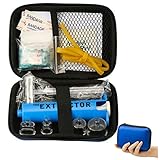
- Keep a bite and sting extractor kit handy for all of your outdoor activities. It's a handy addition to your First Aid Supplies, car glovebox, backpack, etc. Rattlesnake Bite Kit is essential for backcountry camping, fishing, hiking or just a day at the local park
- This bee sting kit can be helpful helpful in extracting bee, wasp or spider venom from the wound site. The pump is easy to use even with only one hand
- Venom extractor includes four sizes of extraction vessels that attach to the pump handle. Choose the size that best suits your current needs. As a rattle snake bite kit, bee sting kit and venom extractor this versatility is essential
- Snake bite kit is light, compact and highly portable. It comes in a hard-shell case with four sizes of extraction cups and a tourniquet band to help control the spread of the venom until it can be extracted
- Snake bite kit by WAEKIYTL is a sturdy, reliable First Aid tool for extracting subcutaneous venom from snake bites, bee stings, wasp stings, etc. Note, venom extractors work well to pull venom from just beneath the skin but not from within the muscle tissue. Effectiveness will vary depending upon where the bite/sting occurred and how deep it is. Always seek professional medical attention immediately
Are copperheads venomous?
Yes. Copperheads are venomous pit vipers. Bites may cause local pain, swelling, redness, bruising, or blisters and can sometimes cause low blood pressure, bleeding, nausea, vomiting, breathing or vision problems, weak pulse, or tingling.
What should I do if a copperhead bites me?
Move away, call emergency services, keep still, keep the bitten limb at heart level, remove rings and other constricting items, and gently wash the area with soap and water. Do not use ice, a tourniquet, cutting, or suction, and do not drive yourself.
Do these 3 things before closing this tab:
1Repair Windows errors before they cause bigger problems2Scan for outdated or missing drivers - takes under a minute3Clear out junk files and repair common Windows errorsShould I wait for symptoms before getting help?
No. Some bites initially cause few or no symptoms, while others worsen. Prompt professional assessment is recommended even when pain or swelling seems limited.
Can I take a picture of the snake for doctors?
Only from a distance that does not put anyone at risk. Never move closer, block the snake’s escape, or return to capture an image. A photograph is optional and must not delay emergency care.
Where do copperheads live?
They range through Eastern states west to Texas and may occur in forests, rocky areas, swamps, and places near water. They can also be encountered near developed areas adjoining natural habitat.
Do copperheads chase people?
They are not usually aggressive. The main danger is defensive behavior when a person steps near, reaches toward, corners, or tries to handle one. A motionless snake can still strike if it feels threatened.
Does a historical hospitalization count prove copperheads cause the most bites?
No. In one historical sample of 2,836 hospitalized cases with detailed records, 954 were attributed to rattlesnakes and 811 to copperheads. Hospitalized cases are not all bites, and that sample cannot establish a current national species ranking.
Who can provide telephone guidance in the United States?
Poison Control can be reached at 1-800-222-1222 for expert guidance. Use it alongside, not instead of, urgent emergency medical care.
The Bottom Line
Copperheads are usually identifiable from a distance by copper-to-tan coloring and dark hourglass bands, but identification should never involve handling or cornering a snake. If a bite is possible, leave the area, call emergency services, keep the person still, remove tight items, wash gently, and avoid tourniquets, ice, cutting, and suction. Current figures do not establish that copperheads bite more Americans than every other snake.





Leave a Reply