
Quick wins for a faster PC:
Scan for outdated or missing drivers - takes under a minuteDriver Scan →Clear out junk files and repair common Windows errorsFree Scan →Fix the driver behind crashes, sound loss and screen glitchesFind Drivers →A good corn snake care plan has four non-negotiables: a secure, escape-proof enclosure; a measured warm-to-cool thermal gradient; appropriately sized prey and clean water; and a commitment to care for the snake for its entire life. Corn snakes are generally kept alone, can reach about 150 cm, and the RSPCA gives a captive lifespan of 10–15 years. The figures below are RSPCA guidance, not a substitute for an examination or individualized advice from a reptile veterinarian.
What you are committing to
Plan for a long-term animal rather than a temporary display pet. The RSPCA describes corn snakes as reaching around 150 cm and living 10–15 years in captivity. That means the enclosure, heating equipment, replacement bulbs, feeder supply and veterinary budget must remain workable as the snake grows and as your circumstances change.
As an Amazon Associate I earn from qualifying purchases.
- Adult space: an enclosure that lets the snake stretch out, turn easily and choose between warm and cool areas.
- Daily care: check temperature, humidity, water and enclosure security; remove waste and soiled material promptly.
- Regular care: feed on an age-appropriate schedule, weigh the snake periodically and inspect its body, eyes, skin and breathing.
- Safety: every heat source needs a thermostat, heat lamps need guards, and doors or lids must not leave an escape route.
Do not buy a hatchling enclosure that cannot be upgraded. Young snakes may feel more secure in smaller housing or in confined spaces inside a larger vivarium, but the permanent setup still needs to accommodate the adult animal.
Recommended Free Tools
Choose and secure the enclosure before the snake arrives
Size and shape
The RSPCA’s example for a snake measuring 150 cm is a minimum enclosure of 150 cm long × 50 cm wide × 50 cm deep. Treat that as a minimum example for that body length, not a universal formula for every corn snake or a reason to stop measuring as the animal grows. The key test is whether the snake can stretch fully and still has a distinct warm end, cool end, hides and furnishings.
#1 Best Overall

- 【Versatile Reptile Habitat】 Our innovative enclosure serves as a gecko tank, bearded dragon tank, snake tank, and turtle tank all in one. With precision sealing technology, it caters to various habitats, creating a dynamic and captivating reptile terrarium.
- 【360° Unobstructed Viewing Experience】 Crafted from high-transparency PC material, this vivarium tank ensures a panoramic view of your reptile's world, be it a gecko, snake, or lizard. Enhance your observation with an enclosure that brings the captivating reptilian habitat closer to you.
- 【Durable PC Glass Construction】 The tank's robust PC glass material sets it apart from standard reptile tanks. It is tailored for the bearded dragon, offering exceptional load-bearing capacity and resistance to breakage, providing a secure and long-lasting home for your pet.
- 【Convenient Feeding Port】 Featuring a powerful magnetic feeding port, this reptile tank simplifies the feeding process for your gecko, snake, or lizard. No need to lift the lid – a gentle push closes the port automatically, ensuring both ease of use and the freshness of your pet's food.
- 【Top Mesh with High-Temperature Resistance】 Specifically designed for reptile comfort, the top mesh of our lizard tank is heat-resistant. Whether you need to place a heating lamp for your snake or turtle, this enclosure ensures a cozy environment, making it an ideal reptile terrarium kit for diverse reptilian companions.
A hatchling can be housed in a smaller enclosure or given additional confined hides in an adult-sized enclosure. As the snake grows, remove temporary dividers and review the layout so that hides, branches and the water bowl do not crowd out usable floor space.
Construction and ventilation
Use a solid material that is easy to clean and able to retain heat, with enough ventilation to exchange air without creating an uncontrolled temperature drop. The enclosure must be free of sharp edges, gaps, loose hardware and openings through which a snake could push its head. Test every door, sliding panel, mesh section and cable opening before placing the animal inside.
Put the heat source at one end rather than in the middle. This creates a usable gradient: the snake can warm itself and then move away from the heat without leaving the enclosure. Keep the cooler end genuinely shaded and less exposed to the lamp.
What’s actually slowing this PC down?
Pick the symptom - the matching free tool is one click away.
Heat-lamp safety
Guard heat lamps against burns and against injury if a bulb shatters. Secure the guard so it cannot collapse onto the snake, and position climbing furniture so the snake cannot press its body against a hot bulb or fitting. Any cable entering the enclosure should be protected from chewing, pulling and gaps around the entry point.
Rank #2

- VERSATILE CLIMBING PATHS - Interlocking triple-ring ball python tank accessories design allows snakes to weave through 6+ directional paths, promoting natural muscle exercise and curiosity stimulation.
- SAFE 360° EDGES - Rounded ABS plastic snake climbing accessories rings (4.6" diameter) with reinforced joint connectors prevent scale abrasion during intensive climbing sessions.
- MULTI-SPECIES APPROVED - Perfectly sized for Ball Pythons (Up To 5ft), Corn Snakes, Bearded Dragon, Chameleon, Iguana, Gecko, Lizard, Parrot. and Juvenile Boa Constrictors - ideal for breeders and exhibitors.
- CUSTOMIZABLE CLIMBING CHALLENGES - Snake enrichment toy interlock two modular rings to create extended 28" climbing tunnels, allowing ball pythons to build muscle strength through adjustable difficulty levels in bioactive enclosures.
- EASY TERRARIUM INTEGRATION - Snake enclosure accessories includes hooks to secure on mesh lids without damaging enclosure seals.
Set up the thermal gradient and verify it
RSPCA care-sheet figures are a hot end of 28–30°C and a cool end of 20–24°C. These are target ranges for the warm and cool zones, not a single temperature to maintain everywhere. A gradient lets the snake regulate its body temperature by moving through the enclosure.
- Install the heat source at one end. Keep the opposite end free from direct heat so a cooler retreat remains available.
- Connect every heat source to a thermostat. Do not operate a lamp, heat panel or other heater without thermostat control; a thermostat is the safety device that limits overheating.
- Place the thermostat probe correctly. For a heat lamp, the RSPCA advises positioning the probe just above the substrate at the animal’s level. Secure it so the snake cannot move it onto a hotter or cooler surface.
- Adjust the thermostat while measuring the basking zone. Use a digital thermometer to check the actual basking area rather than relying on the thermostat’s setting alone.
- Measure both ends. Record the warm and cool readings at the snake’s usable level, then repeat checks at different times of day and after room-temperature changes.
- Run the enclosure empty before arrival. Confirm that the gradient is stable, the lamp guard stays cool enough to be safe, and no part of the enclosure becomes dangerously hot.
A thermostat setting is not proof that the animal is receiving the intended temperature. Sensor placement, lamp distance, ventilation and room temperature all affect the result, so the digital thermometer reading is the operational check.
Humidity, lighting and the day-night layout
Humidity
The RSPCA gives a humidity range of 40–50%, measured with a hygrometer. Place the hygrometer where it reflects the snake’s general enclosure conditions rather than directly in a mist plume or immediately beside the water bowl. If humidity is persistently above the target, increase ventilation and check for wet substrate, spills or a poorly ventilated lid. Avoid trying to correct a high reading by simply raising the heat.
Windows Errors? Fix Them Before They Spread
Repair common Windows errors and clear accumulated junk for a smoother, more stable PC - no reinstall needed.Free scan · no reinstallOutdated Drivers Are Slowing You Down
One free scan finds every outdated or missing driver and matches the right update for your exact hardware.Free scan · exact hardware matchPetMD discusses offering a humidity hide containing moist sphagnum moss. Use a hide the snake can enter and leave freely, keep the moss clean and replace it when soiled or moldy. A humidity hide is an option for providing a locally more humid retreat; it does not remove the need to monitor the enclosure’s overall humidity.
Rank #3
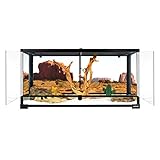
- [Patent Design] Size of RK0119:36" x 18" x 18"(Only include the mesh sides, not include the glass sides). A tough screen top provides ventilation and allows UVB and infrared penetration.
- Raised bottom frame in order to fit a substrate heater; Waterproof bottom makes this tank can be used both as a desert terrarium and rainforest tank.
- Front doors can open separately, easy to feed your pet and prevent escape.
- Window ventilation on the left and right, on top and right, have closable inlets for wires and tubing.
- Easy to install or knock down in 5 minutes with step-by-step instructions; Our glass terrariums are carefully packaged with tough cardboard and thickened reinforced foam for transportation. Should you have any questions when receive it, please reach out to us. A replacement service is provided for damaged parts.
UVB and visible light
The RSPCA describes low-output UVB lighting, such as a 2–7% UVB tube over part of the enclosure, with a basking UVI of 1.0 grading to zero in shade. Grouping the light with the heat source creates a brighter warm end and a shaded cool end. Cover only part of the enclosure so the snake can leave both the UVB and the heat when it chooses. Follow the lamp manufacturer’s replacement and distance instructions, and keep mesh, guards and furnishings from blocking the measured basking zone unexpectedly.
Substrate, hides and furnishing
The available care guidance does not establish one universally mandatory substrate. Choose a material that is cleanable, allows you to see waste and does not create sharp edges or dangerous dust. PetMD cautions against pine and cedar bedding because their oils can irritate snakes. Whatever material you use, replace contaminated portions promptly and perform complete cleaning on a schedule appropriate to the enclosure’s condition.
Provide at least one secure hide at the warm end and one at the cool end. Hides should be snug enough to make the snake feel concealed while leaving its body clear of pinch points. Add stable branches, cork or other non-abrasive furnishings if they cannot fall, trap the snake or block the thermal gradient. Anchor heavy items so a burrowing or climbing snake cannot shift them onto itself.
The Tool Desk
Outbyte Driver Updater FREEScan for outdated or missing drivers - takes under a minuteDriver Scan →Outbyte PC Repair FREEClear out junk files and repair common Windows errorsFree Scan →- Check that every hide has an entrance large enough for the snake’s widest point.
- Remove décor that develops splinters, sharp cracks, exposed wire or unstable bases.
- Keep a clear route between the warm hide, cool hide and water bowl.
- Inspect the enclosure after every major rearrangement; a safe layout can become an escape route when a branch is moved.
Water: placement, cleaning and bathing access
Keep clean, fresh water at the cool end. The RSPCA advises refreshing it at least daily and replacing it immediately if fouled. Use a bowl large enough for the snake to drink from and, if it chooses, soak its body. A heavy, stable bowl is less likely to tip when the snake pushes against it.
Rank #4

- Effortless and Efficient Feeding Experience: As a snake hobbyist, you may often face troubles during the feeding process, such as insufficient grip strength and unstable gripping. Our snake feeder tongs have a serrated design that provides a better grip and reduces hand pressure during feeding, allowing you to complete feeding tasks easily and efficiently.
- Safe and Reliable Length Design: Safety is crucial when feeding snake animals. With a total length of 15 inches, our snake feeding tongs are long enough to ensure that you have enough distance between you and the snake to reduce the risk of accidental bites. This design allows you to feel more secure and at ease during the feeding process.
- Comfortable Non-Slip Handle Design: In order to provide a better using experience, we especially use a silicone sleeve on the handle of the snake feeder pliers to make sure that you can have a firm grip on it and not easy to slide when you use it. In this way, you will be able to carry out the feeding operation with more confidence and avoid accidents caused by hand sliding.
- Durable and Rustproof Material: Our snake feeding tongs are made of high quality stainless steel material with excellent rust resistance and durability. This means that even after prolonged use, it will still maintain its good quality and be able to cope with the challenges posed by the aquarium environment.
- Suitable for Many Applications: In addition to reptile tank feeding tasks, our snake feeding tongs are also suitable for other scenarios such as aquarium cleaning, picking up debris, and various other scenarios.
- Rinse the bowl and refill with fresh water every day.
- Change the water as soon as substrate, feces or shed material enters it.
- Wash and disinfect the bowl regularly, following the disinfectant’s reptile-safe directions and rinsing thoroughly.
- Check the surrounding substrate for damp patches; repeated spills can raise humidity beyond the intended range.
Feeding schedule and prey selection
What to feed
The RSPCA recommends dead mice, with prey slightly wider than the snake’s widest point. Frozen-thawed prey is commonly used because it avoids the injury risk of live prey; thaw it safely according to the supplier’s instructions and offer it with feeding tongs. Do not handle a mouse with bare hands and then immediately handle the snake: wash your hands after touching prey.
As the snake grows, increase prey size gradually rather than jumping to a much larger item. The RSPCA also suggests occasional variation with prey such as quail or rats. These alternatives should still be appropriately sized and sourced; variety is not a reason to offer oversized or nutritionally unsuitable food.
RSPCA example intervals
| Snake stage or prey example | RSPCA interval | How to apply it |
|---|---|---|
| Hatchling | One pinky every five to six days | Use as a starting example, then adjust prey size and timing as growth and body condition change. |
| Growing snake | Interval and prey size change as the snake grows | Move up prey sizes gradually; monitor weight and body condition instead of following a calendar blindly. |
| Adult-mouse example | One adult mouse every seven to 14 days | The wider interval reflects an example range, not a requirement that every adult eat on the same day. |
Feed in the vivarium with tongs, present the prey without pushing it against the snake and remove it if it is not taken within a reasonable period. Keep a record of the date, prey type and size, and the snake’s weight at regular intervals. The RSPCA says supplements should not be needed when prey is good quality. Do not add supplements routinely without a veterinarian identifying a reason.
Free tools Windows power users keep installed
One-click scans. No signup required.
When food is refused
A single missed meal does not identify a cause. PetMD advises seeking veterinary advice if a snake misses more than a couple of feeding sessions, particularly when it is not shedding. Record recent temperatures, humidity, shedding status, handling, prey size and any other changes so the veterinarian has useful context. Do not diagnose illness from food refusal alone.
Best Value

- 【Spacious & Secure】Size: 30" (W) x 12" (D) x 12" (H). The 20 gallon reptile cage offer ample room for your pet. Full view transparent glass, which is convenient observation and interaction.
- 【Top Opening Doors】Dual sliding doors for easy access, the top contains wire inlets for installing heating pads, heating cables, sensors, etc.
- 【Dual-Cover Design】Reptile terrarium boast has double screen covers, one side for daily opening, the other side for placing reptile lamp or other accessories. Metal mesh cover ensures adequate ventilation, allows full spectrum, UVB, and IR light penetration.
- 【Easy Feeding】The top of the cage includes specially designed feeding ports for easy feeding and to prevent escapes.
- 【PVC Tray】The knock-down reptile habitat comes with a transparent PVC tray for holding water and substrate, easily cleaning. Perfect for reptiles small animals pets as bearded dragon, lizard, snake, ball python, hamster, hedgehog, tortoise etc.
After feeding
Do not handle the snake for 48 hours after a meal. The RSPCA’s wording is: “Wait 48 hours after feeding before handling your snake to avoid them bringing up their food.” Leave the enclosure quiet, maintain the normal gradient and check visually rather than lifting the snake.
Independent reader supportYour contribution helps us test, update, and keep practical guides available for everyone.Keep the snake alone
The RSPCA describes corn snakes as solitary and recommends individual housing. A second snake can compete for heat, hides and food, and separating animals makes feeding, weight tracking and illness monitoring clearer. Provide enough furnishings for one snake to hide and thermoregulate without being forced into contact with another animal.
Safe handling, from first contact to routine sessions
Before lifting
- Confirm that the snake has not eaten within the previous 48 hours.
- Wash hands after handling feeder prey and before touching the snake.
- Work in a quiet room with doors and windows closed and with no other pets loose.
- Identify where you will put the snake if it becomes active or defensive.
How to pick up the snake
- Open the enclosure slowly and allow the snake to see your hand.
- Do not grab from above or pin the head.
- Scoop with one hand near the head and the other nearer the tail, supporting the whole body as you lift.
- Keep the snake close to a secure surface and let it move through your supported hands.
- Return it gently to the enclosure before it becomes chilled, exhausted or agitated.
The RSPCA recommends sessions of about 10–15 minutes, depending on room temperature. A cooler room shortens the safe handling window because the snake cannot maintain body temperature as easily outside its heated enclosure.
Do these 3 things before closing this tab:
1Repair Windows errors before they cause bigger problems2Fix the driver behind crashes, sound loss and screen glitches3Clear out junk files and repair common Windows errorsRecognize defensive behavior
If the snake draws its head back into an S-shaped posture, leave it alone and try another time. Do not chase, restrain or punish it. A defensive response is a signal to stop; repeated forced handling can make future interactions more difficult and increases the chance of a bite or a dropped animal.
Daily, weekly and seasonal checks
Every day
- Read and record warm-end temperature, cool-end temperature and humidity.
- Confirm that the thermostat is powered and the probe has not moved.
- Check the lamp guard, doors, vents and cable openings for escape or burn hazards.
- Refresh water and remove visible waste or heavily soiled substrate.
- Observe posture, movement and breathing without disturbing the snake unnecessarily.
Each week or after feeding
- Inspect hides, branches and the bowl for damage, instability or contamination.
- Review the feeding log and note acceptance, refusal, regurgitation or unusual behavior.
- Weigh the snake at a consistent time when a routine check is due, using a secure container and a scale that cannot be escaped from.
- Check that the snake has enough room to move between zones as it grows.
During shedding
Expect behavior and appetite to change around a shed. Maintain the measured humidity range, provide a secure hide and avoid unnecessary handling. If the snake repeatedly retains eye caps or skin, or appears unwell, contact a reptile veterinarian rather than attempting forceful removal.
Troubleshooting common setup problems
| What you observe | Checks to make | Safer correction |
|---|---|---|
| Warm end is below 28°C | Thermostat setting, probe position, lamp distance, room temperature and digital thermometer accuracy | Correct the setup gradually while continuing to measure the basking zone; never bypass the thermostat. |
| Cool end is warmer than 24°C | Whether the heat source is centered, ventilation is restricted or the room is unusually hot | Restore a true cool retreat by improving ventilation or repositioning the heat source, then recheck both ends. |
| Humidity stays above 50% | Wet substrate, spilled water, poor ventilation and hygrometer placement | Remove wet material and increase ventilation; do not rely on extra heat as the only fix. |
| Snake repeatedly escapes or tests the lid | Door latches, sliding panels, vent gaps and cable holes | Secure every opening before the next handling or feeding session. |
| Snake refuses several meals | Prey width, thawing and temperature, recent shedding, handling and recorded enclosure readings | Seek veterinary advice after more than a couple of missed feeding sessions, especially outside a shed. |
| Snake adopts an S-shaped head and neck | Recent disturbance, attempted handling, feeding and the animal’s retreat options | Stop, close the enclosure and try another time; do not force contact. |
Equipment checklist before purchase
- Secure, well-ventilated vivarium sized for the snake’s current length and planned adult size.
- Heat source positioned at one end and a compatible reptile thermostat.
- Digital thermometer for the basking area and a second reading point for the cool end.
- Hygrometer capable of showing the enclosure’s 40–50% target range.
- Guard for every heat lamp and safe cable management.
- Warm and cool hides, stable furnishings and a cleanable substrate; avoid pine and cedar bedding.
- Stable water bowl large enough for drinking and bathing.
- Low-output UVB tube and a way to create a shaded section, following the RSPCA’s 2–7% UVB and UVI guidance where that setup is used.
- Appropriately sized frozen-thawed or dead feeder mice, feeding tongs, a secure weighing container and a care log.
When professional help is needed
Arrange veterinary assessment for repeated food refusal, regurgitation, breathing difficulty, persistent lethargy, unexplained weight loss, injuries, burns, parasites or shedding that remains stuck. Bring the enclosure log, recent weights, feeding dates, prey sizes and temperature and humidity readings. Those records help distinguish a husbandry problem from a medical problem without guessing at a diagnosis.
For routine care, the practical standard is simple: the snake must always be able to escape the heat, hide securely, drink clean water, receive correctly sized prey and live without another snake competing for resources. Build and test that environment before the animal arrives, then keep measuring it throughout the snake’s life.
Quick Recap
Product prices and availability are accurate as of the date/time indicated and are subject to change. Any price and availability information displayed on Amazon at the time of purchase will apply.





Leave a Reply