
Free tools Windows power users keep installed
One-click scans. No signup required.
The most effective bee nesting ground is a mosaic, not a single structure: keep a sunny, well-drained patch of suitable soil, retain hollow stems and dead wood, leave a sheltered area of longer grass or leaf litter, and grow regionally appropriate flowers nearby. Avoid pesticides and disturbance around occupied nests. A bee hotel is optional and helps only some aerial cavity-nesting bees; it cannot replace ground habitat.
This guide shows how to create and maintain each habitat type, how to decide whether a hotel fits your site, and how to avoid the design and sanitation mistakes that can harm the bees you want to support.
As an Amazon Associate I earn from qualifying purchases.
What bee nesting grounds actually include
Bees do not share one nesting habit. Many solitary bees excavate tunnels in soil. Others use ready-made cavities in hollow stems, beetle holes or soft dead wood. Bumblebees may nest in longer grass, leaf litter, compost, logs or an abandoned small-mammal burrow. Because of that range, a drilled block can never be a complete bee habitat.
The proportions reported by extension services illustrate why geography matters. The University of Minnesota Bee Lab gives a broad estimate that 60–70% of bees dig ground burrows and 30–40% are cavity nesters; it is an estimate from that program, not a precise global census. North Carolina State Extension reports that about 75% of bee species in North Carolina nest in soil and that no more than about 100 species, or 18% of the state total, might use a bee hotel. Those figures cannot be transferred to every country.
#1 Best Overall

- Lures Pollinators & Beneficial Bugs:This insect hotel, bee hotel & mason bee house attracts mason bees, pollinating bees. As a pollinator habitat, it pairs with garden bee houses to boost yields, plus draws ladybugs for natural balance
- Multi-Zone for Insect Habitats:It integrates bee home, ladybug house, butterfly house—reed tubes for mason bee, nooks for ladybugs. Fits bug hotel, insect house needs, and works as mason bee houses for the garden
- Durable for Garden Use:This bee hotel for the garden, made of solid wood, has a waterproof roof. Safe as bee houses, insect habitat—it’s chemical-free, ensuring safety for mason bees and all beneficial bugs
- Aids Organic Gardening:As bug house, pollinator habitat & mason bee house, it relies on natural balance instead of artificial products. It pairs with bee houses for pollinating bees to nurture ecosystems, supporting biodiversity
- Versatile & Kid-Friendly:This bug habitat fits garden corners or hangs, doubling as butterfly habitat. It’s a kid-safe bug house for kids, blending with gardens while serving as a functional bee home
| Nesting strategy | Habitat to provide | Intervention and upkeep |
|---|---|---|
| Ground nesting | Sunny, mostly bare, well-drained soil in a mixture of exposed, covered, disturbed and undisturbed patches | Protect what is already present; little construction and little routine maintenance |
| Stem or wood cavities | Hollow or pithy stems, standing dead stalks, soft dead wood and natural holes | Retain and renew plant material; inspect without opening occupied nests |
| Bumblebee shelter | Long grass, sheltered vegetation bases, leaves, logs, compost or old small-mammal holes | Leave a quiet refuge; avoid mowing, digging or turning material in an active nest |
| Artificial bee hotel | Managed blocks or bundles with species-appropriate tunnels | Highest responsibility: weather protection, inspection and cleaning or retirement on a regular schedule |
The Royal Horticultural Society’s UK guidance describes around 270 wild bee species (page published 14 August 2026), while other regions have different species and nesting distributions. Use local extension or native-plant advice when choosing plants and dimensions.
1. Make room for ground-nesting bees
Choose a sunny patch and leave it mostly open
Start with a place that receives substantial sun and is not routinely compacted, flooded or covered by thick organic material. The RHS recommends leaving a sunny patch bare or mostly bare for solitary mining bees. Sandy soil is popular because it is easier to excavate, but there is no universal soil recipe: local bees use different textures and moisture conditions.
Do not excavate a new pit where you see bees entering the ground. The useful action is to protect suitable soil that already exists. A small patch beside a path, at the edge of a bed or on a bank can be valuable if people and pets can walk around it rather than across it.
Offer more than one soil condition
The University of Minnesota Bee Lab recommends providing both disturbed and undisturbed soil and both covered and bare soil. That can mean retaining a naturally bare bank while also leaving a lightly used edge where vegetation is sparse. Let bees show you which surfaces they select instead of replacing all soil with imported sand.
Rank #2
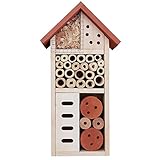
- Shelter for Insect: Lulu Home wooden insect house attracts insects to your garden, and provides them with a safe environment to live, lay eggs, pass the winter or just take shelter from the rain.
- Beneficial for Plants: Some insects are really useful that, when they living in the bug house in your garden, they help to recycle decaying vegetation, pollinate plants, and in some cases even prey on more harmful insects.
- Diverse Rooms in One: To settle more species of insects, each gird of the insect hotel is filled with different material and designed differently. Lulu Home garden bug hotel serves to provide habitat for bees, butterflies, ladybirds, lacewings, etc.
- Premium, Sturdy and Weatherproof: Made of high quality fir wood with exquisite workmanship, it is sturdy and nice-looking. And non-toxic and odorless paint on the proof makes it weather resistant. The materials filled in each grid, such as bamboo, wood shavings, small stakes, are all natural and premium.
- Interesting Decoration: A wonderful ornament to be placed at your garden, balcony, patio, yard, or any place you want. And there is a loop on back for hanging. The bug hotel also provides a great chance for you to find and observe these little creatures in your garden.
Dense turf, buried weed barrier and thick mulch exclude some ground-nesting bees, according to USDA Agricultural Research Service guidance. Avoid laying landscape fabric over a promising patch or spreading a deep mulch layer across it. If you need mulch elsewhere, keep it away from visible entrances and move it without scraping or digging into the nesting area.
Protect visible burrows
Small soil mounds or round entrance holes may be active nests. The RHS specifically advises avoiding disturbance of visible burrows. Mark the perimeter with a discreet label or low barrier so mowing, weeding, children and pets do not cross it. Do not probe holes, pour water into them or smooth the surface to make it look tidy. Activity can be seasonal, so an apparently quiet entrance is not proof that the nest is empty.
2. Retain stems and dead wood
Leave hollow and pithy stems standing
Many cavity nesters use plant material already present in a garden. The Minnesota Bee Lab recommends hollow and pithy stems from flowers and grasses. Its habitat guidance gives a height of 8 to 24 or more inches and a diameter of 1/8 to 5/16 inch. Those measurements are practical guidance, not limits that every species follows.
Bees may occupy vertical, horizontal or angled stems. Keep suitable stalks through summer, winter and at least the first half of the second summer so developing bees can complete their life cycle. Following the Minnesota guidance, cut the old stems in spring, not immediately after flowering. New growth can then replace them while the old stems remain available long enough for emergence.
Rank #3
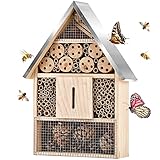
- Dimensions: 9 x 16 x 3 Inch,More capacity, More uses.
- The mason bee house has more holes to accommodate for more Butterflys, bees and ladybugs to habitat, hatcheries or shelter from rain.
- Made of natural materials, such as pine wood, bamboo and pine cone, and not painted. The different filling materials attract a variety of different bugs.
- The metal roof will help protect it from the weather.Waterproof to protect the hotel from erosion,and help stop rain from soaking the bits and pieces that are supposed to keep the ladybirds and lacewings dry.
- Suspension design (via hooks on the back),You can hang it on garden walls, fences, trees, or anywhere else you can hang it.Keep it as dry as possible
Do not bundle stems tightly
Leave stems as individual pieces or in loose, natural groups. The Minnesota Bee Lab cautions that clumping or bundling can encourage parasites. Some bees excavate the soft pith of dead rose or raspberry canes and dry flowering stalks rather than using a pre-existing hollow, so retain both kinds of material.
Keep useful dead wood
USDA Agricultural Research Service guidance describes native bees using hollow stems and excavating soft dead wood. A fallen branch, an old log or a standing dead section can therefore be habitat rather than waste. Place it where it will not be moved or split for firewood, and leave its natural cavities intact. Check for an active nest before cutting or relocating any piece.
3. Provide bumblebee shelter
Bumblebees often need a sheltered cavity rather than a drilled tunnel. The RHS describes longer grass as nesting habitat for ground-nesting bumblebees that may dig a burrow or reuse an old mouse hole. Its guidance says a single square metre of long grass can be enough space for a bumblebee nest; treat that as RHS garden advice, not a universal ecological minimum.
The Tool Desk
Outbyte Driver Updater FREEFix the driver behind crashes, sound loss and screen glitchesFind Drivers →Outbyte PC Repair FREERepair Windows errors before they cause bigger problemsFix Now →On a smaller property, let grass grow around the base of native grasses, under a hedge or beside a quiet fence. The Minnesota Bee Lab also suggests sheltered spaces containing compost, dried grass at the bases of native grasses, logs and leaves. Keep one refuge unmown during the season and avoid turning compost or leaf piles when bees are active.
Rank #4

- Durable Bee House: Our Mason Bee House is a beautifully crafted, wax-coated bee hotel designed to provide a suitable habitat for peaceful pollinators in your garden. This durable bee house is ready to use straight out of the box
- Long-lasting Design: The natural wooden construction of this Mason Bee Box features a wax coating that boosts its longevity, supporting steady use in outdoor surroundings while attracting mason bees effectively
- Optimal Habitat: Each tube in our bee hotel is made from kraft paper with a diameter of 5/16 inches and a length of 6 inches, providing an ideal space for mason bees to nest and thrive in their new insect hotel
- Easy Installation: The back of the bee house includes a sturdy metal wall hook for easy mounting on walls or garden stakes. For hanging in trees, we also provide a special rope, ensuring versatile placement options in any outdoor setting
- Enhance Pollination Efficiency: Attracting mason bees to your garden not only beautifies your surroundings but also significantly improves pollination efficiency for flowers and fruit trees, making our Habitat Home Hotel an essential addition for any gardener
If you discover a bumblebee nest, observe from a distance and route foot traffic around it. Do not lift a log, rake out the cavity or fill a suspected mouse hole. A temporary marker is safer than trying to improve the nest while it is occupied.
4. Put forage and nest-building materials nearby
Nesting habitat works only when adult bees can find food and the materials needed to finish cells. The Minnesota Bee Lab recommends diverse plants that can supply leaves, plant hairs and resin as well as nectar and pollen. Mud-building bees need access to damp soil or open water. University of Georgia Extension also recommends pollinator-friendly trees and flowers and a shallow water source.
There is no defensible universal seed mix. Climate, soil, season and local bee fauna determine which plants are useful. Ask your regional extension service, botanic garden or native-plant organization for species appropriate to your area. Select a succession of locally suitable blooms rather than relying on one short flowering period, and leave some leaves, stems and resin-producing plants available instead of clearing every bed.
Windows Errors? Fix Them Before They Spread
Repair common Windows errors and clear accumulated junk for a smoother, more stable PC - no reinstall needed.Free scan · no reinstallOutdated Drivers Are Slowing You Down
One free scan finds every outdated or missing driver and matches the right update for your exact hardware.Free scan · exact hardware matchFor water, use a shallow container with stones or textured material that provides landing places. Refresh it regularly so it stays clean and does not become a hazard for small animals. Keep water close enough to the nesting area to be useful, but do not saturate a dry nesting bank.
Best Value

- Heavy Wax Coated: The mason bee house is full body coated with wax, helping extend its service life for outdoor use
- Assembled Wooden Bee House: The handmade wooden mason bee nest you receive is assembled and ready to use and with stainless steel screw clasp on the back of the bee house, you can hang it on a tree or wall
- Mason Bee House: Effectively attract mason bees through our bee house to help increase pollination efficiency in gardens and orchards, promoting plant growth and fruit production
- Mason Bee House Tube Size: For mason bee and easy to get the mason bee cocoons, same 5/16" diameter size hole and 6" long which is a suitable size for mason bee; easily for mason beekeeper to remove the cocoons
- Package Include: 1 Completed mason bee house assembled with hook and nails,1 meter rope to hang on a tree or wall to attract mason bees and butterflies to live in your garden, creates a comfortable environment for pollinator bees and enhance productivity of pollination
5. Decide whether a bee hotel belongs on your site
What a hotel can and cannot do
A bee hotel is a set of pre-existing tunnels or hollow tubes for aerial cavity-nesting species. The Natural History Museum describes this basic purpose, and North Carolina State Extension notes that many solitary wasps may use the same structures. Hole diameter influences which insects can enter, and nesting bees may need nearby leaves, resin or mud to divide and seal their cells.
A hotel is not a hive and does not support ground-nesting bees. If your only available space is a drilled block, you are addressing a minority of local nesting strategies. Protecting soil, stems and dead wood usually offers broader coverage before you add an artificial structure.
Understand the maintenance obligation
Artificial nests can accumulate parasites and disease organisms in reused materials. The Minnesota Bee Lab warns that an unmanaged artificial nest may do more harm than good. North Carolina State Extension recommends regular cleaning or retiring and disinfecting materials every one to three years in its guidance. Follow a credible regional design and maintenance guide rather than treating a hotel as disposable décor.
Keep records of when a block was installed and serviced. If tunnels cannot be opened, replaced or disinfected safely, choose a design that uses removable nesting components or retire the entire unit on the schedule recommended by your regional authority. Never open a sealed cell simply to check whether it contains a larva.
Interpret local findings cautiously
A 2026 University of Georgia Extension post summarizing work by researcher Dr. Miriam Lyon in Clarke County, Georgia, reported that hotels in that local study were almost entirely occupied by two non-native species: the giant resin bee (Megachile sculpturalis) and mason bee (Osmia taurus). The post discusses possible competition and parasite or disease concerns. This is a local finding, not evidence that hotels everywhere are dominated by non-native bees.
Independent reader supportYour contribution helps us test, update, and keep practical guides available for everyone.6. Build a narrow DIY cavity block only if it fits your goals
For readers who specifically want a wooden block, University of Georgia Extension provides a limited set of construction directions: use untreated wood, add a roof to protect nesting sites from rain, and select a drill bit in the 5/16- to 3/8-inch range for its particular instructions. Those dimensions are not a universal specification for every native bee.
- Choose untreated lumber. Avoid wood treated with preservatives or coatings that could contact nesting cells.
- Drill clean, straight tunnels. Use the 5/16- to 3/8-inch bit range described by the UGA instructions, while recognizing that North Carolina State Extension stresses species-specific tunnel diameters.
- Add a rain-shedding roof. The roof is part of the UGA construction guidance; it protects the nesting face from direct rain.
- Use a regional design. Confirm tunnel sizes, depth, placement and replacement intervals with an extension or conservation guide for your area before building many units.
- Install only after natural habitat is protected. Keep a bare-soil patch, stems and shelter available so the block supplements rather than replaces them.
- Plan servicing before installation. If you cannot clean, replace or retire the nesting material on schedule, do not install the block.
Do not market a generic block as suitable for all bees. A hotel with one hole size serves a narrower audience than a mixed habitat, and a decorative bundle that cannot be cleaned can create a concentration point for parasites.
Recommended Free Tools
Quick Recap
7. Create the habitat in a deliberate sequence
- Survey before changing anything. Walk the property at different times of year and note bare banks, burrows, hollow stems, dead wood, long grass and sheltered cavities. Photograph locations instead of digging to investigate them.
- Protect existing nests. Mark visible entrances and leave a buffer from mowing, foot traffic, mulch spreading and pesticide applications.
- Design a soil mosaic. Keep one sunny, mostly bare and well-drained patch; retain other areas with light vegetation or natural cover so different preferences are represented.
- Delay stem cutting. Leave hollow and pithy stems standing through the first half of the second summer, then cut them in spring as advised by the Minnesota Bee Lab.
- Retain woody material. Leave suitable logs, branches and soft dead canes where they will not be repeatedly moved.
- Create a quiet shelter. Allow a section of longer grass and keep leaves, dried grass, logs or compost undisturbed. Use the RHS one-square-metre figure only as a local garden reference, not a guaranteed minimum.
- Plant for the local season. Use regional native-plant guidance to provide flowers plus leaves, hairs or resin, and add a shallow, safe water source for mud-building bees.
- Reassess before adding a hotel. If natural cavities are already occupied, a hotel may add little. If you still install one, choose a serviceable regional design and record its maintenance date.
Seasonal maintenance calendar
| Time of year | Useful actions | Actions to avoid |
|---|---|---|
| Spring | Cut last season’s retained stems; check that soil patches remain open; inspect a hotel externally for weather damage. | Do not cut or move stems that are still being used, and do not dig through visible burrows. |
| Summer | Leave stems standing, allow the long-grass refuge to remain, keep flowers blooming and refresh shallow water. | Avoid mowing, pesticide drift, heavy weeding and turning compost near active nests. |
| Autumn | Leave dead stalks, leaves and logs in place; note which patches were occupied. | Do not clear every bed or remove natural cavities for tidiness. |
| Winter | Protect habitat from storage, vehicles and soil compaction; plan replacement or cleaning for managed hotels according to regional guidance. | Do not open sealed tubes or relocate a block simply because it looks inactive. |
Common problems and practical fixes
| What you see | Likely issue | Better response |
|---|---|---|
| A promising soil patch is covered in mulch or turf. | Some ground nesters avoid dense cover, buried barrier and thick mulch. | Keep a separate bare or lightly covered patch; remove future mulch before it reaches occupied entrances and do not scrape active nests. |
| Stems are cut after flowering and disappear over winter. | Developing bees may not have completed their cycle. | Retain suitable stems through at least the first half of the second summer, then cut in spring. |
| A stem bundle becomes damp or heavily colonized by unwanted organisms. | Tightly packed material can encourage parasites. | Use individual or loose stems and retain natural spacing. |
| A hotel is occupied by wasps. | Solitary wasps can use the same cavities. | Do not assume this is a design failure; follow the regional maintenance plan and preserve broader natural habitat. |
| A hotel has mold, damaged wood or no way to service tunnels. | Moisture and unreplaced nesting material increase management risk. | Repair only according to the design guide, or retire the unit; do not keep an unserviceable block indefinitely. |
| You see little activity. | Bees may be using soil, stems or wood elsewhere, or activity may be seasonal. | Survey the entire habitat over time rather than judging success from one hotel or one visit. |
| People or pets cross the nesting area. | Repeated trampling can disturb entrances and shelters. | Use a visible boundary and route traffic around the patch without fencing in an active nest. |
Which option is right for your garden?
| Your situation | Priority action | Why |
|---|---|---|
| You have bare soil or a sunny bank. | Protect it from mulch, turf, pesticides and trampling. | It may already support ground-nesting bees, which hotels cannot serve. |
| You have annual beds, grasses or old canes. | Leave hollow and pithy stems standing and cut them in spring after the recommended retention period. | Natural stems provide varied cavity sizes without construction. |
| You have a quiet lawn edge, hedge base or leaf pile. | Let a section grow longer and leave shelter materials in place. | Bumblebees may use grass, leaves, logs, compost or old mammal burrows. |
| You want to observe cavity nesters and can maintain equipment. | Use a regionally specified, serviceable hotel as a supplement. | It can support selected cavity nesters, but requires sanitation and does not replace soil. |
| You cannot clean or replace a hotel. | Skip the hotel and invest effort in soil, stems, wood, shelter and forage. | Natural habitat has a lower maintenance burden and broader potential coverage. |
Source-backed guidance
- Royal Horticultural Society: 5 easy ways to make a habitat for wild bees — sunny soil, long grass, visible-burrow protection and UK-specific figures.
- University of Minnesota Bee Lab: Create Nesting Habitat — ground-habitat diversity, stem dimensions and retention period, bumblebee shelter and nearby resources.
- North Carolina State Extension: What is a Bee Hotel? — hotel scope, North Carolina statistics, cavity sizes and sanitation guidance.
- University of Georgia Extension: Creating Pollinator Nesting Boxes to Help Native Bees — untreated wood, roof and drill-bit instructions.
- USDA Agricultural Research Service: Gardening and landscaping practices for nesting native bees — soil, stems, wood and sanitation practices.
- UGA Extension: To Bee Hotel or Not to Bee Hotel — 2026 Clarke County, Georgia, findings and cautions about local hotel occupancy.
- Natural History Museum: How to make a bee hotel — definition and scope of bee hotels.
Product prices and availability are accurate as of the date/time indicated and are subject to change. Any price and availability information displayed on Amazon at the time of purchase will apply.





Leave a Reply