
Windows Errors? Fix Them Before They Spread
Repair common Windows errors and clear accumulated junk for a smoother, more stable PC - no reinstall needed.Free scan · no reinstallCrashes, No Sound, or Screen Glitches?
Random freezes, missing sound and display glitches usually trace back to one bad driver. Find and replace yours safely.Free scan · under a minuteCuttlefish are cephalopod mollusks related to squid and octopuses, but they have a remarkable combination of abilities all their own. They can reshape their skin, steer two specialized feeding tentacles, hover with an internal gas-filled shell, and escape in a cloud of ink. The ten facts below use the common cuttlefish (Sepia officinalis) for measurements and life-history details, while identifying traits that belong to cephalopods as a wider group.
The most important distinction is species and group. A common cuttlefish measurement is not a measurement for every cuttlefish species, and three hearts or blue blood are cephalopod-wide characteristics rather than cuttlefish-only features.
As an Amazon Associate I earn from qualifying purchases.
Quick reference: 10 cuttlefish facts
| Fact | What it means |
|---|---|
| Classification | Cuttlefish are cephalopod mollusks, alongside squid, octopuses and nautiluses. |
| Arms and tentacles | They have eight arms plus two longer tentacles used to seize prey. |
| Skin | Chromatophores, iridophores and papillae create color, light and texture displays. |
| Buoyancy | A gas-containing cuttlebone helps regulate floating and sinking. |
| Movement | A rippling fin provides routine propulsion; the siphon supplies rapid bursts. |
| Defense | Ink can form a smokescreen, distraction or decoy. |
| Circulation | Cephalopods have three hearts and copper-based blue blood. |
| Eggs | Common cuttlefish lay grape-like clusters that hatch in roughly one to three months, depending on water temperature. |
| Size | Common cuttlefish are listed at 20–30 cm (7–12 in), with large males reaching about 49 cm (19 in). |
| Range | The common cuttlefish is recorded in the eastern Atlantic, Mediterranean, North Sea, Baltic Sea and northwestern Africa. |
Measurements and range in this table refer to the common cuttlefish profile from Monterey Bay Aquarium, not to every species.
The Tool Desk
Outbyte PC Repair FREEClear out junk files and repair common Windows errorsFree Scan →Outbyte Driver Updater FREEScan for outdated or missing drivers - takes under a minuteDriver Scan →1. Cuttlefish are mollusks, not fish
The name can be misleading: a cuttlefish is an invertebrate mollusk. Its closest familiar relatives are other cephalopods, including squid and octopuses. The common cuttlefish is Sepia officinalis, one species within a much larger group whose members vary in size, color and distribution. The word “cephalopod” means “head-foot,” reflecting the way the animals’ arms surround the head.
#1 Best Overall

- REALISTIC SQUID SHAPE: The vivid image of our squid can be well portrayed in your hearts, whether it is the various claws, the special treatment of the tail, and the beard on the top of the head, we have achieved the simulation.
- HIGH QUALITY FABRICS: Our fabrics are made of high-quality PP cotton, 100% handmade, and the vivid and interesting image will make children like it. You can rest assured to let our praying squid accompany the children to play.
- SPECIFIC SIZE DESCRIPTION: Our Our cute squid toy has a length of 30 inch from tail to tentacles, a belly of 4 inch, and a length of 12 inch from mouth to tail.
- THE BEST CHOICE FOR INNOVATIVE GIFTS: Our simulationtoy can not only be used as a gift for children, to help them understand the world of animals and enrich their childhood, but also can be used as home decoration in the living room and bedroom for you add a different kind of fun to your life.
- RELIABLE QUALITY: When you get hand-made cute simulation toys, it entrusts our brand's sincere love for handmade toys, which is why we only use super soft fabrics and super fluffy filling items. When you receive the goods and have any questions, please feel free to contact us, we will provide you with quality after-sales service.
Like other cephalopods, cuttlefish have a soft body, a mantle that encloses major organs, and a siphon that directs water. Their shell is not an external clam-like shell; the cuttlebone is internal. This combination of a flexible body, grasping appendages and sophisticated sensory systems lets a cuttlefish behave very differently from most other mollusks. The Monterey Bay Aquarium’s cephalopod overview places cuttlefish in this broader evolutionary group.
2. Eight arms and two feeding tentacles do different jobs
A cuttlefish has eight shorter arms arranged around its mouth and two longer feeding tentacles. The arms help manipulate food and explore nearby surfaces. The tentacles normally remain tucked in, then shoot outward to capture prey such as shrimp or fish. Each tentacle ends in a club covered with suckers that grip the target.
How the strike works
The animal aims before extending the tentacles, allowing it to seize prey with surprising accuracy. Once the prey is held, the arms draw it toward the beak-like mouth. This division of labor is why describing a cuttlefish as having “ten arms” misses an important anatomical difference: eight appendages are arms, while two are specialized, rapidly deployable capture tools. The distinction is described in the aquarium’s cephalopod profile.
3. Its skin is a programmable display system
Cuttlefish skin does far more than cover the body. It contains several layers of structures that alter the animal’s appearance within moments:
- Chromatophores contain pigments and expand or contract to change visible color and pattern.
- Iridophores reflect light, adding shimmering or metallic effects.
- Papillae alter the skin’s surface texture, helping the animal look smoother, rougher or more like its surroundings.
These components work together for camouflage, stalking prey, courtship and interactions with rivals. A cuttlefish can match a background, break up its outline, or produce a conspicuous signal when concealment is no longer the goal. Calling it a “chameleon of the sea” can be a useful first comparison, but it is incomplete: the cuttlefish changes texture and reflected light as well as pigment. The mechanisms are summarized by Smithsonian Ocean and the Monterey Bay Aquarium common-cuttlefish profile.
Color can communicate
Not every display is an attempt to disappear. Patterns may signal sexual interest, warn a rival or coordinate an interaction. Smithsonian Ocean describes social interaction and communication in common cuttlefish, but that evidence does not justify ranking cuttlefish as universally more intelligent than octopuses or other animals.
Rank #2
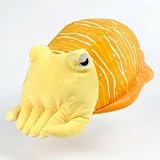
- Cute Cuttlefish Cartoon Design:This plushie features a vivid and lovely cuttlefish shape with soft tentacles and delicate details, restoring the cute image of marine life, perfect for sea animal lovers.
- Ultra Soft & Skin‑Friendly Material:Made of high‑quality plush fabric and filled with full PP cotton, it is extremely soft, comfortable to touch, not easy to deform, and safe for kids to hug and sleep with.
- Multi‑Functional Soft Pillow Doll:Can be used as a cuddle companion, sleeping pillow, lumbar cushion or sofa decoration, bringing comfort and warmth to daily life, napping and traveling.
- Perfect Gift for Children & All Ages:Ideal gift choice for birthdays, Children’s Day, Christmas, Halloween and ocean theme parties, suitable for kids, toddlers, sea animal fans and plush collectors.
- Lightweight & Easy to Carry:Compact and lightweight design allows kids to take it anywhere, such as bedroom, living room, car, travel and outdoor activities, bringing long‑term companionship.
4. The cuttlebone is an internal buoyancy device
Inside the mantle is a chalky structure called the cuttlebone. It is made of calcium carbonate chambers that contain gas, giving the animal a way to adjust its density and remain suspended at different depths. Instead of constantly swimming to avoid sinking, a cuttlefish can fine-tune buoyancy while its fins provide steering and position control.
Recommended Free Tools
The cuttlebone is a shell, but not one that protects the animal from predators like a snail’s external shell. It is lightweight and relatively brittle, and it occupies much of the mantle. After a cuttlefish dies, washed-up cuttlebones are familiar on beaches. The same calcium-rich material is also used in bird care as a mineral and calcium supplement; that secondary use should not obscure its primary biological function. See the anatomy description at the Monterey Bay Aquarium.
5. It has a cruising mode and a getaway mode
Cuttlefish do not rely on one form of swimming. For ordinary travel, a long fin runs along the mantle and ripples in waves. This undulating fin produces controlled, energy-efficient movement and helps the animal hover, turn and move quietly while hunting.
When speed matters
For a sudden escape, the cuttlefish draws water into the mantle cavity and forcefully expels it through the siphon. The resulting jet provides a quick burst of acceleration. Fin swimming and siphon propulsion are complementary rather than competing systems: the fin is suited to routine movement and maneuvering, while the siphon is valuable when a predator is close or a rapid repositioning is needed. The two modes are outlined in the common cuttlefish account.
6. Ink is a layered defense, not just a black cloud
When threatened, a cuttlefish can release ink into the surrounding water. The cloud may obscure the animal’s outline, distract an attacker or act as a decoy, buying time for the cuttlefish to jet away. Camouflage and ink solve different problems: camouflage helps a cuttlefish avoid being noticed, whereas ink is often deployed after a threat has already detected it.
Free tools Windows power users keep installed
One-click scans. No signup required.
The historical description is striking. Smithsonian Ocean quotes Aristotle’s The History of Animals, translated by Arthur Leslie Peck and Edward Seymour Forster in 1937: “When the Sepia is frightened and in terror, it produces this blackness and muddiness in the water, as it were a shield held in front of the body.” This is a historical observation reproduced by Smithsonian Ocean, not modern scientific terminology.
Rank #3

- REALISTIC SQUID SHAPE: The vivid image of our squid can be well portrayed in your hearts, whether it is the various claws, the special treatment of the tail, and the beard on the top of the head, we have achieved the simulation.
- HIGH QUALITY FABRICS: Our fabrics are made of high-quality PP cotton, 100% handmade, and the vivid and interesting image will make children like it. You can rest assured to let our praying squid accompany the children to play.
- SPECIFIC SIZE DESCRIPTION: Our Our cute large squid toy has a length of 48 inch from tail to tentacles.
- THE BEST CHOICE FOR INNOVATIVE GIFTS: Our simulationtoy can not only be used as a gift for children, to help them understand the world of animals and enrich their childhood, but also can be used as home decoration in the living room and bedroom for you add a different kind of fun to your life.
- RELIABLE QUALITY: When you get hand-made cute simulation toys, it entrusts our brand's sincere love for handmade toys, which is why we only use super soft fabrics and super fluffy filling items. When you receive the goods and have any questions, please feel free to contact us, we will provide you with quality after-sales service.
Why the defense can work
A predator following movement or scent may strike the ink instead of the fleeing animal. The cuttlefish’s flexible skin display, jet propulsion and ink release can therefore operate as a sequence: blend in when possible, disrupt the attacker’s view when necessary, then accelerate away.
7. Three hearts pump copper-based blue blood
Three hearts and blue blood are traits of cephalopods as a group. Two branchial hearts pump oxygen-depleted blood through the gills, where it picks up oxygen. A separate systemic heart then sends oxygenated blood through the rest of the body.
The blood appears blue because its oxygen-carrying protein is hemocyanin, which uses copper rather than the iron found in human hemoglobin. Hemocyanin works in the marine conditions where cephalopods live, and the three-heart arrangement supports circulation through the gills and body. It is inaccurate to present these features as exclusive to cuttlefish; squid and octopuses share the same broad cephalopod pattern. The circulation explanation appears in Smithsonian Ocean’s cephalopod overview.
8. Common cuttlefish eggs look like bunches of grapes
Female common cuttlefish attach eggs in clusters that resemble small grapes. Each egg is coated in an inky jelly, giving the cluster a dark appearance and helping it blend into the surroundings. The young develop inside the individual eggs rather than passing through a long, free-swimming larval stage described for many other marine animals.
Temperature changes the timetable
Hatching takes about one to three months, with water temperature influencing the exact duration. Warmer conditions generally speed development within the species’ viable range, while cooler water lengthens it. Because this schedule comes from the common cuttlefish profile, it should not be applied automatically to every cuttlefish species. The egg description and timing are reported by the Monterey Bay Aquarium.
9. The common cuttlefish can approach half a metre
For the common cuttlefish, Monterey Bay Aquarium lists a typical length of 20–30 cm (7–12 inches). Its profile also records large males reaching about 49 cm (19 inches). These are documented figures for Sepia officinalis, not a maximum for all cuttlefish worldwide; other species have different adult sizes.
Rank #4

- Generous Size Dimensions: 25.6''/65cm (full length, including tentacles). Please NOTE: It is manual measurement, please allow the size deviation of 2-3cm (about 1'')
- Premium Quality Material: This Giant Red Squid Plush is made of soft, durable plush and filled with PP cotton, very soft
- Realistic Appearance Design: This Giant Red Squid Plush is inspired by real Squid in nature, has a realistic appearance, unique design, very adorable
- Thoughtful Gift Option: A very good choice to give the Giant Red Squid Plush to friends, and family as birthday, Valentine's Day, Halloween, Christmas gifts
- Versatile Placement Options: You can put it on the sofa, bed, desk, car and other spaces to add decorative charm and comfort
Sex matters in the upper end of the range because the cited large individuals are males. A length figure also needs context: it refers to the animal’s body measurement as used in the profile, not to the span of extended arms or tentacles. Keeping the species and measurement basis attached to the number prevents a common cuttlefish statistic from becoming an inaccurate claim about the entire order.
10. Its range crosses several connected seas
The common cuttlefish has a broad but geographically specific documented range. It occurs in the eastern Atlantic, the Mediterranean Sea, the North Sea, the Baltic Sea and northwestern Africa. This distribution spans waters with different temperatures, salinities and habitats, yet it should not be treated as a map for every cuttlefish species.
A range description tells you where a species has been recorded, not that every individual travels across the whole area. Local populations can occupy particular coastal habitats, and boundaries can shift with environmental conditions. For the common cuttlefish’s listed geography, use the Monterey Bay Aquarium profile.
What these facts say about cuttlefish in the wild
Adaptations work as a package
The most impressive ability is not any single trick. A cuttlefish can use a gas-filled cuttlebone to hold position, its fin to approach quietly, its programmable skin to blend into a background, its tentacles to capture prey, and its siphon and ink to escape. Each system covers a different stage of living in open water, where both hunting and avoiding predators require rapid changes.
Do not confuse a species profile with a group average
Use the common cuttlefish name whenever quoting the 20–30 cm size range, the 49 cm large-male figure, the one-to-three-month hatching period or the eastern Atlantic–Mediterranean distribution. Use “cephalopods” when discussing three hearts, blue hemocyanin-based blood, ink and the general arm-and-tentacle plan. This wording keeps a fascinating fact accurate instead of making it universal without evidence.
Quick wins for a faster PC:
Scan for outdated or missing drivers - takes under a minuteDriver Scan →Repair Windows errors before they cause bigger problemsFix Now →Fix the driver behind crashes, sound loss and screen glitchesFind Drivers →A dated conservation note
Monterey Bay Aquarium reports that the common cuttlefish had an IUCN Least Concern listing in 2009 and notes fisheries pressure. The 2009 date is historical; it is not proof of a current reassessment or a current population trend. No named global abundance figure or worldwide fisheries total is established here, so a precise conservation number would be misleading.
Quick Recap
Product prices and availability are accurate as of the date/time indicated and are subject to change. Any price and availability information displayed on Amazon at the time of purchase will apply.





Leave a Reply