Colossal Biosciences has not cloned an intact dire wolf from ancient DNA. It has created living canids from gray-wolf cells, edited at 20 reported loci across 14 genes using information recovered from dire-wolf remains. Colossal calls the animals a de-extinction achievement; independent scientists more cautiously describe them as gray-wolf-based proxies with selected dire-wolf-associated traits.
That distinction matters. The laboratory work is a genuine technical accomplishment, but a designed resemblance is not automatically a restored species, a recovered population, or a recreated ecosystem.
As an Amazon Associate I earn from qualifying purchases.
Calling these animals “dire wolves” is scientifically and rhetorically complicated. Colossal Biosciences has created living, gene-edited canids using living gray-wolf cells, cloning-related reproductive methods, and selected genetic changes informed by dire-wolf ancient DNA. The company calls the result de-extinction. Independent scientists generally describe the animals more cautiously: as gray-wolf-based proxies carrying some dire-wolf-associated traits.
Crashes, No Sound, or Screen Glitches?
Random freezes, missing sound and display glitches usually trace back to one bad driver. Find and replace yours safely.Free scan · under a minutePC Slower Than It Used to Be?
A free scan shows the junk files, broken settings and background clutter dragging Windows down - then fixes them in one click.Free scan · Windows 10 & 11That distinction does not make the work trivial. Recovering and interpreting ancient DNA, comparing extinct and living canid genomes, editing multiple genetic targets, and producing healthy animals through cloning and surrogate pregnancies are substantial achievements. But they are not the same as recreating an intact Aenocyon dirus genome, restoring an extinct population, or returning the dire wolf to its former ecological role.
#1 Best Overall

- Complete Prehistoric Experience: Seamlessly combine VEOJEIN's 3D Mosquito in Amber Resin with the uniquely detailed resin base to capture the essence and fascination of the dinosaur era.
- Important Note: The mosquito in amber product has a seam due to the manufacturing process. This seam may be visible from certain angles. While we strive to minimize its appearance, it is not entirely avoidable. We want to be transparent about this aspect of the product.
- Perfect Gift for Dino Enthusiasts: Enclosed in themed packaging, this bundle becomes an unforgettable present for enthusiasts and collectors alike, merging artistry, history, and vintage charm. Versatile Decor & Collectible: Elevate your space with this bundle that serves both as an exquisite decor element and a must-have for collectors passionate about dinosaurs, amber, and the prehistoric world.
- High-Quality Craftsmanship: Meticulously designed and crafted from durable resin, both pieces in the bundle exhibit unmatched attention to detail, ensuring you have not just collectibles but pieces of art.
- Engage & Educate: Beyond aesthetics, the bundle inspires curiosity and a deeper understanding of the prehistoric world, making it an engaging conversation starter and a tool to ignite passion for history and learning.
What Colossal actually produced
Colossal says its scientists studied dire-wolf remains, reconstructed a more complete genomic reference than earlier work had allowed, identified variants associated with selected traits, and introduced edits at 20 loci across 14 genes. The company presents the resulting animals as the first de-extincted dire wolves.
The animals associated with the public announcement are named Romulus, Remus, and Khaleesi. Colossal says they are being monitored and maintained in a secure reserve. Its current position is that there are no plans to release them into the environment while ecological, safety, and welfare risks are evaluated.
| Question | What can be stated confidently |
|---|---|
| Were the animals cloned from ancient dire-wolf DNA? | No. Ancient DNA supplied genetic information for selecting edits; living gray-wolf cells supplied the biological starting material. |
| How many edits did Colossal report? | Twenty edits across 14 genes, according to the company. |
| Are their genomes identical to extinct dire wolves? | No. The project used selected edits rather than recovering an intact extinct genome or the genetic diversity of a dire-wolf population. |
| Are they living in the wild? | No. Colossal says they remain in a secure reserve and are not currently planned for environmental release. |
| Are they pets? | No. They are research animals held under controlled conditions, not animals available for private ownership. |
How the process worked
The phrase “cloned a dire wolf” suggests that scientists found an ancient cell, placed its nucleus into an egg, and produced an identical animal. That is not what happened. Ancient DNA has been chemically damaged and fragmented over time; it cannot be used as a living nucleus in the way a cell from a recently living animal can.
The Tool Desk
Outbyte Driver Updater FREEScan for outdated or missing drivers - takes under a minuteDriver Scan →Outbyte PC Repair FREEClear out junk files and repair common Windows errorsFree Scan →Independent reporting describes a process with several distinct stages:
- Ancient-DNA analysis: Researchers examined dire-wolf remains and used the recovered sequences to infer genetic variants that differed from those found in living canids. A reconstructed reference genome is an important scientific resource, but it is an inferred sequence rather than a preserved dire-wolf cell.
- Trait selection: Colossal selected a limited number of genetic targets associated with features it wanted the engineered animals to express. The company reports 20 edits at 14 genes.
- Gray-wolf cell editing: Scientists cultured cells from living gray-wolf blood and edited those cells. This means the edited nuclei—and therefore most of the resulting animals’ genomes—came from modern gray wolves.
- Cloning-related reproduction: Nuclei from edited cells were used in cloning procedures. Reproductive materials associated with domestic dogs and surrogate mothers were also part of the process described in reporting.
- Birth and monitoring: The resulting pups were raised under human care and placed in a secure setting for observation rather than released into a natural ecosystem.
The most precise description is therefore “gene-edited gray-wolf-based animals carrying selected dire-wolf-associated traits.” That wording is less dramatic than “a cloned dire wolf,” but it more accurately describes the biology.
For further reading: Beth Shapiro’s How to Clone a Mammoth offers a broader, non-company explanation of de-extinction science, its technical limitations, and the conservation arguments surrounding it. It is useful context for understanding why reconstructing genetic information is different from cloning an intact extinct organism.
Why the dire wolf’s evolutionary history changes the debate
The choice of a gray wolf as the starting point might seem obvious because the two animals look similar. Genomic research published in Nature in 2021 made that assumption much harder to defend. The study found that the dire wolf represented the last member of an ancient New World canid lineage, rather than being simply a large or specialized form of the modern gray wolf.
That finding does not automatically disqualify a gray-wolf-based proxy. A living gray wolf is a practical biological chassis: it provides viable cells and canid reproductive biology that ancient remains cannot. But evolutionary distance matters when interpreting the outcome. Similar body shapes do not mean that two animals share the same developmental history, physiology, immune system, behavior, or ecological relationships.
Rank #2

- Approx Weight of Disc Fossil Conch Specimen: 160g Approx Size: 10~11cm/3.93Inch~4.33Inch
- Package including: 1 X Gorgeous Disc Fossil Conch Specimen and 1 X Stand
- These series Gorgeous Disc Fossil Conch Specimen With Stand Set are the perfect room decor and healing products. It also can make a meaningful and very special gift for any occasion.
- Each Crystal Gorgeous Disc Fossil Conch Specimen is one-of-a-kind with its own shape and size. The Fossil Disc's shape and color make it a creative and eve-catching piece.
- Occasion Idea: Christmas Gift + Housewarming Gift + Birthday Gift + Anniversary Gift + Graduation Gift +Moving Gift + Wedding Gift + New Year Gift+ Halloween Gift
In other words, the gray wolf is a workable starting material, not a time machine. The farther the extinct lineage is from the living species used as its chassis, the more cautious scientists must be about describing a small collection of edits as a full restoration.
Three different meanings of “de-extinction”
Much of the disagreement is caused by treating three separate goals as though they were interchangeable.
| Claim | What it would mean | Status of Colossal’s animals |
|---|---|---|
| Genome restoration | Reconstructing the genetic content of an extinct animal, including the complex interactions and variation found across its population. | Not demonstrated. The animals contain selected edits in a predominantly gray-wolf genome. |
| Trait-based proxy creation | Engineering a living animal to express selected physical or physiological traits associated with an extinct species. | This is the strongest description supported by the available information. |
| Ecological proxy creation | Producing an animal that can safely and beneficially perform some of the extinct species’ ecological functions. | Not demonstrated. The animals have not been released, and no long-term ecological evidence establishes that outcome. |
The IUCN Species Survival Commission’s de-extinction principles use the idea of a proxy rather than promising a perfect restoration. That framework is helpful because it shifts the question from “Does it look like the extinct animal?” to “What biological and conservation function can it perform, under what conditions, and with what risks?”
Do these 3 things before closing this tab:
1Repair Windows errors before they cause bigger problems2Fix the driver behind crashes, sound loss and screen glitches3Clear out junk files and repair common Windows errorsWhat is genuinely impressive about the project
Rejecting the strongest marketing language should not turn the project into a punchline. Several parts of the work are scientifically significant.
- Ancient-genome interpretation: Ancient DNA is incomplete and damaged. Extracting useful information, comparing it with living relatives, and building a more complete reference requires sophisticated computational and laboratory work.
- Multiplex editing: Editing 20 loci across 14 genes is more complicated than changing one gene associated with one visible feature. Each edit must be assessed for its intended effect and for possible effects elsewhere in development and physiology.
- Cloning and reproductive biology: Turning edited cells into viable embryos and live births requires advances in nuclear transfer, embryo development, pregnancy management, and neonatal care.
- Conservation-adjacent tools: Techniques developed for this project could potentially contribute to genetic rescue, biobanking, reproductive assistance, and disease-resistance research for living endangered species.
The significance of those advances does not depend on whether the animals ultimately receive the taxonomic label Aenocyon dirus. A proxy can be an important technological achievement even when it is not the extinct species itself.
Why selected traits do not recreate a species
A species is not a checklist of visible characteristics. Genes work in networks, and their effects depend on when and where they are expressed. They influence development, metabolism, immune function, reproduction, behavior, and interactions with other organisms. A small number of edits can produce noticeable changes without reconstructing the full biological system that produced an extinct animal.
The project also cannot recreate the genetic diversity of the original dire-wolf population from one inferred reference. Populations contain many variants, and those variants can affect health, disease resistance, fertility, adaptation, and behavior. Even a perfectly reconstructed sequence from one individual would not represent every dire wolf that once lived.
Quick wins for a faster PC:
Fix the driver behind crashes, sound loss and screen glitchesFind Drivers →Clear out junk files and repair common Windows errorsFree Scan →This is why “genetically identical to a dire wolf” is not an accurate description. The animals may carry particular sequence states associated with dire wolves, but their genomes are overwhelmingly derived from living gray wolves and do not reproduce the extinct lineage’s complete genetic history.
Rank #3

- Ammonite conch ornament ,Size and Shape even the Color vary from picture shown.
- It improves memory and concentration.Helps to clear and open all chakras and energy centers within your body.It can decorate the study, living room and bedroom.Because the energy-rich stone can balance a vibrant environment and help strengthen the individual mind.
- They are exactly suitable for home decor,study ,healing,figurine,living room ,kitchen,collecting,fengshui.A good gift for festival,Christmas,new year,anniversaries,new house's moving,business partners etc..
- Energy Crystal - Meditation and Spirit Chakra Balance.It can be displayed at home, office and studio to absorb energy.
- Please note: this stone is natural and unique, with a variety of colors, sizes and textures.The shape and size of the dots will vary slightly because they are hand-made by skilled craftsmen.Therefore, you will receive a work similar to the picture.
Appearance is not the same as behavior
Colossal has highlighted traits such as a larger body, a broad head, powerful jaws, and a pale coat. Those features can make the animals look convincingly wolf-like—or dire-wolf-like—to human observers. They do not establish that the animals think, communicate, hunt, reproduce, or socialize as extinct dire wolves did.
Behavior is shaped by genes, development, learning, social relationships, and environment. A pup raised by humans cannot inherit the hunting knowledge and social traditions of a vanished population simply because some of its genetic variants have been changed. Even if the animals develop stable social groups in captivity, that would not demonstrate that they possess the behavior of wild dire wolves.
For the same reason, photographs and videos can show appearance and some activity, but they cannot by themselves establish a restored behavioral phenotype. Reliable conclusions would require long-term, independently assessed behavioral and veterinary studies.
Why an attractive animal would not automatically restore an ecosystem
Even a healthy animal with a convincing appearance would not automatically recover the ecological role of the dire wolf. The ecosystem in which the species lived has changed. Prey communities, competitors, pathogens, climate, vegetation, landscapes, and human pressures are not frozen in the past.
A genuine ecological proxy would need to be evaluated against questions such as:
- What ecological function is supposed to be restored?
- Does a modern ecosystem still contain suitable habitat and prey?
- Would the animal compete with or harm living predators?
- Could it spread disease or disrupt existing food webs?
- How many animals would be needed to create a viable, genetically diverse population?
- Who would manage the animals if a release caused unexpected harm?
- Would the same money and technology produce a greater benefit for an endangered species that still exists?
None of those questions is answered merely by producing three animals. Colossal’s decision not to plan an environmental release while risks are assessed is therefore important. It also means that claims about ecological restoration remain hypothetical.
Animal-welfare questions remain open
De-extinction projects raise the same welfare obligations as other advanced breeding and cloning programs, along with unusual questions about the animals’ long-term needs.
What’s actually slowing this PC down?
Pick the symptom - the matching free tool is one click away.
Potential concerns include the health effects of editing multiple genes, unintended developmental consequences, the risks of cloning procedures, and the welfare of surrogate mothers. Once the animals are born, researchers must also consider their physical health, fertility, social needs, ability to form stable groups, stimulation, and quality of life in captivity.
Rank #4

- LEGO SET FOR ADULTS – Jurassic Park fans aged 18+ can build the LEGO Jurassic World Dinosaur Fossils: Tyrannosaurus rex (76968) set, a detailed skeleton model perfect for home or office decor
- JURASSIC PARK ICONS – This building set includes LEGO minifigures of Ellie Sattler and Alan Grant inspired by the original 1993 film, plus a display stand with an information plaque
- POSABLE DINOSAUR SKELETON – Features articulated joints including a movable head, opening jaw, posable hands, and tail for creating dynamic display poses
- MOVIE EASTER EGGS – Discover hidden dig-site details including a special amber piece that references the iconic Jurassic Park DNA source
- GIFT FOR DINOSAUR FANS – Makes a perfect present for adults who love the iconic dinosaur movie franchise and Jurassic World collectibles
Colossal’s husbandry and risk materials indicate that monitoring is part of its approach. Monitoring is necessary, but it is not the same as independently demonstrated long-term welfare success. A responsible assessment would need longitudinal veterinary and behavioral data, transparent reporting of complications, and clear standards for deciding what happens if the animals develop chronic health or social problems.
There is also a special ethical issue: the animals themselves did not choose to become demonstrations of a controversial technology. Their welfare must not be treated as secondary to the publicity value of the project or to the desire to prove that a technique works.
Could the technology help living endangered species?
Supporters argue that the most important outcome may not be a dire-wolf-like animal at all. The same research areas—reproductive technology, genome editing, cryopreservation, and genetic analysis—could potentially help living species threatened by inbreeding, disease, or shrinking populations.
Free tools Windows power users keep installed
One-click scans. No signup required.
That is a credible potential benefit, but it is not an automatic conservation victory. Tools developed during a high-profile project only matter for conservation if they are transferred into practical programs, shown to be safe, and used where they solve a real problem. The IUCN framework emphasizes conservation justification, ecological assessment, risk analysis, alternatives, and governance.
Critics’ opportunity-cost concern is therefore serious. Public attention and private investment are limited. If an extinct predator attracts substantially more funding than a less famous endangered species, the scientific spectacle could indirectly weaken conservation priorities. Supporters may reasonably answer that ambitious research can create tools traditional conservation would not fund. The relevant test is evidence: which technologies reach living species, at what cost, with what welfare outcomes, and with what measurable conservation benefit?
Independent reader supportYour contribution helps us test, update, and keep practical guides available for everyone.What evidence would make the claims clearer?
The debate would be easier to resolve if the public record included more independently verifiable information. Particularly useful evidence would include:
- Genome-level analysis: A full account of the edited loci, the surrounding sequences, confirmation that the intended edits are present, and analysis of unintended changes.
- Comparative biology: Data showing which physical and physiological traits differ from gray wolves, rather than relying mainly on photographs or descriptions.
- Long-term welfare records: Independent veterinary assessments covering growth, skeletal health, organ function, fertility, disease, behavior, and lifespan.
- Behavioral studies: Structured observations of communication, social development, learning, and responses to human care.
- Population planning: An explanation of how genetic diversity could be maintained if the animals were ever intended to form a population rather than remain a small research group.
- Ecological analysis: Evidence that a carefully defined conservation goal exists and that a proxy would be safer and more effective than available alternatives.
Until that evidence exists, the most defensible language is descriptive rather than absolute: Colossal has created gene-edited gray-wolf-based canids carrying selected traits associated with the extinct dire wolf.
So, did Colossal bring back the dire wolf?
The answer depends on what “bring back” means. If it means using modern biotechnology to create a living canid that expresses selected dire-wolf-associated characteristics, Colossal has achieved something remarkable. If it means recreating an intact extinct genome, restoring the original species’ genetic diversity and behavior, or re-establishing its ecological role, the available evidence does not support that claim.
Best Value
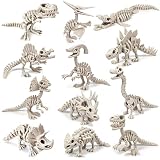
- Museum-Quality Fossil Statues This 12-piece set showcases highly detailed 3D printed dinosaur skeleton figurines in realistic bone-white. Each statue reflects authentic fossil anatomy, designed as collectible display pieces for enthusiasts and educators.
- Articulated for Adjustable Display Each dinosaur skeleton features poseable joints, and select species include adjustable jaws. This allows for customized presentation, making them versatile figurines for shelving, desk displays, or curated collections.
- Complete Prehistoric Collection Covering 12 iconic species — including T-Rex, Triceratops, Raptor, and Brachiosaurus — the set offers varied sizes from 3.4 to 5.8 inches, creating a visually compelling fossil lineup for any display case.
- Accessory Set for Enhanced Narratives Includes miniature bones, a fish, and a squid that can be positioned within the open jaws of select figures. These accent pieces add storytelling depth to your fossil arrangement without implying play functionality.
- Premium 3D Printed Craftsmanship Made from durable PLA with precision 3D printing, these figurines feature fine textures and structural integrity. Designed exclusively for adult collectors and display applications. Recommended for ages 14+.
The controversy is not only about vocabulary. Calling a proxy a resurrected species can cause readers to misunderstand what ancient DNA, cloning, and gene editing can do. At the same time, dismissing the project as merely a publicity stunt obscures genuine advances that could eventually benefit conservation.
For animal lovers, the practical takeaway is straightforward: Romulus, Remus, and Khaleesi are not wild dire wolves, and they are not pets. They are living research animals whose creation demonstrates the growing power of genetic engineering—and whose future will test whether that power can be used with scientific restraint, transparent welfare standards, and a real conservation purpose.
Frequently Asked Questions
Did Colossal clone a dire wolf from ancient DNA?
No. Ancient DNA informed the genetic targets, but the animals were produced using living gray-wolf cells. Scientists cannot use fragmented ancient DNA as the living nucleus of a cloned embryo.
Are Colossal’s animals genetically dire wolves?
They are gene-edited canids whose genomes are overwhelmingly derived from gray wolves, with selected changes intended to produce dire-wolf-associated traits. Whether that qualifies as a dire wolf depends on the definition of de-extinction, and independent scientists dispute the company’s terminology.
Will the animals be released into the wild?
No. Colossal says Romulus, Remus, and Khaleesi are being monitored in a secure reserve and that there are currently no plans for environmental release while ecological and welfare risks are evaluated.
Can someone keep a de-extincted dire wolf as a pet?
No. They are research animals maintained under controlled conditions, not animals available for private ownership or ordinary pet keeping. Their physical and social needs would also be far beyond those of a domestic dog.
Why does the dire wolf’s evolutionary history matter?
The 2021 genomic research published in Nature found that dire wolves belonged to an ancient New World canid lineage. That means a gray wolf is a practical living chassis for the work, but not a simple genetic substitute for the extinct animal.
Recommended Free Tools
The Bottom Line
Bottom line: Colossal has created gene-edited animals based on living gray-wolf cells and carrying selected dire-wolf-associated traits. Calling them resurrected dire wolves reflects the company’s definition of de-extinction, not an uncontested scientific conclusion. The technology is real; the claim that an extinct species has been fully restored remains unproven.
Quick Recap
Product prices and availability are accurate as of the date/time indicated and are subject to change. Any price and availability information displayed on Amazon at the time of purchase will apply.




