
Yes—cats can distinguish their owners from unfamiliar people, with the strongest evidence involving voice. Controlled experiments show cats respond differently to an owner’s voice than to strangers’ voices. A 2025 odor study also found that cats treated an unfamiliar person’s odor differently from their owner’s, although it did not prove that cats can identify a particular owner by smell alone.
Recognition does not necessarily look like a dog-style greeting. In the clearest voice study, cats mainly moved their ears and heads when the owner spoke after a series of unfamiliar voices. They did not reliably meow, wag a tail or approach. The evidence therefore supports discrimination of familiar and unfamiliar cues, while leaving open exactly how a cat experiences “knowing” its person.
As an Amazon Associate I earn from qualifying purchases.
What “recognising an owner” means in cat research
Researchers cannot ask a cat whether it knows who is speaking. Instead, they present controlled stimuli and measure changes in behaviour: head or ear orientation, looking time, sniffing duration, or surprise when a familiar cue appears in an unexpected place. Those responses show that a cat detected a difference. They do not directly reveal affection, attachment, a human-like identity concept, or the percentage of all cats that recognise their owners.
Free tools Windows power users keep installed
One-click scans. No signup required.
That distinction matters because “recognise” can mean several things. A cat may discriminate its owner’s voice from other voices, learn that a particular voice predicts food or attention, identify a familiar household odor, or combine a voice with a face. The studies below test different abilities, in different populations and settings, rather than one single all-purpose recognition skill.
#1 Best Overall
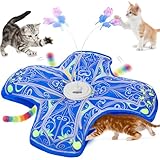
- Top-Tier Dual Interactive Fun: Qraxond's new indoor cat toy has dual motors, controlling random rotation of butterfly and plush tail swing rod accessories, bringing fun, exciting play for kittens and adult cats. Hide-and-Seek: The animal tail-shaped plush hides under the cover cloth, rotating irregularly to appear/disappear, creating a hide-and-seek game. It mimics real prey, bringing unpredictable chases to stimulate the cat's brain and senses. Irregular Rotating Butterfly: The top has an auto-rotating butterfly that rotates, pauses or swings to simulate real flight, keeping the cat engaged. Various interactions ensure the cat gets enough exercise to avoid obesity
- 3 Adjustable Speed Modes: Customize the excitement with separate buttons for the butterfly and tail. Choose from 3 settings: Steady (Blue Light), Active (Purple Light), and Random (Yellow Light). Suitable for high-energy cats to burn off steam or for calm cats to enjoy gentle play. Keep your feline entertained and prevent boredom, especially when they are home alone
- Touch-Sensitive Activation: Your Cat's in Control! With smart touch-sensor technology, just tap the device to fire up the fun mode, it will kick off a 5-minute automatic play session instantly. Right after the play session ends, it switches directly to touch-sensitive standby mode, where the purple indicator light flashes every 20 seconds. Simply tap again to reactivate it for another 5-minute cycle. This smart loop ensures your cat gets sufficient exercise and prevents overstimulation
- Large Rechargeable Battery: Enjoy long-lasting play with the built-in 2500mAh battery. It charges fully in just 2.5 hours via the included USB cable (use a 5V adapter only). The efficient auto on/off cycle extends battery life, making it convenient for busy pet owners while ensuring your cat gets healthy, moderate exercise
- Realistic Bird Chirping: Elevate the hunt with lifelike sound. The built-in speaker emits authentic bird chirps to attract your cat's attention and stimulate their prey drive. Combined with the random motions of the butterfly and tail, it creates an irresistible and engaging play experience that keeps your cat happily chasing even when they're by themselves
The clearest evidence: cats distinguish an owner’s voice
How the 2013 experiment worked
Atsuko Saito and Kazutaka Shinozuka tested 20 domestic cats while each owner was out of the cat’s sight. The researchers played recordings of three unfamiliar people saying the cat’s name, followed by a recording of the owner saying it. Repeated exposure caused the cats to become accustomed, or habituated, to the sequence. When the owner’s voice appeared, 15 of the 20 cats showed a significant “response rebound”—a renewed reaction after the familiar voices had stopped producing much response. The study is published in Animal Cognition.
What the cats actually did
The response was primarily orienting behaviour: ear movements and head movements toward the sound. The cats did not consistently add the conspicuous social signals people often expect, such as vocalising or moving the tail. That quiet reaction should not be interpreted as failure to recognise the owner. Orienting is precisely the kind of measurable change that indicates the cat detected the different voice.
The result supports vocal discrimination: these cats could distinguish their owner’s recorded voice from unfamiliar voices under the test conditions. It is not a population estimate. Fifteen cats in this small sample responded in the reported way, but that number cannot be converted into “75% of cats recognise their owners.” The experiment also does not establish whether a cat was identifying an individual person, anticipating a familiar event, or both.
Rank #2

- A NEW CHOICE FOR INDOOR ENTERTAINMENT: Endless fun for your cat! Designed for indoor environments, this interactive toy ball rolls quickly across the carpet and emits an appealing cat-attracting chittering sound. Not only does it stimulate your cat's hunting instincts, it also allows them to enjoy outdoor chasing indoors while reducing the risk of furniture scratching
- INTELLIGENT INTERACTION AND FUN: This automatic cat toy is your pet's new playmate. It has two modes: ① Normal mode (green light), which runs for five minutes and then automatically shuts off. ② Intelligent mode (blue light), after running for five minutes the exercise ball automatically enters the dormant mode, when your cat touches it again, the exerciser will interact with your cat again. So whether it's a long game or a short interaction, this interactive cat ball meets the needs of both you and your pet, allowing your pet to entertain itself while you're busy
- TWO SPEEDS FREELY SWITCHING: The BABORUI interactive cat toy offers two speeds, fast and slow, which can be freely switched at any time. Even if your cat is cute and short-legged, it can still keep up with the pace of the exercise ball
- TRIPLE FUN, TRIPLE HAPPINESS: This cat toys for indoor cats comes with three fun tails that provide your cat with triple the fun. They can have endless fun chasing and catching the ball, while the sound of the bells on the tails will further stimulate their curiosity and desire to chase
- SAFE MATERIAL, LASTING AND DURABLE: We understand that your pet's safety is of utmost importance to you. The shell of this kitten toys is made of safe silicone material, so you don't need to worry even if your pet chews it. The durable design means it can withstand daily wear and tear, providing long-lasting companionship for you and your pet
Can cats recognise an owner by smell?
What the 2025 odor study found
Miyairi and colleagues presented cats with three samples: an owner’s odor, an unfamiliar person’s odor and a blank control. The cats spent longer sniffing the unknown person’s sample than the owner’s sample. The findings, reported in PLOS ONE, support discrimination between familiar and unfamiliar human odors.
Longer investigation of the unfamiliar odor is compatible with novelty: a known smell may require less checking than an unknown one. But the study does not prove that cats can identify a specific owner from scent alone. The authors explicitly call for further work on whether cats recognise an individual person through olfactory cues. The safest conclusion is therefore “cats distinguish familiar and unfamiliar human odor,” not “a cat can always identify its owner by smell.”
Do cats connect a person’s voice with their face?
A result that depended on the cats’ living setting
Takagi and colleagues tested whether cats could match a voice calling their name with the face of the same person. A recording played first, followed by an image of either the speaker or a different person. Cat-café cats looked longer when the face did not match the preceding voice. That mismatch response suggests they had formed a cross-modal expectation: after hearing a particular person, they anticipated that person’s face. The study appears in Animal Cognition.
Rank #3

- [Trending Interactive Entertainment]: Potaroma's new indoor cat toys provide an engaging, stimulating play experience for kittens and older cats alike. This automated toy features a rotating butterfly on the top, a removable cover, an enticing feather wand hidden under the cover, consisting a hide-and-seek game. This interactive toy is a great birthday gift for enriching your pet's daily life. Even when left at home alone, your cat can play by itself independently like having a party
- [Advanced Electronic Irregular Motion]: Powered by a smart motorized system, this electric cat toys deliver irregular movements to keep your cat entertained. The play experience includes spinning, chasing, and hunting elements that mimic real-life prey, especially the chasing feather that pops out unpredictably, stimulating your kitty's brain and senses
- [Multi Modes for Indoor Fun]: Features a range of captivating movement modes that stimulate cat's natural instincts to chase, pounce, and play. 3 rotating modes of chasing feather; Simultaneous or seperate working of chasing feather and spinning butterlfy; What's more, the cover can be removed to expose the chasing feather completely for more fun. The diverse play options ensure your cat gets the mental and physical stimulation and enough exercise to eliminate boredom
- [Durable]: Built to withstand even the most aggressive play sessions, thanks to its durable design and high-quality materials. The motors inside the toy are designed to move smoothly and resist wear and tear. Whether your cat loves to chew, scratch, or paw at their toys, Potaroma's cat toy can handle it all. Experience the magic of Potaroma's interactive cat toy, making it a must-have for cat owners seeking a durable and entertaining option for their pets
- [Rechargeable & Large Capacity Battery]: Provide hours of fun for your furry friend. With a built-in rechargeable battery that offers a long-lasting charge, your kitten can enjoy uninterrupted self playtime for up to several days. No need for frequent recharging, making it a convenient choice for busy pet owners. Keep your cat entertained and happy with our innovative cat toys, featuring a battery that's as powerful as your cat's curiosity
Household cats in the same experiment did not show the comparable mismatch-looking pattern. This is a group difference, not evidence that house cats are incapable of recognising faces. Café cats may encounter many visitors and therefore receive more varied voice-and-face experience, while a home cat may have less reason to develop the same response in a brief laboratory test. The result cannot be generalised to every cat or used to claim that cats normally recognise owners visually in the way humans do.
Recommended Free Tools
Owner speech can matter more than a stranger’s speech
In a study of 16 indoor companion cats, researchers compared cat-directed speech—the higher-pitched, exaggerated style people often use with cats—with ordinary adult-directed speech. The cats discriminated between the two styles when the sentences were spoken by their own person. They did not show the same distinction when a stranger spoke. The record is available through PubMed.
This pattern points to learning within a particular human–cat relationship. The cats were not simply reacting to any speaker using a “cat voice.” They had learned something about how their owner addressed them. It still does not tell us that every cat prefers baby talk, understands the words, or will visibly greet the owner; it shows a speaker-specific difference in response.
Rank #4

- 🐱 Trigger Natural Hunting Instincts - Concealed feather wand mimics real prey with unpredictable pop-up motion + realistic mouse squeak. Satisfies your cat's predator drive even when you're away
- 🤖 3 Smart Modes for Every Personality - Normal/Active/Interactive modes adapt to lazy loungers or energy balls. Motion sensor auto-activates on touch; auto-sleep saves battery
- Beat Boredom & Anxiety - Mental stimulation + physical exercise in one. Reduces destructive scratching, over-grooming, and midnight zoomies. Perfect for solo play while you work
- ⚡ 2-Hour Charge = Weeks of Fun - Built-in 1200mAh battery eliminates disposable battery costs. USB-C charging (cable included) - eco-friendly & travel-ready
- 🛡️ Built for Rough Play - Thickened padded mat withstands pouncing & clawing. Replaceable feather wand extends toy lifespan. Rounded edges protect paws
Cats track where a familiar voice seems to be
A separate spatial-cognition experiment tested cats’ reactions when an owner’s voice appeared to come from different locations. The greatest surprise occurred when the familiar voice seemed to move to a new location. The findings, reported in PLOS ONE, support the idea that cats retain information about a familiar voice and its apparent position.
This is evidence of tracking a sound source, not proof that cats construct a human-like map of the home or imagine an owner in the same way a person would. The experiment adds another layer to voice recognition: a familiar sound can generate an expectation about where it should be heard.
What the studies show side by side
| Study and population | Cue tested | Measured response | Most defensible conclusion |
|---|---|---|---|
| Saito and Shinozuka, 2013; 20 domestic cats | Three strangers’ voices followed by the owner’s voice | Rebound in ear and head orientation after habituation | Cats distinguished the owner’s voice from unfamiliar voices in this controlled test. Source |
| Miyairi et al., 2025; domestic cats | Owner, unfamiliar-person and blank odor samples | Time spent sniffing | Cats discriminated familiar from unfamiliar human odor; recognition of a specific person by odor alone remains unestablished. Source |
| Takagi et al., 2019; café and household cats | Voice followed by a matching or mismatching face | Looking time at the face | Café cats reacted to mismatches; household cats did not show the same effect. The result is context-dependent. Source |
| Indoor companion cats, 2022; 16 cats | Cat-directed versus adult-directed speech from owners or strangers | Discrimination of speech style | Cats distinguished speech styles in their owner’s voice, but not a stranger’s. Source |
| Saito et al., 2021; domestic cats | Owner’s voice apparently moving between locations | Surprise response to an unexpected location | Cats tracked information about a familiar voice and its apparent location. Source |
Why a recognised owner may receive little visible reaction
Cat communication is often subtle, and the experiments measured attention rather than a greeting ritual. A cat that knows a voice may simply rotate its ears, turn its head, look toward a doorway, or pause what it is doing. In the 2013 experiment, orienting—not meowing or tail movement—was the main response. A lack of running, purring or vocalising therefore cannot be used as a test that the cat does not know you.
Best Value

- Ball Cat Toy: Multi-level cat toy with 3 tiers and 6 spinning balls—keeps indoor cats active, curious, and entertained
- Enrichment: Encourages batting, swatting, and chasing to satisfy hunting instincts and enhance everyday enrichment
- Durable & Safe: Sturdy, non-slip base and a secure safety bar for hours of safe independent play
- Feline Favorite: Designed for older kittens and adult cats alike; great for multi-cat homes or gifting; not recommended for kittens under 12 weeks
- Expandable: Enjoy on its own or pair with Catstages Topper Toys (sold separately) for even more interactive chaos
Context also changes behaviour. The voice-and-face study produced different results in café and household cats, and owner-directed speech was distinguished from stranger speech only for the owner’s voice. Familiarity is not a single switch that produces the same response in every setting. The cat’s previous experience, the salience of the cue, the task, and whether the person is visible can all affect what researchers observe.
What you can—and cannot—learn from your own cat
Useful observations
- Notice whether your cat orients its ears or head when you speak from another room, especially when it cannot see you.
- Compare its response to your normal voice with its response to an unfamiliar person saying the same short phrase, without increasing the volume or startling the cat.
- Watch for changes in attention when you return after an absence, but record subtle signals rather than expecting an approach or vocal greeting.
- Consider the whole context: feeding routines, play, the time of day and whether the cat is resting can all change its reaction.
Limits of a home “test”
Playing recordings, presenting scents or showing photographs at home would not reproduce the published experiments and is not a validated recognition test. A response could reflect novelty, sound quality, expectation of food, anxiety or simple distraction. Do not force a cat to sniff an item, increase the volume, or repeatedly expose it to a stimulus in an attempt to obtain a stronger reaction.
Do cats understand their owner’s words?
The studies support sensitivity to a familiar person’s voice and speech style, not comprehension of human language in the full human sense. Cats may learn that particular sounds predict food, play, opening a door or attention, but the owner-recognition experiments did not test vocabulary. A voice can be familiar even when the words are meaningless to the cat.
It is also important not to confuse cats recognising people with people interpreting cats. In a 2020 study, 225 human participants tried to classify six meows recorded in situations including waiting for food, isolation and brushing. Fewer than half correctly identified the tested context. That result concerns human listeners’ ability to read meows; it does not measure whether cats recognise owners. The study is listed at Animals.
What remains unknown
- No broad population estimate establishes what share of domestic cats recognise their owners.
- The odor evidence shows familiar-versus-unfamiliar discrimination, but not reliable identification of a named individual by smell alone.
- The voice-face finding differs between café and household cats, so it cannot be treated as a universal visual-recognition ability.
- Small samples and laboratory tasks measure observable responses, not a cat’s private experience or the strength of its bond with a person.
There is also no single cue that should be treated as definitive. A cat may use voice, odor, routine, location and visual information together, with different cues becoming important in different circumstances. Current evidence is strongest for distinguishing a familiar voice, supports discrimination of human odors, and suggests—but does not settle—cross-modal voice-and-face representations.
Bottom line for cat owners
Your cat probably can tell your voice from a stranger’s, and it may treat your odor as familiar. The best-supported evidence is behavioural and often understated: an ear turn, head movement, altered attention or surprise when a familiar voice appears in an unexpected place. Those signs are compatible with recognition even when your cat does not come running. Claims that every cat identifies an owner by face or smell alone go beyond what the studies have established.
Quick Recap
Product prices and availability are accurate as of the date/time indicated and are subject to change. Any price and availability information displayed on Amazon at the time of purchase will apply.
What’s actually slowing this PC down?
Pick the symptom - the matching free tool is one click away.





Leave a Reply