
Yes—common land snails have eyes. Each eye sits at the tip of a long, retractable upper tentacle. Those eyes detect changes in brightness and may pick out broad, blurred shapes, but they do not form a sharp, colorful picture like human eyes do. Snails also navigate with touch and chemical senses, so sight is only one part of how they experience their surroundings.
Where a familiar land snail’s eyes are located
When people picture “snail eyes,” they usually mean the eyes of a common land snail. These snails have two pairs of tentacles. The longer, upper pair carries one eye at the tip of each tentacle. The shorter, lower pair is used mainly for touch and chemical sensing—the combination of smell and taste that helps a snail investigate its surroundings and find food.
As an Amazon Associate I earn from qualifying purchases.
The upper tentacles are exposed sensory stalks, so they are retractable. A land snail can pull them inward when something touches them or when the animal needs to protect them. This is why an apparently eye-less snail may suddenly extend two long feelers again after a disturbance: the eyes have not disappeared; the tentacles have been withdrawn.
What’s actually slowing this PC down?
Pick the symptom - the matching free tool is one click away.
The University of Wisconsin–Milwaukee Field Station and Missouri Department of Conservation both describe this upper-tentacle arrangement for land snails. It is a useful identification guide, but not a rule for every gastropod. Eye position changes among habitats and groups.
#1 Best Overall
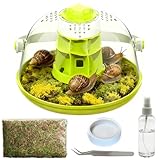
- 【Snail Terrarium Kit】Our snail observation kit includes a snail breeding box, feeding bowl, tweezers, spray bottle and 1.8 oz dried moss, covering all the basic tools needed for feeding, humidity maintenance and daily cleaning. You can easily set up a complete snail incubator ecosystem to restore the natural habitat of snails without extra time and purchase
- 【Ideal Insect Observation Container】Our insect terrariums are made of drop-resistant, sturdy plastic, safe and odor-free. The 360° transparent top design ensures plenty of light and excellent visibility, ideal for observing and studying insect behavior. The top has multi-directional ventilation holes to maintain air circulation and allow pets to grow better. All parts of the insect enclosure can be disassembled and cleaned easily
- 【Practical Feeding Accessories】The moss plays a role in natural decoration and humidity regulation, and the spray bottle assists in moisturizing, which can maintain stable temperature and humidity, provide a comfortable space for insects to grow up, and reduce stress reactions. Tweezers can feed accurately to prevent disturbing snails. A set of tools for feeding care is efficient and hassle-free
- 【Easy to Carry and Practical 】Snail breeding box design has a handle, easy to carry, want to change the position or take out the door to let snails bask in the sun, are very convenient, break the traditional breeding box heavy feeling. The central grid column provides excellent climbing and living space for snails and other insects, all designed to create an ideal habitat for your small pet
- 【Wide Application】This snail terrarium kit is suitable for a variety of small pets, including snails, tarantulas, mantis, beetles, geckos and so on. It is a practical feeding box placed on the desktop, and it is also a micro habitat with natural interest, which not only meets the feeding needs, but also decorates the living space
What can a land snail actually see?
Ordinary land-snail vision is limited. The clearest supported description is that their eyes distinguish light from dark. They can also detect broad, nearby shapes or outlines, but the image is blurred rather than sharply focused. The Natural History Museum summarizes snail and slug vision as detecting differences in light intensity and blurred outlines; the university field-station and conservation descriptions give the same practical picture.
Brightness is more important than detail
A land snail’s eyes are useful for noticing that one area is brighter or darker than another. That can help the animal respond to changing illumination, a passing shadow or an opening versus a covered space. It does not mean the snail reads a detailed visual scene. Fine textures, small objects and distant features are beyond the modest visual resolution described by these sources.
Color claims need a species qualification
The Missouri conservation guide says the land-snail eyes it discusses see light and dark, not colors, and may distinguish large objects. That statement should stay scoped to those land snails. It is not safe to turn it into a universal claim that every gastropod is categorically color-blind. Marine species can have substantially different eyes, as the conch example below shows.
Why “snails are blind” is wrong
Calling snails blind confuses limited vision with no vision. A snail with eyes that register brightness and coarse outlines is receiving visual information. Its visual world is less detailed than ours, but it is not empty. The animal can react to a change in illumination even when it cannot resolve the object that caused it.
Rank #2

- Complete Explorer's Kit – Everything in One Box:Receive a comprehensive habitat set including a 11.22" x 7.87" x 6" (28.5x20x15 cm) transparent acrylic terrarium (simple assembly required), a 7-inch climbing wall for your pets, and a 2.1oz bag of premium substrate. It's the perfect starter home for snails, isopods, pill bugs, and other small critters, making it an ideal educational gift for kids.
- Premium Crystal-Clear Acrylic for Optimal Viewing:Crafted from 0.12-inch thick high-transparency acrylic, this cage offers a crystal-clear view for observing your pets' natural behaviors. Unlike cheaper plastic, this material provides excellent clarity for STEM learning and classroom observation, allowing children to safely watch snails eat, move, and explore.
- Natural Climbing Wall & Enrichment:Encourage your pet's natural instincts with the included handmade 7-inch climbing wall. Made from natural materials, it provides a textured surface that small animals love to explore. The included natural snail substrate (simply soak, squeeze, and place) helps maintain humidity and creates a cozy, naturalistic environment that attracts snails and reptiles to play and hide.
- Sturdy Assembly & Easy to Set Up:Designed with user-friendliness in mind, the critter keeper features precision-cut pieces and special reinforced splicing openings. Simply follow the included visual instructions for a strong, durable assembly that holds its shape. Setup is a fun, quick 5-minute activity before introducing your live insect habitat to its new home.
- Important Use Tip for Lasting Durability: We‘ve prioritized ultra-clear transparency for the best viewing experience. This high-clarity acrylic is lightweight but less impact-resistant than opaque plastics. Please handle with care and avoid dropping the terrarium from
How snails use more than sight
Because their vision is coarse, snails depend heavily on other senses. Touch is especially important. The tentacles probe the immediate environment, allowing a snail to detect contact and surface conditions as it moves. The lower pair contributes chemical information, and the upper tentacles also participate in chemical sensing. In everyday terms, a snail’s “smell” and “taste” are closely linked tools for evaluating its path and locating food.
Chemical trails and food-finding
Institutional guides describe snails as using a combination of smelling and tasting to explore and find food. Chemical cues can tell a snail that a potentially edible resource is nearby even when the object is outside the narrow range of useful visual detail. This helps explain why a snail may appear to move purposefully despite having eyes that do not form a crisp image.
Light-sensitive cells across the body
The Natural History Museum notes that light-sensitive cells occur across a snail’s body, not only in the eyes. These cells contribute to a shadow reflex: when illumination suddenly changes because a shadow falls over the animal, it may retreat into its shell. The response does not require the snail to identify a predator visually. A rapid drop in light can be enough to trigger protective behavior.
Land, aquatic and marine snails do not all share one eye design
“Snail eyes” is a broad phrase covering animals from very different habitats. Eye placement, eye size, mobility and visual ability can vary. Before describing a snail’s “eye stalks,” identify whether it is a land snail, an aquatic snail or a particular marine group.
Rank #3

- This is a house shape geometric terrarium made of tin-selaed glass panels features a swing glass lid with latch; The two glass panels at the top are set with 4 small round acrylic sheets with airholes to allow good ventilation. It allows space for your snails
- This glass terrarium is also suitable for snails, insects, or any other mini creatures you pick up from garden or park
- NOT DESIGNED TO HOLD WATER: Not designed to hold standing water. May leak if water is added directly. However, a small spray of water to keep the interior of the terrarium moist is ok
- Suitable for miniature tabletop arrangements, It is also ideal for ferns, small succulents, small plants
- Size: 10.2 x 5.9 x 8.2 inches; What is included: terrarium only ( NO Plants )
| Example | Eye location and structure | Vision described by the sources | Functional context |
|---|---|---|---|
| Common land snails | One eye at the tip of each long, upper tentacle; tentacles retract. A shorter lower pair serves touch and chemical sensing. | Primarily light-versus-dark detection; broad or blurred outlines may be distinguishable. The Missouri guide describes no color vision for the land snails it covers. | Vision supplements touch and chemical senses during movement and feeding. |
| Aquatic snails | The University of Wisconsin–Milwaukee Field Station describes two tentacles with eyes at their bases, rather than the familiar land-snail arrangement. | The sources do not assign one uniform visual capacity to all aquatic snails. | Habitat and group matter; do not generalize from a land snail. |
| Strombid conch snails | Eyes on mobile stalks; the Natural History Museum reports eyes up to ten times larger than those of their relatives and able to peer in many directions. | Much more developed vision than the reduced-eyed relatives discussed in the same report. | Detecting predators and supporting sudden leaps along the seabed. |
The marine conch exception: unusually capable snail eyes
A report published by the Natural History Museum on 16 January 2025 describes research on strombid conch snails. Their eyes can be up to ten times larger than those of their relatives. The eyes are mobile on stalks, allowing the snails to look in many directions. The report connects this developed vision with predator detection and with the animals’ ability to make sudden leaps along the seabed.
This is not a contradiction of the basic account of land-snail vision. It demonstrates that “snail” does not describe one standardized eye. The museum report contrasts the strombids with smaller-eyed relatives whose reduced lenses, disorganized retinas and eye placement at the bases of tentacles limit vision. Habitat and evolutionary pressures can produce very different sensory equipment within the same broad mollusk category.
Dr Alison Irwin, quoted in the museum’s account and now based at the University of Copenhagen, described the finding this way: “That means it’s really strange to find conch snails with such good eyesight. They’re algae-grazers, not predators, so they must be using their excellent vision for something else.” The quotation highlights an open behavioral question: good eyesight may help these grazing snails avoid predators even though they are not hunting visually.
What a snail’s visual world is like
For a typical land snail, imagine a low-resolution brightness map rather than a photograph. The eye can register whether conditions are light or dark and may detect the rough outline of a large object. The animal’s other senses then provide much of the information needed for close-range decisions.
Rank #4

- This is a house shape glass terrarium, made of tin-selaed glass panels, with a swing acrylic lid housing multiple airhoes to allow ventilation. It allows plenty of ventilation on the front acrylic panel, It allows space for your snails
- This glass terrarium is also suitable for insects, or any other mini creatures you pick up from garden or park
- NOT DESIGNED TO HOLD WATER: Not designed to hold standing water. May leak if water is added directly. However, a small spray of water to keep the interior of the terrarium moist is ok
- This product cannot be exposed to humidity, since humid environment can cause the acrylic lid warping or bending out of shape
- Size: 10.2 x 5.9 x 8.2 inches; What is included: terrarium only
At a distance
A distant object is unlikely to appear as a detailed shape. A snail may register a change in light intensity or a vague outline, but the available descriptions do not support claims that it recognizes faces, reads patterns or tracks small moving objects with human-like precision.
At close range
As the snail approaches a surface or possible food, touch and chemical cues become increasingly important. The tentacles can contact the environment, while chemical sensing helps evaluate what the snail has encountered. Sight may guide a general movement toward darker cover or away from a sudden shadow, but it is not the sole decision-making system.
When a shadow passes
A sudden shadow can prompt retreat into the shell through the shadow reflex described by the Natural History Museum. This response is best understood as sensitivity to changing illumination, not proof that the snail has identified a specific predator. A cloud, a hand or another object can all alter the light reaching the animal.
Free tools Windows power users keep installed
One-click scans. No signup required.
How to interpret common observations
“The tentacles look like antennae, not eyes.”
In a common land snail, the eyes really are at the ends of the upper tentacles. The tentacles serve as stalks that position the eyes and can retract for protection. Their additional sensory roles mean that they are not equivalent to a simple human eyeball on a rigid stem.
Best Value

- Materials: We value the ecological link and adhere to sustainable development. Begeterday moss comes from agricultural farmland and forested areas that can be cultivated in a beautiful environment, far from pollution, ensuring the quality of the moss from the source, through artificial cultivation and careful management to obtain sustainable moss.
- Size: It comes in a small mini compressed package, please don't be fooled by its small size, it is made of 3.5 ounces of compressed moss, when you submerge it in water you will get about 4 quarts of moist moss.
- Safe and healthy: Begeterday moss has been hand-screened several times to remove the dirt, stones, leaves and twigs mixed in the natural moss to ensure that the moss is clean. We strongly resist any chemical dyes to ensure your pet can use it with confidence!
- Natural functions: Not only does it help to maintain the humidity levels in your pet snail enclosure, it provides the right environment for your snails. And it can add a touch of natural color to your pet snail environment.
- Notes: Keep the enclosure clean by removing uneaten food, maintains a healthy environment.
“The snail pulled its eyes in.”
It most likely retracted the upper tentacles. Retraction is a normal protective behavior, not evidence that the snail lacks eyes or has lost them.
“It moved toward food even though it cannot see detail.”
Movement toward food can be guided by chemical sensing and touch. The available descriptions specifically emphasize the combination of smell and taste in locating food, so purposeful movement does not require sharp vision.
“A snail did not react when I moved nearby.”
Failure to show an obvious response does not establish that the snail saw nothing. Limited visual resolution, the direction of the light change and the animal’s other sensory cues all affect behavior. The sources support modest claims about what the eyes detect, not a prediction that every snail will react visibly to every movement.
Quick wins for a faster PC:
Repair Windows errors before they cause bigger problemsFix Now →Fix the driver behind crashes, sound loss and screen glitchesFind Drivers →What is established—and what should remain qualified
The institutional sources agree on the central answer: common land snails have eyes at the tips of their upper tentacles, and those eyes provide limited visual information. They also agree that touch and chemical senses are important. The exact arrangement and capability should be qualified when discussing other groups.
- Do say that common land snails have paired eyes on retractable upper tentacles.
- Do describe their supported visual ability as light-and-dark detection with possible coarse, blurred outlines.
- Do keep the no-color description tied to the land snails covered by the Missouri conservation guide.
- Do identify aquatic or marine examples before assuming they share land-snail anatomy.
- Do not call all snails blind.
- Do not claim that every gastropod has identical eye placement, color vision or visual acuity.
The most recent example in these sources—the Natural History Museum’s 2025 account of strombid conch research—shows why broad statements need care. A land snail’s simple eye arrangement and limited vision are a sound description of that familiar group, not a definition of every snail species.
Why the answer matters
Knowing that snails have eyes changes how their behavior is interpreted. A snail is not navigating with vision alone, nor is it moving through a completely sightless world. Its eyes detect broad changes in illumination; its tentacles provide touch and chemical information; and light-sensitive cells across the body can trigger withdrawal when a shadow falls. Together, these systems produce a sensory strategy suited to a slow-moving animal that often needs to find food, avoid exposure and respond quickly to disturbance.
The practical answer, then, has two parts: yes, familiar land snails have eyes, and no, they do not see the world as humans do. Their view is limited and blurred, while touch and chemical sensing carry much of the detail. Marine conch snails demonstrate that some relatives depart dramatically from this pattern, with larger, mobile eyes adapted to a more visually demanding life.
The Tool Desk
Outbyte Driver Updater FREEFix the driver behind crashes, sound loss and screen glitchesFind Drivers →Outbyte PC Repair FREEClear out junk files and repair common Windows errorsFree Scan →Quick Recap
Product prices and availability are accurate as of the date/time indicated and are subject to change. Any price and availability information displayed on Amazon at the time of purchase will apply.





Leave a Reply