Recommended Free Tools
Yes—lawn fertilizer around a pond can contribute to a fish kill, but the usual mechanism is oxygen depletion caused by nutrient runoff, not instant poisoning. Fertilizer that reaches the water can stimulate algae and plant growth; when those organisms respire or decompose, dissolved oxygen may fall low enough to kill fish. Weed-and-feed and insect-control products add a separate risk because their pesticide ingredients may be directly toxic to aquatic life.
Yes, lawn fertilizer can contribute to a fish kill in a pond—but usually indirectly. Rain or irrigation can carry nitrogen and phosphorus into the water, stimulating algae and aquatic-plant growth. Respiration and decomposition then consume dissolved oxygen, sometimes leaving fish gasping or dying, especially in a small, shallow, warm, still, or already nutrient-rich pond. Excess phosphorus is strongly linked to freshwater algal growth.
As an Amazon Associate I earn from qualifying purchases.
A plain fertilizer application does not automatically poison every pond. The risk depends on the product, amount applied, distance to the shoreline, slope and drainage, rainfall soon afterward, pond depth and circulation, water temperature, and the pond’s existing nutrient and oxygen levels. If the product is a weed-and-feed or insect-control fertilizer, it may pose an additional direct toxicity risk because it contains pesticides.
What’s actually slowing this PC down?
Pick the symptom - the matching free tool is one click away.
How fertilizer runoff can kill fish
The usual pathway is nutrient pollution rather than immediate poisoning:
#1 Best Overall
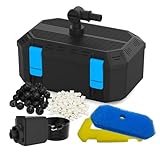
- HIGH-PERFORMANCE POND FILTER PUMP - Turn your pond into a breathtaking oasis with this powerful pond pump (40W, 850GPH max flow, 9ft max height). Perfect for ponds 500-750 gallons. It delivers both power and efficiency to keep your water clear.
- SAFETY-FIRST POND FILTER BOX - The rugged pond filter box acts as a protective barrier, preventing debris from clogging the pump while keeping fish safely away from moving parts. It’s a must-have fish pond filter for anyone with koi or goldfish outdoors.
- 4-STAGE PROFESSIONAL FILTRATION - Achieve crystal-clear water with this advanced koi pond filter. Its 4-layer filtration process includes: Layer 1 – Coarse Sponge (traps large debris), Layer 2 – Fine Sponge (captures fine particles), Layer 3 – Ceramic Rings (Cultivates bene-ficial bac-te-ria), and Layer 4 – Bio-balls (Improves oxygen levels). Perfect for maintaining a clean and healthy pond environment.
- DUAL-PURPOSE DESIGN - This versatile filter serves a double function: it acts as a primary filtration system for your pond, while simultaneously functioning as an efficient pre-filter for water features, fountains, and waterfalls. Simply connect it to your setup with a hose (to be obtained separately) to enjoy crystal-clear water and maximize the performance of your aquatic display!
- QUICK INSTALL & EASY UPKEEP - Designed for convenience, this fish pond filter is simple to install and maintain. The removable and reusable filter media make cleaning effortless, saving you time while keeping your pond in pristine condition.
- Fertilizer is spread on the lawn.
- Rain, irrigation, erosion, or overspray transports nutrients toward the pond.
- Nitrogen and phosphorus stimulate algae and aquatic plants.
- Algae, plants, and microorganisms respire continuously, including at night.
- When algae or plants die, bacteria use still more oxygen while decomposing them.
- Dissolved oxygen falls low enough to stress or kill fish.
Oxygen can be relatively high during daylight because algae photosynthesize, then reach its daily low shortly before sunrise. A warm, cloudy, windless period or a sudden algae die-off can make the decline especially severe. Fish may become lethargic, gather near an inflow or the surface, and gasp before dying. The U.S. Environmental Protection Agency explains how temperature, photosynthesis, respiration, and decomposition affect dissolved oxygen, while Kentucky Fish and Wildlife identifies low dissolved oxygen as the most common cause of fish kills in ponds and describes excess nutrients as one route to oxygen depletion.
Plain fertilizer is different from weed-and-feed
| Product | Main pond risk | What to check |
|---|---|---|
| Plain lawn fertilizer | Indirect nutrient loading, algae growth, and oxygen depletion | Nitrogen and phosphorus analysis, application rate, runoff and rain restrictions |
| Weed-and-feed | Nutrient loading plus possible direct pesticide toxicity | Active ingredients and the label’s Environmental Hazards section |
| Fertilizer with insect control | Nutrient loading plus possible toxicity to fish or aquatic invertebrates | Aquatic warnings, setbacks, runoff restrictions, and prohibited uses |
| Aquatic herbicide or algaecide | Direct product-specific risk; dying vegetation can rapidly deplete oxygen | Exact aquatic-use label, dose, waterbody restrictions, and staged-treatment directions |
In the United States, fertilizer-pesticide combinations are regulated as pesticide products, and the pesticide label is legally enforceable. Do not assume a product is safe near water because it is marketed for lawns. Read the complete label, especially the Environmental Hazards statement and instructions about water, runoff, rainfall, irrigation, and application distance. EPA notes that aquatic warnings may state that a pesticide is toxic to fish or aquatic invertebrates. The National Pesticide Information Center’s fish and weed-and-feed guidance is useful for understanding why the active ingredient, formulation, movement, and exposure all matter.
When is fertilizer runoff most dangerous?
Risk rises when several unfavorable conditions occur together:
- The lawn slopes directly toward the pond or is connected by a ditch, gutter, drain, or bare soil.
- Granules are spread close to the water or land on the bank.
- Heavy rain or excessive irrigation follows application.
- The pond is small, shallow, warm, stagnant, or low in water.
- The pond already has dense algae, abundant aquatic plants, or excessive nutrients.
- Fish are already stressed by heat, disease, low oxygen, or poor circulation.
- Large amounts of algae or aquatic vegetation die at once.
A fish kill that occurs soon after fertilizing is a reason to investigate, not proof of causation. Other possibilities include a natural algae bloom, hot weather, cloudy conditions, pond turnover, low water levels, disease, manure or sewage, pesticide runoff, and sudden changes in circulation. USGS describes fish kills as events with both natural and human causes.
Rank #2

- 18W High-Efficiency UV Clarifier – Effectively eliminates green water algae in as little as 3-7 days, keeping your pond crystal clear while being 100% safe for fish and plants.
- Advanced 6-Layer Professional Filtration – 3 layers of premium mechanical filter pads trap debris + 1 layer activated carbon removes odors & impurities + 1 layer lava rock + 1 layer bio balls support billions of beneficial bacteria for superior biological filtration.
- Powerful 42W High-Flow Water Pump – Delivers strong circulation up to 660 GPH, ensuring excellent water movement and oxygenation for ponds up to 1500 gallons.
- 3 Interchangeable Fountain Nozzels – Customize your pond with 3 stunning spray patterns (lotus, bell, and jet), adding beautiful visual effects and extra surface aeration.
- Easy Setup & Long-Lasting Performance – Plug-and-play installation, durable construction, perfect for koi ponds, water gardens, and backyard ponds – enjoy cleaner, healthier water with significantly reduced maintenance.
How to prevent fertilizer from harming pond fish
1. Test the soil before fertilizing
A soil test can show whether the lawn actually needs fertilizer and which nutrients are deficient. Avoiding unnecessary applications reduces both runoff risk and wasted money. A lawn soil test kit can be a convenient starting point, although follow-up laboratory testing may be more useful when the lawn is near sensitive water or the results are unclear. The University of Minnesota Extension explains soil testing for lawns and gardens.
2. Keep fertilizer away from the shoreline
Leave a permanent strip of grasses, shrubs, trees, or other perennial vegetation between fertilized turf and the pond. Do not broadcast granules toward the water or fertilize the bank itself. A vegetated buffer slows runoff, traps sediment, absorbs some nutrients, stabilizes soil, and can provide shade.
There is no single setback distance that is national law for every fertilizer and pond. Requirements vary by state, locality, product, land use, and whether the product contains a pesticide. Follow the label and local rules. Shoreland guidance from Minnesota Extension illustrates why recommended precautions can differ by situation; Penn State also recommends reducing fertilizer near ponds, diverting nutrient-rich runoff, and using vegetated buffer strips.
3. Apply accurately and recover spills
Use the product’s specified rate and calibrate the spreader. A drop spreader for lawn fertilizer gives you more control near a pond than indiscriminate broadcasting. Keep granules off the shoreline, sidewalks, driveways, streets, gutters, and other hard surfaces. Sweep spills and misplaced granules back onto the lawn; do not hose them into a drain or the pond. UGA Extension recommends careful application and cleanup to reduce nutrient delivery to residential ponds.
Rank #3

- 🐟【Integrated Filtration System】The multi-functional compact pond filter combines everything required to run a healthy small pond. It is designed to help keep water healthy balanced and crystal clear, and protect the pump from being clogged with debris, also protects fish from the pump's impeller.
- ⛲【Built-in Pond Pump & Fountain Kit】Our filter box includes 660 GPH energy efficient & low noise water pump which suitable for ponds of 1180 gallons. Also includes a fountain kit with 3 waterspray nozzles that creates a beautiful display, while adding oxygen to pond water.
- 🐟【Runs Two Water Features】You can choice of fountain or waterfall, the filter kit includes with 3 additional inlets to attach hose for a second water feature. And a diverter valve which allows simultaneous running of the fountain and a secondary outlet. Both are fully adjustable thanks to the built in flow control vales.
- ⛲【Easy Access & Maintenance】This filter kit designed as a single smart unit allows for a much easier installation compared to a standard pond set up. Filter maintenance is straightforward thanks to the easy access clips which allow quick removal of the lid for easy cleaning.
- 🐟【Premium Filter Materials】The filter sponges and filter-balls will make a double filter area per unit volume, which help improve water clarity in water gardens and reduce maintenance. Maintaining excellent water quality for healthy fishkeeping.
4. Check the weather and ground conditions
Do not fertilize when heavy rain is expected, when the soil is saturated or frozen, or when irrigation would produce runoff. The label may contain more specific restrictions. If water is already flowing off the lawn toward the pond, postpone the application and address the drainage first.
5. Improve the pond edge
Native grasses, shrubs, trees, and other plants suited to your region can form a useful shoreline buffer. Choose species that are locally appropriate and noninvasive; water level, soil, flooding, shade, and local regulations all matter. A native pond-edge plant or shoreline-buffer seed mix may help with a longer-term buffer project, but no plant mix can compensate for continual fertilizer or sewage runoff.
6. Keep other oxygen-demanding material out of the water
Do not allow grass clippings, leaves, manure, pet waste, or other organic debris to wash into the pond. These materials add nutrients and organic matter, and their decomposition can increase oxygen demand. They can turn a moderate fertilizer problem into a serious oxygen crash.
What to do if fish are gasping or dying
Surface-gasping fish, lethargy, an unusual odor, suddenly dark or brown water, a dense algae bloom, and numerous dead fish are warning signs. They can indicate oxygen depletion, but they do not identify fertilizer as the cause.
Rank #4

- COMPLETE 190 GPH POND KIT: Pondmaster PMK 190 Garden Pond Filter and Pump Kit includes everything needed to create a beautiful, relaxing water feature in one convenient package. Ideal for small to medium-sized ponds, water gardens, and decorative containers.
- RELIABLE 190 GPH WATER PUMP: Includes a dependable 190 GPH water pump designed to provide continuous water circulation throughout your water feature. The pump is CUL/UL Listed for reliable performance and added peace of mind.
- DELUXE FILTER SYSTEM: The included deluxe filter helps circulate pond water through the filtration system, making it easier to maintain a cleaner, healthier-looking water feature. Provides convenient filtration without the need to purchase separate components.
- ELEGANT BELL FOUNTAINHEAD: Creates an attractive bell-shaped fountain pattern that adds movement, visual appeal, and the soothing sound of flowing water. A beautiful focal point for ponds, water gardens, and decorative containers.
- EASY ALL-IN-ONE SETUP: Pondmaster combines the pump, deluxe filter system, and bell fountainhead into one convenient kit, taking the guesswork out of selecting compatible equipment. With the bell fountainhead attached, the system measures 20 1/2" from the top of the bell to the bottom of the filter; filter dimensions: 8 1/2" W x 11" D x 2 3/4" H.
- Stop the suspected input. Stop fertilizing and pause irrigation or drainage that is carrying material toward the pond.
- Do not add more chemicals. Avoid fertilizer, algaecide, herbicide, manure, and fish feed while the problem is being assessed.
- Increase oxygen and surface movement. Use an appropriately sized fountain, diffuser, pond aerator, or other safe aeration method. Emergency aeration can help fish survive very low oxygen, but it does not remove nutrients or fix the source of runoff.
- Measure and record conditions. If possible, check dissolved oxygen at daybreak, when it is often near its daily minimum. Also record water temperature, pH, recent rainfall, visible algae, the fertilizer or pesticide name, application rate, and application time. A pond water test kit may help with pH, nitrate, or phosphate, but not every basic kit measures dissolved oxygen, and an emergency decision should not rely on an unverified kit’s accuracy.
- Preserve evidence. Keep the product container, label, receipt, lot number, and remaining material if pesticide exposure is possible. Photograph the pond, dead fish, runoff path, weather conditions, and product application area.
- Report a substantial kill or suspected release. Contact your state fish-and-wildlife agency, county extension office, environmental agency, or a qualified pond-management professional. They can advise on sampling and help distinguish oxygen depletion from pesticide toxicity, disease, or another cause.
Kentucky Fish and Wildlife advises emergency aeration or surface agitation when oxygen is very low. Aeration is a response and risk-reduction measure—not a substitute for stopping nutrient inputs. If fertilizer and other nutrients continue entering the pond, aeration alone will not reverse the underlying enrichment problem.
Independent reader supportYour contribution helps us test, update, and keep practical guides available for everyone.Can treating algae make the fish kill worse?
It can. An algaecide or aquatic herbicide may kill algae or plants quickly, but the dead material can then decompose and consume dissolved oxygen. Treating a large bloom all at once can therefore create a second crisis, particularly in a warm, poorly aerated pond. Use only a product specifically labeled for the intended aquatic setting, follow its dose and restrictions exactly, and observe any directions to treat in stages. Do not improvise with lawn chemicals or household products.
How to work out whether fertilizer caused this fish kill
Look for a coherent exposure-and-effect pattern rather than relying only on timing:
- Was a product applied, and what were its active ingredients?
- Did rain, irrigation, overspray, erosion, or a visible drainage route connect the lawn to the pond?
- How much was applied, over what area, and how close to the water?
- Were fish gasping near dawn, suggesting low dissolved oxygen?
- Was there a new algae bloom, a large plant die-off, foul odor, or cloudy weather?
- Did the event affect many fish at once, or were there signs of disease or predation?
- Do water tests, tissue samples, or agency investigations support nutrient-driven oxygen depletion or pesticide exposure?
The most defensible conclusion is: lawn fertilizer near a pond can kill fish when runoff causes nutrient-driven oxygen depletion, and fertilizer products containing pesticides may also cause direct aquatic toxicity. Determining whether fertilizer caused a particular fish kill requires site-specific evidence.
Best Value
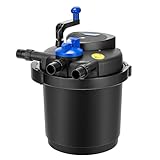
- HIGH-EFFICIENCY PRESSURE FILTERING: Pressurized pond filter delivers strong bio-mechanical filtration for koi, ornamental, and outdoor ponds; Supports up to 1600-gal ornamental or 800-gal fish ponds with max 1580 GPH flow to keep water crystal clear
- ADVANCED FILTRATION & CLARIFYING SYSTEM: This pond bio pressure filter uses a reusable coarse and fine sponge system with two blue 20 PPI sponges and two yellow 25 PPI sponges, supported by an integrated 13W clarifying lamp for cleaner pond water
- EASY CLEANING AND MAINTENANCE: Switch between Filter and Clean modes with one control; Rotate the handle to backflush until water runs clear; Clean weekly or immediately if the red float rise; Modular body and detachable lid make routine maintenance fast and simple
- MULTI-SIZE ADAPTERS FOR COMPATIBILITY: Comes with three hose adapters (3/4", 1", 1-1/4") to fit most pond pumps; Clear inlet and outlet labels prevent installation mistakes, and pairing with a larger hose is recommended for more stable, efficient filtration
- DURABLE OUTDOOR CONSTRUCTION: Strengthened ABS housing withstands long-term outdoor use; Weather-resistant design ensures safe, continuous operation in koi ponds and other water features, delivering reliable performance through changing seasons
Frequently Asked Questions
How does lawn fertilizer kill fish?
Usually indirectly. Nitrogen and phosphorus runoff can fuel algae and aquatic plants; nighttime respiration and decomposition can then deplete dissolved oxygen. A fertilizer containing pesticides may also create a direct toxicity risk.
What should I do if fish are gasping after fertilizing?
Stop fertilizer and runoff immediately, do not add algaecide or other chemicals, and increase safe aeration or surface agitation. If possible, measure dissolved oxygen at daybreak and contact a fish-and-wildlife agency or extension office for a significant kill.
Does a fish kill after fertilizing prove fertilizer was responsible?
No. A fish kill after fertilizing may also result from heat, algae, pond turnover, disease, sewage or manure, pesticide runoff, low water, or poor circulation. Timing alone does not establish the cause.
Crashes, No Sound, or Screen Glitches?
Random freezes, missing sound and display glitches usually trace back to one bad driver. Find and replace yours safely.Free scan · under a minuteWindows Errors? Fix Them Before They Spread
Repair common Windows errors and clear accumulated junk for a smoother, more stable PC - no reinstall needed.Free scan · no reinstallHow can I fertilize a lawn near a pond safely?
A permanent vegetated buffer, accurate application, spill cleanup, soil testing, and avoiding fertilizer before heavy rain all reduce risk. Product labels and local rules determine any required setback or restriction.
The Bottom Line
Bottom line: Keep fertilizer away from pond edges, maintain a vegetated buffer, avoid applications before rain, and follow the label—especially for weed-and-feed products. If fish are gasping, stop the runoff and increase safe aeration immediately while seeking water-quality or agency help.
Quick Recap
Product prices and availability are accurate as of the date/time indicated and are subject to change. Any price and availability information displayed on Amazon at the time of purchase will apply.




