
Some links on this page are affiliate links: if you buy through them we may earn a commission, at no extra cost to you.
The dog-faced puffer (Arothron nigropunctatus) is a tropical Indo-Pacific marine fish that can reach about 33 cm (13 inches). Plan for an adult aquarium of roughly 125 gallons or larger, stable saltwater, powerful biological filtration, and a diet that includes shell-bearing foods. Published minimums range from 90 to 125 gallons, so the responsible choice is to treat 125 gallons as a planning target rather than a universal rule. It is not reef safe: corals and ornamental invertebrates may be eaten, and any fish combination remains conditional on individual temperament, size and space.
What a dog-faced puffer is
The dog-faced puffer is Arothron nigropunctatus, a marine puffer from the Indo-Pacific. Tropical Fish Hobbyist Magazine lists a maximum size of 33 cm (13 inches) and describes it as a tropical marine species with a rounded body and beak-like fused teeth. Its natural diet centers on invertebrates, especially mollusks and crustaceans, with algae also reported as part of its diet. See the species account at Tropical Fish Hobbyist Magazine.
As an Amazon Associate I earn from qualifying purchases.
Quick wins for a faster PC:
Fix the driver behind crashes, sound loss and screen glitchesFind Drivers →Clear out junk files and repair common Windows errorsFree Scan →Scan for outdated or missing drivers - takes under a minuteDriver Scan →This is a substantial predator, not a freshwater community fish. An adult produces considerable waste when fed the meaty foods it needs, and its bite can be painful. Build the system around adult size and behavior instead of buying a small juvenile and postponing the final tank plan.
Dog-faced puffer tank size: why recommendations conflict
There is no single officially established minimum aquarium volume. The commonly cited figures are hobby-care recommendations from different sources:
Popular on Amazon

- HALF MOON AQUARIUM KIT: Clear plastic, half-moon-shaped front allows for unobstructed viewing.
- IDEAL FOR BETTAS: Bettas require minimal maintenance and make great species for beginners.
- MOVABLE LIGHT: Energy-efficient LEDs can be positioned to light tank from above or below.
- CONVENIENT FEEDING: Clear canopy has a hole to make feeding fish easy.
- PERFECT FOR BEGINNERS: Small aquariums like this 1.1-gallon tank are a great way to get started in the freshwater fishkeeping hobby.
| Source | Recommendation | How to interpret it |
|---|---|---|
| Aquarium Source | 90 gallons for one fish | A one-fish minimum in that guide; page metadata has inconsistent dating. |
| AquariumDomain | 100 gallons or more | A species-profile recommendation, not a controlled stocking standard. |
| Reef Builders (January 17, 2014) | About a standard 125-gallon aquarium for an adult | An adult-focused practical recommendation. |
For a long-term adult setup, plan around 125 gallons or larger. That gives the fish more open swimming room and provides greater water volume to dilute waste from frequent meaty feeding. A community aquarium needs additional capacity beyond a single-fish plan; the larger the stock list and the more heavily you feed, the more conservative your volume and filtration choices should be.
Choose a tank by more than gallons
- Adult size: Leave unobstructed length for a 13-inch fish to turn and cruise.
- Swimming area: Use rockwork to create shelter without filling the entire footprint.
- Bioload: Size biological filtration and maintenance for meaty foods, not just the nominal water volume.
- Tankmates: Add capacity when keeping companions; OATA specifically advises larger aquariums for larger puffers and additional volume for multiple fish.
Marine setup and water quality
Keep the dog-faced puffer in stable tropical marine water. The figures below come from sources with different scopes, so they should not be merged into a falsely precise single specification. The Ornamental Aquatic Trade Association (OATA) guide is general advice for puffers and boxfish, while AquariumDomain presents a dog-faced-puffer profile.
What’s actually slowing this PC down?
Pick the symptom - the matching free tool is one click away.
| Parameter | OATA general puffer/boxfish guidance (September 2022) | AquariumDomain dog-faced profile |
|---|---|---|
| Temperature | 24–26°C | 72–79°F |
| Salinity/specific gravity | 1.020–1.025 | 1.020–1.025 |
| pH | 7.9–8.3 | 8.1–8.4 |
| Ammonia | 0 | Not stated |
| Nitrite | 0 | Not stated |
| Nitrate | No more than 50 mg/L | Not stated |
| Carbonate hardness | 8–12 dKH | 8–12 dKH |
Use a consistent marine target within the published ranges, avoid rapid swings, and verify the actual aquarium with reliable tests. Zero ammonia and zero nitrite are especially important. Nitrate, salinity, pH and alkalinity should be tracked as part of a routine rather than adjusted by guesswork.
Filtration, flow and layout
OATA says every setup needs a filter. Depending on the system, that can include live rock with adequate flow, internal or external filtration, or a sump. A protein skimmer can help remove dissolved organic waste. AquariumDomain warns that the puffer’s meaty diet creates a substantial biological filtration load, so capacity should be based on measured water quality and feeding, not equipment labels alone.
Also popular on Amazon

- 【Temporary Display Tank】Showcase bettas, shrimp, snails, or guppies at home, office, classroom, or events. Compact design capacity of 0.8 gallon (5.83 x 5.7 x 5.7 in) with approx. 0.73 gallon usable volume, easy to move and display
- 【Hatching, Isolation & Recovery】Convenient for fry hatching, breeding, or isolating new or aggressive fish, and provides a safe space for sick or injured fish to recover
- 【Built-in LED Lighting】Energy-efficient White LED lighting enhances visibility and creates a calming atmosphere for both fish and owners
- 【Educational Starter Tank】A great teaching tool for kids and beginners to observe aquatic life, science projects, or practice basic fish care. Small, safe, and easy to handle
- 【Mini Aquascape & Décor】Build a micro aquascape with live plants, gravel, or artificial decorations (Decorations not included). Its compact 6-inch cube design makes it a stylish home or office decoration
Provide a clear swimming lane, secure rockwork and a sheltered area where the fish can retreat. Anchor structures so a large puffer cannot topple them while maneuvering. Check water parameters weekly and perform partial changes; OATA gives 25% weekly as its general marine-puffer husbandry advice, but stocking, feeding, filtration and test results determine whether that schedule is sufficient for your aquarium.
Essential setup checklist
- Marine aquarium planned for approximately 125 gallons or more for an adult.
- Stable heater and saltwater system within a consistent tropical range.
- Biological filtration sized for a heavy carnivorous bioload.
- Mechanical filtration that can be cleaned before trapped food decays.
- Protein skimmer or comparable dissolved-waste control where appropriate.
- Open water for swimming plus stable refuge rockwork.
- Marine test kit covering the parameters relevant to your chosen targets.
What do dogface puffers eat?
Feed a varied marine carnivore diet. Suitable foods cited for this species or larger marine puffers include mussels, clams, shell-on shrimp, crab legs, squid, krill, marine fish and other frozen meaty foods. Petco’s broad puffer guide also lists chopped squid, clams, shrimp, krill, carnivore pellets, frozen foods and shelled mussels. Retain shells on some meals rather than serving only boneless pieces.
Shell-bearing prey matters because the puffer’s beak is made of fused tooth plates that grow continuously. Chewing hard shells provides natural wear while supplying a food the fish is adapted to process. Variety also reduces dependence on one nutrient profile and better reflects its invertebrate-focused feeding ecology.
How often to feed
Published schedules are not consistent. AquariumDomain suggests small portions three to four times per day, while Petco’s generalized puffer sheet says once or twice daily. Neither is a settled, species-specific prescription. Start with portions the fish consumes promptly, include shell-bearing items regularly, and adjust frequency and quantity according to body condition, uneaten food and measured water quality. Remove leftovers before they decompose; a feeding routine that keeps the fish healthy but drives ammonia or nitrate upward is not working for the system.
Also popular on Amazon
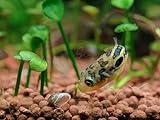
- Meet the Carinotetraodon travancoricus, or the pea puffer—a tiny fish with a big personality! These vibrant, greenish-brown puffers with yellow spots add a burst of life to nano aquariums
- Meet the Carinotetraodon travancoricus, or the pea puffer—a tiny fish with a big personality! These vibrant, greenish-brown puffers with yellow spots add a burst of life to nano aquariums. Known for their intelligence and feisty nature, they're a joy to watch. Plus, they're handy snail hunters, making tank maintenance a breeze. Perfect for both beginners and seasoned aquarists, the pea puffer brings charm and liveliness to any underwater world.
- The pea puffer, scientifically known as Carinotetraodon travancoricus, thrives in freshwater aquariums. To ensure their well-being, maintain water parameters within the following ranges:
- Temperature: Keep the water temperature between 74°F to 82°F (23°C to 28°C). Pea puffers are sensitive to temperature fluctuations, so aim for stability.
- Water Hardness: Aim for a water hardness of 5 to 20 dGH. This range mimics their natural habitat conditions.
Do puffer teeth keep growing?
Yes. The fused beak plates grow throughout the fish’s life. Inadequate abrasive food can allow them to overgrow until the puffer struggles to pick up or crush food. Prevention is safer than corrective trimming: make shell-on mussels, clams, shrimp or crab part of the normal rotation rather than an occasional novelty.
Signs the beak needs attention
- The fish repeatedly attempts to eat but cannot grasp or break food.
- The upper or lower beak visibly extends beyond normal proportions.
- Weight declines despite regular offerings.
- The puffer drops foods it previously handled easily.
Do not routinely file or clip the teeth at home. Reef Builders describes those procedures as stressful and a last resort when natural wear has failed. If the fish cannot eat, seek an aquatic veterinarian or an experienced specialist who can assess the beak and underlying husbandry problem.
Dogface puffer tank mates: possible, never guaranteed
Compatibility is conditional. Tropical Fish Hobbyist Magazine describes a fish-only aquarium with companions of suitable size and aggressiveness. AquariumDomain similarly suggests a large community aquarium with non-aggressive fish. Reef Builders names wrasses, certain tangs, some triggers and larger angelfishes as possible cohabitants. These are examples of combinations that may work, not promises of safety.
Evaluate a proposed companion
- Relative size: Avoid fish small enough to be swallowed or bullied, while also avoiding a giant aggressor that will continually harass the puffer.
- Temperament: Choose robust fish able to compete for food without relentless fin-nipping.
- Feeding competition: Ensure the puffer can eat its shell-bearing portions before faster fish consume everything.
- Space: Provide separate routes and refuge; crowding increases conflict and waste.
- Observation: Be prepared to separate fish if chasing, biting or chronic food loss develops.
Do not add ornamental shrimp, crabs or snails on the assumption they are cleaners or harmless companions. The puffer is an invertebrate predator. Corals and other reef invertebrates may be chewed or eaten, so treat this as a fish-only species rather than a reef-safe choice.
Also popular on Amazon

- 1 Piece feeding dish with suction cup.
- Clover Shaped. Material: High transparent acrylic. Very beautiful.
- Size: feeding dish height---0.7 inch; dish holder height---1.18 inches; dish dia.---2.2 inches.
- High transparent feeder container.
- Perfect for all types of freshwater and saltwater aquarium, fish tank.
Handling, puffing and routine welfare
Never make a puffer inflate for a photograph or entertainment. OATA states that puffing is a stress response and warns that encouraging it can be harmful; its September 2022 guidance says, “Pufferfish should not be encouraged to ‘puff’ up as this is a stress response and can be bad for their health.”
Keep the fish underwater whenever possible. Both OATA and Reef Builders warn about air swallowing. For a necessary transfer, do not chase the fish into a net and lift it through the air. Reef Builders recommends gently guiding it into a suitably sized rigid container while the container remains submerged. Handle only for essential maintenance, and remember that a large puffer can inflict a painful bite.
Recommended Free Tools
A practical dog-faced puffer care routine
- Before purchase: Confirm that the final aquarium is at least your adult-focused target of about 125 gallons, has mature biological filtration and leaves open swimming space.
- At setup: Establish stable tropical marine conditions, secure rockwork and a refuge. Test ammonia and nitrite at zero before introducing a fish.
- During feeding: Rotate marine meaty foods, include shell-bearing items, offer portions the fish can consume promptly and remove scraps.
- Each week: Test the system, inspect the beak and body condition, clean mechanical filtration and perform an appropriate partial water change. OATA’s general example is 25% weekly.
- When adding companions: Reassess bioload and swimming room, introduce only appropriately sized robust fish, and have a separation plan.
- During maintenance or emergencies: Keep the fish submerged in a rigid container; never induce inflation or expose it to air unnecessarily.
Common planning mistakes
- Choosing the smallest published number: A 90-gallon figure does not account for adult size, companions or your feeding load. Use the 125-gallon adult plan as a safer starting point.
- Calling it reef safe: Corals and ornamental invertebrates are potential food.
- Feeding only soft foods: Lack of shell wear can contribute to beak overgrowth.
- Combining water-range endpoints: The cited guides have different scopes and ranges; pick stable targets and monitor your own aquarium.
- Assuming a schedule is universal: Feeding frequency varies by source and must be adjusted to consumption, condition and water tests.
- Using a net for routine transfers: Air exposure and stress can cause avoidable harm.
Bottom line for a responsible setup
Design for the adult Arothron nigropunctatus, not the juvenile in the store: approximately 125 gallons or more, stable tropical marine water, strong waste-processing capacity, open swimming room and secure refuge. Feed a varied marine diet with regular shell-bearing foods so the continuously growing beak receives natural wear. Keep expectations realistic about tankmates and reef compatibility, monitor water quality weekly, and keep every necessary transfer submerged.





Leave a Reply