
Recommended Free Tools
Yes. Most dogs need closely supervised, restricted recovery after leg surgery. Follow the operating veterinarian’s written discharge plan, control movement, protect the incision or bandage, give only prescribed medicines, and report concerning changes promptly. The operation, the leg and joint involved, and your dog’s health determine the exact restrictions and timeline; no generic schedule can replace the surgeon’s instructions.
Why leg surgery requires special care
“Leg surgery” describes many different procedures, from repair of a ligament or fracture to surgery on a joint, bone, muscle, or soft tissue. A dog may leave the hospital walking cautiously, yet the tissues underneath still need protection while they heal. Too much activity can strain a repair, make a wound open, displace an implant, or cause a setback that is not obvious until later.
As an Amazon Associate I earn from qualifying purchases.
Orthopedic discharge instructions commonly cover five separate issues: how much movement is allowed, how to inspect the incision, what to do with a bandage, which medicines to give, and when the dog must return for an examination or imaging. Ask the operating clinic to explain anything that is unclear before you leave. If verbal advice differs from the written plan, call the clinic and confirm which instruction applies to your dog.
Start with the surgeon’s plan, not a standard timeline
Recovery length depends on the procedure, the operated area, whether bone or an implant must heal, the condition of the incision, and your dog’s age and general health. Routine procedures may have a shorter restriction period than major orthopedic operations, but the sources do not support one universal number of days for every leg surgery. The date when a dog seems comfortable is not the same as the date when the repair is strong enough for normal activity.
#1 Best Overall

- Leave the Cones Behind: Swap out uncomfortable cones of shame for a cozy surgery suit for dogs. This dog surgery suit is made with soft cotton and lycra, which promotes better airflow than nylon spandex suits. It even has an inner layer pocket for ice packs and pads.
- Supercharge Your Pet’s Recovery: Our dog body suits after surgery keeps your fur babies from scratching, licking, or biting their wounds. This dog cone alternative also shields sutures, incisions, or cuts from dirt, dust, or external elements.
- From Ruff to Relaxation: Designed with elastic bands around the neck, tail, and legs, and a snap closure, this dog recovery suit provides a snug fit that can help ease your pup’s restlessness. Our dog post surgery suit also features a clip-up system for easy walks and potty breaks.
- The Suit that Won’t Quit: Perfect for busy fur parents, our dog recovery suit is machine washable and reusable for easy maintenance. It can withstand repeated washing without losing its sturdiness.
- The Way to a Happy Recovery: At Suitical, we collaborated with veterinarians, professionals, and pet owners to develop premium pet products that help improve the wellness of your beloved furry friends!
| Recovery question | What determines the answer | What to do |
|---|---|---|
| How much walking is allowed? | The procedure, leg, joint or bone involved, and the surgeon’s assessment | Use only the movement level written in the discharge instructions; ask before increasing it. |
| Does the dog need a bandage? | Whether the operation and wound require one, and the clinic’s bandage protocol | Keep it dry and secure, inspect it as directed, and call about slipping, wetness, odor, swelling, or other changes. |
| Is a sling or harness appropriate? | Whether the dog needs temporary hind-end support and whether the surgical team approves a particular technique | Use a sling or towel only after the surgeon explains when and how to use it. |
| When are rechecks or X-rays needed? | The repair and the clinician’s plan for monitoring healing | Keep every scheduled examination and imaging appointment, even if the dog appears better. |
| When can rehabilitation begin? | The tissues involved and the operating veterinarian’s rehabilitation directions | Ask for a qualified veterinary rehabilitation provider if one is recommended; do not add exercises independently. |
Control movement while your dog heals
Use short, controlled leash trips
Unless the surgeon gives different instructions, postoperative guidance generally limits outdoor trips to brief, slow leash walks for toileting. Keep the leash short enough to prevent sudden lunges, and choose a level, non-slippery route. Return indoors as soon as the dog has eliminated. Do not allow off-leash roaming in a yard, even if it is fenced.
Prevent running, jumping, and rough play
Running, stairs, jumping onto furniture, chasing toys, wrestling with people or other animals, and slipping on smooth floors can all exceed the permitted load. Block access to stairs and use gates to separate the recovering dog from active pets or children. Lift or guide the dog only as the clinic demonstrates; an awkward lift can stress the operated limb.
Create a safe confinement area
A crate, pen, or small room can provide the controlled environment your veterinarian recommends. It must be large enough for the dog to stand, turn, lie down, and accommodate any protective collar without catching. Put the bed on a stable, non-slip surface, keep food and water easy to reach, and remove objects that encourage climbing. A pen or room may be more suitable than a crate for a large dog or one that cannot comfortably turn with a cone.
PC Slower Than It Used to Be?
A free scan shows the junk files, broken settings and background clutter dragging Windows down - then fixes them in one click.Free scan · Windows 10 & 11Outdated Drivers Are Slowing You Down
One free scan finds every outdated or missing driver and matches the right update for your exact hardware.Free scan · exact hardware matchPlan supervision for the times when the dog is most likely to become excited, such as greetings, meals, doorbell activity, or seeing another pet. Calm enrichment that does not prompt movement—quiet companionship, food puzzles approved by the clinic, or gentle attention—can make confinement easier. Stop any activity that causes the dog to lunge, twist, or scramble.
Rank #2

- Signature 4-Way Stretch: Experience the ultimate in canine comfort with Spark Paws' signature 4-way stretch fabric, designed exclusively for dogs.
- Hug-Like Comfort: Our calming fleece interior creates a soothing, hugging sensation, making your dog feel safe and secure.
- Precision Fit: Fit tested on thousands of dogs to ensure the perfect fit for all breeds and sizes, providing unparalleled comfort.
- Effortless Potty Breaks: The deep V cut at the rear section ensures easy and hassle-free potty breaks for your furry friend.
- Durable Design: Crafted with high-quality materials, these pajamas are built to last, keeping your dog cozy night after night.
Use support equipment only when prescribed
Some dogs, particularly after hind-leg procedures, may be supported briefly with a sling or towel under the rear end. A TPLO discharge example describes this type of assistance, but it is not appropriate for every operation. Ask the surgeon where the support should sit, how much weight the dog may bear, and when the aid should be removed. Never improvise a harness that presses on the incision or bandage.
Protect the incision and any bandage
Stop licking and chewing
Dogs can damage sutures or introduce bacteria within minutes of reaching an incision. Use the Elizabethan collar or other protective device recommended by the veterinary team. Check that it is fitted so the dog cannot bend around it to reach the leg, while still allowing normal breathing, eating, and drinking. Keep it on for the period specified by the clinic, including when you are asleep or away, unless the veterinarian gives a supervised alternative.
Inspect the wound as instructed
Look at the incision at the frequency the clinic recommends and compare it with the previous inspection. A healing incision should not develop progressively worse redness, swelling, heat, pain, discharge, or odor. A wound that appears to separate or open needs prompt veterinary advice. Do not pick at scabs, pull at sutures, or attempt to remove staples yourself.
Keep dressings dry and in place
If the leg is bandaged, follow the hospital’s exact instructions about checking and changing it. Keep the dressing dry during toileting and do not cover it with an airtight plastic layer unless the clinic specifically directs that method. A wet, slipping, chewed, foul-smelling, or visibly soiled bandage should be reported to the veterinary clinic rather than repaired at home. Do not cut, loosen, or replace a bandage without instructions, because an altered wrap can cause pressure injury or fail to support the limb.
Rank #3
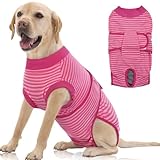
- SIZE GUIDE: X-Small (Back:8.3-11.4in,Chest:12.6-15.7in, Weight:4-7 LB), Small (Back:11.4-13.4in,Chest:15.7-19.3in, Weight:7-15 LB), Medium (Back:13.4-16.1in,Chest:19.3-23.2in, Weight:14-25 LB), Large (Back:16.1-20.1in,Chest:23.2-27.6in, Weight:23-48 LB), X-Large (Back:20.1-24.8in,Chest:27.6-32.3in, Weight:42-75 LB), XX-Large (Back:24.8-29.5in,Chest:32.3-39.3in, Weight:70+ LB)
- [PRACTICAL DESIGN]: FUAMEY dog onesie conforms to the dog's body structure, is easy to wear and take off. dog bodysuit is more flexible and lighter than collars, so that the dog will not be angry and depressed when defecation and eating, and prevent the dog from licking the wound.
- [MULTI-PURPOSE]: Our recovery suit is suitable for post-operative care such as neuter and childbirth.✔Can be used as postpartum care for female dogs to prevent dogs from catching cold.Postpartum use as weaning gown . ✔Can be used as a protective spay suit for pet neutering or post-caesarean section .✔Use with diapers to prevent male dogs from urinating .✔can also be used as a favorite home clothes with complete freedom of movement.
- [KEEP TIDY]: Our recovery suit is suitable for indoor or outdoor activities. It can effectively isolate dust and dirt, keeping your dog clean and tidy.
- [BREATHABLE FABRIC]: Our dog recovery suit is made of 95% cotton and 5% spandex. The recovery shirt is highly elastic and breathable, allowing the dog to feel comfortable and move freely after wearing it. No deformation after machine wash.
Use no unapproved cleaners or creams
Do not put disinfectant, ointment, powder, alcohol, peroxide, or another topical product on the incision unless the operating veterinarian tells you to use that specific product. Home remedies can irritate tissue, delay healing, or hide a developing infection. Keep bedding clean and change it if it becomes damp or contaminated.
Give medication exactly as prescribed
Use every medicine according to the label and discharge sheet: the stated dose, interval, route, and duration. Do not substitute a human pain reliever, change the dose because the dog seems uncomfortable, or stop early because the dog seems improved. If a dose is missed, vomited, or accidentally repeated, call the clinic for instructions rather than guessing.
Ask the veterinary team which effects are expected and which require a call. A dog that becomes markedly more painful, unusually sedated, repeatedly vomits, develops severe diarrhea, refuses food or water, or shows another new change should be discussed with the prescribing clinic. Keep medicines secured away from pets and children, and bring the medication containers to an appointment if you are unsure what was given.
What’s actually slowing this PC down?
Pick the symptom - the matching free tool is one click away.
Know which changes require a call
Contact the operating clinic when you notice a worsening trend or cannot carry out the written plan. Call promptly for:
Rank #4

- Protective Recovery Suit: The professional surgical recovery suit can protect your little pet from licking wound and help dog recover sooner after operation. It can avoid animal suffer from skin disease when exposing to outer environment and keep little animal calm down when it gets anxious.
- Important Tip for Male Dogs: Trim the pre-marked crotch circle before use to ensure a comfortable fit without tightness.
- Easy to Use: Designed with convenience in mind, this recovery suit is easy to put on and take off, making the process stress-free for both pets and owners.
- Calming Effect: The snug fit of the suit provides a sense of security, helping to reduce anxiety and promote calmness during the recovery period
- The snap is designed for daily wear and normal adjustments, withstanding 2-3kg vertical force
- Increasing redness, swelling, heat, pain, discharge, or odor at the incision.
- A wound that appears to open, missing sutures, or the dog repeatedly reaching the site.
- A wet, slipping, tight, damaged, foul-smelling, or otherwise concerning bandage.
- A sudden decline in the dog’s ability to stand or use the limb compared with the instructions you were given.
- Pain or distress that is not controlled by the prescribed plan.
- Any uncertainty about medication, confinement, toileting, a sling, or the allowed amount of activity.
Texas A&M Veterinary Medical Teaching Hospital, VCA postoperative guidance, and procedure-specific discharge instructions all emphasize contacting the veterinary team about abnormal incision or bandage changes. The clinic can distinguish expected postoperative findings from a complication because it knows which procedure was performed and what the dog looked like at discharge. If the clinic is closed and the dog has severe distress, uncontrolled bleeding, collapse, or another emergency sign, use the emergency service identified in your discharge paperwork.
Independent reader supportYour contribution helps us test, update, and keep practical guides available for everyone.Make the first days at home easier
Before bringing the dog home
- Prepare the confinement area on one floor, away from stairs and slippery flooring.
- Place a stable bed, water, food, leash, protective collar, and prescribed medicines within easy reach.
- Remove low furniture or objects the dog might use to jump.
- Arrange help so someone can supervise toileting and medication during the first day and night.
- Write down the next dose time, incision-check schedule, and recheck appointment.
At each bathroom trip
- Put on the leash before opening the door and prevent the dog from bolting.
- Walk slowly over the safest available surface to the toilet area.
- Provide only the support equipment and assistance approved by the surgeon.
- Return directly to the recovery area and check that the incision or bandage remains clean and secure.
Keep a simple recovery record
Record medicine times, appetite, water intake, bathroom habits, permitted walks, and anything you observe at the incision. A daily photograph taken from a similar angle can help the clinic assess a change, but it does not replace an examination. Bring the record and any questions to rechecks.
Rechecks and rehabilitation are part of aftercare
Follow-up examinations let the surgeon assess the incision, pain, limb use, and progress of the repair. Some operations also require imaging before activity is expanded. Do not cancel a recheck because the dog is walking comfortably; apparent comfort does not prove that bone, ligament, or an implant has finished healing.
Do these 3 things before closing this tab:
1Scan for outdated or missing drivers - takes under a minute2Clear out junk files and repair common Windows errors3Fix the driver behind crashes, sound loss and screen glitchesRehabilitation may be recommended to restore strength, joint motion, balance, or a safe walking pattern. The timing and exercises must match the operation. Ask the operating veterinarian whether a qualified veterinary rehabilitation provider is appropriate and which activities are allowed at home. Avoid internet exercise plans that were written for a different procedure or that encourage stretching, stairs, swimming, or longer walks without surgical approval.
Common mistakes that cause setbacks
- Allowing freedom too soon: A dog that appears energetic may still need strict restriction. Wait for the surgeon’s clearance before returning to normal play.
- Removing the collar for convenience: Unsupervised licking can undo a repair quickly. Use a different protective device only if the clinic approves it.
- Managing a bandage at home: Cutting or rewrapping a dressing can create dangerous pressure or remove needed support. Call the clinic instead.
- Using household pain medicine: Human medicines can be unsafe for dogs. Give only what was prescribed for this patient.
- Adding exercises without guidance: Even a well-intended massage or range-of-motion exercise can be wrong for a particular repair.
- Ignoring a small change: Early redness, odor, swelling, or slipping may be easier to treat than a delayed complication. Report concerns while they are developing.
How to decide what your dog can do today
When an activity is not specifically addressed, use this decision sequence:
- Check the written discharge instructions for the procedure-specific restriction.
- Ask whether the activity involves running, jumping, twisting, stairs, slippery footing, or pressure on the operated limb.
- If it does, do not proceed until the operating clinic approves it.
- If the activity is necessary for toileting or basic care, keep it brief, controlled, and supported exactly as instructed.
- Call the clinic whenever the dog’s comfort, incision, bandage, or ability to move differs from the expected plan.
The safest recovery is not the one with the fastest return to normal activity; it is the one that protects the repair while the veterinary team verifies healing at each stage.
Quick Recap
Product prices and availability are accurate as of the date/time indicated and are subject to change. Any price and availability information displayed on Amazon at the time of purchase will apply.
Free tools Windows power users keep installed
One-click scans. No signup required.





Leave a Reply