Free tools Windows power users keep installed
One-click scans. No signup required.
“Completely trained” does not mean a dog that obeys flawlessly in every situation. It means a dog that can live safely and comfortably with people: responding to important cues, eliminating in the right place, walking without constant pulling, settling at home, tolerating routine handling, and making sensible choices around everyday distractions.
Those skills are built through reward-based training, careful management, and practice in the places where you need the behavior. A dog that sits perfectly in the kitchen may still need separate training to sit at the front door, at the veterinarian, or beside a busy road.
What “fully trained” should mean
Every dog needs a slightly different training plan. A puppy may need intensive house-training and socialization, while an adult rescue dog may need help with leash reactivity or being left alone. Senior dogs can learn too, although pain, hearing loss, vision changes, or cognitive decline can affect how quickly they progress.
A useful end point includes:
- Reliable response to their name and an attention cue.
- Basic positions such as sit, down, and standing calmly.
- A release cue, such as okay, so the dog knows when an exercise has ended.
- A practical stay, recall, leave-it, and drop-it.
- Loose-leash walking and safe door, gate, and car manners.
- House-training and appropriate chewing.
- Comfortable crate or mat time, if those skills suit your household.
- Calm greetings and the ability to settle around visitors.
- Cooperative handling of paws, ears, mouth, collar, harness, grooming tools, and veterinary procedures.
- Positive, controlled exposure to people, places, sounds, surfaces, transport, and suitable dogs.
These are maintained skills rather than a certificate a dog earns once. Continue rewarding good choices and refresh important behaviors throughout the dog’s life.
#1 Best Overall

- New communication tool about you and your puppy.
- Pet Dog Training Clickers for Puppy, Cat, Potty, Bird, Horse, Pet, Trainer Training Tools, Behavior Aids
- Just press to mark desired behavior, then reward for faster learning.
- The spring wrist length : 16cm/6.3inches and can strength to 25cm/9.84inches.
- Package include : Black + Blue,each color 1 pcs.
Use reward-based training
The current position of the American Veterinary Society of Animal Behavior is that dog training and behavior modification should use reward-based methods only. That means reinforcing behavior you want with something the dog values: food, play, attention, access to the yard, or the opportunity to continue a walk.
A marker word such as yes or a clicker can identify the precise moment the dog does the right thing. Say the marker immediately, then deliver the reward. The marker is not the reward; it tells the dog which action produced it.
Reward-based training still includes rules and boundaries. You can prevent access to the trash, use a baby gate, pause a game when teeth touch skin, or withhold access to the sofa until the dog is invited up. The difference is that you teach and manage without pain, fear, intimidation, leash corrections, choke chains, prong collars, electronic collars, shouting, or physical “alpha” techniques. AVSAB’s 2025 clarification also states that an older document sometimes cited to justify aversive tools was outdated and rescinded; its humane-training statement remains the current position.
Prepare the household before teaching cues
Training becomes much easier when the dog cannot repeatedly practice the behavior you are trying to replace. Use closed doors, baby gates, pens, a covered trash can, a leash indoors when supervised, and safe chew items. If a dog keeps jumping on a counter, blocking access while teaching go to mat is more effective than repeating “off” 30 times a day.
Agree on the vocabulary first. If one person says down to mean “lie down” and another uses it to mean “get off the sofa,” the dog receives inconsistent information. Keep cues short and use them once. Repeating “come, come, come” teaches the dog that the first cue can be ignored.
Gather:
- Very small, soft treats and a higher-value option for difficult environments.
- A comfortable harness or flat collar and a suitable leash.
- A clicker or a consistent marker word.
- Baby gates, a pen, or another way to control access.
- A mat or bed for settle training.
- Safe chew toys and an enzymatic cleaner for accidents.
Keep sessions short and stop while the dog is still successful. Several two- to five-minute sessions usually beat one long session in which the dog becomes tired, frustrated, or overexcited.
The training progression: make success easy first
When a behavior fails, do not assume the dog is stubborn. The exercise may be too difficult, the reward may be inadequate, or the environment may be too distracting. Increase only one challenge at a time:
| Difficulty factor | Begin with | Progress toward |
|---|---|---|
| Duration | One second of stillness | Longer stays and settling |
| Distance | One step away | Moving across a room or yard |
| Distraction | Quiet room | Front yard, sidewalk, park, or visitors |
| Location | Familiar home | New buildings and outdoor areas |
Do not raise duration, distance, and distraction all at once. A cue learned in a quiet room does not automatically transfer to a park. Practice each skill in new places, beginning again at an easier level.
Quick wins for a faster PC:
Fix the driver behind crashes, sound loss and screen glitchesFind Drivers →Clear out junk files and repair common Windows errorsFree Scan →Scan for outdated or missing drivers - takes under a minuteDriver Scan →Rank #2

- ▼Come in 4 pack button clickers with wrist strap in 4 different colors:Black, Green, Orange, Yellow, each color 1 PCS
- ▼Can be used to train the dog basic obedience, small trick, and correct the bad behavior; Scientific method of training your pet safely and easily.
- ▼Stop barking and dog obdeience. Train your dog quiqly just by simply pressing the clicker and command.
- ▼Well constructed and durable, metal clicker will not rust or break.
- ▼Big button for easy clicking and loud sound. Easy to use in any position.
Teach the foundation behaviors
1. Name and attention
- Say the dog’s name once in a quiet, low-distraction area.
- The instant the dog looks toward you, mark and reward.
- Repeat until turning toward you is automatic.
- Gradually practice from greater distances and around mild distractions.
Do not use the dog’s name only before something unpleasant, such as nail trimming or being taken indoors from play. You want the name to predict useful information and good outcomes.
2. Sit, down, and stand
Capture these positions when they happen naturally by marking and rewarding. You can also guide the dog with a treat, then fade the visible lure quickly and add the verbal cue once the movement is predictable. Reward while the dog is still in the position, not after it has wandered away.
These cues are useful, but calm standing is important too. A dog must be able to stand still for a harness, examination, drying, or grooming.
3. Release cue and stay
Teach a release cue such as okay. Ask for a brief sit, wait one second, mark and reward, then say okay and encourage movement. The release prevents the dog from guessing when the exercise is over.
For a stay, begin with one second and almost no distance. Return to the dog to reward rather than calling it out of position. Build duration before adding distance, and add distractions only after the easier versions are reliable. If the dog gets up, calmly reset at an easier level; do not punish the mistake.
4. Come or recall
Start indoors with the dog only a short distance away. Say the recall cue in a cheerful voice, move backward, and reward generously when the dog reaches you. Practice with a long line in a safe outdoor area before considering off-leash work.
Never use recall to punish the dog. If “come” consistently predicts the end of all fun, baths, or something frightening, the dog may stop responding. Occasionally call the dog, reward, and then release it back to play. For a safety-critical recall, use an especially valuable reward and refresh the behavior regularly.
5. Leave it and drop it
Leave it means do not approach an item. Begin with a boring treat in a closed hand. When the dog stops investigating and moves away, mark and reward from your other hand. Progress to an exposed item and then to real-life objects under controlled conditions.
Rank #3
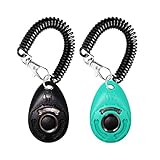
- EASY TO USE - Simple push button with distinct clicking sound.
- Comes with an elastic wrist band so you can leave it on your wrist or clip it to the leash or your pants.
- Not only train the dog but also the cat, bird, chicken, sheep a new behaviors like sit, fetch, roll over, lie down.
- For effective pet training ALWAYS reward with a treat after clicking.
- Can be used to train the dog basic obedience, small trick, and correct the bad behavior; Scientific method of training your pet safely and easily.
Drop it means release something already in the dog’s mouth. Offer a better reward or a favorite toy, mark the release, and give the reward. Whenever safe, return the toy afterward so dropping an object does not always end the game. If the dog guards food or objects, do not reach into its mouth; obtain professional guidance.
6. Go to mat or place
Reward any interest in a mat, then four paws on it, then lying down. Add a release cue and gradually increase the time you move around. Use the mat during meals, deliveries, children’s activity, or visitors. It gives the dog a clear alternative to jumping, pacing, or crowding people.
House-train from the first day
Take the dog to the designated bathroom area on a predictable schedule and reward immediately after elimination. Young puppies commonly need to go after waking, eating, drinking, playing, napping, or leaving a crate. Depending on age and individual control, some need trips every two to four hours or more often.
Supervision is the other half of the plan. If you cannot watch the puppy, use a properly managed pen, crate for an appropriate short period, or a small puppy-proofed area. If you catch an accident beginning, calmly interrupt and take the dog outside. Do not punish an accident discovered later: delayed punishment cannot teach the dog what it should have done and may cause hiding.
Do these 3 things before closing this tab:
1Scan for outdated or missing drivers - takes under a minute2Repair Windows errors before they cause bigger problems3Fix the driver behind crashes, sound loss and screen glitchesClean indoor accidents with an enzymatic pet-odor product according to its label. If house-soiling continues despite a consistent schedule and supervision, arrange a veterinary examination. Urinary disease, diarrhea, pain, and other medical problems can look like incomplete training.
Crate-train without creating panic
A crate should be a safe resting area, never a punishment. Choose one large enough for the dog to stand, turn around, and lie down comfortably. Introduce it in stages:
- Leave the door open and reward investigation.
- Place treats or meals inside and let the dog enter voluntarily.
- Briefly move the door, then open it before the dog becomes worried.
- Close the door for a few seconds while you remain nearby.
- Gradually extend the duration, then add small amounts of distance.
- Practice after exercise and toileting, while still providing interaction, play, and breaks.
Whining often means you increased duration or distance too quickly. A young puppy whining overnight may need a bathroom trip. Panic, nonstop distress, escape attempts, heavy drooling, or self-injury are not ordinary resistance. Stop the progression and contact a qualified behavior professional. A puppy should not be crated all day, and confinement must not exceed its ability to eliminate.
Loose-leash walking and outdoor safety
Start inside or in a quiet yard. Mark and reward when the leash is slack and the dog is near you. If the dog reaches the end of the leash, stop or calmly change direction; resume forward movement when the leash loosens. Reward frequently at first, especially near smells, people, and other dogs.
What’s actually slowing this PC down?
Pick the symptom - the matching free tool is one click away.
Rank #4

- MANUAL AUDIBLE CLICKER: Produces an audible click when manually pressed. The clicker contains no electronics, batteries, remote-control functions, or Electronic Stimulation features.
- INDIVIDUAL RESPONSE TO SOUND MAY VARY: Dogs and other animals may respond differently to audible clicker sounds. Introduce the clicker gradually and discontinue use if the animal shows discomfort or fear.
- COMPACT HANDHELD DESIGN: Small finger-clicker design is intended to be carried and operated by the user. Review the product images and compact size before ordering to confirm it meets your expectations.
- 5-INCH VELCRO FINGER STRAP: Includes an approximately 5-inch adjustable Velcro strap designed to position the clicker on the user's finger or hand. The strap is worn by the user and is NOT intended to be worn by the pet.
- TEAL CLICKER ACCESSORY: Includes one Teal manual finger clicker and training instructions. Remote transmitter, receiver collar, batteries, and other training-system components are NOT included.
Increase distractions gradually. A dog that pulls toward a busy street may not be ready for that location, regardless of how well it walks in the living room. Practice emergency turns, attention to name, and a reliable recall on a long line in secure areas. Do not allow off-leash freedom near roads or in unsecured spaces simply because the dog knows “sit.”
Socialization means safe, positive exposure
Socialization is not forcing a puppy to greet every dog. It is teaching the dog that different people, surfaces, sounds, locations, vehicles, grooming experiences, and appropriate dogs can predict calm, rewarding experiences.
Keep exposure below the dog’s fear threshold. If the dog freezes, hides, lunges, growls, refuses food, or cannot disengage, increase distance and make the situation easier. Do not drag a fearful dog toward the trigger or hold it in a frightening situation until it “gets used to it.” Flooding can worsen fear. Gradual exposure paired with rewards is safer.
The first three months are especially important for puppies, but socialization continues throughout life. A well-run puppy class may be appropriate before the entire vaccination series is complete if it requires current vaccines, screens for illness, and uses a cleanable environment. A dog park with unknown dogs and disease exposure is not equivalent. Follow your veterinarian’s advice for local disease risks.
Teach calm greetings and handling
For greetings, reward four paws on the floor or a sit. If the dog jumps, the person should turn away and wait rather than pushing the dog down or exciting it further. Practice with one calm helper, then vary the person, doorway, clothing, and level of excitement.
Handling should be trained in tiny steps. Touch a shoulder, mark, and reward. Progress to paws, ears, collar, mouth, brushing, harnessing, and nail-trimming equipment only while the dog remains relaxed. Pair the presence of each tool with food before attempting the procedure. Cooperative handling is particularly valuable at the veterinary clinic, where forcing an unprepared dog can create lasting fear.
Common training mistakes
| Mistake | More effective response |
|---|---|
| Punishing an accident found later | Increase supervision, improve the schedule, clean enzymatically, and investigate medical causes. |
| Repeating a cue louder | Reduce distractions, improve the reward, or return to an easier step. |
| Using food as a visible lure forever | Fade the lure, then reward after the behavior is completed. |
| Rewarding too late | Mark and deliver the reward while the dog is still doing the behavior you want. |
| Training only in one room | Generalize gradually across rooms, outdoors, and real-life situations. |
| Using dominance or an “alpha roll” | Teach an alternative behavior and manage the environment without intimidation. |
| Flooding a fearful dog | Increase distance, work below threshold, and use gradual desensitization and counterconditioning. |
Reward every correct response while teaching a new behavior. Once the dog is reliable, vary the rewards rather than eliminating reinforcement entirely. A dog may earn access to a walk by waiting at the door, a game by dropping a toy, or outdoor sniffing by walking on a loose leash. Food remains useful for difficult behaviors and distracting environments.
Independent reader supportYour contribution helps us test, update, and keep practical guides available for everyone.When training needs veterinary or professional help
Arrange a veterinary evaluation for sudden aggression, touch sensitivity, anxiety, house-soiling, unusual irritability, or any abrupt behavior change. Pain and illness can make a previously easy behavior appear to become “disobedience.”
The Tool Desk
Outbyte PC Repair FREEClear out junk files and repair common Windows errorsFree Scan →Outbyte Driver Updater FREEFix the driver behind crashes, sound loss and screen glitchesFind Drivers →Best Value

- Stronger Bark Control with 3X Ultrasonic Emitters: Unlike single-emitter devices, our upgraded dog bark deterrent features three synchronized ultrasonic heads—delivering 3X the coverage to quickly stop barking, biting, and jumping behaviors. Ideal for anti barking training, safer than bark collar, more effective than a dog whistle, offers a humane, high-performance dog training solution
- 6-in-1 Safe & Humane Training Modes:Our dog bark deterrent device features dual ultrasonic frequencies (fixed 25kHz and variable 20-30kHz), combining 4 ultrasonic modes plus an audible beep and LED flashlight for versatile training. Whether for daily training or stubborn, persistent barking, this anti bark device adapts to different dogs providing effective bark control without causing pain or distress. Perfect for training at home or to stop neighbors dog bark that disturbs your peace
- 23 FT Extended Range & Night Safety: Bark Control Anytime, Anywhere: Stop barking and bad behavior from up to 23 feet away with our powerful dog bark deterrent device — perfect for your yard, neighbor’s yard, outdoor walks, and off-leash areas. Whether you're relaxing at home or out for a stroll, enjoy safe, long-distance control to correct disruptions quickly. The built-in LED flashlight adds safety for evening walks, and low-light training
- Fast Charge & Long Battery Life – Always Ready for Training:With a Type-C fast charging port, our dog bark deterrent device reaches a full charge in just 2 hours and provides up to 30 days of regular use on a single charge, along with 180 days of standby time. Whether you're correcting anti barking behavior or training your dog in public places, you’ll always be prepared for any situation. Forget the hassle of frequent charging and enjoy reliable, long-term barks no more support
- Ultra-Compact Design for Everyday Convenience:50% smaller than standard dog bark deterrent devices, our anti barking device is ultra-compact and lightweight, fitting effortlessly into your pocket, bag, or hand. Whether you're on daily walks, outdoor adventures, or dealing with unexpected situations in public places, this portable design helps you stop barking and encourage good behavior anywhere, anytime. Say goodbye to constant noise and enjoy a barks no more experience with your dog
Get professional help promptly for bites, serious aggression, severe fear, panic, separation anxiety, resource guarding with bite risk, escape behavior, or self-injury. Manage safety first with barriers, distance, leashes, and closed doors; do not test whether the dog is “better” by exposing people or animals to risk.
Dog training is not regulated as a profession in the United States, so ask prospective trainers exactly what tools and procedures they use. Observe a class if possible. Avoid anyone who promises instant results, relies on pain or intimidation, describes behavior mainly in terms of dominance, or says fear is something the dog must simply endure. Your veterinarian can help identify appropriate veterinary behavior and training referrals.
FAQ
How long does it take to completely train a dog?
There is no universal timetable. Basic household skills may develop over weeks or months, while reliable recall, calm behavior around distractions, and cooperative handling require ongoing practice. Adult and senior dogs can learn, but history, health, motivation, and environment affect the pace.
Can a dog be trained without a shock, prong, or choke collar?
Yes. Current AVSAB guidance recommends reward-based training only and rejects aversive tools and intimidation. Use rewards, management, clear routines, gradual progression, and replacement behaviors instead.
Recommended Free Tools
What should I do if my dog ignores a command?
Do not repeat the cue louder. Make the exercise easier, move away from distractions, use a more valuable reward, or return to a step the dog already performs successfully. Then rebuild difficulty gradually.
Is it too late to train an older dog?
No. Older dogs can learn new behaviors. Keep sessions short and consider hearing, vision, pain, mobility, or cognitive changes. A veterinary check is appropriate if behavior has changed suddenly or the dog seems uncomfortable.
The Bottom Line
Train the dog you have, in the situations where you need reliable behavior. Use rewards delivered at the right moment, prevent unwanted rehearsal, build duration and distractions gradually, and practice beyond the living room. House-training, recall, leash skills, socialization, calm greetings, and cooperative handling matter more than collecting a long list of impressive commands. For aggression, panic, serious fear, self-injury, or sudden behavior changes, involve a veterinarian and qualified behavior professional rather than trying to solve the problem with force.
Quick Recap
Product prices and availability are accurate as of the date/time indicated and are subject to change. Any price and availability information displayed on Amazon at the time of purchase will apply.




