Recommended Free Tools
Fiona is an approximately 131-million-year-old ichthyosaur fossil discovered in Chilean Patagonia, preserved with a near-term fetus and what researchers interpret as her last meal. The find offers a rare glimpse of marine-reptile reproduction, diet and burial during the Early Cretaceous. It does not prove that one catastrophe killed every animal at the site or resolve every question about how the fossil field formed.
What is Fiona, and was she really pregnant?
Fiona is an ichthyosaur—a marine reptile, not a dinosaur—found near Tyndall Glacier in Patagonia, Chile. University of Texas at Austin researchers report that she was about 11 feet (3.4 meters) long and lived roughly 131 million years ago, during the Hauterivian stage of the Early Cretaceous. The university describes Fiona as the only fully preserved and excavated pregnant ichthyosaur known from Chile and the only known pregnant ichthyosaur from the Hauterivian interval.
The evidence for pregnancy is the preserved fetus within the mother’s body. It was close to the end of development and lay tail-first toward the birth canal. That position fits the live-bearing reproduction known in ichthyosaurs. The fossil therefore provides unusually direct evidence of a reproductive stage, rather than an inference based only on an adult and young animals found near one another.
What was preserved inside the fossil?
A fetus positioned for birth
The fetus’s orientation and late developmental stage make Fiona useful for studying how an ichthyosaur pregnancy looked near its end. Ichthyosaurs gave birth to live young; the tail-first position is consistent with that pattern. The specimen preserves the mother and fetus together, allowing their relationship to be read from the fossil itself.
Free tools Windows power users keep installed
One-click scans. No signup required.
#1 Best Overall

- Replica Chirostenotes dinosaur claw – approx. 4.5 inches (11.43cm)
- Species: Chirostenotes pergracilis, Late Cretaceous (~76.5 million years ago), Alberta, Canada
- Realistic texture and anatomical accuracy – great for collectors, educators, and fossil enthusiasts
- Useful in paleontology education, museum displays, or as a unique prehistoric gift
- Display-ready fossil replica (stand not included)
A probable last meal
A cluster of small fish vertebrae lies inside Fiona’s ribcage. Researchers interpret these remains as stomach contents, likely her last meal. This is evidence about what she had eaten shortly before death, not a complete account of her diet.
An old injury and possible illness
Researchers documented a healed fin injury and fused bones that may reflect an infection. These features suggest Fiona survived an earlier injury and may have experienced disease, although the fused bones are not definitive proof of infection.
Smithsonian Magazine reported in 2025 that a later CT scan showed evidence of a second fetus. In that account, the finding was awaiting a dedicated paper, so the two-fetus result should be treated as a reported follow-up rather than as a settled result in the primary publication. The fossil is established as pregnant; the published account cited here does not settle the final embryo count.
How did Fiona become so well preserved?
Fiona’s snout had penetrated about four inches into the sand when she reached the seafloor. Sedimentary structures suggest she may have been caught in an underwater landslide or a similar sediment flow and buried rapidly. Quick burial can protect remains from scavengers and currents that would otherwise scatter bones. In Fiona’s case, it helps explain how the mother, fetus and probable stomach contents remained associated.
Rank #2

- Detailed Pterodactylus kochi skeleton replica
- Crafted with care to capture the unique structure of this Cretaceous pterosaur
- Makes an eye-catching piece for paleontology enthusiasts and fossil collector
- Appropriate for home décor, offices, or educational spaces
This is a geological interpretation, not a witnessed account of her death. The evidence supports rapid burial in a sediment flow; it does not establish every detail of the event or prove that all animals in the area died at the same time.
How was the fossil discovered and excavated?
Paleontologist Judith Pardo-Pérez discovered Fiona in 2009. The remote, glaciated site made excavation and transport difficult. The fossil was removed in five sections and airlifted to the Natural History Museum Río Seco in Punta Arenas for research.
The nickname Fiona came from the Shrek character: a reaction involving preservative temporarily turned the bones green. It is a memorable label, not the animal’s formal species name.
What does the wider fossil field reveal about the ancient ocean?
A rich marine-reptile site, but not necessarily one mass death
The find came from a larger concentration of ichthyosaur remains. UT Austin reports 87 other ichthyosaurs in the glacial field. Smithsonian Magazine also describes neonate and newborn remains and notes a possible nursery interpretation. A concentration of young animals can suggest an area used for breeding or early life, but the nursery idea remains an interpretation, not a demonstrated fact.
Rank #3
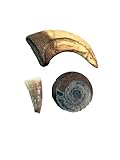
- Three-Item Fossil Set – Includes one Velociraptor claw replica, one Mosasaur tooth (B-grade), and one genuine small ammonite fossil
- Educational and Collectible – A great hands-on way to explore prehistoric life and paleontology
- Genuine Fossils Included – Both the Mosasaur tooth and ammonite are real fossil specimens
- Realistic Replica Claw – Velociraptor claw cast features high quality texture and curvature
- Ready for Display or Teaching – Great for collectors, educators, or science-themed gifts
Preliminary geological work suggests the site may contain multiple mass-death layers formed by repeated landslides rather than a single event that killed all the animals at once. Researchers are conducting geochemical analyses to investigate whether one or several events caused the burials and what triggered them. The cause and timing of the full assemblage’s formation remain under study.
A changing coastline and ocean gateways
Fiona lived while South America was separating from Africa. The opening of ocean passages could have changed currents, climate, migration routes and the locations where marine reptiles found food or reproduced. These are important questions for understanding the setting, not conclusions that Fiona’s fossil alone can answer. As UT Austin assistant professor Matt Malkowski put it, predators depend on “migration pathways” and places to hunt and reproduce.
Independent reader supportYour contribution helps us test, update, and keep practical guides available for everyone.How old is the fossil?
UT Austin reported a high-precision age of approximately 131 million years in 2025, placing Fiona in the Hauterivian stage of the Early Cretaceous. Live Science used the broader estimate of roughly 129–139 million years for the Tyndall specimen in 2022. The more precise figure is the later university report; the older range reflects an earlier, less specific estimate rather than a separate, more exact date.
Why Fiona matters—and what the evidence cannot yet say
Fiona matters because several kinds of evidence occur together in one exceptionally informative specimen: a pregnant adult, a near-term fetus in birth-consistent orientation, probable stomach contents, and signs of an old injury and possible illness. The site also places that individual within a broader assemblage that may preserve repeated burial events during a period of continental change.
As ichthyosaur specialist Erin Maxwell told Live Science in 2022, the site captures a period in Earth’s history with a relatively poor marine-reptile fossil record. That scarcity makes the specimen valuable, but it also counsels restraint: Fiona can illuminate one animal and contribute to interpretations of the site, while ongoing geological and geochemical work is needed to test the wider explanations.
Quick Recap
Product prices and availability are accurate as of the date/time indicated and are subject to change. Any price and availability information displayed on Amazon at the time of purchase will apply.




