
Quick wins for a faster PC:
Scan for outdated or missing drivers - takes under a minuteDriver Scan →Repair Windows errors before they cause bigger problemsFix Now →For a first freshwater fish tank, start with four functional groups: a correctly supported aquarium, a filter, water conditioner plus a test kit, and temperature equipment when the fish and room require it. The heater is not universal; species, aquarium size and room temperature determine whether you need one. This guide covers freshwater systems, because saltwater aquariums require different equipment and preparation.
The most important purchase is not a particular brand. It is a setup that fits the adult fish, can hold stable water conditions and gives you time to mature the biological filter before stocking.
As an Amazon Associate I earn from qualifying purchases.
The four items to plan for
| Functional group | What it does | When it is required |
|---|---|---|
| Aquarium and stable stand | Provides enough swimming space and a safe, level support structure. | Always. Select the size and shape for the species at adult size. |
| Filter | Moves water through mechanical and biological media and supports bacteria that process fish waste. | Essential for almost every normal home freshwater aquarium. |
| Water conditioner and test kit | Conditioner neutralizes harmful disinfectants in tap water; testing reveals ammonia, nitrite, nitrate and pH. | Use conditioner whenever tap water is added and test especially closely during startup. |
| Heater and thermometer | Maintains and verifies a suitable temperature. | Usually needed for tropical fish or cool rooms; not every species or room needs a heater. |
Additional equipment such as a lid, light, substrate, plants, hiding places and a gravel vacuum can make a tank safer and easier to maintain. Their suitability depends on the fish and the aquascape, so they are not universal substitutes for the four core groups.
The Tool Desk
Outbyte PC Repair FREEClear out junk files and repair common Windows errorsFree Scan →Outbyte Driver Updater FREEFix the driver behind crashes, sound loss and screen glitchesFind Drivers →1. Choose the aquarium and stand together
Size for adult fish, not the shop size
Research each species before buying the tank or fish. Check adult length, activity level, swimming style, social needs, water parameters and temperature range. A fish that is small in a store may need substantially more room as an adult, and some species need long horizontal swimming space rather than a tall container.
#1 Best Overall
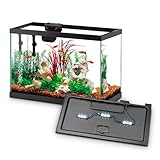
- PERFECT FOR BEGINNERS AND SEASONED AQUATIC HOBBYISTS: User-friendly setup designed for quick aquarium assembly and maintenance.
- COMPLETE STARTER KIT: Includes a 10-gallon glass rectangle aquarium, low profile hood with cool white LED lighting and feeding door, SmartClean filtration, EcoRenew cartridge, preset heater 50W, thermometer, fish net, premium fish food and a water conditioner.
- SIMPLE MAINTENANCE: SmartClean internal power filter provides quick and easy water changes to help improve water quality.
- IDEAL TEMPERATURE: Preset heater keeps your aquarium temperature at a constant 78 degrees, appropriate for most tropical fish.
- DURABLE GLASS CONSTRUCTION: Ensures clarity and durability, providing a safe environment for your fish. Made from high-quality materials for long-lasting use.
Buy as large an aquarium as you can reasonably accommodate and maintain. A larger volume generally changes temperature and chemistry more slowly, making mistakes less abrupt and water quality more stable. That does not make an overstocked large tank safe: stocking still has to match the species and filtration capacity.
Do not treat the often-repeated one-inch-of-fish-per-gallon idea as a universal welfare rule. The Centers for Disease Control and Prevention repeats it as a general guideline, but body shape, adult behavior, filtration, surface area and social requirements make a single formula inadequate for every fish.
Dimensions affect behavior and water exchange
Two aquariums with the same nominal volume can provide very different living space. Length and width determine usable swimming area; surface area affects gas exchange; height affects access and maintenance. Choose dimensions that let the fish turn, establish territories and reach the surface normally.
What’s actually slowing this PC down?
Pick the symptom - the matching free tool is one click away.
Support the full, filled weight
Place the aquarium on a level, weight-bearing stand designed for that tank. Aqueon estimates a filled aquarium with gravel and decorations at approximately 10 pounds per gallon. That is an attributed manufacturer estimate, not a universal engineering specification, so follow the stand and aquarium maker’s requirements and account for every decoration, cabinet and equipment item.
Use a safe location
- Keep the tank away from direct sunlight, which can overheat water and encourage algae.
- Avoid radiators, fireplaces, air-conditioning outlets and cold draughts that create temperature swings.
- Choose a quiet location away from repeated vibration, slamming doors and loud equipment.
- Leave enough clearance to reach the filter, unplug equipment, perform water changes and lift the lid.
- Make sure the floor and stand are level before filling; a filled aquarium cannot be safely repositioned.
2. Install a real filter, then mature it
What filtration actually does
A filter pulls water through media, catches suspended debris and provides a surface where beneficial bacteria can grow. Those bacteria help convert toxic fish waste into less harmful compounds. Filtration is therefore both water movement and biological treatment; a pump that merely circulates water is not the same as a mature biological filter.
How to compare filters
Match the filter to the aquarium’s volume, the species’ tolerance for current and the amount of biological media it can hold. Look for a flow that turns over the tank effectively without exhausting slow-moving fish. Consider whether media can be replaced or rinsed without destroying the established bacterial surface, whether the intake can be guarded for small fish and whether maintenance is practical in your cabinet.
The available guidance does not establish one universally best filter type or brand. A filter that is quiet and easy to service may be a better beginner choice than a more powerful model that creates excessive current or is neglected because it is difficult to clean.
A new filter is not biologically mature
Switching on a brand-new filter does not make a tank ready for fish. The bacterial population needs time and an ammonia source to develop. During this period, ammonia and nitrite may rise and later fall. Continue testing instead of declaring the aquarium cycled after a fixed number of days.
3. Condition tap water and test it
Why tap water needs treatment
Municipal water can contain chlorine or chloramine used for disinfection. These chemicals can injure fish and damage the bacteria you are trying to establish. Add an aquarium water conditioner according to that product’s directions whenever preparing initial water or replacement water. Do not assume that letting water stand will reliably remove chloramine.
Rank #2
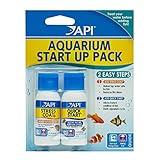
- Contains one (1) API AQUARIUM START UP PACK Water Conditioner 1.25-Ounce Bottle 2-Pack
- Makes tap water safe for fish and reduces fish stress.
- Starts aquarium cycle and allows instant addition of fish.
- Comes with two API products, STRESS COAT and QUICK START, for a healthy start-up aquarium.
- Use when starting a new aquarium, changing water, or adding fish. Add STRESS COAT first and then QUICK START.
The four measurements a beginner should track
- Ammonia: produced by waste and dangerous even at low levels.
- Nitrite: an intermediate compound that is also toxic to fish.
- Nitrate: the later product of biological processing; it is managed with maintenance and water changes.
- pH: acidity or alkalinity, which must suit the selected species and remain reasonably stable.
The Ornamental Aquatic Trade Association recommends a test kit that measures ammonia, nitrite, nitrate and pH. Follow the kit’s timing, sample volume and color-reading instructions exactly. Do not compare results from different methods as if they were interchangeable.
Testing is most important during startup
Test the source water before stocking, then test repeatedly while the filter matures. Record dates and results so you can see whether ammonia and nitrite are falling rather than relying on appearance or a clear-looking tank. If either is detectable after fish are present, stop adding fish, test again to confirm the result and perform appropriate conditioned-water changes while investigating the cause.
4. Add temperature equipment only when the fish need it
Heater requirements vary
Tropical fish generally need water warmer than many homes provide, while some temperate species may be comfortable without a heater in a stable room. Fish differ in their required range, and the sources do not support one temperature that is safe for every aquarium animal. Confirm the species’ temperature range before purchasing equipment.
Select by volume, target temperature and room minimum
Choose a heater rated for the aquarium volume and capable of maintaining the required temperature above the room’s lowest temperature. Aqueon’s wattage table assumes a room temperature of 68–72°F; do not reuse those recommendations if your room is colder, warmer or subject to large fluctuations. The same aquarium may need different capacity in different rooms or seasons.
Use a separate thermometer to verify actual water temperature. Set the heater according to its instructions, allow it to acclimate as directed before switching it on, and check that it is fully submerged if the model requires that. A thermometer is useful even when you do not install a heater because it reveals seasonal changes and equipment failure.
Useful extras, and items that are not automatically mandatory
Lid or hood
A lid reduces evaporation, limits jumping and helps keep dust or household chemicals out. Leave openings needed for cables and safe gas exchange according to the aquarium design.
Lighting
Choose lighting for the animals and plants. A fish-only aquarium needs a different lighting approach from a planted display, and excessive light can fuel algae. Provide a predictable day-night schedule rather than leaving lights on continuously.
Substrate, cover and decor
Use substrate and decorations that are safe for the species and cannot trap or injure them. Hiding places and plants can reduce stress and let fish display natural behavior. Rinse new gravel with plain water only; never use soap or household cleaning products.
Gravel vacuum and maintenance tools
A gravel vacuum simplifies removal of debris during water changes. Keep dedicated buckets, a thermometer and simple cleaning tools that have never contacted detergents, pesticides or other chemicals.
Rank #3

- 【𝐀 𝐅𝐫𝐢𝐞𝐧𝐝𝐥𝐲 𝐒𝐭𝐚𝐫𝐭𝐞𝐫 𝐊𝐢𝐭 𝐟𝐨𝐫 𝐅𝐢𝐬𝐡𝐤𝐞𝐞𝐩𝐢𝐧𝐠】Everything you need to start a thriving aquarium is right here: a crystal-clear fish tank, a multi-stage filtration system, a heater, a digital thermometer, a LED light with Timer, a water changer, and a net. It eliminates worries about water quality, temperature, or light, making it the perfect gift for a kid, a beginner, or anyone desiring the serenity of nature without the hassle.
- 【𝐇𝐢𝐝𝐝𝐞𝐧 & 𝐏𝐫𝐨𝐭𝐞𝐜𝐭𝐞𝐝】eWonLife small aquarium features a hidden multi-storage design that neatly tucks away all essential gear, including heaters and filters. This gives you a clutter-free view and allows your curious fish to explore happily, fearlessly, and free from harm from the pump
- 【𝐌𝐨𝐫𝐞 𝐅𝐢𝐥𝐭𝐞𝐫 𝐌𝐞𝐝𝐢𝐚, 𝐅𝐞𝐰𝐞𝐫 𝐖𝐚𝐭𝐞𝐫 𝐂𝐡𝐚𝐧𝐠𝐞𝐬】After the initial sponge filter, we've added ceramic rings and quartz balls to create a paradise for beneficial bacteria. Think of them as a tiny, powerful cleanup crew that constantly removes invisible toxins from fish waste. This creates a clear and stable environment where your aquatic friends can thrive, and far less work for you
- 【𝟕𝟖°𝐅 𝐂𝐨𝐧𝐬𝐭𝐚𝐧𝐭 𝐓𝐞𝐦𝐩𝐞𝐫𝐚𝐭𝐮𝐫𝐞 & 𝐄𝐚𝐬𝐲 𝐑𝐞𝐚𝐝𝐢𝐧𝐠𝐬】The included heater creates a stable, ideal 78°F world for your Betta fish and tropical fish to thrive. The clear LED thermometer instantly confirms the perfect conditions, so you can sit back and enjoy watching your fish swim happily
- 【𝐂𝐨𝐦𝐩𝐚𝐜𝐭 & 𝐂𝐫𝐲𝐬𝐭𝐚𝐥-𝐂𝐥𝐞𝐚𝐫 𝐃𝐞𝐬𝐤𝐭𝐨𝐩 𝐀𝐪𝐮𝐚𝐫𝐢𝐮𝐦】Made from high-clarity, durable plastic, this lightweight tank (15"L x 7.9"W x 8.3"H) fits perfectly on any desk or balcony. The 3.5 gallon swimming space is an ideal home for a Betta, small schooling fish (like Cardinal Tetra or Zebra Danios), and ornamental shrimp (such as Red Cherry or Blue Velvet)
Air pumps are conditional
An air pump can increase surface agitation or power certain filters, but Aqueon notes that aeration is not a necessity in every aquarium. A correctly sized filter, appropriate stocking and good surface movement may provide adequate gas exchange. Add an air pump when the setup or species benefits from it, not as an automatic purchase.
Free tools Windows power users keep installed
One-click scans. No signup required.
Set up the tank in this order
- Research the livestock first. Write down adult size, social requirements, temperature range, pH preference and expected activity before choosing the aquarium.
- Position the empty aquarium. Put it on its intended level stand, away from sunlight, heat, draughts, vibration and high-traffic areas. Confirm that the stand is designed for the tank.
- Rinse substrate and hardscape. Use plain water only. Do not use soap, bleach or household cleaners unless a product’s aquarium-specific directions explicitly require a safe treatment and thorough rinsing.
- Install the filter and heater. Follow each manufacturer’s instructions. Arrange cords with a drip loop so water cannot run along a cable into an outlet.
- Add conditioned water. Dose the conditioner for the volume and water type specified by its label. Fill slowly to avoid disturbing the substrate and arrange decorations and plants.
- Set and verify temperature. If a heater is required, set it for the species’ range and check the water with a separate thermometer. Confirm that the filter is moving water normally.
- Begin a fishless cycle. Add a measured ammonia source as directed by a reliable cycling method and test regularly. Proprietary bacterial cultures may help when used according to their instructions, but they do not remove the need to test.
- Wait for biological evidence. Add fish only after ammonia and nitrite reach zero and remain at zero while the system processes its intended ammonia load. PetMD’s freshwater overview gives four to six weeks as a typical natural-cycle estimate, but that is not a guarantee or a substitute for test results.
- Stock gradually. Add a small group appropriate to the tank, allow the filter to adjust and continue testing before adding more. Avoid filling the aquarium to its planned maximum on the first day.
- Start a maintenance log. Record tests, water changes, filter servicing and unusual behavior. Trends often reveal a problem before fish show severe signs.
Fishless versus fish-in cycling
| Approach | How it works | Risk and beginner guidance |
|---|---|---|
| Fishless cycling | A measured ammonia source feeds bacteria before fish arrive. | Preferred because fish are not exposed to an immature filter. It still requires repeated testing and patience. |
| Fish-in cycling | Fish provide the ammonia while the bacterial population develops. | Ammonia and nitrite can harm fish. OATA advises using this only with great care and retailer guidance, with frequent testing and prompt management. |
The calendar is only an estimate. A cycle can take less or more time depending on temperature, pH, surface area, ammonia supply, water changes and the bacterial culture present. Zero readings on one day are not enough if the filter has not demonstrated that it can process waste consistently.
How to choose between equipment options
| Decision | Compare these factors | Avoid this shortcut |
|---|---|---|
| Aquarium | Adult fish size, length and footprint, swimming space, total volume, stand support and cleaning access. | Choosing by the juvenile fish’s current size or by volume alone. |
| Filter | Species-appropriate flow, biological-media capacity, intake safety, noise and maintenance access. | Assuming the strongest flow or most expensive design is automatically best. |
| Conditioner | Whether it treats the disinfectant in your tap water and the dose for your actual water volume. | Using a random household water treatment or guessing the dose. |
| Test kit | Ammonia, nitrite, nitrate and pH coverage, readable directions and a method you will use consistently. | Relying on water clarity, fish behavior or a single strip result as proof of safety. |
| Heater | Required species temperature, aquarium volume and the room’s minimum temperature. | Applying a wattage chart without checking its room-temperature assumptions. |
Common first-tank mistakes and fixes
Adding fish immediately
Problem: The filter runs, but ammonia and nitrite rise because the bacterial population is immature. Fix: Cycle fishlessly whenever possible and wait for sustained zero ammonia and nitrite before stocking.
Buying a tank that is too small
Problem: Small volumes change temperature and chemistry quickly and may not provide adequate swimming space. Fix: Start with the largest practical aquarium and select fish that fit its adult dimensions and maintenance demands.
Using untreated tap water
Problem: Chlorine or chloramine can injure fish and disrupt biological filtration. Fix: Condition every batch of tap water according to the product label.
Replacing all filter media at once
Problem: Removing established media can remove much of the bacterial population. Fix: Follow the filter instructions, preserve biological media where possible and rinse reusable media only as directed, using water that will not expose it to cleaning chemicals.
Overheating or trusting the heater dial
Problem: A dial setting is not the same as measured water temperature, and a heater sized under different room assumptions may not perform as expected. Fix: Use a separate thermometer, check the tank regularly and size the heater for the actual room and volume.
Overstocking because the water looks clear
Problem: Clear water can still contain toxic ammonia or nitrite. Fix: Base additions on test results, adult fish needs and the filter’s demonstrated capacity, adding livestock gradually.
A simple maintenance rhythm after cycling
- Daily: Observe appetite, breathing, swimming and temperature; remove obvious dead material.
- During the first weeks: Test ammonia and nitrite frequently, especially after each new group of fish.
- At scheduled water changes: Test the replacement water, condition it, match temperature as closely as practical and use a gravel vacuum where appropriate.
- When servicing the filter: Follow its instructions and avoid chlorinated cleaning or replacing every biological surface at once.
- Whenever something changes: Retest after adding fish, changing equipment, treating illness or seeing unusual behavior.
The CDC recommends researching tank type, size, fish requirements, temperature, filtration, water treatment, cleaning and cycling before bringing fish home. The U.S. Fish and Wildlife Service’s classroom-salmon supply list supports the same broad equipment categories, but it is not a universal home tropical-fish shopping list. OATA provides detailed freshwater care guidance, while Aqueon’s equipment explanations and weight and heater figures are manufacturer-specific. PetMD’s April 24, 2026 article by Sean Perry, DVM, is a practical freshwater setup reference.
Recommended Free Tools
Set up the aquarium, condition and test the water, mature the filter and add fish only when the measurements show that the system can process waste. That sequence matters more than buying extra accessories.
Quick Recap
Product prices and availability are accurate as of the date/time indicated and are subject to change. Any price and availability information displayed on Amazon at the time of purchase will apply.





Leave a Reply