
The largest barracuda recognized in Florida’s state record program is a 67.00-pound great barracuda caught by Harold K. Goodstone at Islamorada on January 29, 1949. That is the Florida Fish and Wildlife Conservation Commission (FWC) all-tackle weight record. Other impressive figures—such as a 37.75-pound fly-fishing record and a 142-centimeter international length record—belong to different categories and should not be presented as a heavier Florida state catch.
The largest barracuda caught in Florida
When “largest” means the heaviest recognized Florida catch, the answer is the FWC’s 67.00-pound great barracuda. Harold K. Goodstone caught it at Islamorada on January 29, 1949. The entry appears in the FWC’s Florida Saltwater Fishing Records listing, which is the relevant authority for a Florida state-record question.
As an Amazon Associate I earn from qualifying purchases.
The fish is a great barracuda, the species covered by the record entry. The FWC table treats this as an all-tackle weight record, meaning the comparison is based on certified weight rather than length, fly-fishing equipment, line class, or an informal report.
Crashes, No Sound, or Screen Glitches?
Random freezes, missing sound and display glitches usually trace back to one bad driver. Find and replace yours safely.Free scan · under a minutePC Slower Than It Used to Be?
A free scan shows the junk files, broken settings and background clutter dragging Windows down - then fixes them in one click.Free scan · Windows 10 & 11Florida barracuda records at a glance
| Record system and category | Recorded result | Angler, place and date | How to interpret it |
|---|---|---|---|
| FWC Florida saltwater all-tackle weight | 67.00 lb | Harold K. Goodstone, Islamorada, January 29, 1949 | Florida’s listed heaviest great barracuda state record |
| FWC Florida saltwater fly-fishing weight | 37.75 lb | Joe Machiorlatti, Key West, December 19, 1978 | A separate fly category, not a replacement for the all-tackle record |
| IGFA All-Tackle Length Fly world record | 142 cm | Captain Nick LaBadie, off Key West, January 31, 2025 | A length-based international record; the fish was released |
| Florida Museum species profile | 1.7 m (5.5 ft), 44 kg (103 lb) hook-and-line fish | Location and record category are not identified as Florida state-record details | General size context, not evidence of a larger Florida state catch |
The figures are not interchangeable. A weight record answers “heaviest,” while a length record answers “longest under that organization’s rules.” A Florida state record and an IGFA world record also come from different governing systems.
#1 Best Overall

- COLOR - Chartreuse, Pink, Orange, Green, Black
- TOTAL LENGTH - 21", TUBE LENGTH - 15", TUBE SIZE - 7/16"
- HOOK - (2) 4/0, WEIGHT - (2) 1/4 oz, WIRE - 60 LB Surflon, SWIVEL - 150 LB, WEIGHT - 1.6 ozs
- Made in the Florida Keys with all American made parts.
Why the 67-pound entry is the answer to the Florida question
It is the FWC all-tackle category
The FWC maintains marine-fish records for catches made in Florida state waters and in qualifying federal waters extending directly outward from Florida state waters. Its program includes all-tackle, youth and fly-fishing records, plus length records for selected species. Great barracuda is an eligible species.
For a question asking for the largest barracuda caught in Florida, the ordinary meaning is the heaviest eligible Florida catch. That makes the 67.00-pound all-tackle listing the direct answer. The catch date is 1949, but the age of the entry does not make it less applicable: a state record remains the listed record until a properly documented fish replaces it.
The record listing is different from a reported big fish
Anglers may encounter photographs, local stories or species-size claims describing very large barracuda. Unless a fish is accepted in the relevant record category, those reports cannot displace the FWC entry. The current listing reviewed for this topic contains no same-category competing Florida all-tackle claim that supersedes 67.00 pounds.
Do these 3 things before closing this tab:
1Repair Windows errors before they cause bigger problems2Scan for outdated or missing drivers - takes under a minute3Clear out junk files and repair common Windows errorsRank #2

- Extremely realistic. Features incredibly life-like details such as 3D eyes, gill plates, scale pattern and laser holographic painting that make hungry fishes crazy. Please refer to the second image for detail look of each color.
- Classic shape popper with a new cup mouth design will deliver a much more aggressive popping action to trigger more bites. Cup mouth and steel balls will generate loud gurgling and rattling sound to call out fishes from the depth.
- Armed with two razor sharp VMC treble hooks and enhanced stainless steel split rings to dramatically increase hook-up percentage. Strengthened ABS material and steel wire-through body are ready to stand against the attack from predators.
- Designed with internal smart weight-shift chamber and rattling balls allow you to cast with longer distance and higher accuracy.
- Quantity: Pack of 3. Length: 5.5"; Weight: 1.41oz.
How the other notable numbers fit
Florida’s 37.75-pound fly record
Joe Machiorlatti’s 37.75-pound great barracuda, caught at Key West on December 19, 1978, is the FWC fly-fishing weight record listed for Florida. Fly-fishing records impose a different tackle category, so this number should not be compared with the all-tackle result as if both were measured under identical rules. It is lower than 67.00 pounds, but it is still the relevant Florida record for that fly category.
The 142-centimeter IGFA record
In a January 15, 2026 recap, the International Game Fish Association (IGFA) reported that Captain Nick LaBadie caught a 142-centimeter great barracuda off Key West on January 31, 2025. The fish set an All-Tackle Length Fly World Record. LaBadie used an Official IGFA Measuring Device and released the fish.
That achievement does not supersede Florida’s 67-pound all-tackle weight record. It measures length, not mass, and it is an IGFA world category rather than an FWC Florida state category. A long, lean fish and a shorter, heavier fish can rank differently in those two systems.
Rank #3
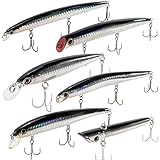
- Holographic silver painting mimic real sea bait fish and create flashing reflection under water, maxmize their attraction in dark sea water
- 2 of them comes with Mustad treble hooks to offer secured hold for huge saltwater species
- Different styles of saltwater baits including poppers and jerkbaits allows you to target different saltwater species in different condition. Covers almost all water column
- Streamlined lure body creates a wobbling swimming action to mimic wounded bait fish. Works like a charm for hungry, fierce sea predators
- Built-in weight chamber increases casting distance. Works for different techniques like surf fishing or offshore boat fishing. Targets species like striper, tarpon, barracuda, snapper and more
Junior and line-class records
IGFA’s July 2025 recent-records listing also includes junior great barracuda line-class catches in the Florida Keys. Line-class and junior records recognize performance within narrower tackle or age categories. They are not evidence that Florida’s heaviest all-tackle barracuda has changed.
What’s actually slowing this PC down?
Pick the symptom - the matching free tool is one click away.
How large can a great barracuda get?
The Florida Museum of Natural History profile supplies useful biological context but does not identify its figures as Florida state records. It reports a hook-and-line-caught great barracuda measuring 1.7 meters (5.5 feet) and weighing 44 kilograms (103 pounds). The profile also says the species is reported to attain about 2 meters and 50 kilograms.
Those numbers explain why a 67-pound Florida record is substantial without proving that a 103-pound fish was caught in Florida under FWC rules. The profile does not establish the location, eligibility, documentation or record category of the 1.7-meter, 44-kilogram fish. Treat it as species-size information, not as a competing Florida record.
Rank #4

- Made in the USA: Quality and precision for the discerning angler.
- Colors: Effectively attracts various fish species.
- High-quality Hooks: Reliable hooks for secure catches.
- Weight: 1 oz: Ideal for casting and long-distance throws.
Where Florida’s record waters are defined
The FWC describes its marine state-record jurisdiction as Florida state waters and federal waters extending directly outward from those state waters between latitude 30.712 in the Atlantic and longitude -87.518 in the Gulf of America. That definition matters because a fish caught near Florida is not automatically a Florida record; the water must fall within the program’s geographic rules, and the catch must satisfy the category requirements.
The two named Florida record locations are in the Keys: Islamorada for the 1949 all-tackle fish and Key West for the 1978 fly fish. The IGFA length record was also caught off Key West, but its international length category remains separate from the FWC listing.
Recommended Free Tools
Florida barracuda regulations to check before fishing
Rules depend on the county and water body. The FWC page cited for this topic lists the following framework, but regulations can change; check the live FWC regulations page before a trip and verify any federal or park rules that also apply.
Best Value
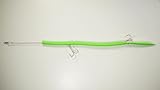
- COLOR - Chartreuse, Pink, Orange, Green, Black
- TOTAL LENGTH - 21", TUBE LENGTH - 15", TUBE SIZE - 7/16"
- HOOK - (2) 4/0, WEIGHT - (2) 1/4 oz, WIRE - 60 LB Surflon, SWIVEL - 150 LB, WEIGHT - 1.6 ozs
- Made in the Florida Keys with all American made parts.
| Florida waters covered by the cited FWC rule | Size rule | Bag or possession limit | Season |
|---|---|---|---|
| Off Collier, Monroe, Miami-Dade, Broward, Palm Beach and Martin counties | 15–36 inches fork length; one fish greater than 36 inches per person or vessel per day | The cited summary specifies the slot and large-fish allowance | The cited summary does not state a separate closed season |
| Other Florida waters covered by the cited page | No minimum size listed on that page | Two fish or 100 pounds per day, whichever is more | Year-round |
Biscayne National Park has special regulations. A county rule, park rule, federal-water rule and record-program rule are different obligations, so meeting a record requirement does not by itself make a harvest legal.
Independent reader supportYour contribution helps us test, update, and keep practical guides available for everyone.What documentation a record application needs
Record fish are accepted on evidence, not on an estimate. The FWC guidance distinguishes weight and length documentation and asks for enough material to verify the fish, the measurement and the equipment used.
- Choose the category before fishing. Decide whether the goal is an FWC all-tackle weight, an FWC fly-fishing weight, a length record or an IGFA category. The category determines the applicable tackle and measurement rules.
- Confirm the fish’s identity. Take clear photographs that show the entire fish and its identifying features. FWC guidance calls for fish-identification photographs along with gear documentation.
- Document a weight with a certified scale. For an FWC weight record, supporting certified-scale evidence is required. IGFA rules likewise reject estimated weights; a guess cannot substitute for an accepted scale measurement.
- Document length visibly. Length applications need visible measurement evidence. For the IGFA length record, the angler used an Official IGFA Measuring Device, illustrating why the measuring surface and reading must be clear in photographs.
- Photograph the tackle and participants. FWC asks for gear and fish-identification photographs. IGFA’s application rules call for acceptable photographs of the fish, tackle, scale where relevant and angler.
- Keep the original evidence. Preserve the scale or measuring-device images and the complete application information until the governing body has finished its review. Do not rely on a cropped social-media image as the only record of the measurement.
Responsible handling of a potential record fish
Documentation should not come at the expense of the fish. FWC guidance encourages best handling practices, particularly for length records, and says that large fish not being harvested should not be removed from the water or brought aboard because doing so can injure them.
The Tool Desk
Outbyte Driver Updater FREEFix the driver behind crashes, sound loss and screen glitchesFind Drivers →Outbyte PC Repair FREERepair Windows errors before they cause bigger problemsFix Now →Plan the measurement and camera positions before lifting or restraining a fish. If the fish is intended for release, keep it in the water whenever possible, minimize handling time and obtain the required evidence without unnecessary delay. A valid length record is not a reason to take avoidable risks with a large animal.
The IGFA account of the 142-centimeter Key West fly record demonstrates that a record fish can be measured with an official device and released. Release decisions must still follow the applicable law and the fish’s condition; a record application does not override conservation or safety requirements.
Common mistakes when quoting Florida’s biggest barracuda
- Calling 103 pounds the Florida record. The 103-pound figure comes from a general Florida Museum species profile whose location and record status are not established as a Florida state catch.
- Calling 142 centimeters the heaviest fish. The 142-centimeter IGFA entry is a length record, not a weight record.
- Replacing the all-tackle result with the fly result. The 37.75-pound Key West fish is a separate FWC fly-fishing category.
- Mixing FWC and IGFA labels. FWC records apply to Florida’s state program; IGFA records use international categories and rules.
- Assuming a photograph proves a record. Record bodies require documented measurements, tackle information and fish identification. An estimated weight is not accepted by IGFA.
- Ignoring water-specific regulations. County limits, Biscayne National Park rules and federal-water requirements can differ. Check the current rule before keeping or measuring a fish.
The bottom line on Florida’s largest barracuda
Florida’s recognized heaviest great barracuda is the 67.00-pound all-tackle fish caught by Harold K. Goodstone at Islamorada on January 29, 1949, according to the FWC state-record listing. The 37.75-pound Key West fly record, the 142-centimeter IGFA length record and the Florida Museum’s 103-pound species-size figure are all legitimate context, but none changes that answer because each belongs to a different category or lacks Florida state-record documentation.
Quick Recap
Product prices and availability are accurate as of the date/time indicated and are subject to change. Any price and availability information displayed on Amazon at the time of purchase will apply.
Quick wins for a faster PC:
Scan for outdated or missing drivers - takes under a minuteDriver Scan →Repair Windows errors before they cause bigger problemsFix Now →Fix the driver behind crashes, sound loss and screen glitchesFind Drivers →




Leave a Reply