Fostering bottle-fed kittens can be deeply rewarding. Watching a tiny kitten gain weight, open its eyes, and start to play is a real payoff. But it is also a round-the-clock job built on a strict feeding, warmth, and monitoring routine, and it carries real risk if a kitten is sick. Before you pick up a bottle, the first question is whether the kittens need you at all.
Start by confirming the kittens are actually orphaned
A mother cat is often nearby. She may be out finding food, or she may be waiting for people to leave before she returns. The ASPCA advises leaving apparently stable kittens where they are when it is safe to do so, watching to see whether their mother comes back, and moving them only if they need to be relocated to a safe place nearby.
When kittens need help now
If kittens appear ill or injured, contact a local shelter, rescue, or veterinary clinic promptly. Call first to confirm that the organization can accept them, because intake space and staffing vary by location. Kittens that are weak, injured, not feeding, or not gaining weight should be treated as a veterinary matter rather than a home-care project.
Check whether the kittens have an owner
For kittens that appear to be strays, look for identification and ask a veterinarian or shelter about a microchip scan. Found-animal rules differ by city, county, and country, so check local requirements before you decide to keep the kittens. If you are unsure, coordinate with a local shelter, rescue, or veterinarian who can advise you on the next step.
Quick wins for a faster PC:
Repair Windows errors before they cause bigger problemsFix Now →Fix the driver behind crashes, sound loss and screen glitchesFind Drivers →#1 Best Overall

- SQUEEZE BOTTLE - 60ml nursing bottle for newborn kittens and puppies, 2.1 ounce capacity, small animal feeding bottle is easy to squeeze and easy to control the amount of milk.
- SMALL ANIMAL FEEDER SET - 1ml for small nipples, 3ml, 5ml, 10ml for medium and large nipples, 60ml feeding bottles can be freely combined with (small, medium, large) nipples.
- 5 REPLACEABLE NIPPLES - Different sized nipples to meet the needs of small animal at every stage, the soft rubber-tipped nipple prevents scratching the gums of newborn kittens and puppies.
- 5ML BROWN FEEDER - The brown 5ml syringe is made of light-safe material to prevent photosynthesis of medication, use a separate dedicated feeder for better use when your pet is sick.
- NEWBORN KITTENS & PUPPIES GIFT - Suitable for newborn and not yet teething small animals, kittens, puppies, hamsters, chinchillas, squirrels, rabbits, etc. you will be a very gentle owner, take care of it, love it and grow with it.
What bottle-feeding involves
Bottle-feeding is the core task. It has three parts that must be right every time: the formula, the position, and the flow.
Use a commercial kitten formula
According to the ASPCA, newborn kittens normally get complete nutrition from their mother’s milk for the first four weeks. When a mother is ill, cannot produce enough milk, or the kittens are orphaned, a commercial milk replacer may be needed. Ask a veterinarian for product and feeding recommendations.
Cow’s milk is not an appropriate substitute. The VCA Animal Hospitals guidance states: “Commercial kitten milk replacers are recommended as they are superior to cow’s milk and homemade mixtures.” The ASPCApro Kitten Bottle Feeding Guide is even more direct: “Foster Caregivers must only use the provided, approved, kitten formula.” Do not improvise a homemade recipe.
Rank #2
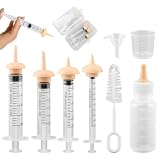
- One-Stop Scientific Feeding: Designed specifically for newborn kittens, puppies, and various small animals, this kit includes a 50ml professional feeding bottle, four precision syringes of different capacities (1ml, 3ml, 5ml, 10ml), four biomimetic nipples, as well as a funnel and measuring cup. From precise feeding immediately after birth to supplemental feeding during the transition period, this single kit meets all your care needs.
- Precise Measurement for Safe Feeding: Recognizing that newborn pets are extremely sensitive to feeding amounts, the kit includes four syringes of different sizes, each featuring clear, durable graduations. This allows you to control feeding with milliliter-level precision based on your pet’s weight and age, effectively preventing choking or digestive strain caused by overfeeding.
- Bio-Mimetic Nipples: Made from ultra-soft, food-grade silicone, these bio-mimetic nipples replicate the natural feel of a mother dog or cat’s mouth. They are bite-resistant and gentle on the mouth. Multiple nipple shapes are available to suit pets of different sizes and developmental stages, increasing the success rate of feeding.
- Easy to Clean, Comes with a Dedicated Storage Case: The included cleaning brush easily reaches the bottom of bottles and syringes, ensuring no milk residue remains. All accessories are neatly stored in a transparent storage jar/container, making it convenient for home storage and keeping your tools organized and ready to use—whether you’re traveling with your pet or on the go.
- Essential Professional Tools for Young Pets: Whether caring for orphaned puppies or kittens, administering medication to sick adult pets, or providing nutritional support for frail premature pets, this multifunctional kit offers the most professional support. The included measuring cup and funnel make the process of mixing formula more precise and spill-free, making it the ideal assistant for pet owners and animal rescuers.
Position the kitten and control the flow
Place the kitten on its stomach, not on its back. The ASPCApro guide puts it plainly: “Never cradle them on their backs, like one would a human baby.” VCA recommends a horizontal, head-neutral position and a nipple that releases one drop at a time. Fast flow can cause aspiration, which is inhalation of formula into the lungs, and can lead to severe outcomes. Never force formula into a kitten’s mouth. If the kitten is not sucking, stop and reassess rather than pushing the bottle in.
A kitten nursing bottle designed for small pets is the right category of equipment. Choose one with a nipple sized for a very small mouth, and confirm that you can clean and sterilize it between feeds.
Follow a feeding schedule, and get your own from a mentor
Published schedules differ, and the right interval depends on age, body weight, health, how much the kitten is taking in, and the formula being used. The table below shows the two sources reviewed for this article. Neither should be treated as universal.
Rank #3

- Product:1 Bottles,2 Syringes,6 Nipples,1 Storage Measuring Cup
- Features:The items included in this product can meet the feeding needs of kittens and puppies. Syringes and nipples of different specifications can be flexibly matched and used according to the age, food intake and oral size of pets. Nipples of various sizes can be installed on the feeding bottles or syringes according to the oral size of pets
- Instructions for Using the Feeding Syringe: For newborn kittens and puppies that are unable to feed on their own, this feeding syringe can be used for assisted feeding. The set includes 5 types of nipples and comes in 3ml and 5ml sizes to accommodate different feeding needs and allow better control of feeding amounts
- Feeding Bottle Instructions: For newborn kittens and puppies that can suckle on their own, this feeding bottle can be used for regular feeding. It includes 3 types of silicone nipples that can be replaced according to different growth stages of your pet.
- Attention:If your kittens or puppies have already grown teeth, please be careful to prevent them from biting the nipples during use, so as to avoid the risk of the nipples being bitten and the pets accidentally swallowing pieces of the nipples
| Source | Kitten age | Feeding interval |
|---|---|---|
| Kitten Lady | 0 to 1 week | Feeding and stimulation every 2 hours |
| Kitten Lady | 1 to 2 weeks | Every 2 to 3 hours |
| Kitten Lady | 2 to 3 weeks | Every 3 hours |
| VCA Animal Hospitals | First week | Every 2 to 4 hours |
| VCA Animal Hospitals | After the first week, until weaning | Every 4 to 6 hours |
Use the interval your veterinarian, rescue mentor, or sponsoring organization gives you. A kitten that is consistently hungry between feeds, or that takes very little at each feed, needs the plan reviewed by a professional.
Weight, intake, and the daily log
Weight is the most useful early indicator that a kitten is doing well. The VCA guidance gives the following care figures. These are clinical care guidance values from VCA Animal Hospitals, not results from a population study, and the publication year is not stated on the reviewed page.
Crashes, No Sound, or Screen Glitches?
Random freezes, missing sound and display glitches usually trace back to one bad driver. Find and replace yours safely.Free scan · under a minutePC Slower Than It Used to Be?
A free scan shows the junk files, broken settings and background clutter dragging Windows down - then fixes them in one click.Free scan · Windows 10 & 11| Measure | Figure given by VCA |
|---|---|
| Birth weight | 80 to 120 grams |
| Weight gain | At least 7 grams per day |
| Weight gain over the first six months | About 100 grams per week |
| Daily fluid intake | 155 to 230 mL per kilogram of body weight |
| Average daily fluid intake | About 180 mL per kilogram of body weight |
| Weighing schedule | Daily through the first four weeks, then weekly from week five |
A digital gram scale is the practical tool for this. Weigh each kitten at the same time of day, on the same scale, and record the result.
Rank #4

- Angled Bottle Design for Natural Feeding: 45 angled kitten bottles allow nursing pet babies to drink milk while lying down, which is the most natural way for pet babies to feed. The ergonomic design provides comfort during feeding sessions, and holding the kitten feeding bottle for extended periods will not cause fatigue. The kitten nipple can be used in conjunction with a syringe for accurate milk portion control, especially useful when weak kittens need syringe feeding
- Three Silicone Nipple Sizes for All Ages: Three different sizes of pacifiers ensure kitten feeders can be used from birth to weaning. The soft silicone nipple is appealing for kittens and puppies. If the nipple's milk outlet needs adjustment, scissors can be used to widen the opening for better flow
- Ventilation System to Reduce Choking: Bottle features a ventilation system similar to human baby bottles, eliminating the need for manual ventilation during feeding and reducing the probability of choking on milk. Provides a safety protection comparable to infant feeding products
- Complete Feeding Kit Included: The product includes 1 x 60ml bottle, 1 x 5ml syringe, 1 x small nipple, 1 x medium nipple, and 1 x large nipple, providing everything needed for feeding kittens at various stages of development
- Safety Precaution for Teething Pets: When pet babies develop sharp teeth, use the feeding products with caution as nipples can be easily bitten off or swallowed by accident. Monitor your pet during feeding to ensure safe usage
VCA recommends keeping a log that covers weight, intake, urination and defecation, activity, developmental milestones, and general observations. The log is what lets a veterinarian spot a problem early, so it is worth keeping even when every kitten looks fine.
Independent reader supportYour contribution helps us test, update, and keep practical guides available for everyone.Warmth, cleanliness, and elimination
Set up a heat source with an escape route
Kittens cannot regulate their own body temperature well. Kitten Lady recommends a covered heating pad, with enough space for the kitten to move away from the heat. Keep at least part of the enclosure unheated so the kitten can self-regulate. Heat, nutrition, elimination, sanitation, and social stimulation are the core needs of orphaned kittens, according to VCA.
Stimulate elimination after feeds
Kittens generally cannot eliminate on their own until about three weeks of age. After feeding, gently stimulate the kitten with a warm, moistened cotton ball or soft cloth, following the technique a veterinarian shows you. Keep the bedding clean and dry, and use non-clumping litter once the kitten is old enough to use a tray.
Best Value

- NURSING KIT - This kit was designed to feed Esbilac, KMR, Goat’s Milk KMR, Goat’s Milk Esbilac, PetLac, or other liquids to small animals.
- WHAT’S INCLUDED - The kit includes a 2 oz. nursing bottle with cap, 5 silicone nipples (3 regular, 1 elongated for smaller mouths, 1 balloon for larger mouths), and a bottle brush.
- PROMOTES NATURAL FEEDING - Our flexible, latex-free nipples simulate the milking action of a mother’s nipple, which develops facial muscles and stimulates the normal flow of saliva. Bottle feeding also allows the animal to refuse formula when full.
- EASY TO USE - Marked with gradations, the included bottle makes monitoring food intake easier and helps prevent over or under feeding. It’s durable enough to stand up to repeated use, and is easy to clean thoroughly with the brush.
- ABOUT US - PetAg is a trusted leader in pet wellness, with science-backed formulas in our milk replacers, health supplements, and grooming products helping pet owners to proactively enhance the lives of their pets, for more healthy years together.
Weaning
The ASPCA says orphaned kittens may begin weaning at about three weeks. Start by offering formula in a shallow dish. Then progress to a gruel made from kitten food and formula, and reduce the formula gradually as the kitten takes more solid food. Move slowly. A sudden change in diet can upset a kitten that is still very young.
Equipment checklist
- Commercial kitten milk replacer, prepared exactly as the product label and your veterinarian direct
- Kitten nursing bottles with small nipples that release one drop at a time
- A digital gram scale for daily weights
- A covered pet heating pad, with an unheated area the kitten can move into
- Soft cloths or cotton balls for stimulation after feeds
- Non-clumping litter for later stages
- A written log for weights, feeds, elimination, activity, and milestones
Signs that need a veterinarian today
Call a veterinarian or rescue immediately if a kitten is weak, injured, not feeding, not gaining weight, or appears ill. Do not wait to see if it improves. Ask first, and confirm that the clinic or shelter can accept the kittens before you transport them.
What is fun, and what is hard
The fun is real. Kittens that are fed, warm, and growing change quickly, and the early milestones are visible from day to day. The work is also real. Feeding is frequent and continues through the night in the earliest weeks, and every feed needs the same care. The sources reviewed for this article do not establish success rates for foster kittens, population outcomes, or the time and cost involved. Plan for those factors on your own.
Quick Recap
Consider these questions before you commit:
- Can you feed on the interval your mentor or veterinarian gives, including overnight during the first weeks?
- Do you have a reliable way to weigh and log every kitten daily?
- Do you have a place to keep kittens warm that is safe from pets, children, and drafts?
- Do you know which local shelter, rescue, or veterinary clinic you would call if a kitten gets sick?
- Can you accept that some kittens will not survive, even with excellent care?
Product prices and availability are accurate as of the date/time indicated and are subject to change. Any price and availability information displayed on Amazon at the time of purchase will apply.




