
Do these 3 things before closing this tab:
1Clear out junk files and repair common Windows errors2Fix the driver behind crashes, sound loss and screen glitches3Repair Windows errors before they cause bigger problemsSome links on this page are affiliate links: if you buy through them we may earn a commission, at no extra cost to you.
A homemade kitten milk recipe is an emergency stopgap, not a substitute for commercial kitten milk replacer. Young kittens need carefully balanced calories, protein, fat, vitamins, minerals, and amino acids; plain cow’s milk, goat’s milk, and adult-cat “cat milk” do not meet those needs.
Before preparing a recipe, make sure the kitten is truly orphaned. A mother cat may be nearby even when you cannot see her. If the kittens are warm, clean, quiet, and appear well fed, watch from a distance for several hours to see whether she returns. Contact a veterinarian or rescue organization immediately if a kitten is cold, injured, weak, sick, or clearly abandoned.
As an Amazon Associate I earn from qualifying purchases.
Use commercial kitten milk replacer as soon as possible
Commercial kitten milk replacer is the safest and nutritionally superior option for an orphaned kitten. Follow the product label rather than combining its instructions with a generic feeding chart, because different products have different calorie concentrations and mixing directions.
Use a homemade mixture only while obtaining a commercial replacer or veterinary help. Neither recipe below is suitable as a long-term diet.
Popular on Amazon

- KITTEN MILK REPLACEMENT - When mom can’t nourish them, KMR can. Scientifically the next best to mother’s milk, KMR provides all the nutritional elements necessary for kittens; newborn to six weeks old.
- COMPLETE, BALANCED NUTRITION - Our formula is closest to mother's milk in protein, fat and carbohydrates. We’ve also added vitamins, minerals and trace nutrients; plus prebiotics and probiotics for healthy immunity and digestion.
- EASY TO DIGEST - KMR is highly palatable and formulated with a special fiber blend for easy digestion and Improved gut health.
- EASY-TO-MIX FORMULA - Whisk or Shake 1 part powdered KMR into 2 parts warm water. Do not mix more KMR than can be consumed in 24 hours. Do not use a blender.
- ABOUT US - PetAg is a trusted leader in pet wellness, with science-backed formulas in our milk replacers, health supplements, and grooming products helping pet owners to proactively enhance the lives of their pets, for more healthy years together.
Milks and products to avoid
- Plain cow’s milk: not a complete diet for kittens and may cause diarrhea or other digestive upset.
- Plain goat’s milk: not nutritionally equivalent to kitten milk replacer. Some veterinary or rescue protocols allow it only as a very short-term emergency measure, not as a complete substitute.
- Adult-cat “cat milk” treats: these are not kitten milk replacers.
- Human infant formula: do not use unless a veterinarian specifically directs you to.
Emergency homemade kitten milk recipes
These recipes come from emergency-care guidance and are intended only to bridge a short gap until you can obtain commercial kitten milk replacer. Prepare them carefully, refrigerate them between feedings, and discard leftovers after 24 hours.
Recipe 1: condensed milk, yogurt, and egg yolk
Ingredients
- 6 tablespoons (90 mL) condensed milk
- 6 tablespoons (90 mL) water
- ½ cup (120 mL) plain, full-fat yogurt
- 3 large egg yolks, or 4 small egg yolks
Method
- Blend the ingredients until the mixture is uniform.
- Warm only the amount needed for the current feeding to approximately 95–100°F (35–37.8°C).
- Keep the remaining mixture refrigerated between feedings.
- Discard any unused mixture after 24 hours.
Use plain, full-fat yogurt—not a low-fat variety. This recipe should still be replaced with commercial kitten milk replacer as soon as it is available.
The Tool Desk
Outbyte PC Repair FREERepair Windows errors before they cause bigger problemsFix Now →Outbyte Driver Updater FREEFix the driver behind crashes, sound loss and screen glitchesFind Drivers →Recipe 2: milk, egg yolk, and oil
Ingredients
- 1 cup (240 mL) cow’s milk
- 3 egg yolks
- 1 tablespoon (15 mL) corn oil
- A small pinch of salt
- 1 drop of a high-quality oral pet multivitamin solution, if available
Method
- Blend the ingredients until uniform.
- Warm the amount required for one feeding to 95–100°F (35–37.8°C).
- Refrigerate the rest between feedings.
- Discard the mixture after 24 hours.
Do not microwave the mixture. Heat it in a warm-water bath, then test a drop on your wrist or forearm before feeding. Microwaving can create dangerously hot spots.
Prepare the kitten before feeding
Warm a chilled kitten first
Never feed a cold or hypothermic kitten. A chilled kitten may be unable to suckle or digest food properly, and feeding can lead to serious complications. Wrap the kitten in a towel and use gentle external warmth, such as a safely positioned heating pad covered with several layers of fabric. The kitten must be able to move away from the heat.
If the kitten remains cold, limp, weak, or unresponsive, stop trying to feed it and seek urgent veterinary or rescue assistance.
Use the right bottle and nipple
Use a kitten nursing bottle with a properly sized nipple. When the bottle is inverted, formula should come out at approximately one drop at a time. A hole that is too large can release milk faster than the kitten can swallow, increasing the risk of choking and aspiration. A hole that is too small may frustrate the kitten and discourage nursing.
Free tools Windows power users keep installed
One-click scans. No signup required.
Wash and sterilize the bottle and nipple between uses. Keep prepared formula refrigerated, and discard formula that has been at room temperature for about one hour.
How to bottle-feed an orphaned kitten safely
- Warm the formula. Bring it to about 95–100°F (35–37.8°C), then test it on your wrist.
- Place the kitten on its stomach. Keep the head in a neutral position. Never feed a kitten on its back or upright like a human baby.
- Offer the nipple gently. Let the kitten latch and control the pace. Hold the bottle at an angle that allows the nipple to remain full without flooding the mouth.
- Do not squeeze the bottle. Never force milk into the mouth or push formula with a syringe during ordinary bottle-feeding.
- Stop when the kitten stops nursing or unlatches. Do not keep feeding simply because the kitten cries; crying may indicate chilling, illness, dehydration, inadequate intake, or another problem.
- Burp gently if needed. Hold the kitten upright against your body briefly and rub its back gently, without pressing on the abdomen.
- Stimulate elimination when necessary. After feeding, use a warm, damp cotton ball or soft cloth to gently stroke the genital and anal area.
Feeding on the back, forcing milk, squeezing the bottle, overfeeding, or allowing milk to flow too quickly can cause regurgitation, aspiration pneumonia, or death.
Also popular on Amazon
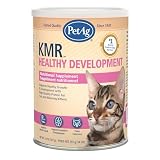
- NUTRITIONAL SUPPLEMENT - KMR Healthy Development supports healthy growth and development with high-quality protein for cats weaning to 6 years.
- SUPPORTS COGNITIVE DEVELOPMENT – With DHA (Omega 3 fatty acids) and Vitamin E, our formula supports visual & cognitive development.
- CONTAINS OMEGA 6 FATTY ACIDS - Our powder contains Omega 6 fatty acids to support a healthy skin and coat.
- GREAT TASTE - KMR Healthy Development is formulated with a great taste cats love. Supports transition to solid foods for weaning kittens.
- ABOUT US - PetAg is a trusted leader in pet wellness, with science-backed formulas in our milk replacers, health supplements, and grooming products helping pet owners to proactively enhance the lives of their pets, for more healthy years together.
A kitten too weak to suckle may need syringe or tube feeding, but tube feeding should be taught and supervised by a veterinarian. Incorrect tube placement can put formula directly into the lungs.
How much and how often should a kitten eat?
Weigh the kitten in grams using a kitchen, postage, or baby scale. Record the weight at least once a day, preferably at the same time, along with feeding times, approximate amounts, urination, and stool. Feeding charts are estimates; the kitten’s condition, hydration, stool, formula concentration, and weight gain matter more than a single number.
PC Slower Than It Used to Be?
A free scan shows the junk files, broken settings and background clutter dragging Windows down - then fixes them in one click.Free scan · Windows 10 & 11Outdated Drivers Are Slowing You Down
One free scan finds every outdated or missing driver and matches the right update for your exact hardware.Free scan · exact hardware matchFor commercial replacer, the label’s instructions take priority. The following is a general shelter-care guide:
| Approximate age | Typical interval | Approximate amount per feeding |
|---|---|---|
| 1 week or younger | Every 2–3 hours, including overnight | About 3–4 mL, depending on weight |
| 2 weeks | About every 3 hours | About 5–6 mL, depending on weight |
| 3–4 weeks | About every 4 hours | About 13–17 mL, depending on weight |
| Around 4 weeks | Continue formula while starting weaning | Individual needs vary |
Another commonly used guide estimates approximately 20–26 calories per 100 g of body weight per day, with a maximum comfortable stomach capacity of about 4 mL per 100 g per feeding. Because homemade and commercial formulas differ in calorie density, do not use volume alone to decide how much a kitten needs. Exceeding stomach capacity can cause bloating, diarrhea, regurgitation, and aspiration.
Feed slowly and allow the kitten to pause. A growing kitten should show steady weight gain. Failure to gain weight is a reason to contact a veterinarian, even if the kitten appears eager to eat.
Help very young kittens urinate and defecate
Kittens generally cannot urinate or defecate without stimulation until approximately 3 weeks of age. After each feeding, gently stroke the genital and anal area with a warm, damp cotton ball or soft cloth until the kitten eliminates. Be gentle; vigorous rubbing can injure the skin.
At around 4 weeks, when the kitten is eliminating independently, provide a shallow litter box with non-clumping litter.
When to begin weaning
Weaning usually starts at approximately 3½–4½ weeks. Offer a shallow dish of gruel made from wet kitten food mixed with kitten milk replacer. Continue formula feedings while the kitten learns to lap and eat.
Also popular on Amazon

- KITTEN MILK REPLACEMENT - When mom can’t nourish them, KMR can. Scientifically the next best to mother’s milk, KMR provides all the nutritional elements necessary for kittens, newborn to six weeks old.
- COMPLETE, BALANCED NUTRITION - Our formula is closest to mother's milk in protein, fat, and carbohydrates. We’ve also added vitamins, minerals, and trace nutrients; plus prebiotics and probiotics for healthy immunity and digestion.
- EASY TO DIGEST - KMR is highly palatable and formulated with a special fiber blend for easy digestion and improved gut health.
- EASY-TO-MIX FORMULA - Whisk or shake 1 part powdered KMR into 2 parts warm water. Do not mix more KMR than can be consumed in 24 hours. Do not use a blender.
- ABOUT US - PetAg is a trusted leader in pet wellness, with science-backed formulas in our milk replacers, health supplements, and grooming products helping pet owners to proactively enhance the lives of their pets, for more healthy years together.
Over the following days, gradually reduce the added formula as the kitten becomes more comfortable eating wet kitten food. Do not abruptly remove formula from a kitten that is not yet eating enough on its own.
Independent reader supportYour contribution helps us test, update, and keep practical guides available for everyone.Warning signs that need veterinary help
Contact a veterinarian or emergency clinic urgently if the kitten is:
- Cold, limp, unresponsive, or severely lethargic
- Persistently refusing to nurse
- Coughing, choking, wheezing, or breathing rasply after a feeding
- Showing milk from the nose
- Repeatedly vomiting
- Experiencing significant diarrhea or a swollen, painful abdomen
- Dehydrated or unable to swallow normally
- Failing to gain weight
Milk from the nose, coughing, or breathing changes after feeding may indicate aspiration. Do not continue force-feeding a kitten that will not swallow. A veterinarian may need to treat hypothermia, dehydration, infection, gastrointestinal disease, or aspiration.
Common homemade-feeding mistakes
| Risky advice | What to do instead |
|---|---|
| “Cow’s milk is fine.” | Use commercial kitten milk replacer; use a homemade recipe only temporarily in an emergency. |
| “Goat’s milk is a complete substitute.” | Do not treat goat’s milk as a complete diet. Ask a veterinarian about any emergency-only use. |
| “Feed the kitten on its back.” | Feed with the kitten resting on its stomach and its head in a neutral position. |
| “Squeeze the bottle or syringe milk into the mouth.” | Let the kitten suckle at its own pace. Stop if it will not swallow. |
| “More formula means faster growth.” | Measure carefully according to weight and formula instructions; overfeeding can be dangerous. |
| “A crying kitten just needs more food.” | Check warmth, hydration, elimination, feeding technique, and health before offering more. |
For further guidance, consult the VCA orphaned-kitten feeding guide, the ASPCApro bottle-feeding guide, and Maddie’s Fund emergency milk-replacer recipes.
FAQ
Can I feed a kitten plain cow’s milk?
Plain cow’s milk is not a complete diet for a kitten and may cause diarrhea or digestive upset. Use commercial kitten milk replacer. If none is immediately available, an emergency homemade recipe may be used only temporarily while you contact a veterinarian, rescue group, or pet-supply provider.
How warm should homemade kitten formula be?
Warm it to approximately 95–100°F (35–37.8°C), close to body temperature. Heat it in a warm-water bath rather than a microwave, mix thoroughly, and test a drop on your wrist before feeding.
Recommended Free Tools
Should I feed a newborn kitten on its back?
No. Place the kitten on its stomach with its head in a neutral position. Feeding on the back or forcing milk into the mouth can cause aspiration.
How do I know whether a bottle-fed kitten is getting enough?
Weigh the kitten in grams at least daily and record feeding amounts, urination, stool, and behavior. Steady weight gain is reassuring; failure to gain weight, persistent refusal to nurse, diarrhea, vomiting, bloating, or lethargy requires veterinary advice.
The Bottom Line
Commercial kitten milk replacer is the right food for an orphaned kitten. Homemade recipes can provide a short emergency bridge, but they should never become the kitten’s regular diet. Keep the kitten warm, feed slowly on its stomach, measure portions by weight and product instructions, stimulate elimination until about 3 weeks of age, and get veterinary help for any weak, chilled, non-nursing, coughing, vomiting, bloated, or non-gaining kitten.





Leave a Reply