Do these 3 things before closing this tab:
1Clear out junk files and repair common Windows errors2Scan for outdated or missing drivers - takes under a minute3Repair Windows errors before they cause bigger problemsA mackerel gets its food by swimming through the sea and using two feeding methods: it filters tiny plankton from dense patches of water, or it catches larger and more scattered prey one at a time. Atlantic mackerel commonly eat copepods, krill, shrimp, squid, and sometimes small fish.
A mackerel gets its food by swimming through the sea and either filtering tiny prey from the water or catching larger prey one at a time. When plankton is concentrated, an Atlantic mackerel can swim with its mouth open and use comb-like structures called gill rakers to retain food as water flows out through the gills. When prey are larger, more widely scattered, or easier to pursue individually, it switches to picking them off one by one.

As an Amazon Associate I earn from qualifying purchases.
Atlantic mackerel commonly eat copepods, krill, shrimp, squid, and sometimes small fish. The precise answer depends on which mackerel species is meant, as well as the fish’s age, location, season, and the prey available around it.
First, what does “mackerel” mean?
“Mackerel” is a common name used for several related but different marine fish. Atlantic mackerel (Scomber scombrus) is a useful reference for explaining the group because it is a fast-swimming pelagic fish that feeds in the open water, rather than mainly on the seafloor.
#1 Best Overall
Other fish called mackerel do not all have identical diets. Larger predatory species, including Spanish mackerel, generally take more substantial prey such as fish and squid. A description of Atlantic mackerel feeding should therefore not be treated as a rule for every mackerel species.
If you need to tell Atlantic, Spanish, king, and other mackerels apart, a saltwater fish field guide can be useful. Identification details, habitat, body size, and feeding habits vary among species and regions, so one guide should not be assumed to cover every mackerel equally well.
What does an Atlantic mackerel eat?
Atlantic mackerel are often described as planktivorous but opportunistic. Their frequently eaten prey include:
Outdated Drivers Are Slowing You Down
One free scan finds every outdated or missing driver and matches the right update for your exact hardware.Free scan · exact hardware matchPC Slower Than It Used to Be?
A free scan shows the junk files, broken settings and background clutter dragging Windows down - then fixes them in one click.Free scan · Windows 10 & 11- Copepods: tiny crustacean-like animals that are often an important part of the diet;
- Krill and other small crustaceans;
- Shrimp and other small swimming invertebrates;
- Squid; and
- Small fish, particularly when suitable prey are available.
In studies of some Northeast Atlantic populations, calanoid copepods were the dominant prey during parts of the summer feeding season. One Icelandic study found that they made up more than 60% of stomach-content weight on average, with Calanus finmarchicus accounting for much of the copepod biomass. That is strong evidence for those populations and conditions—not a universal percentage for every Atlantic mackerel everywhere.
How does filter feeding work?
When tiny prey occur in a dense patch, a mackerel can use a swimming-and-sieving method of feeding:
Rank #2
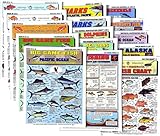
- Easy-to-Use Fish Identification: Features visual illustrations for quickly identifying various saltwater fish, suitable for both beginners and experienced anglers for inshore, offshore, and big game fishing
- 100% Waterproof Construction: Built with high-quality, weather-resistant materials to withstand the rigors of outdoor use, ensuring long-lasting reliability on every fishing trip
- Portable & Lightweight Design: Convenient, travel-friendly size fits in tackle boxes or fishing bags, allowing you to have it on hand whenever you need to identify a new species
- Comprehensive Gift Option: Suitable for beginners, seasoned fishermen, kids and scouts, and outdoor enthusiasts looking to master fish identification
- Extensive Species Coverage: Includes identification information for over 100 saltwater fish species across both Atlantic and Pacific regions with detailed full-color illustrations
- The fish swims into the plankton-rich water with its mouth open or partly open.
- Water carrying copepods and other small organisms enters the mouth.
- The water passes across the gill rakers, rows of structures positioned near the gills.
- The rakers retain suitably sized food particles while much of the water continues out through the gill openings.
- The captured food is swallowed.
The important point is that this is not simply passive straining while the fish waits motionless. The mackerel’s forward movement helps drive water and prey through the mouth and filtering area. It is an active way to process many small organisms in a productive patch of ocean.
The gill rakers are selective rather than a universal net with one fixed mesh size. Their effectiveness depends on the fish’s anatomy, the size and shape of the prey, and the way the fish moves water through its mouth. There is no single prey-size cutoff that applies to every mackerel species or situation.
What’s actually slowing this PC down?
Pick the symptom - the matching free tool is one click away.
Does a mackerel always filter-feed?
No. Mackerel use two complementary feeding modes.
Filter feeding is most useful when zooplankton are abundant and closely packed. The fish can process many small prey during each passage through the patch.
Particulate feeding is used when prey are more scattered, larger, or more profitable to pursue individually. The mackerel then targets a copepod, shrimp, squid, or small fish and engulfs it directly rather than relying mainly on bulk filtering.
Experimental observations support this flexible strategy: mackerel behave more like filter feeders at high concentrations of zooplankton and more like visual, individual-prey feeders when food is less concentrated. This flexibility helps them continue feeding even when the structure of a food patch changes.
Rank #3

- Includes: Size, Weight, Location, Hook Size, Food Quality, And Coloring
- Easy-to-Use Fish Identification: Features visual illustrations for quickly identifying various saltwater fish, perfect for both beginners and experienced anglers. Ideal for offshore, and big game fishing.
- 100% Waterproof: Built with high-quality, weather-resistant materials to withstand the rigors of outdoor use, ensuring long-lasting reliability on every fishing trip.
- Portable & Lightweight: Convenient, travel-friendly size fits in tackle boxes or fishing bags, allowing you to have it on hand whenever you need to identify a new species.
- Perfect Gift for All Anglers: Ideal for beginners, seasoned fishermen, kids and scouts, and any outdoor enthusiasts looking to master fish identification.
How does swimming speed affect feeding?
A mackerel does not swim at one fixed speed while feeding. Its behavior can change according to the density of prey:
Free tools Windows power users keep installed
One-click scans. No signup required.
- In a dense plankton patch, it may slow down because plenty of food is already passing through the filtering area.
- When zooplankton are sparse, it may swim faster, allowing it to encounter and process more water and increasing the chance of finding prey.
This is one reason mackerel are well suited to life in the open water. They can adjust both their movement and their feeding method to the way food is distributed rather than searching for prey in only one manner.
Do mackerel feed in schools?
Atlantic mackerel commonly form schools, often in the upper part of the water column. A school can encounter a plankton-rich area collectively and allow many fish to exploit the same productive patch.
Schooling does not mean that every feeding event requires a school, however. When prey are larger or scattered, individual mackerel can capture prey separately. Schooling is best understood as a behavior that can help mackerel locate and use pelagic food—not as the only mechanism by which they feed.
How does a mackerel’s diet change as it grows?
Young mackerel begin by eating very small planktonic organisms. As they grow, they can handle larger zooplankton and may add shrimp, squid, and fish to their diet, depending on their species and surroundings.
Recommended Free Tools
Rank #4
- Includes Size, Weight, Location, Hook Size, Food Quality, And Coloring.
- Easy-to-Use Fish Identification: Features visual illustrations for quickly identifying various saltwater fish, perfect for both beginners and experienced anglers. Ideal for offshore, and big game fishing.
- 100% Waterproof: Built with high-quality, weather-resistant materials to withstand the rigors of outdoor use, ensuring long-lasting reliability on every fishing trip.
- Portable & Lightweight: Convenient, travel-friendly size fits in tackle boxes or fishing bags, allowing you to have it on hand whenever you need to identify a new species.
- Perfect Gift for All Anglers: Ideal for beginners, seasoned fishermen, kids and scouts, and any outdoor enthusiasts looking to master fish identification.
This age-related change is practical: a larger fish has a larger mouth, greater swimming ability, and different energy requirements. It can pursue prey that would be unavailable or too difficult for a larva or juvenile. Even among adults, diet can change with season, region, body size, and the local prey community.
How do different mackerel species differ?
| Fish commonly called a mackerel | General feeding pattern |
|---|---|
| Atlantic mackerel | Often feeds heavily on zooplankton such as copepods, but can also take crustaceans, squid, and small fish. |
| Spanish mackerel and other larger predatory mackerels | Generally place greater emphasis on larger prey, especially fish and squid. |
This comparison is intentionally broad. Diets can overlap, and local conditions matter. The safest way to identify a species and understand its feeding habits is to combine the fish’s appearance, location, size, and a reliable regional reference.
Why is mackerel feeding important in the ocean?
Mackerel connect different levels of the marine food web. By eating copepods, krill, and other zooplankton, they transfer energy from microscopic and tiny drifting animals into the bodies of larger, fast-swimming fish. Mackerel are then available as prey for still larger marine predators, including fish, seabirds, and marine mammals.
Because mackerel can consume large quantities of plankton when conditions are favorable, their feeding can also influence pressure on local plankton communities. At the same time, their ability to switch to individual prey makes them adaptable when plankton becomes less concentrated or when larger prey are available.
Quick wins for a faster PC:
Repair Windows errors before they cause bigger problemsFix Now →Fix the driver behind crashes, sound loss and screen glitchesFind Drivers →Clear out junk files and repair common Windows errorsFree Scan →In one sentence
A mackerel gets its food by swimming through the water, filtering dense patches of tiny plankton with its gill rakers, and capturing larger or scattered prey—such as shrimp, squid, and small fish—individually.
Best Value

- Includes Size, Weight, Location, Food Quality, And Coloring
- Easy-to-Use Fish Identification: Features visual illustrations for quickly identifying various saltwater fish, perfect for both beginners and experienced anglers. Ideal for inshore, offshore, and big game fishing.
- 100% Waterproof: Built with high-quality, weather-resistant materials to withstand the rigors of outdoor use, ensuring long-lasting reliability on every fishing trip.
- Portable & Lightweight: Convenient, travel-friendly size fits in tackle boxes or fishing bags, allowing you to have it on hand whenever you need to identify a new species.
- Perfect Gift for All Anglers: Ideal for beginners, seasoned fishermen, kids and scouts, and any outdoor enthusiasts looking to master fish identification.
Frequently Asked Questions
Do mackerel eat only plankton?
No. Atlantic mackerel can filter dense patches of zooplankton, but they also capture larger or scattered prey individually. Depending on the species and circumstances, mackerel may eat shrimp, squid, and small fish as well as plankton.
Does a mackerel filter food passively?
Yes, in a particular sense: forward swimming helps carry water and prey into the mouth and across the gill rakers. Filter feeding is therefore active swimming-and-sieving, not simply waiting for food to drift into a stationary filter.
What do young mackerel eat?
Young mackerel start with very small planktonic prey. As they grow, they can take larger zooplankton and, depending on species and local conditions, squid, shrimp, and fish.
The Tool Desk
Outbyte PC Repair FREEClear out junk files and repair common Windows errorsFree Scan →Outbyte Driver Updater FREEFix the driver behind crashes, sound loss and screen glitchesFind Drivers →The Bottom Line
Mackerel are flexible open-water feeders, not fish that rely on one technique. Atlantic mackerel often exploit abundant copepods and other zooplankton by swimming with the mouth open and sieving food with their gill rakers, but they can also pursue and swallow individual prey. Their feeding method and diet change with species, size, season, location, and prey availability.
Quick Recap
Product prices and availability are accurate as of the date/time indicated and are subject to change. Any price and availability information displayed on Amazon at the time of purchase will apply.




