How does an anglerfish eat? An anglerfish uses a modified dorsal-fin ray as a fishing rod, brings prey within range with a lure, and then rapidly opens its mouth to suck in water and prey. Backward-pointing teeth help hold the meal, which may be a fish, crustacean, mollusk, or other available animal.
That answer describes the shared ambush strategy, but “anglerfish” is a broad group rather than one species. Deep-sea ceratioids, monkfish, goosefish, frogfish, and other relatives differ in habitat, lure design, jaw mechanics, and diet.
As an Amazon Associate I earn from qualifying purchases.
Key takeaways
- Anglerfish usually ambush prey instead of chasing it over long distances.
- The anglerfish “fishing rod” is a modified dorsal-fin ray called the illicium, and the lure at its tip is the esca.
- An anglerfish captures prey with a rapid gape-and-suck motion, then uses backward-pointing teeth to help prevent escape.
- Depending on the species and life stage, anglerfish eat fish, shrimp and other crustaceans, squid and other mollusks, and sometimes seabirds or diving ducks.
- A 2008 stomach-content study found 70% teleost fish and 30% crustaceans among nonempty stomachs of one threadfin anglerfish species from the Pacific coast of Costa Rica.
- NOAA educational material says an anglerfish can swallow fish twice its size, but that statement is not a universal maximum for every anglerfish species.
How does an anglerfish eat?
An anglerfish eats by luring prey close with a modified fin ray, then rapidly opening its mouth and sucking in water and prey. Rows of backward-pointing teeth help hold the victim inside. Anglerfish are ambush predators, so the lure attracts or deceives prey; it does not hook and reel prey into the mouth.
Do these 3 things before closing this tab:
1Repair Windows errors before they cause bigger problems2Fix the driver behind crashes, sound loss and screen glitches3Clear out junk files and repair common Windows errorsThe name “anglerfish” covers many species with different habitats, body shapes, lures, and diets. Deep-sea ceratioid anglerfish are not identical to benthic monkfish, goosefish, or frogfish. The feeding pattern described below is therefore a useful overview, not a rule that applies in exactly the same way to every species.
#1 Best Overall

- Aquarium Background Size: 36(W)x20(H)in for decoration. Seamless design enhances the visual appeal of your tanks. The aquarium backdrop is durable and can be reused many times.
- Aquarium Backdrop Material: The Terrarium Background is made from vinyl fabric, which is lightweight, soft and delicate. The background retains its vibrant colours under aquarium lighting, ensuring long-lasting beauty and durability.
- Terrarium Background Features: Create a magical atmosphere in your aquarium or reptile habitat with this artistic background, resulting in clear and beautiful pictures that perfect for enhancing the visual appeal of your pet's environment.
- Aquarium Background Occasions: This aquarium backdrop is suitable for most aquariums and terrariums. Choose the right size of aquarium backdrop poster, making it an excellent decoration for fish tanks and reptile environments.
- Enhance Pet's Habitat: Realistic aquarium backgrounds further enhance the adaptability of pets by providing a similar living environment, making them a versatile and eye-catching addition to your pet's habitat.
What happens when an anglerfish catches prey?
- The anglerfish waits. Deep-sea food is scarce, and constantly swimming in search of prey can use more energy than an ambush strategy. NOAA’s explanation of fishes in the midnight zone describes lures as an adaptation that helps predatory fish attract prey instead of continuously searching for it.
- The fish displays or moves its lure. The fishing-rod-like structure is the illicium, a modified dorsal-fin ray. The structure at its end is the esca. In many deep-sea species, the esca contains bioluminescent bacteria that produce light. The Smithsonian’s overview of anglerfish lures explains how this specialized appendage helps bring prey within range.
- Prey approaches the mouth. The lure is not the meal and usually does not work like a fishing hook. The lure functions as an attraction or deception device. NOAA Fisheries says monkfish use a modified spine “as a fishing pole and bait to lure small fish toward their mouths.”
- The anglerfish opens its mouth and creates suction. When prey is close enough, the fish rapidly enlarges its mouth cavity. The sudden movement draws water and prey inward in a gulp. This “gape-and-suck” feeding style is described by the Smithsonian, while NOAA Fisheries’ monkfish profile explains that prey is sucked into the mouth.
- The teeth help keep prey inside. Anglerfish have rows of teeth that point backward. The teeth help trap prey after the suction-driven capture and make escape difficult.
- The fish swallows the meal. Some anglerfish have flexible bones, large mouths, and expandable stomachs that allow them to take unusually large prey. NOAA’s educational transcript says an anglerfish “can swallow fish that are twice its size.” That is an attributed description of anglerfish capacity, not a confirmed group-wide limit for every species.
Does an anglerfish really use a light to hunt?
Many deep-sea anglerfish use a glowing lure, but a glowing lure is not universal across all anglerfish. In many deep-sea species, bacteria living in the esca produce bioluminescent light. The light can make the lure resemble a small animal or otherwise attract potential prey in dark water.
Shallow-water relatives may have non-glowing lures or use other kinds of mimicry. The broad term “anglerfish” includes species with different lure structures, so it is more accurate to say that many deep-sea anglerfish use light than to say that every anglerfish glows. The Smithsonian’s anglerfish resource and NOAA Ocean Exploration’s midnight-zone resource describe the deep-sea lure and its role in attracting prey.
What do anglerfish eat?
Anglerfish commonly eat fish, crustaceans, and mollusks, but the exact menu depends on the species, body size, life stage, habitat, and prey available in that location.
Windows Errors? Fix Them Before They Spread
Repair common Windows errors and clear accumulated junk for a smoother, more stable PC - no reinstall needed.Free scan · no reinstallOutdated Drivers Are Slowing You Down
One free scan finds every outdated or missing driver and matches the right update for your exact hardware.Free scan · exact hardware match| Anglerfish example or life stage | Documented or reported prey | Important qualification |
|---|---|---|
| Monkfish or goosefish larvae | Zooplankton | Larvae have a different diet from older fish. |
| Juvenile monkfish | Small fish, shrimp, and squid | Juveniles generally take smaller prey than adults. |
| Adult monkfish or goosefish | Fish, crustaceans, mollusks, seabirds, and diving ducks | Fish are the main food, but the diet can be broad and opportunistic. |
| European anglerfish, Lophius piscatorius | Fish, mollusks, and aquatic crustaceans | Young fish tend to focus more on invertebrates; older fish take fish opportunistically. |
| Deep-sea ceratioid anglerfish | Variable animal prey | A 2023 study describes ceratioids as dietary generalists and found substantial diversity in jaw and tooth shape. |
NOAA Fisheries reports that monkfish larvae eat zooplankton, juveniles mainly eat small fish, shrimp, and squid, and adults mainly eat fish while also taking crustaceans, mollusks, seabirds, and diving ducks. The University of Michigan’s Animal Diversity Web account similarly describes European anglerfish as sit-and-wait predators whose young focus more on crustaceans and cephalopods while older fish consume fish.
Rank #2

- Realistic Design: Lifelike orange and brown swimming sea turtle decoration adds a natural touch to your aquarium, captivating both kids and adults. Your turtle looks as if he is gliding through your tank, attached to a decorative base of sea plant life and shells to give an authentic ocean floor feeling.
- Easy Installation: Designed with a sturdy base for hassle-free placement in freshwater or saltwater aquariums. Wash with clean water before placing into tank, never use soap as it is harmful to your fish and their environment. perfect décor for small to medium-sized tanks.
- Vibrant Colors: Enhance your tank's aesthetics with vivid, fade-resistant colors that won't alter water quality. Crafted from high-quality, non-toxic materials, ensuring a safe environment for your aquatic pets.
- Small-sized ornament measuring 2.75"D x 3.50" W x 4.00" H,
- SHOP PENN PLAX FOR ALL YOUR PET’S NEEDS: Penn Plax creates excellent pet supplies for animals both great and small, at affordable prices.
FishBase describes Lophius piscatorius as lying partly buried on sandy or muddy bottoms and waiting for prey attracted by its fishing filament. Fish are listed as its main food in the FishBase species account.
Do anglerfish eat fish or shrimp?
Anglerfish eat both fish and shrimp, although the balance varies by species and size. Fish, shrimp and other crustaceans, squid, and other mollusks are all documented prey categories. Some adult benthic anglerfish also eat larger or less typical prey, including seabirds and diving ducks.
A direct stomach study illustrates why a single diet percentage should not be applied to every anglerfish. Universidad de Costa Rica researchers Mario Espinoza and Ingo S. Wehrtmann (2008) examined 200 adult threadfin anglerfish, Lophiodes spilurus, collected from deep bottom trawls at 105–238 meters off Costa Rica’s central Pacific coast. Among the nonempty stomachs, the study found 70% teleost fish and 30% crustaceans. The study also recorded that 52% of sampled stomachs were empty.
Those percentages describe one species, one region, one size range, and the stomachs examined in that study—not all anglerfish. The most frequently identified prey included the pandalid shrimp Plesionika trispinus and the fathom mora Physiculus rastrelliger. Larger threadfin anglerfish took larger stomatopods, while teleost fish remained important across several size classes. The full 2008 stomach-content study of Lophiodes spilurus provides the direct evidence behind these figures.
Rank #3
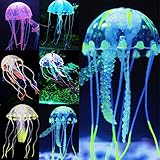
- Realistic Jellyfish Decor: An exquisite combination of 6 colorful jellyfish (blue, purple, green, orange, pink and yellow). Perfect for decorating fish tanks.
- Charming Glowing Effect: Not Glow In the Dark! They are only luminescent under actinic lighting (blue or purple light is recommended). Greatly brighten and invigorate your plain fish tank.
- Vivid Landscape: Pulled by an invisible line, they’ll always float freely and elegantly with the slightest movement of water flow. Blend with fish’s swimming to create a splendid harmony!
- Reliable Material: Made of dependable silicone material, these appealing jellyfish ornaments are trustworthy to keep fish lively anytime while adorning your tank.
- Easy to Use: Pull out the cap on the sucker, tie the string to the cap, press the cap in and stick it to the tank. It’ll turn your tedious aquarium into a vibrant underwater world.
How are deep-sea anglerfish different from monkfish?
Deep-sea ceratioid anglerfish and benthic monkfish share an ambush-predator strategy, but they should not automatically be assigned the same diet or hunting mechanics.
| Feature | Deep-sea ceratioid anglerfish | Benthic monkfish or goosefish |
|---|---|---|
| Typical setting | Food-limited bathypelagic, or open deep-sea, water | Seafloor habitats, including sandy or muddy bottoms |
| Lure | Many species have an esca that glows through bioluminescent bacteria | A modified head spine or fishing filament can act as a fishing pole and bait; a glowing lure is not required |
| Basic strategy | Attract prey and capture it with rapid mouth expansion and suction | Lie in wait, lure prey toward the mouth, then gulp and trap it with teeth |
| Diet evidence | A 2023 study describes ceratioids as dietary generalists and documents diversity in feeding structures | Species accounts and stomach studies document fish, crustaceans, mollusks, and other prey |
| Why diets differ | Prey availability, jaw shape, tooth shape, and lineage differ among species | Bottom habitat, body size, life stage, and local prey availability influence the diet |
The 2023 peer-reviewed study, “Many ways to build an angler”, found substantial diversity in the jaws and teeth of deep-sea ceratioids. That finding supports a careful conclusion: anglerfish share broad ambush-predation themes, but different lineages can capture prey in different ways.
Can an anglerfish swallow something bigger than itself?
Some anglerfish can swallow exceptionally large prey relative to their own body size. NOAA’s Ocean Today transcript states: “With flexible bones, and a stomach that can be expanded, it can swallow fish that are twice its size.” The statement is useful for describing the group’s remarkable feeding capacity, but it should not be treated as a universal anatomical maximum for every species.
Large expandable feeding structures are especially valuable where meals are unpredictable and widely spaced. However, no reliable group-wide statistic establishes how often all anglerfish feed, how long every species can go without food, or the exact maximum prey-to-body-size ratio across the entire group.
Rank #4

- Charming Aquarium Décor: Imitating the real sea urchins, the appealing rainbow ornament turns your tedious fish tank into a lifelike ocean landscape.
- Glow Under Extra Lights: The rainbow décor can't be luminescent in the dark but glows under actinic lighting. Great for brightening and invigorating your plain aquarium.
- Stable in Water: Designed with a strong resin base weighing 4.4 oz, it always stands stably in the tank when the rainbow needles swing with the movement of water.
- Reliable Material: It’s made of soft silicone material, which causes no threat to your fish and is dependable to keep them lively anytime.
- Easy to Use: Measure 2.3'' D x 4.3'' H. Just put it into your fish tank and it will always remain realistic looking. Fit for both fresh water and marine aquariums.
Why does an anglerfish have such a big mouth?
An anglerfish has a large, expandable mouth because an ambush predator may encounter an occasional meal that is much larger than the prey it normally catches. A wide gape lets the fish engulf prey quickly, while suction draws the prey inward before it can react. Flexible bones, expandable tissues, and backward-pointing teeth support the same capture strategy.
The size of the mouth does not mean every anglerfish eats anything that fits. Diet studies show patterns shaped by species, size, habitat, life stage, and local prey availability. “Opportunistic” means the fish can exploit available prey; it does not mean all anglerfish have an identical unlimited menu.
Further reading for young learners
For young readers who want to explore the lure and other deep-sea adaptations, an anglerfish book such as Anglerfish: The Seadevil of the Deep by Elaine M. Alexander, illustrated by Fiona Fogg, is a relevant optional choice. The Candlewick Press publisher page describes the juvenile nonfiction title and its focus on the deep-sea anglerfish, while Kirkus Reviews’ book review discusses its feeding content. Retail availability, price, and any retailer program should be checked at publication time.
Recommended Free Tools
Frequently Asked Questions
How does an anglerfish catch its food?
Anglerfish usually do not chase prey. They wait and use a modified dorsal-fin ray with a lure to bring prey close, then rapidly open the mouth and suck in water and prey. Backward-pointing teeth help hold the prey inside.
Best Value

- Green Aquarium Decorations: 12 Pieces green and Fish Tank Plants. ( Various Heights 5 to 22 cm. ( 2 inch to 8.6 inch )
- The plastic Aquarium Decor Plants are made of soft and healthy material, no harm to water and fish. It is suitable for both fresh and sea water and does not affect the PH in the water.
- The fish tank plants will neither fade nor create pollution to the water,No lighting required, no pruning is needed. ,Can provide attachment place for nitrifying bacteria.
- Each plant has its own base for holding it in the gravel.
- Easy to clean - The smooth surface is also very easy to wipe and keep clean. Please wash it before using!
Does every anglerfish use a glowing light to hunt?
Many deep-sea anglerfish use bioluminescent bacteria in the lure at the end of the illicium, or modified fin ray. However, not every anglerfish has a glowing lure; shallow-water relatives may use non-glowing lures or other forms of mimicry.
What do anglerfish eat?
Anglerfish eat both fish and shrimp, along with other crustaceans, squid, and mollusks. Some documented adult monkfish also eat seabirds and diving ducks, while larvae and juveniles generally consume smaller prey.
The Bottom Line
Anglerfish usually eat by waiting in ambush, using a modified fin ray and lure to bring prey close, then gulping the prey in with suction. Fish, crustaceans, and mollusks are common foods, but the menu varies widely among species and life stages. Their impressive mouths can take large meals, yet the claim that an anglerfish can swallow a fish twice its size should remain attributed to NOAA rather than treated as a universal limit.
What’s actually slowing this PC down?
Pick the symptom - the matching free tool is one click away.
Quick Recap
Product prices and availability are accurate as of the date/time indicated and are subject to change. Any price and availability information displayed on Amazon at the time of purchase will apply.




