The Tool Desk
Outbyte PC Repair FREERepair Windows errors before they cause bigger problemsFix Now →Outbyte Driver Updater FREEFix the driver behind crashes, sound loss and screen glitchesFind Drivers →There is no single timetable. Some adopted cats act at home within a few hours; shy or nervous cats may need several weeks or even months. The most useful measure is not a deadline but a steady change in behavior: more exploration, eating, play, grooming and voluntary contact. The ASPCA’s “3-3-3 Guideline” can provide a rough mental model, but it is a rule of thumb, not a clinical standard or promise that every cat follows.
Why settling time varies so much
Cats Protection says there is “no definitive answer to how long it will take your new cat to settle in.” Temperament, previous experiences and the new environment all matter. A confident cat that has lived comfortably indoors may investigate almost immediately. A cat that has experienced upheaval, limited handling or several moves may remain hidden and cautious for much longer.
As an Amazon Associate I earn from qualifying purchases.
Even within one adoption, progress is rarely linear. A cat may explore at night, retreat during the day, then become more sociable later. A noisy visitor, a change in routine or an introduction to another pet can temporarily make a cat seem less settled again. Judge the overall trend rather than one quiet evening or one setback.
Recommended Free Tools
What “settled” actually means
Settling in does not necessarily mean becoming a lap cat. A settled cat may still prefer distance, hide when visitors arrive or choose when to be touched. The practical goal is that the cat can eat, rest, use the litter tray, groom, play or explore according to its own comfort, and move through the home without persistent signs of distress.
#1 Best Overall

- Pet Carrier: 17.5” L x 11” W x 11” H, Recommended max load of 16 lbs cats small dogs. Please do not choose your carrier based on weight--please reference your pet's length and height in selecting a pet carrier size.
- Fits for under-seat dimensions of most airlines. Every airline has a specific set of rules and regulations, please contact with airline before flying with your cats small dogs.
- Mesh windows for ventilation, top and side entry with locking zippers for safety. Carrying handles, adjustable shoulder strap which can also be used as seatbelt, and back strap can fasten the pet carrier to your luggage.
- Pet carrier comes with a removable base insert, which creates a solid surface for your pet to stand on, along with a removable & hand washable cozy fleece pet bed, which offers a cozy sleeping space for your traveling cats small dogs.
- "Toys for pets, of textile materials". Mostly used as a Toy of Fabric Pet Home for pets playing and relaxing.
The 3-3-3 guideline: a useful frame, not a countdown
The ASPCA describes a broad adoption framework in which the first three days may feel overwhelming, the following three weeks are a period of decompression and learning, and longer-term adjustment continues as the pet becomes familiar with the home. This can help adopters avoid expecting instant confidence, but it is not a measured population average. Cats do not all reach the same milestones on day three or week three.
| Rough phase | What you might see | Best response |
|---|---|---|
| First few days | Hiding, staying quiet, eating little or only overnight, and watching rather than interacting. | Keep the cat in a calm, prepared room. Provide essentials and let it observe without pressure. |
| Following weeks | More exploration, a predictable routine, occasional play, scent rubbing or brief voluntary contact. | Maintain consistency and expand access gradually when the cat is ready. |
| Longer adjustment | Growing confidence and a clearer preference for people, places and activities. | Continue allowing choice. Do not assume a calendar milestone means introductions or handling should be rushed. |
Prepare a safe room before bringing the cat home
Preparation reduces the number of unfamiliar decisions the cat must make at once. Choose a quiet room that can be closed off from visitors, children and other animals. Set it up before the carrier arrives.
- Food and water: place them in separate areas so the cat can eat and drink without feeling crowded.
- Litter tray: keep it away from food and water, in a location the cat can reach easily.
- Hiding place: provide a box, covered bed or another safe retreat. Never pull the cat out to make it interact.
- High spot: a stable shelf, cat tree or other secure elevated place can let the cat watch from a distance.
- Sleep area: include a quiet, comfortable place to rest.
- Scratching post and a few toys: offer outlets for normal behavior without filling the room with too many new objects.
- Familiar scent: if the shelter or previous home can provide bedding or another familiar-smelling item, place it in the room. Familiar scent may be reassuring, but it cannot guarantee a faster adjustment.
A secure, easy-to-clean carrier is useful for transport. Have the carrier ready so the cat can leave it at its own pace after the door is closed and the room is quiet.
What’s actually slowing this PC down?
Pick the symptom - the matching free tool is one click away.
What to do during the first hours
- Take the carrier directly to the safe room. Avoid a tour of the house. Extra rooms, voices and unfamiliar smells can be overwhelming on arrival.
- Close the door and open the carrier. Sit nearby only if your presence appears calming. Otherwise, leave the room for a while.
- Let the cat choose whether to emerge. Do not reach into the carrier or hiding place, drag the cat out or insist on cuddling.
- Keep the environment predictable. Use a quiet voice, limit visitors and keep feeding, cleaning and checking routines consistent.
- Observe without turning observation into pressure. Check that food, water and the litter tray are available, then give the cat uninterrupted time to inspect the room.
It is common for a newly adopted cat to hide or to eat only at night while it is adjusting. Those behaviors should be considered alongside the trend over time, not treated as proof that the adoption is failing.
Rank #2
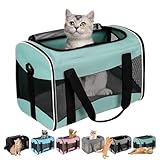
- [PRODUCT DIMENSIONS] Pet travel carrier size : 17x11x11 inches, recommended up to 15 lb pets, it is suitable for large, medium cats and small dogs. Please don't choose your airline cat carrying case based on weight, please refer to your pet's length and height when choosing a pet carrier size.
- [AIRLINE APPROVED] This cat carrier is designed with airline approved, it can fit comfortably under most flight seats, we can take our pets wherever we want. Dog travel carrier offers two attachment loop handles that can be used as a dual harness or as a luggage strap for balanced carry and secure transport.
- [EXCELLENT MATERIAL] Collapsible cat carrier is made of polyester fabric, supported by a steel ring, washable, wear-resistant and durable. The three sides and the top of this pet carrier are nylon mesh, scratch-resistant and not easy to damage, it can not only check your pet in real time, but also ensure enough air circulation.
- [SAFE AND COMFORTABLE] Dog travel bag has metal zippers on the top and side entrances, durable and not easy to deform, it allows your pets to enter and exit easily. The cat carrying case is equipped with an anti-escape safety buckle, which can effectively prevent pets from accidentally falling. It is suitable for car rides and vet rides.
- [PORTABLE AND FOLDABLE] Pet travel carrier comes with a detachable and hand washable wool pet bed, it can provide a comfortable sleeping space for your traveling pet. The cat travel case comes with an adjustable shoulder strap and handle for easy portability. When not in use, you can fold it up for storage.
How to help over the following days and weeks
Use quiet company
You can sit quietly in the room, read or work without staring at the cat. Turn your body slightly to the side and allow the cat to decide whether to approach. A retreat should always remain available.
Keep a predictable routine
Regular times for feeding, cleaning and calm interaction help the cat learn what happens next. Cats Protection’s settling guidance emphasizes space and routine, particularly in care environments where many changes can otherwise accumulate.
Expand the territory gradually
When the cat is confidently eating, using its room and choosing to investigate, leave the door open for short periods if the rest of the home is safe. Let the cat return to the safe room. Do not carry it around the house or block the route back to its refuge.
Follow the cat’s signals
If the cat approaches, offer a hand for scent investigation and stop if it moves away. Delay lifting, prolonged handling and introductions to visitors until the cat is consistently choosing contact. Moving faster can add stress rather than shortening the adjustment.
Rank #3

- High Quality Design:Sturdy steel cage structure and wooden support board maintain good spatial stability and shape. Breathable mesh windows on four sides,which can ensure good air circulation and views,make pets have a comfortable and safe travel.It can also be easy for you to check on your pets.There is a front pocket to store pet toys,treats,etc.
- Dimension and Weight:Made of durable tear-resistant fabric.Four easy entrances for pets. Dimensions: 17 inch x 11 inch x 11 inch (L*W*H), suitable for pets up to 16 lbs.Please don't choose your carrier based on weight only,consider your pet's length and height when choosing a carrier.
- Airline Approved & Safty:Can be placed under the seats of most airplanes(Four non-slip feet on the bottom to prevent movement), and comfortably on the seat next to you in a car or bus.It has a adjustable shoulder strap.Can also be fastened to the car seat with a safety belt or shoulder strap to keep your pet safe.
- Easy to Clean :You can clean the stains and dirt on the surface with a soft cloth.Soft mat inside the pet carrier is removable and washable.You can take it out and wash it easily to solve all stains.
- Easy to Collapsible & Lightweight:When not in use,fold it into a flat,space saving and easy to store.Only 2.2lbs,it's easier to carry around.It can also used as a toy of pet house,allowing pets to play in a safe space to relax and rest.
Signs that an adopted cat is settling
Look for small changes that accumulate. Cats Protection lists the following as possible signs of progress:
- Exploring more of the room or home.
- Showing increased confidence.
- Seeking attention, company or proximity on the cat’s own terms.
- Eating more normally and maintaining a regular pattern.
- Playing or showing interest in toys.
- Rubbing against people or objects to leave scent.
- Grooming regularly.
These signs do not have to appear in a particular order. A cat may eat well before it plays, or explore at night before approaching a person in daylight.
Signs of stress and when to ask a vet
During transition, a cat may hide, avoid people, eat little or only overnight, toilet only at night, groom more or less than usual, play less, explore less, scratch or spray. Some of these behaviors can occur temporarily in a new home. Record whether they are becoming less frequent or whether the cat is making no progress.
If stress is prolonged and there is no improvement, Cats Protection advises contacting a vet. The available guidance does not set a universal number of days for this decision, because the right threshold depends on the individual cat and circumstances. A vet can help distinguish adjustment stress from a health or behavior problem and advise what to do next.
Rank #4
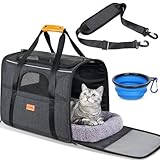
- 【 Spacious & Comfortable Cat Carrier 】The large cat carrier provides ample space for your feline friend to move, turn, and stretch during travel. Measuring 17.3 x 12.2 x 13.4 inches, it is wider and taller than most cat carriers, ensuring your pet feels comfortable and at ease while on the go.
- 【Balanced Mesh Design】Unlike other cat carrier hard, our cat carrier soft strikes the perfect balance with 40% mesh surface area. This ensures your pet can observe the surroundings and breathe easily while feeling safe and secure at the same time. The cat carrier large is suitable for pets in all kinds of situations.
- 【Built-in Dual-Sided Cushion】The detachable pad offers two distinct comforts: a cool side for summer and a super-soft, warm side for winter. You can easily flip it to match the season, providing the perfect temperature for your pet in any weather.
- 【Includes Foldable Bowl】Designed for on-the-go use, our foldable bowl carries 410g of food or 20oz of water. After use, simply collapse it and attach it directly to your pet's collar or leash, perfect for keeping your pet fueled and hydrated anywhere.
- 【Safe & Durable】Safety is our top priority, and the pet carrier for cat is equipped with a secure buckle to prevent your pet from escaping. The cat carrier soft is made of reinforced snow silk fabric and hard mesh material, ensuring durability and preventing any tearing during long-distance travel.
Introducing other pets without rushing
A new home is already a major change, so do not combine it with an immediate face-to-face meeting. Keep the adopted cat in its safe room while it becomes familiar with the new smells and routine. Introductions should be gradual and should not remove the cat’s ability to retreat.
Start with separation
Give each animal its own food, water, resting areas and toileting resources. Allow the new cat to settle before asking it to share space with a resident animal.
Progress at the animals’ pace
Short, calm steps are preferable to a single forced encounter. If either animal becomes more fearful or agitated, return to the previous comfortable step. Do not promise yourself that the cats will become friends; a successful outcome may simply be calm, separate use of the home.
Protect the safe room
The new cat should always have a place where the resident pet cannot follow. Children and visitors should also be taught not to enter that space to coax out a hiding cat.
Best Value
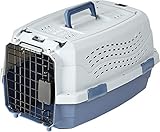
- Hard sided pet carrier with 2 doors for front and top entry; suitable for cat or extra-small dog breeds, such as chihuahuas and toy poodles (up to 11 pounds)
- Durable plastic construction with steel wire front door; screws keep the top and bottom sections securely connected
- Top door can swing open to the left or right for easy access and convenience
- Plenty of ventilation on sides, top, and back of the carrier
- Note: Be sure to measure the size of the pet when choosing carrier size
Factors that can lengthen or shorten the adjustment
- Temperament: confident cats often investigate sooner than shy or nervous cats.
- Previous experiences: unfamiliar handling, upheaval or repeated moves can make a new environment harder to trust.
- Household activity: noise, visitors and constant access by people or animals can delay decompression.
- Environmental complexity: a quiet room gives the cat a manageable starting point; a whole house on the first day may be too much.
- Routine: predictable care supports learning and confidence.
- Changes after arrival: moving resources, changing food locations or rushing introductions can create new uncertainty just as the cat begins to adjust.
These factors are reasons to tailor the process, not a formula for calculating an exact arrival date. No measured average settling time has been established by the cited guidance.
A practical settling-in checklist
- Prepare and secure one quiet room before pickup.
- Place food, water, a litter tray, bedding, a hiding place, a high spot, a scratching post and a few toys in that room.
- Bring familiar bedding or another familiar scent when available.
- Open the carrier and allow the cat to leave voluntarily.
- Keep early contact quiet, brief and optional.
- Maintain a predictable routine.
- Track eating, grooming, play, exploration and voluntary contact as trends.
- Expand access only when the cat is showing confidence, while preserving the safe room.
- Delay visitors and other-pet introductions until the cat is ready.
- Ask a vet for advice when stress persists without improvement.
Optional aids: what they can and cannot do
Cats Protection mentions synthetic pheromone products as something an adopter may consider. Treat them as optional support, not a requirement and not a guaranteed way to make a cat settle faster. They cannot replace a quiet room, choice, routine or gradual introductions.
The bottom line for adopters
Plan for a range: some cats settle within hours, while shy or nervous cats may need weeks or months. Use the first three days and following three weeks in the ASPCA framework as a gentle reminder to provide time, space, patience and routine—not as a deadline. Your cat’s steady behavior is the better guide. When progress is absent and stress continues, contact a vet rather than waiting for an arbitrary day on the calendar.
Quick wins for a faster PC:
Repair Windows errors before they cause bigger problemsFix Now →Fix the driver behind crashes, sound loss and screen glitchesFind Drivers →Clear out junk files and repair common Windows errorsFree Scan →Quick Recap
Product prices and availability are accurate as of the date/time indicated and are subject to change. Any price and availability information displayed on Amazon at the time of purchase will apply.




