
What’s actually slowing this PC down?
Pick the symptom - the matching free tool is one click away.
Guppies are hardy, active livebearers, but they are not maintenance-free. Their welfare depends on a cycled aquarium, a working filter, stable water chemistry, modest varied feeding, compatible companions and a plan for frequent fry. Set up and test the aquarium before buying fish, then add stock gradually.
What do guppies need in a tank?
Start with the largest aquarium you can reasonably accommodate. The Ornamental Aquatic Trade Association (OATA) recommends at least 45 litres for a small group of the smaller species covered by its care sheet. A Seriously Fish profile for the traditional guppy, Poecilia reticulata, gives an aquarium base of 45 × 30 cm and approximately 41 litres. These are source-specific starting points, not a universal stocking formula. More water volume generally dilutes waste and makes temperature and chemistry changes slower, so a larger tank is easier to keep stable.
As an Amazon Associate I earn from qualifying purchases.
A traditional guppy is Poecilia reticulata. Endlers are Poecilia wingei, a related livebearer that is usually smaller. Their care is broadly similar, although the smaller foods suggested for Endlers can include cyclops. Check which species and adult sizes you are buying before deciding how many fish the aquarium can support.
Essential equipment
- A suitably sized glass or acrylic aquarium with a secure lid. OATA lists a lid as optional but recommends one; guppies can jump, especially when startled.
- A filter sized for the aquarium. OATA states, “Whatever the size, a filter is always essential.” Choose gentle circulation because strong currents can exhaust guppies and are discouraged in the Seriously Fish profile.
- A heater and a thermometer so temperature can be checked rather than guessed.
- Tap-water conditioner or dechlorinator that treats the water you add.
- Freshwater test kits for ammonia, nitrite, nitrate, pH and water hardness. OATA calls test kits “a necessity not an optional extra.”
- Gravel, sand or another aquarium-safe substrate.
- A siphon or purpose-designed gravel cleaner and a dedicated bucket for aquarium use. Never siphon by mouth.
- Live plants or smooth ornaments for cover. Avoid sharp or rough edges that can tear long fins, and leave open swimming space.
- Lighting on a consistent day-night schedule; lighting is required if you keep live plants.
Cycle the aquarium before adding guppies
“Cycled” means the biological filter has developed beneficial bacteria that process fish waste. An unprepared aquarium can accumulate toxic ammonia and nitrite, a problem OATA associates with rapid stocking and overstocking as “new tank syndrome.” Do not put guppies into an uncycled tank simply because the water looks clear.
#1 Best Overall

- High Palatability : Our guppy food contains up to 35% of wild sword prawns and all other 100% natural ingredients which make it highly nutritious without sacrificing superior taste—even the pickiest guppy can't resist it!
- Easy to Intake & Digest : As small as 0.6mm granule, it softens quickly, easy for guppy to digest. *Feed 1-3 times per day, no more than your fish can consume within 3 minutes. Don't overfeed your fish
- Ultra Natural Coloration : Ultra-enhanced formulation of natural seaweed, Australian spirulina, and premium fresh sword prawns enhances the natural coloration of your fish, presenting them in their most natural and vibrant colors.
- Healthy Growth Formula : It's not only tasty, but it also keeps guppies healthy! Our food is jam-packed with vitamins (A, C, D3, E, B1, B2, B6, B12) great for reaching full potential in size, color, fins, and A+ immunity!
- 3 Million CFUs/g Probiotics : 3 million CFUs/g probiotics are within our food to automatically help dissolve fish excrements, residuals and keeps water clean. Other than that it helps fish to fully absorb nutrition, help to excretion, enhance the immune system and lower the risk of digestive problems.
- Set up the aquarium, substrate, decorations, heater and filter. Use water conditioner according to its label whenever tap water is added.
- Run the filter and heater continuously. Allow the aquarium to mature using a suitable fishless cycling method and monitor ammonia and nitrite with test kits.
- Before purchasing fish, confirm that ammonia and nitrite are zero. Also record nitrate, pH, hardness and temperature so you know the starting conditions.
- Add fish gradually rather than filling the aquarium at once. A filter’s bacterial population needs time to adjust to the increased waste load.
Test more often after each addition. If ammonia or nitrite is detectable, stop adding fish, test again, and seek advice from a knowledgeable aquatic retailer or veterinarian. A water change may be needed, but the long-term fix is correcting the biological load and maintenance routine rather than repeatedly masking an overstocked tank.
What temperature and water parameters do guppies need?
Use your own tap and aquarium tests as the starting point. The ranges below come from two different references and should not be treated as one combined prescription.
| Parameter | OATA guppy and molly care sheet | Seriously Fish P. reticulata profile |
|---|---|---|
| Temperature | 20–28°C | 17–28°C |
| pH | 7.0–8.0 | 7.0–8.5 |
| General hardness | 8–18°dH | 8–30 dGH |
| Carbonate hardness | 5–15°dkH | Not listed in the cited profile |
| Ammonia | 0 mg/L | Not listed as a target in the cited range |
| Nitrite | 0 mg/L | Not listed as a target in the cited range |
| Nitrate | No more than 20 mg/L above normal tap-water levels | Not listed in the cited range |
OATA’s figures come from a care sheet whose publication year is not displayed on the accessed page. The Seriously Fish profile was last revised in 2016 and is useful as a cross-check, not proof that every guppy should be kept at the edge of its wider range. Both references place guppies in neutral to alkaline water and describe moderate to hard water as suitable.
Recommended Free Tools
Rank #2

- TROPICAL FORMULATION: Highly digestible ingredients for use as staple food for your top- and mid-feeding tropical fish.
- COMPLETE DIET: Nutritionally balanced for optimal health.
- ACTIVE LIFE FORMULA: With added antioxidants for healthy cells, select proteins for growth and prebiotics for digestion.
- CLEAR-WATER FORMULA: Won’t cloud water when used as directed.
- LESS WASTE: Feed two to three times daily, only as much as your fish can consume within three minutes.
Do not rapidly alter pH or hardness just to hit a number. Sudden chemistry changes can be more dangerous than a stable value that is slightly outside a preferred range. Test the source water and aquarium water, choose fish suited to those conditions, and make any adjustment gradually with species-specific local advice.
How to maintain a guppy aquarium
Build maintenance into a weekly schedule. OATA recommends testing at least once a week and changing 25% of the water weekly. A larger or heavily stocked aquarium may need closer observation; test whenever fish are added or their behavior changes.
Weekly routine
- Check temperature and inspect fish for changes in swimming, colour, breathing, body condition, appearance or appetite.
- Test ammonia, nitrite, nitrate, pH and hardness. Record the results so a gradual trend is visible.
- Prepare replacement water and treat it with dechlorinator before it enters the aquarium. Match its temperature as closely as practical.
- Use a gravel cleaner to remove debris while taking out about 25% of the water. Never siphon by mouth.
- Refill slowly, keeping plants and decorations secure, and check that the heater and filter restart correctly.
- Inspect the filter for blockages. If media needs cleaning, gently swish it in water removed from the aquarium, not under a tap; untreated tap water can damage beneficial bacteria.
Do not replace all filter media at once unless a specialist has directed you to do so. The bacterial colonies that make the aquarium safe live on the media and other wet surfaces. Remove uneaten food and dead plant material promptly because decomposition adds waste.
Rank #3

- TROPICAL FORMULATION: Highly digestible ingredients for use as staple food for your top- and mid-feeding tropical fish.
- COMPLETE DIET: Nutritionally balanced for optimal health.
- ACTIVE LIFE FORMULA: With added antioxidants for healthy cells, select proteins for growth and prebiotics for digestion.
- CLEAR-WATER FORMULA: Won’t cloud water when used as directed.
- LESS WASTE: Feed two to three times daily, only as much as your fish can consume within three minutes.
When test results are abnormal
- Any ammonia or nitrite: stop feeding temporarily if advised by a professional, do not add fish, test again, and seek knowledgeable help. Check for overfeeding, a blocked filter, dead livestock or recent overstocking.
- Rising nitrate: review feeding and stocking, verify that the weekly partial changes are actually being completed, and test the tap water so you know its baseline.
- Sudden pH or hardness shift: check the source water, substrate and decorations, then make changes slowly rather than adding corrective chemicals impulsively.
- Fish gasping, clamped fins, unusual colour or loss of appetite: test water immediately and obtain advice from a knowledgeable retailer or aquatic veterinarian.
What do guppies eat?
Guppies are omnivores. OATA recommends a good-quality flake or granule food with high algae content, supplemented with small live or frozen foods. Suitable examples include daphnia, small bloodworm and tubifex; smaller frozen foods such as cyclops can suit Endlers.
A practical feeding method
- Feed once daily at a consistent time.
- Offer only what the fish can finish within a few minutes.
- Watch that smaller or slower fish get access instead of allowing dominant fish to take everything.
- Remove obvious leftovers and reduce the next portion if food remains.
Overfeeding is not a kindness: uneaten food decomposes, raises the waste load and can contribute to toxic ammonia and nitrite. Variety matters, but portions should remain small. Live or frozen foods are supplements, not a reason to abandon a balanced staple diet.
How many guppies should you keep together?
Guppies are social and should not be kept as a solitary display fish. OATA suggests at least three, with two females for every male. The female-heavy ratio gives females opportunities to move away from persistent male attention and can reduce stress.
Rank #4
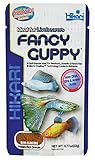
- Encapsulation process prevents dissipation of indispensable nutrients guppies need
- Slowly sinks allowing all fish ready access to its nutrition
- Will not cloud the water when used as directed
- Contains a special iodine derived from seaweed which improves overall conditioning
That ratio also creates a breeding obligation. Mixed-sex groups commonly produce fry, so decide before purchase whether you can house, rehome or otherwise responsibly manage additional fish. If you do not want fry, keep a single-sex group and confirm the sex of every fish; females purchased from mixed tanks may already be carrying sperm.
Independent reader supportYour contribution helps us test, update, and keep practical guides available for everyone.Can guppies live with other fish?
Compatibility depends on adult size, temperament, water requirements, swimming space and fin-nipping behavior. Avoid fin-nippers; OATA specifically gives barbs as an example of a group to avoid. A peaceful fish can still be unsuitable if it requires very different chemistry or temperature, grows large enough to eat guppies, or competes aggressively for food.
Choose companions only after comparing their requirements with the guppies’ measured conditions. Provide plants and smooth cover, but retain open swimming room. Watch introductions closely for chasing, torn fins, hiding, rapid breathing or a fish being excluded from food. Separate an aggressor or injured fish promptly. The Seriously Fish profile also cautions against strong currents, so ensure tankmates do not require flow that leaves guppies struggling.
Best Value

- High Palatability : Our guppy food contains up to 35% of wild sword prawns and all other 100% natural ingredients which make it highly nutritious without sacrificing superior taste—even the pickiest guppy can't resist it!
- Easy to Intake & Digest : As small as 0.6mm granule, it softens quickly, easy for guppy to digest. *Feed 1-3 times per day, no more than your fish can consume within 3 minutes. Don't overfeed your fish
- Ultra Natural Coloration : Ultra-enhanced formulation of natural seaweed, Australian spirulina, and premium fresh sword prawns enhances the natural coloration of your fish, presenting them in their most natural and vibrant colors.
- Healthy Growth Formula : It's not only tasty, but it also keeps guppies healthy! Our food is jam-packed with vitamins (A, C, D3, E, B1, B2, B6, B12) great for reaching full potential in size, color, fins, and A+ immunity!
- 3 Million CFUs/g Probiotics : 3 million CFUs/g probiotics are within our food to automatically help dissolve fish excrements, residuals and keeps water clean. Other than that it helps fish to fully absorb nutrition, help to excretion, enhance the immune system and lower the risk of digestive problems.
How guppy breeding works
Guppies are livebearers: the female gives birth to free-swimming young rather than scattering eggs. OATA says breeding is almost certain when males and females are mixed. Its care sheet gives 20–80 fry after a pregnancy of 24–30 days. Those figures describe possible outcomes, not a guaranteed litter size or timetable.
If you want to raise fry
- Prepare a plan for the extra fish and a suitably large breeding net or separate rearing aquarium before breeding occurs.
- Provide dense, gentle plant growth or other smooth cover. In a community aquarium, cover gives some fry a chance to avoid adult fish.
- If using a breeding net, monitor the female closely and avoid leaving her confined longer than necessary; move her away from the young after birth.
- Feed fry specialist food in tiny portions until they can feed freely and are no longer easily eaten. Keep water quality especially stable because small aquariums foul quickly.
- Sort or rehome growing juveniles before the aquarium becomes crowded, and separate sexes if you need to prevent another generation.
If you do not want fry
Choose a single-sex group and ask the seller to verify sex. Do not assume a newly purchased female is unmated: sperm storage means a female from a mixed-sex tank may produce young later. If accidental fry appear, decide quickly whether the existing aquarium can support them and contact a knowledgeable local retailer or keeper about responsible rehoming.
Quick Recap
Common mistakes that harm guppies
- Buying fish before cycling: clear water is not proof that ammonia and nitrite are safe.
- Adding a full group at once: sudden waste can overwhelm the developing filter bacteria.
- Skipping a test kit: behavior can change after water quality has already deteriorated.
- Overfeeding: excess food becomes additional pollution.
- Using untreated tap water: chlorine or chloramine can damage fish and beneficial bacteria.
- Washing filter media under the tap: this can remove or kill the bacteria that process waste.
- Choosing fin-nipping or high-flow companions: torn fins and chronic exhaustion are preventable compatibility failures.
- Ignoring reproduction: a small starter group can become an overcrowded aquarium within weeks.
- Chasing numbers with rapid chemical changes: stability and gradual correction are safer than abrupt pH or hardness swings.
A simple welfare-first checklist
- The aquarium is mature and tests show zero ammonia and zero nitrite before fish arrive.
- The filter runs continuously and creates circulation without forcing guppies to fight the current.
- Temperature, pH and hardness are measured and stable within a suitable range.
- There is cover, smooth décor and enough open swimming space.
- Tap water is conditioned before every addition.
- Fish are added gradually and observed daily.
- Water is tested at least weekly and about 25% is changed each week.
- Food is varied but limited to a portion eaten within a few minutes.
- Tankmates are peaceful, similarly sized and compatible with the water conditions.
- A plan exists for fry before males and females are housed together.
Product prices and availability are accurate as of the date/time indicated and are subject to change. Any price and availability information displayed on Amazon at the time of purchase will apply.
The Tool Desk
Outbyte Driver Updater FREEFix the driver behind crashes, sound loss and screen glitchesFind Drivers →Outbyte PC Repair FREERepair Windows errors before they cause bigger problemsFix Now →




Leave a Reply