Quick wins for a faster PC:
Fix the driver behind crashes, sound loss and screen glitchesFind Drivers →Clear out junk files and repair common Windows errorsFree Scan →A kitten without a mother in sight is not automatically orphaned. Confirm that first. If the kittens really have no mother, the job is to get veterinary or rescue guidance on a kitten-specific milk replacer, bottle-feed slowly with the head held neutral, and wean gradually over several weeks. Each kitten’s health and feeding needs are individual, so the general schedules below are reference points, not a substitute for veterinary care.
Confirm the kittens are actually orphaned
Mother cats often leave their litter to find food, drink, or a bathroom, and some wait for people to move away before returning. Picking up kittens that are merely unattended can separate them from a mother who was close by the whole time.
- Watch from a distance, out of sight if you can, for several hours. ASPCA guidance on found kittens advises checking whether the mother comes back before intervening.
- Note whether she returns at dusk or after you leave the area. A mother may only come back when no one is nearby.
- If the kittens are in danger from traffic, weather, or predators, moving them is a reasonable step. Keep the kittens together and as close as possible to where you found them, so the mother can still find them.
Get prompt help for ill or injured kittens
Kittens that are injured, lethargic, cold, or not feeding need help from a shelter, rescue, or veterinary clinic without delay. ASPCA guidance on found kittens says that ill or injured kittens should be taken for help promptly. Do not wait to see whether a weak kitten improves on its own, because very young kittens can decline quickly.
Choose a milk replacer, not cow’s milk or adult cat food
When maternal nursing is unavailable, a commercial kitten milk replacer is the usual substitute. ASPCA’s cat nutrition guidance states: “If you find yourself in this situation, contact your veterinarian for product and feeding recommendations.” The same guidance says newborns receive complete nutrition from their mother’s milk for the first four weeks, and that kittens separated from the mother may need commercial milk replacer. ASPCA is credited as the publisher of that guidance; no individual author is named.
#1 Best Overall
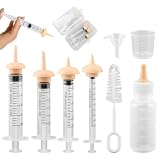
- One-Stop Scientific Feeding: Designed specifically for newborn kittens, puppies, and various small animals, this kit includes a 50ml professional feeding bottle, four precision syringes of different capacities (1ml, 3ml, 5ml, 10ml), four biomimetic nipples, as well as a funnel and measuring cup. From precise feeding immediately after birth to supplemental feeding during the transition period, this single kit meets all your care needs.
- Precise Measurement for Safe Feeding: Recognizing that newborn pets are extremely sensitive to feeding amounts, the kit includes four syringes of different sizes, each featuring clear, durable graduations. This allows you to control feeding with milliliter-level precision based on your pet’s weight and age, effectively preventing choking or digestive strain caused by overfeeding.
- Bio-Mimetic Nipples: Made from ultra-soft, food-grade silicone, these bio-mimetic nipples replicate the natural feel of a mother dog or cat’s mouth. They are bite-resistant and gentle on the mouth. Multiple nipple shapes are available to suit pets of different sizes and developmental stages, increasing the success rate of feeding.
- Easy to Clean, Comes with a Dedicated Storage Case: The included cleaning brush easily reaches the bottom of bottles and syringes, ensuring no milk residue remains. All accessories are neatly stored in a transparent storage jar/container, making it convenient for home storage and keeping your tools organized and ready to use—whether you’re traveling with your pet or on the go.
- Essential Professional Tools for Young Pets: Whether caring for orphaned puppies or kittens, administering medication to sick adult pets, or providing nutritional support for frail premature pets, this multifunctional kit offers the most professional support. The included measuring cup and funnel make the process of mixing formula more precise and spill-free, making it the ideal assistant for pet owners and animal rescuers.
VCA Animal Hospitals’ guidance on feeding orphaned kittens says a replacer should meet the nutrient requirements of growing kittens. Check the label for that statement and ask your veterinarian which product suits the kitten in front of you. Avoid substituting cow’s milk, which does not meet kitten nutritional needs, and do not assume that a generic adult cat food is equivalent to kitten food for growth. ASPCA recommends kitten-formula food for the weaning stage.
Plan the feeding schedule
VCA describes scheduled feeds every two to four hours during the first week of life. Treat that as general reference guidance. The right interval, volume, and number of feeds depend on the kitten’s age, weight, and condition, so ask your veterinarian to set a plan for your specific kitten.
Rank #2

- SQUEEZE BOTTLE - 60ml nursing bottle for newborn kittens and puppies, 2.1 ounce capacity, small animal feeding bottle is easy to squeeze and easy to control the amount of milk.
- SMALL ANIMAL FEEDER SET - 1ml for small nipples, 3ml, 5ml, 10ml for medium and large nipples, 60ml feeding bottles can be freely combined with (small, medium, large) nipples.
- 5 REPLACEABLE NIPPLES - Different sized nipples to meet the needs of small animal at every stage, the soft rubber-tipped nipple prevents scratching the gums of newborn kittens and puppies.
- 5ML BROWN FEEDER - The brown 5ml syringe is made of light-safe material to prevent photosynthesis of medication, use a separate dedicated feeder for better use when your pet is sick.
- NEWBORN KITTENS & PUPPIES GIFT - Suitable for newborn and not yet teething small animals, kittens, puppies, hamsters, chinchillas, squirrels, rabbits, etc. you will be a very gentle owner, take care of it, love it and grow with it.
Energy needs of a newborn kitten
A 2022 peer-reviewed feline neonatology review, titled “Feline neonatology: From birth to commencement of weaning – what to know for successful management,” reports an energy requirement of 20–26 kcal per 100 g of body weight per day for newborn kittens. The review also notes that many commercial milk replacers provide about 1.0 kcal per ml.
These two figures describe a review’s reference values and a typical product density. They are not a bottle volume. Use them to understand why a kitten’s feeding amount must be calculated from its weight and the specific product’s label, and confirm the calculation with your veterinarian.
The Tool Desk
Outbyte PC Repair FREERepair Windows errors before they cause bigger problemsFix Now →Outbyte Driver Updater FREEFix the driver behind crashes, sound loss and screen glitchesFind Drivers →Rank #3

- NURSING KIT - This kit was designed to feed Esbilac, KMR, Goat’s Milk KMR, Goat’s Milk Esbilac, PetLac, or other liquids to small animals.
- WHAT’S INCLUDED - The kit includes a 2 oz. nursing bottle with cap, 5 silicone nipples (3 regular, 1 elongated for smaller mouths, 1 balloon for larger mouths), and a bottle brush.
- PROMOTES NATURAL FEEDING - Our flexible, latex-free nipples simulate the milking action of a mother’s nipple, which develops facial muscles and stimulates the normal flow of saliva. Bottle feeding also allows the animal to refuse formula when full.
- EASY TO USE - Marked with gradations, the included bottle makes monitoring food intake easier and helps prevent over or under feeding. It’s durable enough to stand up to repeated use, and is easy to clean thoroughly with the brush.
- ABOUT US - PetAg is a trusted leader in pet wellness, with science-backed formulas in our milk replacers, health supplements, and grooming products helping pet owners to proactively enhance the lives of their pets, for more healthy years together.
Bottle-feed safely
Bottle feeding is the standard way to give replacer to a kitten that can suckle. Use a pet nursing bottle with a slow-flow nipple, and follow the steps below.
- Prepare the replacer exactly as the label or your veterinarian directs. Do not add extra water to stretch it or make it more concentrated.
- Hold the kitten on its belly, horizontally, with its head neutral. The head should not be tilted back or raised above the body.
- Offer the nipple and let the kitten draw the milk at its own pace. Do not squeeze the bottle to force milk in.
- Stop if milk runs out of the nose, the kitten coughs, or its breathing becomes labored, and allow it to recover before continuing.
- Keep feeds at the interval your veterinarian has set, and record how much each kitten takes.
VCA warns that excessive nipple flow can cause aspiration, pneumonia, or death. A kitten that is too weak to suckle needs veterinary help with alternative feeding methods. Do not attempt tube feeding without veterinary instruction.
Rank #4

- Angled Bottle Design for Natural Feeding: 45 angled kitten bottles allow nursing pet babies to drink milk while lying down, which is the most natural way for pet babies to feed. The ergonomic design provides comfort during feeding sessions, and holding the kitten feeding bottle for extended periods will not cause fatigue. The kitten nipple can be used in conjunction with a syringe for accurate milk portion control, especially useful when weak kittens need syringe feeding
- Three Silicone Nipple Sizes for All Ages: Three different sizes of pacifiers ensure kitten feeders can be used from birth to weaning. The soft silicone nipple is appealing for kittens and puppies. If the nipple's milk outlet needs adjustment, scissors can be used to widen the opening for better flow
- Ventilation System to Reduce Choking: Bottle features a ventilation system similar to human baby bottles, eliminating the need for manual ventilation during feeding and reducing the probability of choking on milk. Provides a safety protection comparable to infant feeding products
- Complete Feeding Kit Included: The product includes 1 x 60ml bottle, 1 x 5ml syringe, 1 x small nipple, 1 x medium nipple, and 1 x large nipple, providing everything needed for feeding kittens at various stages of development
- Safety Precaution for Teething Pets: When pet babies develop sharp teeth, use the feeding products with caution as nipples can be easily bitten off or swallowed by accident. Monitor your pet during feeding to ensure safe usage
Wean gradually
Weaning is the change from milk-only feeding to solid food. ASPCA guidance states that orphaned or hand-fed kittens can generally begin weaning at about three weeks of age. Readiness matters more than the calendar. Look for the kitten’s eyes open and able to focus, and steadiness on its feet. A kitten that is unwell or not yet showing these signs should not be pushed toward solid food.
| Age (typical, per ASPCA) | Milestone | Notes |
|---|---|---|
| About 3 weeks | Weaning can begin for orphaned or hand-fed kittens | Start only if the kitten shows readiness signs |
| 5–6 weeks | Nibbling kitten food | Broad milestone, not a deadline |
| 8–10 weeks | Typically accustomed to unmoistened food | Individual kittens vary |
Stage 1: Replacer in a shallow dish
Offer the milk replacer in a shallow dish. Dip the kitten’s face into the dish only if necessary to show it what to do, and never push the face into a bowl. Inhaling liquid can cause pneumonia or other lung problems.
Best Value

- Soft silicone pacifier: Soft silicone pacifier, even if the newborn kitten and dog without teeth can suck and drink smoothly, and will not choke when drinking milk
- Pinhole liquid outlet: As long as the newborn kittens and puppies suck or nibble, the milk can flow out smoothly, thus achieving the purpose of feeding
- Anti-choking valve design: The bottle body is controlled by the pressure valve, which can limit the flow in the drop inlet and control the milk flow to prevent choking
- Capacity: 20 ml
Stage 2: Soft gruel
Mix high-quality kitten food with replacer into a soft gruel. Make the gruel thin enough to lap easily, and follow the replacer’s preparation instructions.
Stage 3: Shift toward kitten food
As the kitten learns to eat, gradually reduce the amount of replacer and increase the kitten food. The change is gradual because each kitten progresses at its own pace. If a kitten stops eating or loses interest in food, return to the previous stage and call your veterinarian.
Quick Recap
When to call a veterinarian
- The kitten is weak, cold, injured, or cannot suckle.
- The kitten coughs, sneezes, or has trouble breathing during or after a feed, which can signal aspiration.
- The kitten refuses food, loses weight, or does not progress through the weaning stages.
- You are unsure which replacer, quantity, or feeding interval is right for the kitten.
Sources
- ASPCA, “Cat Nutrition Tips,” cat nutrition guidance, checked 7 October 2026.
- ASPCA, “I Found Kittens Outside, What Do I Do?”, guidance on checking for the mother and seeking help for ill or injured kittens, checked 7 October 2026.
- VCA Animal Hospitals, “Feeding Orphaned Kittens,” veterinary guidance on milk replacer, bottle feeding, and feeding schedules, checked 7 October 2026.
- “Feline neonatology: From birth to commencement of weaning – what to know for successful management,” peer-reviewed feline neonatology review, 2022.
Product prices and availability are accurate as of the date/time indicated and are subject to change. Any price and availability information displayed on Amazon at the time of purchase will apply.




