
Some links on this page are affiliate links: if you buy through them we may earn a commission, at no extra cost to you.
There is no single list of “best tankmates” that works for every tropical aquarium. A peaceful combination depends on the exact species, their adult size and temperament, the aquarium’s dimensions and territories, and whether temperature, pH and hardness suit all of them. Treat familiar community fish as candidates to investigate—not as a guarantee that any two fish can share a tank—and keep a way to separate fish if behavior becomes unsafe.
What makes a tankmate compatible?
Compatibility is a pairing in a particular aquarium, not a permanent label attached to a species. Aqueon identifies tank size, adult size, geographic origin, sex, schooling behavior, territoriality, predation, breeding behavior and individual personality as factors that can change the outcome. Two fish may coexist in one heavily planted, spacious aquarium and fail in a smaller, open tank. A fish that is peaceful most of the year may defend a nest, and a small fish that looks safe in a shop may eventually fit in another fish’s mouth.
As an Amazon Associate I earn from qualifying purchases.
Before buying, identify every fish by exact species and check its adult length and care requirements. Common names can cover several species with different sizes or temperaments. Make a practical relocation plan as part of stocking: a cycled quarantine or spare aquarium, divider, net and suitable filter are useful insurance if chasing, fin damage or predation starts.
Community-fish candidates to research
Aqueon’s starter community examples include the groups below. They are often considered for tropical freshwater communities, but the list is not an all-against-all compatibility chart. Check the exact species, adult size, group requirement and water preference before combining any of them.
Popular on Amazon

- 【Product size】aquarium divider separator kit includes 8pcs 11.8 Inch X 5 .9 Inch aquarium divider boards with 0.15Inch hole and 10pcs clips with suction.
- 【Novel DIY design】Our fish tank divider separate boad can be freely pieced together through concave convex buckles, and can be cut into the shape you want with scissors according to your tank needs.
- 【Made of high quality materials】Durable,Sturdy, strong weighing capacity and not easy to be broken which can effectively prevent birds or cats from scratching fish
- 【Product usage functions】The aquarium board can be used as a fish tank isolation board. First, cut the board to the size you need, and then install aquarium divider with suction cup clips to separate the fish tank into multiple independent spaces, avoiding some fish from biting each other etc
- Our aquarium board can also be used as Aquarium divider,Turtle basking platform,Aquarium lid,Aquarium stone base plate,Aquarium filter media bottom plate,Egg crate and the bottom plate of the aquarium and so on
| Candidate group | Why aquarists consider it | Checks before adding |
|---|---|---|
| Guppies | Small livebearers with active color and generally community-oriented forms. | Males and females can produce frequent fry; fin shape and individual males may provoke chasing. Confirm hardness, pH and temperature suit the rest of the tank. |
| Danios | Active schooling fish that OATA describes as generally compatible with most community species. | Fast, constant activity can stress timid fish. Provide swimming length and keep an appropriate group rather than a lone fish. |
| Mollies | Hardy livebearers often seen in community setups. | Adult size, social sex ratio, mineral-rich water needs and prolific breeding can exceed a small aquarium’s capacity. |
| Tetras | Many small schooling species suit peaceful planted communities. | “Tetra” is a broad group. Verify adult size, minimum school, temperature and whether a species is prone to fin-nipping. |
| Platies | Usually active, approachable livebearers for community aquariums. | Plan for fry, check water hardness and allow enough floor and open-water space for adults. |
| Swordtails | Colorful livebearers that can occupy the middle and upper water. | They grow larger than many nano-community fish and males may harass females or one another. Match tank length and water chemistry. |
| Barbs | Schooling fish with lively movement and a wide range of available species. | Some barbs nip fins or become too large and boisterous for timid tankmates. Identify the species and keep the recommended group. |
| Rasboras | Small schooling fish commonly used in planted community aquariums. | Aqueon says rasboras prefer planted aquariums and groups of seven or more; verify that recommendation for the particular rasbora species. |
| Otocinclus | Small algae-grazing catfish that can use surfaces and plants without competing for open water. | They need a mature, stable aquarium with suitable food. Do not assume every “algae eater” has the same needs. |
| Keyhole cichlids | Aqueon includes them among starter community examples. | They are still cichlids: confirm adult size, breeding behavior, territory and the space needed for a pair or group. |
Use this table to create a shortlist, then test each possible pairing against the checklist below. A fish being listed as a community candidate does not override a mismatch in mouth size, water chemistry or available space.
The compatibility checklist
1. Compare adult size, not shop size
Write down the expected adult length of every fish and the largest mouth or body shape it will develop. A predator does not need to be aggressive to eat a tankmate; it only needs a sufficiently large mouth and an opportunity. Account for fish that are juveniles at purchase, seasonal growth and the size of fry. Avoid combinations in which one fish can swallow another, even if the current specimens look similar.
Quick wins for a faster PC:
Repair Windows errors before they cause bigger problemsFix Now →Fix the driver behind crashes, sound loss and screen glitchesFind Drivers →Clear out junk files and repair common Windows errorsFree Scan →Large-bodied fish also create more waste and displace more swimming room than their juvenile appearance suggests. Recalculate space and filtration as fish grow rather than waiting for crowding, stunting or deteriorating water quality.
2. Match temperament and activity
Look beyond the word “peaceful.” Ask whether a fish is territorial, a fin-nipper, a persistent chaser, a nest defender or an easily frightened species. OATA warns that active danios may stress timid fish. A boisterous species can prevent a shy fish from feeding even when there are no visible injuries.
Observe the way fish use the aquarium. Combining bottom-oriented fish with midwater schoolers can reduce direct competition, but it does not make a predatory or territorial species safe. Provide visual barriers—plants, wood, rocks and caves—so subordinate fish can break line of sight and retreat.
3. Meet schooling and social needs
Many community fish are schooling or shoaling species. A single individual may be nervous, hide, or behave abnormally, while a proper group can spread aggression and produce more natural behavior. Aqueon’s rasbora guidance recommends groups of seven or more, but that is a care recommendation from its rasbora article, not a universal number for every rasbora species.
What’s actually slowing this PC down?
Pick the symptom - the matching free tool is one click away.
Also popular on Amazon

- 【2-in-1 Breeding & Isolation Design】Use it as a dedicated breeding box for pregnant fish or install the removable divider to create a protected maternity chamber. Remove the divider to instantly convert it into a spacious isolation tank for injured, aggressive, or newly introduced fish.
- 【Increase Fry Survival Rate】The integrated fry escape system allows newborn fish to pass safely through the specially designed openings into the lower protection area, helping reduce predation by adult fish and improving fry survival.
- 【360° Water Circulation】Precision slots and perforations on all sides promote continuous water exchange with the aquarium, maintaining stable water conditions while providing a safe environment for fish and shrimp.
- 【Crystal-Clear Viewing Experience】Made from highly transparent acrylic panels for unobstructed viewing of breeding, recovery, and fry development. Ideal for monitoring pregnant fish, newborn fry, shrimp, and juvenile fish.
- 【DIY Assembly & Space-Saving Installation】Features a simple tool-free assembly design with silicone fixing rings and secure suction cups. Easily mounts inside most aquariums without occupying valuable external space.
Count the required group before calculating how many other fish fit. A tank that can support six individuals of one small species may not support a full school plus livebearers and bottom fish. Do not solve a space problem by buying one schooling fish as a “test” or universal companion.
4. Match temperature, pH and hardness
Use measured aquarium values, not just the number printed on a heater. OATA emphasizes that freshwater fish differ widely in temperature, pH and hardness requirements and that compatibility varies accordingly. Choose species with overlapping long-term preferences, then keep the aquarium stable; rapid swings are often more harmful than a value that is slightly outside a broad published range.
As an example of the need for species-level checking, OATA’s group-level rainbowfish guide suggests 22–27°C and pH 6.5–8.0, while advising that individual species still require verification. Do not apply those ranges automatically to every fish sold as a rainbowfish or to unrelated community species.
5. Size the aquarium by dimensions and territories
Actual water volume matters, but dimensions matter too. Long-bodied swimmers need length; bottom fish need usable floor area; territorial fish need separate retreats. Measure the aquascape’s open swimming lanes after substrate, wood and rocks are installed rather than treating the tank’s nominal volume as entirely available.
Recommended Free Tools
There is no universal stocking number that covers all freshwater combinations. OATA says differences in fish size, needs, water parameters and compatibility are too broad for an exact rule. Use the most demanding species as a starting point, leave room for adult growth and increase numbers slowly while monitoring water quality.
6. Consider origin, sex and breeding
Fish from similar environments may share water preferences, but geographic similarity does not guarantee compatible behavior. Sex ratios can change aggression and breeding pressure in livebearers and cichlids. Spawning pairs may claim a cave or patch of substrate and attack fish that were previously tolerated.
Also popular on Amazon

- What You Will Receive: You will receive 2 sets of fish tank partitions, including 2 plastic grid panels, 6 self-adhesive hooks and 6 cable ties for fixing to ensure a secure installation
- Durable Material: Made of durable plastic, this fish tank partition is waterproof, ensuring long-term use and providing a good environment for your aquatic life
- Size Details: The size of each grid panel is 10.2 x 13.2 inches, and these partitions can be easily cut and customized to fit the size of your aquarium
- Easy to Install: Each partition is equipped with self-adhesive hooks for easy fixing on the tank wall and cable ties for added stability. This design ensures that the partition is firmly fixed to prevent fish from crossing the boundary
- Improve Fish Tank Organization: Helps reduce aggression between fish, provides a controlled breeding environment, and separates different aquatic species within the same tank
Ask whether you can identify sexes, whether fry are acceptable and how you will prevent a breeding population from overwhelming the aquarium. Dense plants can provide cover for fry, but they can also make it harder to catch an injured fish.
Water quality comes before adding another species
Test the aquarium before shopping. OATA’s general freshwater guidance gives ammonia (NH3) and nitrite (NO2) targets of zero mg/L. Any measurable amount means the biological filter or maintenance routine needs attention before adding more waste-producing animals.
Crashes, No Sound, or Screen Glitches?
Random freezes, missing sound and display glitches usually trace back to one bad driver. Find and replace yours safely.Free scan · under a minuteWindows Errors? Fix Them Before They Spread
Repair common Windows errors and clear accumulated junk for a smoother, more stable PC - no reinstall needed.Free scan · no reinstall- Confirm the tank is cycled and that ammonia and nitrite remain at zero mg/L through routine testing.
- Record temperature, pH and hardness at the same time of day for several days so you know the normal range.
- Increase fish numbers gradually. OATA notes that beneficial filter bacteria must adjust to the extra waste when stocking rises.
- Test after each addition and respond to a rising result with appropriate maintenance and reduced feeding rather than adding another fish.
A water test kit helps compare the aquarium’s actual conditions with a candidate species’ care sheet. It cannot predict chasing, territorial disputes or an individual fish’s personality, so water results are necessary but not sufficient.
Special cases that need extra caution
Danios and timid fish
Danios are often recommended for community aquariums, and OATA describes them as generally compatible with most community species. Their speed and constant movement are the important qualification. In a short or sparsely decorated aquarium, they may dominate feeding and keep timid fish in hiding. Use a suitably long tank, maintain the correct group and avoid pairing them with fish that require a quiet, low-traffic environment.
Size still overrides a general temperament label. OATA notes that larger goldfish may eat white cloud mountain minnows; this illustrates why mouth size and growth must be checked even when a combination is sometimes described as “peaceful.” It is not a recommendation for a tropical community tank.
Catfish are not interchangeable
OATA identifies Corydoras, Otocinclus and smaller plecos as possible community additions, but also warns that some catfish are extremely predatory. Identify the exact species before purchase. Check adult length, feeding method, nocturnal behavior, temperature and the amount of floor space it needs.
The Tool Desk
Outbyte Driver Updater FREEFix the driver behind crashes, sound loss and screen glitchesFind Drivers →Outbyte PC Repair FREEClear out junk files and repair common Windows errorsFree Scan →Also popular on Amazon

- Fish tank separator size: 17.3" * 11.8"*0.12" (44cm*30cm*3mm)*2 piece, aperture : 0.2" (5mm); Using laser cutting, the circumference and the hole are smooth, the aperture is well-designed to secure the safety of your fish. Suitable for aquariums with a width of 18 or 12 inches,(Please measure your tank before purchasing! via multiple fish tank dividers).
- Product material: Eco-friendly, non-toxic, high hardness, corrosion resistance, easy to clean; high transparent acrylic (PMMA), the light transmittance is more than 92%, does not affect the aquarium landscaping and looking, and will make the fish tank more beautiful under the light.
- New design: The state of the art design with long holes around, can be placed horizontally and vertically, which is Conducive to fish feces through and more convenient for stitching. Additional accessories allow you to easily assemble more than two dividers to fit more fish tank sizes;The holes are denser, allowing more water to pass through.
- Complete accessories: Including transparent suction cups*16, fixing clip*16, transparent screw*12, Splicing fixed plate*4, screwdriver*1; easy to install, no need to purchase additional accessories, and provide more for spares.
- Safety packaging: Acrylic fish tank isolation board, including accessories, are covered with protective films on both sides to prevent scratches ,The accessories are packaged separately, and the partition is wrapped with shock-absorbing materials for transportation protection purpose,If anything is missing or damaged in shipping please contact us.
Corydoras generally need a group and a soft, safe substrate for bottom foraging. Otocinclus often fare best in mature aquariums with reliable natural and prepared foods. “Pleco” can refer to fish that remain relatively small or species that become very large, so never select one by the shop label alone.
Gouramis and paradise fish
OATA describes gouramis as ranging from timid to aggressive. Advice for one small, calm gourami cannot be transferred to every gourami species. Some individuals may defend the surface, plants or a bubble nest; others may be harassed by active companions.
For more robust gouramis or paradise fish, OATA recommends avoiding timid fish, fish small enough to be eaten and fish likely to nip their fins. Provide cover and a retreat for each fish, and be prepared to remove an aggressor. Watch feeding as well as visible fighting because chronic intimidation can cause weight loss without obvious wounds.
Bettas
Aqueon’s betta care sheet describes a peaceful community aquarium of 15 gallons or larger and names calm, non-aggressive candidates such as tetras, rasboras, livebearers and Corydoras. Treat that as the care sheet’s guidance, not a guarantee. Individual bettas differ, and long-finned tankmates or persistent nippers can create problems even when the species appear on a compatible list.
Use dense planting and visual breaks, avoid fish that compete aggressively at the surface, and introduce tankmates only after the aquarium is stable. Have a divided or second aquarium ready before attempting the combination. If the betta repeatedly flares, chases, bites or stops eating, separate it rather than waiting for a serious injury.
African lake cichlids
African lake cichlids deserve a specialist plan rather than a beginner community list. OATA’s general rule is to keep lake species with species from the same location. It does not generally recommend mixing Malawi and Tanganyikan cichlids because their temperament and behavior differ.
Also popular on Amazon
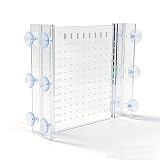
- SELECT 10 GALLON AQUARIUMS – CHECK DIMENSIONS BEFORE BUYING: Designed for select 10 gallon freshwater aquariums. Maximum inner opening: 10.5 inches. Fully retracted body width: 9.3 inches. Center panel width: 9 inches. Divider height: 11 inches. Measure your aquarium's inside width at the intended installation position before ordering. Tank capacity alone does not guarantee compatibility.
- DUAL SUCTION CUP SYSTEM FOR STABLE INSTALLATION Large mounting suction cups combined with additional edge suction cups help improve stability and create a closer fit along aquarium sides.
- CLEAR ACRYLIC FOR BETTER VISIBILITY Transparent acrylic construction keeps your aquarium view clear while creating separated spaces for different fish areas.
- PROMOTES WATER FLOW Precision circulation holes allow water movement through the divider while supporting a connected freshwater aquarium environment.
- QUICK TOOL-FREE INSTALLATION Remove the protective film from both sides, attach suction cups, adjust the width, and install the divider inside your aquarium. Designed for freshwater aquarium applications.
Research the lake, genus and adult size; plan rockwork and territories around the species; and verify water chemistry with a reliable test kit. A Malawi-specific setup may have requirements that are inappropriate for a soft-water community aquarium. Do not add a lake cichlid to a peaceful tetra, rasbora or livebearer tank simply because the juvenile looks small.
Independent reader supportYour contribution helps us test, update, and keep practical guides available for everyone.How to add new fish safely
- Inventory the current aquarium. Record exact species, number, sex where known, adult size, feeding level, temperament and the territories each fish uses. Measure tank dimensions and note open swimming lanes, caves and dense cover.
- Build a shortlist. For each candidate, write the adult size, minimum group, temperature, pH, hardness, diet, activity level and breeding behavior. Remove any fish with an incompatible mouth size or clearly conflicting water requirement.
- Confirm the group requirement first. If a species needs a school, reserve space for the complete group before counting other additions. Do not buy a lone schooling fish as a trial.
- Check water quality. Test ammonia and nitrite; both should be zero mg/L under OATA’s general freshwater targets. Correct instability before adding livestock.
- Quarantine when possible. Use a separate, cycled aquarium to observe new fish, confirm feeding and watch for illness. Quarantine also lets you verify the fish’s identity and growth without exposing the display tank.
- Rearrange territories. Moving wood, rocks and plants can interrupt an established territory before introduction. Keep filtration running and preserve hiding places.
- Acclimate to the display aquarium. Match temperature and follow a careful acclimation process appropriate to the fish and transport water. Avoid pouring shipping water into the display tank.
- Feed lightly and observe. Watch the first hours, the next morning and feeding time. Look for sustained chasing, clamped fins, torn fins, hiding, refusal to eat or one fish being blocked from shelter.
- Increase numbers slowly. Add one planned group at a time, allow the filter to adjust and test again before the next addition. A stable test result is more useful than an arbitrary stocking deadline.
Warning signs and what to do
| Sign | Likely concern | Immediate response |
|---|---|---|
| Repeated high-speed chasing or cornering | Territoriality, mating pressure or a poor activity match. | Add visual barriers if safe, reduce distractions at feeding and prepare the separation tank. Remove the aggressor or target if the behavior persists. |
| Torn fins, bite marks or missing scales | Nipping, predation or a fight over territory. | Separate injured fish promptly, check water quality and identify the responsible species rather than assuming the injury will resolve. |
| One fish hiding constantly or missing meals | Chronic stress or exclusion from food and shelter. | Provide additional cover and observe feeding; separate fish if the subordinate cannot eat or breathe normally. |
| Ammonia or nitrite above zero mg/L | The biofilter is not processing the current waste load. | Stop adding fish, perform appropriate water maintenance, reduce feeding and retest until readings return to zero. |
| Unexpected fry or a sudden territorial dispute | Breeding behavior has changed the social balance. | Decide whether to manage, rehome or separate the breeders and protect other fish from aggression. |
Do not rely on “they have not killed each other yet” as a compatibility test. Stress can be expressed as weight loss, disease susceptibility, poor growth or chronic hiding long before a fatal attack.
A practical decision framework
Use this order when deciding whether a candidate belongs in your aquarium:
- Eliminate dangerous size mismatches. If one fish can swallow, seriously injure or outgrow another, stop there.
- Eliminate water conflicts. Keep only candidates with overlapping temperature, pH and hardness preferences that your aquarium can maintain steadily.
- Reserve space for natural behavior. Include the full school, adult territories, bottom area and swimming length rather than counting fish alone.
- Compare activity and temperament. Remove combinations in which a fast, assertive fish would keep a timid species from shelter or food.
- Plan for breeding. Decide how you will handle fry, nest defense and changing sex ratios.
- Make separation realistic. If you cannot isolate or rehome a fish, do not attempt a marginal pairing.
This process produces a safer answer to “what fish can live together?” than a universal ranking. It also leaves room for individual personality: even a well-researched pairing can fail, and responsible fishkeeping means acting when it does.
Bottom line for choosing tropical tankmates
Start with the aquarium you actually have, then match adult size, temperament, schooling, water conditions and space. Guppies, danios, mollies, tetras, platies, swordtails, barbs, rasboras, Otocinclus and keyhole cichlids can all be research candidates for community systems, but none is automatically compatible with every other candidate. Treat catfish, gouramis, bettas and African lake cichlids as species-specific decisions, add fish gradually, keep ammonia and nitrite at zero mg/L, and maintain a ready way to separate fish when the real animals do not follow the label.





Leave a Reply