
Give the dogs their treats in separate, secure spaces. Put the separation in place before you bring out the food, give each dog their treat without letting the other approach, and wait until both treats are finished and any leftovers are put away before reuniting them. For a long-lasting chew, let each dog enjoy it undisturbed behind a closed door or another barrier that reliably prevents contact.
“Jealous” is a useful everyday description, but a dog that crowds, steals, or guards a treat may be reacting to competition over a valued resource. The priority is preventing access and conflict—not making the dogs share or taking food away to prove a point.
As an Amazon Associate I earn from qualifying purchases.
Why separation works better than asking dogs to share
Food, chews, toys, resting places, and even people’s attention can become resources dogs compete over. Dogs Trust describes behavior around these resources as ranging from avoidance or turning the head away to growling, lunging, or biting. A dog does not need to growl for the setup to be uncomfortable: crowding, watching the other dog closely, or trying to reach a treat can also make an ordinary snack handout a tense moment.
There is no need to decide whether a dog is literally jealous before changing the routine. Treat the behavior you can observe: if one dog rushes over, steals food, blocks the other, or becomes tense when a treat appears, prevent them from reaching each other’s food. VCA Animal Hospitals recommends feeding household dogs in separate rooms because dogs may fight over food. Dogs Trust likewise recommends using different rooms or barriers before giving food or enrichment.
#1 Best Overall

- Auto-Close Baby Gate: Designed with an intelligent self-closing system, this dog gate automatically swings shut at angle under 90°, providing reliable protection against accidental openings
- Dual-Lock Safety: This baby gate for stairs features a secure dual-lock mechanism, ensuring curious children and pets stay safely contained while allowing adults to open it effortlessly with one hand. Parents can pass through the baby gates for doorways with ease even while carrying groceries or a baby
- Tool-Free Installation: The pressure-mounted dog gate indoor provides a secure hold while protecting your walls or furniture from damage, ideal for renters and hassle-free setups. The dog gates for doorways offer a quick, temporary solution that's both safe and convenient. The attached sticky pads are provided to keep the wall cups in place, so you don't need to drill
- Stroller-Friendly Baby Gate for Stairs: Features an anti-stumble pedal, ensuring a seamless transition between the pet gate and the floor. This design reduces the risk of tripping and allows strollers to roll through the child gate effortlessly, making the pressure mounted baby gate ideal for families with elderly members and young children
- Adjustable Pet Gate Indoor: With an adjustable width from 29 to 40 inches, the baby gate with door fits most standard doorways and stair openings, creating a safety environment for your little ones and furry friends while giving you peace of mind. Please measure the width of the openings you want to place the child gate before installation
Separation is management, not a cure for guarding. Its immediate job is to keep each dog from being disturbed or challenged while eating. It also avoids putting either dog in the position of having to defend food or tolerate another dog hovering nearby. A predictable routine can make treat time simpler for the person, too: instead of deciding on the spot whether the dogs seem calm enough to share space, you arrange separation every time.
That applies to dogs that usually get along as well as dogs with a history of conflict. A dog may be comfortable around a quick, low-value snack but not around a chew it wants to keep. Other valued resources—such as toys, resting spots, or attention—can also be involved, so do not assume that a peaceful treat handout proves the dogs are comfortable sharing every resource.
Choose a separation that works for your dogs
The right setup depends on your dogs’ size, behavior, ability to jump or climb, other animals or children in the home, and the layout of the rooms. A barrier counts as separation only if it prevents access in your particular household. Wisconsin Humane Society notes that gates and pens may not be enough for every animal or situation; a second barrier may be needed if a child or another pet could approach.
Do these 3 things before closing this tab:
1Fix the driver behind crashes, sound loss and screen glitches2Repair Windows errors before they cause bigger problems3Scan for outdated or missing drivers - takes under a minute| Setup | When it may work | What to check |
|---|---|---|
| Separate rooms with closed doors | A straightforward choice for routine treats and long-lasting chews, especially if a gate could be bypassed. | Each dog can stay in its own room, and neither can push through or otherwise gain access to the other’s food. |
| Baby gate or other secure barrier | May suit dogs that remain calm on opposite sides and cannot get around or over the barrier. | Can either dog jump, climb, squeeze through, or knock it aside? Could a child or other pet approach and unsettle a dog while it eats? |
| Puppy pen or crate | May fit some homes when each dog is comfortable in the enclosure and it prevents contact. | Is the enclosure appropriate for that dog and secure in this setting? Do not rely on it if the other dog can get close enough to disturb the eater. |
If you are unsure whether a gate is adequate, use a closed room instead. Dogs Trust and Wisconsin Humane Society both discuss barriers as possible separation tools, but neither makes a gate a universal solution; dogs that jump it or other household members who can approach may require a more secure arrangement.
Compare options by asking three practical questions: Does the setup fully prevent access, including jumping or climbing? Can each dog relax and eat without being watched or approached? Can children or other pets get close enough to disturb either dog? A separate room generally offers stronger separation than a gate a dog can bypass. A crate or pen can be useful in some homes, but only if the dog is comfortable there and the arrangement actually keeps the other dog away.
Do not choose a barrier based only on what is convenient or what worked once. A gate may be adequate for one pair of dogs and inadequate for another. If you cannot confidently prevent contact, switch to a closed door or another secure arrangement. Wisconsin Humane Society notes that a double barrier may be needed where children or other animals could approach; the goal is to prevent both direct access to food and unwanted approaches that could unsettle the dog eating.
Rank #2

- [Worry-Free Safety]: Our expandable dog gate is great for doorways and blocking off other indoor spaces to keep your pet safe and secure. This durable puppy gate is made of strong, appealing fieldstone gray plastic with adorable paw print accents.
- [Convenient and Portable]: This gate for dogs is 23" tall, fits a variety of openings 26" - 40" wide. Please measure carefully: it will not work in a wider doorway. It is easy to take down and install - which means you can use it anywhere you need it!
- [Perfect for Modern Homes]: Our portable, adjustable pet gate features rubber bumpers that protect your walls and are positioned higher than other gates to accommodate up to 4" molding. It's an ideal indoor dog gate.
- [Easy and Comfortable to Use]: The sturdy, curved handle allows for a firm grip, which makes mounting and disassembling a breeze!
- [Proud USA-Owned Company]: Our rigorously tested gates & yards bring peace of mind to your family. We stand for the highest safety & quality standards while creating the ideal products for your furry friends. This item is proudly made in the USA!
How to hand out treats safely
- Decide where each dog will be before you get the treats. Use separate rooms, or a barrier only if it reliably prevents contact. Set things up before the dogs are focused on the food.
- Put the dogs in their separate spaces. Make sure the arrangement prevents one dog from reaching the other’s treat, not merely from standing beside it for the moment.
- Give each dog its treat calmly. Hand the treat to the intended dog without inviting the other dog to hover, compete, or approach the barrier.
- Let them eat undisturbed. For chews or other long-lasting treats, choose a quiet area where the dog will not be interrupted.
- Wait until the treats are finished before bringing the dogs together. Put away any remaining food first. Dogs Trust notes that food hidden for later may also become something a dog guards.
Keep the routine simple and consistent. Decide in advance which room or secure area each dog will use, and make sure you can manage the doors or barriers without bringing the dogs face to face around food. If you are giving different treats, hand each one to its intended recipient only after the separation is secure. Do not put a treat down in a shared space and expect the dogs to sort out who gets it.
Crashes, No Sound, or Screen Glitches?
Random freezes, missing sound and display glitches usually trace back to one bad driver. Find and replace yours safely.Free scan · under a minuteWindows Errors? Fix Them Before They Spread
Repair common Windows errors and clear accumulated junk for a smoother, more stable PC - no reinstall needed.Free scan · no reinstallFor longer-lasting chews, the undisturbed part matters as much as the initial handout. A dog that is left alone with its chew may be able to relax rather than monitor another dog’s movements. Keep the separation in place until the chew is finished and any pieces or leftovers are put away. If you discover food the dog has hidden, do not bring the other dog into the area to retrieve it.
This routine applies whether the dogs usually get along or have already had a dispute. A calm handout on one day does not guarantee that a dog will be comfortable sharing a chew on another. Using the same predictable separation routine means you do not have to judge whether the dogs seem ready to compete over food each time.
What to do if a dog is already guarding a treat
If one dog has a treat and the other is approaching, focus on preventing contact rather than intervening with your hands. Dogs Trust advises creating space, keeping others behind a door or gate, and avoiding taking the item away. If you can safely move away or put a physical barrier between the dogs without approaching or cornering the dog with the treat, do that.
- Stay calm and give the dogs distance.
- Keep the other dog and any children or pets away using a door or barrier if you can do so safely.
- Do not chase, corner, crowd, or grab the dog or the food.
- If the item is not hazardous, do not forcefully remove it just to end the episode.
Do not try to pick up the food while the dog is guarding it, reach over the dog, or make the other dog approach as a test. Forcibly taking an item can add pressure to a situation that is already tense. If the item is not dangerous, give the dog space and keep other household members away until you can manage the situation safely.
Free tools Windows power users keep installed
One-click scans. No signup required.
If either dog may bite, has bitten, or is showing tense or aggressive behavior, do not attempt a training exercise in the moment. Prioritize distance and get help from a veterinarian or qualified behavior professional. If an item poses an immediate safety hazard, the risk of approaching a guarding dog is a reason to seek professional guidance rather than improvising a removal.
Rank #3

- ✅ TESTED & TRUSTED BABY SAFETY GATE FOR OVER 30 YEARS: Parent-trusted baby safety product certified by the Baby Safety Alliance. Designed to support everyday baby proofing and help keep babies and toddlers safe at home.
- ❤️AMERICAN DESIGNED & FAMILY OWNED BABY GATE BRAND: Designed in the USA by parents, for parents. Regalo delivers dependable baby gates and baby safety products trusted by families for over 30 years.
- 🔒EXTRA WIDE BABY GATE FOR DOORWAYS & BOTTOM OF STAIRS: Expands to fit openings 29–38.5" wide and stands 30" tall. Ideal for bottom of stairs, hallways, and wide openings. FITS OPENINGS: 29–32" no extension, 35.5–38.5" with 6". DOES NOT FIT OPENINGS: 32–35.5".
- EASY SETUP WITH PRESSURE MOUNT DESIGN: ⚠️Install according to manufacturer’s instructions. ⚠️Wall cups must be used to keep the gate securely in place. ⚠️ To prevent falls, never use at the top of stairs.
- 🐾 CHILD & PET SAFE | PUERTA DE SEGURIDAD PARA BEBÉS Y MASCOTAS: Walk-through safety gate designed for babies ⚠️6–24 months and small to medium pets. Features a secure safety locking system for parent convenience.
Signs that this is more than treat-time excitement
Dogs Trust describes resource-guarding signs that can be subtle as well as obvious. Watch for a pattern around food or other valued things rather than relying on a single dramatic incident. Possible signs include:
- Moving away, avoiding the other dog, or turning the head away when the other approaches.
- Becoming still or tense when a dog or person comes near the treat.
- Keeping close watch on the other dog, blocking access, or trying to take the other dog’s food.
- Growling, lunging, snapping, or biting.
A quiet dog is not necessarily comfortable if it is freezing or trying to avoid the other dog. Conversely, crowding around a snack does not by itself establish a behavioral diagnosis. The useful distinction for day-to-day decisions is whether the dogs can eat without pressure and whether a dog shows signs of guarding or distress. When in doubt, increase separation instead of testing how close they can get.
Look at the context as well as the behavior. Does the tension appear when a chew is present, when another dog moves toward a bowl, or when someone comes near a resting place? Does one dog avoid the other, block access, or watch closely? Noticing the pattern can help you explain the problem to a veterinarian or behavior professional. It is not a reason to provoke the behavior deliberately or to bring the dogs closer to see what happens.
Recommended Free Tools
When to ask for professional help
Get individualized help if a dog has bitten, may bite, snaps or lunges, becomes increasingly tense around food, or if you cannot keep the dogs reliably separated during treats. ASPCA advises professional help when there is bite risk and says to stop food-guarding exercises if a dog shows aggression or stress. Preventive Vet also recommends one-to-one support for guarding directed at another dog.
A veterinarian can help assess the situation and guide you to an appropriate behavior professional. ASPCA identifies qualified applied animal behaviorists, board-certified veterinary behaviorists, and trainers with appropriate experience as possible sources of support. Ask for guidance specific to both dogs and your household arrangement; a plan for food guarding around people is not automatically suitable for conflict between dogs.
When seeking support, describe what happens before, during, and after the conflict, including which resource is involved and whether either dog has snapped, lunged, or bitten. Explain what barriers you have tried and whether either dog can jump, climb, or get around them. This helps the professional consider a plan that fits the actual household rather than relying on a generic instruction to have the dogs share space.
Rank #4

- [Worry-Free Safety]: Our expandable dog gate is great for doorways and blocking off other indoor spaces to keep your pet safe and secure. This durable puppy gate is made of strong, appealing light gray plastic with adorable paw print accents.
- [Convenient and Portable]: This gate for dogs is 23" tall, fits a variety of openings 26" - 40" wide. Please measure carefully: it will not work in a wider doorway. It is easy to take down and install - which means you can use it anywhere you need it!
- [Perfect for Modern Homes]: Our portable, adjustable pet gate features rubber bumpers that protect your walls and are positioned higher than other gates to accommodate up to 4" molding. It's an ideal indoor dog gate.
- [Easy and Comfortable to Use]: The sturdy, curved handle allows for a firm grip, which makes mounting and disassembling a breeze!
- [Proud USA-Owned Company]: Our rigorously tested gates, yards & pens bring peace of mind to the entire family. We stand for the highest safety, quality and operational standards while creating the ideal collection of products for your furry friends. This item is proudly made in the USA!
While arranging help, continue using the secure separation that prevents access. Do not stage a close-up test, put the dogs together to see whether they have improved, or ask one dog to approach the other’s chew. If a professional sets out a gradual behavior plan, follow that plan rather than substituting an improvised exercise.
Why not train the dogs to accept sharing?
Some food-guarding behavior can be addressed through gradual, staged behavior work, but that is different from making dogs eat side by side or taking a treat away to teach them not to guard. ASPCA describes staged food-guarding work that uses small, special treats and cautions people to stop if the dog shows aggression or stress. Preventive Vet discusses gradual work at a distance where the dog remains relaxed and recommends individual professional support for dog-directed guarding.
The emphasis on gradual steps and a relaxed dog matters. The purpose is not to see how close another dog can get before the eater reacts. Preventive Vet describes tossing a valued treat from a distance at which the dog remains relaxed; that is a specific behavior-work concept, not a shortcut to try in a tense encounter. ASPCA’s guidance likewise includes staged work and bite-sized special treats, with a clear instruction to stop if the dog shows aggression or stress.
Those descriptions are not a reason to try a close-range exercise when a bite is possible. The dog’s response matters: if it shows tension, fear, or aggression, stop and seek qualified help. Do not use small treats as a shortcut or assume that rewarding one dog near the other will resolve the underlying problem. For routine treat giving, secure separation remains the practical choice even if a professional is helping with behavior.
Independent reader supportYour contribution helps us test, update, and keep practical guides available for everyone.Common mistakes that can make treat time riskier
- Putting a treat down between the dogs. This invites both dogs to approach the same resource. Give treats only after each dog is in its separate space.
- Assuming a gate is secure because it works for one dog. A dog may jump or climb it, and a child or another pet may approach the barrier. Use a closed room or a more reliable arrangement if the gate does not fully prevent access.
- Reuniting the dogs while a chew is still present. Wait until the treat is finished and put away leftovers, including food a dog may have hidden.
- Taking food away to test the dog. Forcibly removing a guarded item can add pressure and create risk. Make space and keep other household members away instead.
- Treating a growl as a cue to punish or crowd the dog. A growl is a warning sign that the situation needs distance; do not approach or attempt a do-it-yourself exercise if there is bite risk.
- Assuming “they have always shared before” means they are comfortable now. A dog’s response can vary with the resource. Keep long-lasting or valued chews separate even if routine snacks have not caused a problem.
- Using an enclosure without checking what happens around it. A crate or pen is not a reliable answer if the other dog can get close enough to disturb the eater, or if the dog inside is not comfortable there.
- Trying behavior work during a tense moment. If either dog is stiff, frozen, growling, snapping, or otherwise showing distress, create distance. Do not turn the incident into an improvised training session.
Frequently Asked Questions
Can I give both dogs treats at the same time?
Yes, if each dog is already in a separate area that reliably prevents access to the other’s treat. Use separate rooms or a barrier that works for your dogs, and keep them apart until the treats are finished and leftovers are put away. Do not hand treats out in a shared space and expect the dogs to share.
Is a baby gate enough to keep dogs apart while they eat?
Only if it prevents contact in your household. A dog may jump, climb, squeeze through, or knock aside a gate, and children or other pets may approach it. If you are unsure, use closed doors or another secure setup. A double barrier may be needed where others could approach.
Best Value
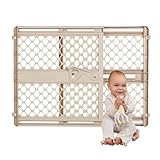
- PROVIDES PEACE OF MIND - The kids gate creates a secure barrier to help prevent access to stairs, bathrooms, kitchens, and other off-limit areas, so your little one can safely explore.
- ADJUSTABLE SAFETY GATE - This plastic child safety gate is adjustable, fits openings 26 to 42 inches wide, and is 26 inches tall. It is designed to be difficult for kids to climb. Our baby gate is perfect for stairs, doorways, hallways, and more.
- EASY TO INSTALL - Two installation options, pressure-mounted baby gate for a quick setup or hardware-mounted for use as a stairway safety gate that swings open. All necessary hardware is included. For stairway use, hardware mounting is required.
- COMFORTABLE HANDLE - Our baby gate for doorways features an ergonomic, easy-press handle that allows smooth opening and secure locking in seconds, even with one hand.
- MADE IN USA - Our JPMA-certified baby gate brings peace of mind to the entire family. We stand for the highest safety, quality, and operational standards while creating the ideal collection of products for babies ages 6-24 months. Proudly made in the USA!
What should I do if one dog steals the other dog’s treat?
Prevent access before treats come out by separating the dogs first. If a dog is already guarding a treat, create distance and use a door or barrier to keep the other dog and household members away if you can do so safely. Do not chase, corner, or grab the dog or food.
Should I take a treat away to teach my dog not to guard it?
No. Dogs Trust advises creating space and avoiding taking a guarded item away. Forcibly removing it can add pressure and create risk. If the item is not hazardous, leave it alone, keep others away, and ask a veterinarian or qualified behavior professional for guidance if guarding is a concern.
Can I train my dogs to eat chews together?
Do not make them eat side by side or test whether they can share a chew. Gradual behavior work is different from forced sharing and should be guided carefully, especially when guarding is directed at another dog. Keep routine treats and chews separate; stop any exercise if a dog shows aggression or stress.
When does treat guarding require professional help?
Seek individualized help if a dog has bitten, may bite, snaps or lunges, becomes increasingly tense around food, or if you cannot reliably separate the dogs. A veterinarian can help assess the situation and direct you to a qualified behavior professional. Keep using secure separation while arranging help.
The Bottom Line
Set up separate, secure spaces before treats appear. Let each dog eat undisturbed, keep the barrier in place until food and leftovers are gone, and do not take a guarded item by force. If you see tension, growling, snapping, or bite risk, increase distance and get qualified help rather than testing whether the dogs can share.
Quick Recap
Product prices and availability are accurate as of the date/time indicated and are subject to change. Any price and availability information displayed on Amazon at the time of purchase will apply.





Leave a Reply