
Recommended Free Tools
To grow a low dwarf hairgrass carpet, buy a correctly identified plant, divide it into small plugs, bury only the roots, and keep the blades above the substrate. Give the substrate enough nutrition, provide medium-to-high light at the bottom of the tank, and keep the plugs anchored until runners spread. Injected CO2 can accelerate or improve growth, but the cited care guidance does not make it a universal requirement.
Results vary because “dwarf hairgrass” is a trade name used for more than one Eleocharis species. Check the scientific name on the listing before you buy, then match your light, substrate and maintenance routine to the goal: keeping a few tufts alive is easier than producing a dense, level lawn.
As an Amazon Associate I earn from qualifying purchases.
What “dwarf hairgrass” means
The common name does not identify one guaranteed plant. Aquarium Co-Op’s current product listing calls its plant “Dwarf Hairgrass” and identifies it as Eleocharis acicularis. Tropica’s Layout 74 and an Aquafleur brochure use Eleocharis parvula. Those names can describe plants with different mature forms and growth habits, so a height or carpeting result listed for one should not automatically be promised for the other.
Aquafleur describes its E. parvula as a low-growing form with a listed maximum height of 10 cm and a listed temperature range of 22–28°C. These are supplier specifications for that product entry, approximately 2023, not universal limits for every population sold under the common name. Ask the seller for the scientific name and, if a very short foreground is essential, confirm which form is actually in stock.
#1 Best Overall

- IMPORTANT: Please note that during times of extreme weather, live plants will can suffer due to extreme temps. During winter, do not order live plants when temperatures are expected to go below 30F at the lowest point during the day.
- LIVE AQUARIUM PLANT - 1 Dwarf Hair Grass Live Aquarium Plants
- SIZE - Our Dwarf Hair Grass plants range from 2 to 3 inches. Size will vary slightly as these are live plants.
- LIVE ARRIVAL GUARANTEE - We guarantee live arrival on all of our livestock provided you don't order when temperatures are expected to go below 30F at the lowest point during the day. If a plant ever arrives dead send us a clear photo of the plant in the unopened bag and and we will replace once verified.
- We do our very best to respond fast and ship happy, healthy plants. If you have any questions or concerns please message us we are always happy to help!
Choose the result you want
- Survival: The plant remains rooted and produces some green blades. Moderate conditions may be enough.
- A visible foreground: Multiple healthy tufts are maintained and allowed to send runners.
- A dense, even lawn: The plant must establish across the substrate, receive adequate light at the bottom, and be trimmed and replanted as needed. This is the most demanding goal.
No source establishes a universal number of weeks for filling a tank. Runner production, light, nutrients, planting density, species and acclimation all affect the timetable, so avoid schedules that promise a complete carpet by a fixed date.
How to plant dwarf hairgrass so it stays down
Most floating clumps are not a mysterious growth problem: they were planted with wool or pot material still attached, inserted too shallowly, or disturbed before roots grabbed the substrate. Plant clean roots deeply enough to anchor, but keep the narrow leaves exposed.
- Remove the plant from its pot. Take off the plastic container and begin splitting the rock wool rather than pulling the whole mass out in one piece.
- Clean the root zone. Gently tease roots away from the wool, remove any fertilizer balls, rinse away loose material and debris, and inspect for damaged portions.
- Divide into small clumps. Separate the plant into manageable plugs where practical. Smaller plugs distribute the plant across the foreground and give individual roots room to contact the substrate.
- Prepare the planting tool. Long planting tweezers make it easier to place each plug without crushing the blades. Work with the substrate level and avoid stirring the entire bed.
- Bury the roots. Push the roots into the substrate until they are covered. If the leaves disappear, pull the plug upward slightly so the blades sit above the surface.
- Anchor stubborn plugs. Insert a loose plug at a slight angle or use a plant weight if it repeatedly lifts. Remove the support after roots hold the plant; do not leave a heavy object crushing the crown.
- Plant across the foreground. The reviewed instructions support dividing into small clumps but do not establish a universal spacing measurement. Place plugs according to the size of each clump and the area you want to cover rather than applying an invented fixed grid.
- Fill the tank carefully. Add water slowly over a dish, plastic bag or other diffuser so the current does not uproot freshly planted plugs.
What should be above and below the substrate?
Roots belong under the substrate; the green blades and crown should remain exposed. Covering the leaves can trap debris and shade the growth point. Leaving most roots above the surface, by contrast, makes the plant easy for fish, snails or water movement to dislodge.
Outdated Drivers Are Slowing You Down
One free scan finds every outdated or missing driver and matches the right update for your exact hardware.Free scan · exact hardware matchPC Slower Than It Used to Be?
A free scan shows the junk files, broken settings and background clutter dragging Windows down - then fixes them in one click.Free scan · Windows 10 & 11Should you rinse every last fiber of rock wool?
Remove as much wool, fertilizer material and loose debris as you can without tearing every root. A clean root ball is easier to plant and less likely to float. Gentle handling is more useful than trying to make the roots perfectly bare.
Light: enough for a carpet, not just survival
Dwarf hairgrass needs more light for a lawn-like foreground than it does merely to remain alive. Aquarium Co-Op describes the requirement as medium-to-high lighting. Its current product specification lists 35–50+ PAR, while a separate care passage on the same page lists 20–50+ PAR. Those overlapping but different ranges are the seller’s guidance, not a universal biological threshold.
PAR is meaningful only with its measurement location and tank setup. A reading at the water surface can be much higher than the light reaching the substrate after depth, surface movement, glass, hardscape and floating plants absorb or scatter light. Treat the figures as a reason to verify light at the carpet level, not as a guarantee that any lamp set to a particular percentage will work.
Practical light checks
- Keep the foreground free of persistent shade from floating plants, tall stems and décor.
- Measure or estimate light where the plugs are planted, not only above the tank.
- Increase intensity gradually if the plant is healthy but stretching upward; sudden large changes can encourage algae or stress other livestock.
- When leaves yellow, check light and root-zone nutrition together instead of assuming one cause.
Bright light cannot compensate for roots that are loose, starved or continually disturbed. Establish the plants first, then tune intensity for the carpet you want.
The Tool Desk
Outbyte PC Repair FREERepair Windows errors before they cause bigger problemsFix Now →Outbyte Driver Updater FREEScan for outdated or missing drivers - takes under a minuteDriver Scan →Rank #2
- IMPORTANT: Please note that during times of extreme weather, live plants will can suffer due to extreme temps. During winter, do not order live plants when temperatures are expected to go below 20F at the lowest point during the day.
- LIVE AQUARIUM PLANT - 3 Dwarf Hair Grass Live Aquarium Plants
- SIZE - Our Dwarf Hair Grass plants range from 2 to 3 inches. Size will vary slightly as these are live plants.
- LIVE ARRIVAL GUARANTEE - We guarantee live arrival on all of our livestock. If a plant ever arrives dead send us a clear photo of the plant in the unopened bag and and we will replace once verified.
- We do our very best to respond fast and ship happy, healthy plants. If you have any questions or concerns please message us we are always happy to help!
Does dwarf hairgrass need CO2?
Not necessarily. Aquarium Co-Op states that CO2 is “not required but preferred.” Injected CO2 can make carpeting easier in a strongly lit, nutrient-managed aquarium, but the cited advice does not support calling it a mandatory minimum for every tank.
Tropica’s Layout 74 shows Eleocharis parvula in a 100 L planted aquarium using 25 mg/L CO2. That number describes one designed layout and its equipment and maintenance regime; it is not evidence that every dwarf hairgrass aquarium must reach 25 mg/L.
If you use injected CO2
- Use a reliable regulator, diffuser and drop-checking or other monitoring method appropriate to your system.
- Introduce CO2 and stronger light in controlled steps rather than changing both abruptly.
- Watch fish and invertebrates for signs of distress and maintain good surface movement and gas exchange.
- Keep injection consistent. Large daily swings can produce unstable growth even when the average concentration looks adequate.
If you do not use CO2
Use realistic expectations: growth may be slower or less compact, and light must be balanced with the available carbon and nutrients. Avoid compensating for a low-carbon setup by driving the light excessively high; that combination often creates algae pressure before the roots have established.
Substrate and root-zone nutrition
Dwarf hairgrass benefits from a planted substrate that contains nutrients. If the bed is inert or has become depleted, Aquarium Co-Op recommends root tabs used according to their product instructions. Place them below the root zone rather than scattering exposed granules across the surface.
Do these 3 things before closing this tab:
1Clear out junk files and repair common Windows errors2Scan for outdated or missing drivers - takes under a minute3Repair Windows errors before they cause bigger problemsRoot tabs are optional supplies, not a guarantee of carpeting. They address nutrition around the roots; they do not fix inadequate light, constant uprooting, poor circulation or an incorrectly identified plant. Follow the tab manufacturer’s dosing directions and keep capsules buried where livestock cannot easily move them.
Yellowing after establishment
The cited care guidance notes that yellowing after a couple of months may indicate nutrient deficiency if the plant is receiving enough light. Check the whole system before choosing a remedy:
- Confirm that light actually reaches the substrate.
- Inspect whether roots are still buried and whether the substrate has compacted around them.
- Consider whether an inert or exhausted bed needs root-zone nutrition.
- Remove dead leaves at the base so decaying tissue does not shade new growth.
- Check water quality and general tank stability rather than attributing every yellow blade to one missing nutrient.
Melting and the transition to submerged growth
Many farm-grown aquarium plants are raised out of water. Aquarium Co-Op explains that such plants can arrive partly adapted to emersed conditions and then shed or replace leaves after planting underwater. Keep the roots planted, provide a nutrient-rich substrate or root tabs when appropriate, and watch for new submerged leaves instead of judging the plant only by its original blades.
Rank #3

- Dwarf Hairgrass - Eleocharis acicularis
- Available in Multiple Formats - Bunch, Potted, Bare Root Options
- Foreground Plant - Carpeting Ground Cover
- Rich Green Foliage - Natural Aquascape Aesthetic
- Moderate Care Level - Suitable for Most Aquariums
Do not label every case of melting “normal.” Widespread deterioration can also follow poor light, exposed roots, nutrient shortage, physical disturbance or unsuitable water conditions. Remove leaves that are dead or collapsing at the base, but avoid repeatedly uprooting the plant to inspect it; that interrupts the very root establishment needed for recovery.
How runners create the carpet
Once established, dwarf hairgrass spreads through runners. New baby plants can be left to extend the original patch or separated and replanted into open areas. Runner growth is the mechanism that closes gaps; repeatedly cutting every new shoot prevents the plant from occupying the foreground.
Replanting daughter plants
- Wait until a runner has produced a distinct baby plant with enough root material to handle.
- Separate the daughter from the mother plant with clean scissors or fingers, taking care not to pull up the surrounding carpet.
- Plant the daughter’s roots in an open patch using the same root-below, blades-above method.
- Anchor it with an angled insertion or temporary plant weight if water movement lifts it.
Trimming for an even lawn
Trim dead or melting leaves at their base. After the carpet is firmly rooted, curved scissors can level the blades to a similar height and remove damaged tips. Make conservative cuts at first: an aggressive haircut can expose thin areas and remove more healthy leaf surface than the plant can replace quickly.
Collect trimmings so they do not decay in the carpet or clog the filter. If a section repeatedly lifts during trimming, stop cutting that area and allow more time for roots to anchor.
Temperature and general conditions
Aquafleur lists 22–28°C for its E. parvula entry. Use that as a product-specific reference, not a universal limit for every plant sold as dwarf hairgrass. The plant’s actual tolerance also depends on the exact species, stock condition and the rest of the aquarium.
Stable conditions, gentle circulation and a clean foreground help new plugs establish. Strong flow should move nutrients and prevent stagnant debris without creating a current that rolls the plants across the substrate. Keep taller plants from permanently shading the carpet and avoid placing heavy décor directly on newly planted plugs.
A setup checklist before planting
- Scientific name confirmed on the listing or package.
- Substrate deep enough to bury roots securely.
- Planted substrate or a plan for root tabs if the bed is inert or depleted.
- Medium-to-high light reaching the foreground; any PAR figure interpreted as seller guidance rather than a universal threshold.
- CO2 decision made in advance: optional, but preferred in the Aquarium Co-Op guidance.
- Planting tweezers, clean scissors and temporary plant weights available if needed.
- A way to fill the tank without washing plugs out of the substrate.
Diagnosing common failures
Plugs float immediately
Check for remaining rock wool or fertilizer balls, shallow planting and excessive filling flow. Reclean the root zone, bury the roots, angle the plug and use a temporary weight. Do not solve repeated floating by burying the leaves.
Rank #4
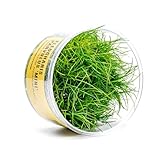
- Dwarf Hair Grass forms dense bright green blades that spread across the substrate, creating a natural carpeting effect ideal for freshwater foreground aquascapes.
- This easy-care carpeting plant spreads through runners and develops a soft grassy appearance that complements stones, driftwood, and nature-style aquarium layouts.
- Ships as a clean UNS tissue culture cup free from pests and algae, allowing hobbyists to divide the plant into multiple portions for wider carpet coverage.
- Care Requirements - Thrives in Medium Light; 8-10 hrs/day - CO₂ optional; improves carpet density, and propagation occurs naturally through spreading runners.
- UNS Tissue Culture distributed by SubstrateSource - We inspect each plant prior to shipping and ship all plants in healthy, stable condition with proper packing. Each is backed by a 100% DOA replacement guarantee with photo proof submitted within 24 hours of delivery.
Leaves are tall, thin or reaching upward
The foreground may not be receiving enough light for compact growth, or the plant may be adapting from emersed leaves. Verify light at the substrate and allow new submerged growth to develop. Raising light without checking nutrients and algae risk is not a complete solution.
The plant melts after planting
Emersed-to-submerged conversion is one possibility, especially with farm-grown stock. Keep roots planted and provide appropriate root-zone nutrition, while checking light, water stability and physical disturbance for additional causes. Remove tissue that is truly dead at the base.
Quick wins for a faster PC:
Fix the driver behind crashes, sound loss and screen glitchesFind Drivers →Clear out junk files and repair common Windows errorsFree Scan →Leaves yellow after several months
Check root-zone nutrition and light together. In an inert or depleted substrate, root tabs may be appropriate when used as directed. Also inspect root anchoring and overall tank conditions before diagnosing a specific deficiency.
Algae appears while the carpet remains sparse
Do not assume that more light will solve the problem. Sparse roots, excess light relative to available carbon, unstable CO2, depleted nutrition and slow acclimation can all leave algae with an advantage. Stabilize planting, light and maintenance before making another large change.
The carpet has gaps
Allow established runners to travel, then replant suitable daughter plants into empty areas. The reviewed sources do not provide a reliable universal fill-in timeline, so judge progress by rooted new growth rather than a promised number of weeks.
How to evaluate different listings
When two sellers use the same common name, compare the details that affect your result:
| Comparison point | Why it matters |
|---|---|
| Scientific name | E. acicularis and E. parvula are both associated with the common name in the cited listings, but their form and height should not be assumed identical. |
| Target outcome | A plant that survives in a low-maintenance tank may not make the dense, level lawn you want. |
| Light at the substrate | Medium-to-high light is cited for carpeting; surface brightness alone does not prove the foreground receives enough. |
| CO2 approach | CO2 is described as preferred rather than universally required; a 25 mg/L example belongs to Tropica’s 100 L layout, not every aquarium. |
| Substrate | Roots need both physical anchoring and access to nutrition; inert or depleted beds may need root tabs. |
These criteria are more useful than a seller’s photograph alone. A display image may show a mature carpet under equipment and maintenance conditions that your aquarium does not share.
A practical care routine
During the first planting period
- Inspect plugs after filling and re-anchor only those that have lifted.
- Keep the substrate undisturbed so roots can attach.
- Remove leaves that are clearly dead, but leave viable blades in place while new growth appears.
- Maintain consistent lighting and, if used, consistent CO2 rather than making daily large adjustments.
After runners appear
- Let healthy runners occupy open space.
- Replant daughter plants when you want to accelerate coverage in a bare area.
- Trim selectively with curved scissors once the lawn is rooted and uneven growth needs leveling.
- Continue checking the root zone in inert or aging substrate and add root tabs only according to the product directions.
Bottom line for a successful carpet
Start with the scientific name, not the trade name. Clean and divide the plant, bury its roots while exposing the blades, and keep the plugs anchored. Provide medium-to-high light at the substrate, use nutrient-rich substrate or correctly placed root tabs when needed, and treat CO2 as a useful option rather than an automatic requirement. Once the plants are stable, runners and careful trimming—not a fixed calendar—determine how the foreground develops.
Quick Recap
Product prices and availability are accurate as of the date/time indicated and are subject to change. Any price and availability information displayed on Amazon at the time of purchase will apply.





Leave a Reply