Quick wins for a faster PC:
Clear out junk files and repair common Windows errorsFree Scan →Fix the driver behind crashes, sound loss and screen glitchesFind Drivers →A tick on a dog may be tiny, flat, swollen, dark, or patterned—and its appearance can change substantially after feeding. Species identification is useful because different ticks occur in different regions and can carry different pathogens, but a photograph alone is not always enough for a reliable diagnosis.
This guide covers eight ticks commonly encountered in the United States: the American dog tick, brown dog tick, blacklegged tick, lone star tick, Asian longhorned tick, Pacific Coast tick, Rocky Mountain wood tick, and western blacklegged tick. The list is not exhaustive; the ticks found on your dog depend heavily on where you live.
How to identify a tick on your dog
Start with the tick’s size, color, markings, leg color, body shape, and whether it is engorged. Then consider where you live and where the tick was found. Location narrows the possibilities, but it does not prove a species because tick ranges overlap.
Adult ticks are easier to identify than larvae and nymphs. Immature larvae have six legs; nymphs and adults have eight. Feeding can stretch and discolor the body, hiding the markings that would otherwise help with identification.
The Tool Desk
Outbyte Driver Updater FREEScan for outdated or missing drivers - takes under a minuteDriver Scan →Outbyte PC Repair FREEClear out junk files and repair common Windows errorsFree Scan →#1 Best Overall
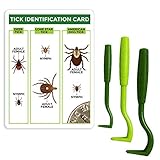
- ✔️ EASY & AFFORDABLE TICK REMOVAL - The hook tip is designed to safely and easily remove ticks from humans or pets, and can be easier to use on a thick-furred, feisty dog or cat than a pair of tweezers.
- ✔️ DURABLE & COMPACT DESIGN - These tick removers are durable, lightweight, and pocket sized, which makes it easy to take with you in your first aid kit or backpack
- ✔️ INCLUDES THREE SIZES OF TICK REMOVER - Keep them together to provide more options, or give one to each member of your family!
- ✔️ FREE TICK ID CARD & STORAGE POUCH - This 3-piece set includes a free pocket-sized Tick Species ID Card, plus a resealable storage pouch
- ✔️ UNIVERSITY RECOMMENDED TICK REMOVAL - Follow the included instructions for safe and complete tick removal by pulling, not twisting, the tick
| Tick | Typical appearance | U.S. distribution | Important health associations |
|---|---|---|---|
| American dog tick | Large, reddish-brown, with pale gray or white ornamentation | Widely east of the Rocky Mountains; related western populations also occur | Tularemia and Rocky Mountain spotted fever |
| Brown dog tick | Reddish-brown, narrow, and usually without ornate pale markings | Worldwide; closely associated with dogs | Rocky Mountain spotted fever in parts of the Southwest and along the U.S.–Mexico border |
| Blacklegged tick | Small, dark legs; female has a dark shield and reddish-orange body | Eastern U.S., Midwest, and parts of the South | Lyme disease, anaplasmosis, babesiosis, and other infections |
| Lone star tick | Adult female usually has one white spot; males have several pale markings | Northeast, South, and Midwest | Ehrlichiosis, tularemia, Bourbon virus, and Heartland virus |
| Asian longhorned tick | Light to dark reddish-brown; engorged females may become gray-green | Established in parts of the Eastern U.S.; range is changing | Animal-health risks are still being studied |
| Pacific Coast tick | Large, brown, and pale-mottled | Especially California and parts of Oregon | Spotted-fever-group rickettsiae |
| Rocky Mountain wood tick | Large, ornate brown tick with pale markings | Rocky Mountain states and southwestern Canada | Colorado tick fever, tularemia, and Rocky Mountain spotted fever |
| Western blacklegged tick | Small, dark-legged; adult female has a dark shield and reddish abdomen | Pacific Coast, especially northern California, Oregon, and Washington | Lyme disease, anaplasmosis, and hard-tick relapsing fever |
1. American dog tick
Dermacentor variabilis is widespread east of the Rocky Mountains. The western form once broadly grouped under this name is now recognized by the CDC as Dermacentor similis; its role in disease transmission needs further study.
Adult American dog ticks are usually reddish-brown with pale gray or white markings on the shield and body. The pattern tends to be more extensive on males. Females have a smaller shield, with ornamentation visible behind it.
They are large, ornate ticks and can be confused with other Dermacentor species, particularly in the western United States. They can transmit tularemia and Rocky Mountain spotted fever.
2. Brown dog tick
The brown dog tick, Rhipicephalus sanguineus, is generally reddish-brown to dark brown. Its body is relatively narrow and elongated, and it usually lacks the white-and-gray decorative pattern seen on American dog, Pacific Coast, and Rocky Mountain wood ticks.
This species is unusual because it can complete its life cycle indoors. It may establish itself in kennels, garages, dog runs, wall cracks, bedding areas, and other sheltered locations. An infestation can therefore continue throughout the year, even when outdoor ticks are inactive.
Finding one tick indoors does not automatically mean it is a brown dog tick—your dog may have carried in an outdoor species. However, repeated ticks in the home, especially around the dog’s resting areas, should prompt veterinary and pest-control advice. Treating the dog alone may not eliminate an established indoor infestation.
3. Blacklegged or deer tick
The eastern blacklegged tick, Ixodes scapularis, is often called the deer tick. Adult females are small, with dark legs, a dark shield near the head, and a reddish-orange abdomen when unfed. Adult males are mostly dark and may look even smaller.
Rank #2

- ✔️ BEST TICK REMOVERS FOR PEOPLE OR PETS - Kit includes stainless steel tick remover for safely removing larger embedded ticks, and a specially shaped super-fine-tip tweezer for removing nymphs and small deer ticks, in a leatherette pouch
- ✔️ UNIVERSITY TESTED - The tools in this tick removal kit have been field-tested and designed for easily and safely removing embedded adult and nymph ticks from humans, dogs, cats, or other pets
- ✔️ FREE TICK IDENTIFICATION CARD to easily identify the most common species of ticks in the United States
- ✔️ SUPPORT LYME RESEARCH - A portion of the proceeds of this tick remover kit helps fund university research on ticks and Lyme
- ✔️ PERFECT FOR OUTDOORS ENTHUSIASTS - Keep your tick remover kit in your first aid kit, glove compartment, or backpack to easily remove ticks wherever you go
It occurs across much of the eastern United States, the Midwest, and parts of the South. It can transmit the agents of Lyme disease, anaplasmosis, babesiosis, hard-tick relapsing fever, and other infections.
Do not assume that blacklegged ticks disappear in winter. Adults may remain active whenever temperatures rise above freezing, so dogs can encounter them during winter thaws.
4. Lone star tick
The lone star tick, Amblyomma americanum, is usually reddish-brown. An adult female has a prominent single white spot on her back—the feature behind the common name. Males may have several pale markings instead of one central spot.
Its range includes much of the Northeast, South, and Midwest, and it is not limited to the Southeast. Lone star ticks are active, aggressive biters. Nymphs and adult females are especially important when considering bites on people and dogs.
This tick is associated with ehrlichiosis, tularemia, Bourbon virus, Heartland virus, and other agents. Redness or irritation around a bite does not, by itself, establish that an infection occurred.
What’s actually slowing this PC down?
Pick the symptom - the matching free tool is one click away.
5. Asian longhorned tick
The Asian longhorned tick, Haemaphysalis longicornis, ranges from light reddish-tan to dark reddish-brown when unfed and may have darker markings. An engorged female can become gray-green with yellowish markings and reach approximately pea size. Immature ticks may be no larger than a sesame seed.
It was first confirmed outside a port-of-entry inspection site in New Jersey in 2017. Established populations have since been documented in parts of the Eastern U.S., from New York south to Georgia and west to Missouri, although the distribution continues to change.
Rank #3

- Emergency Tool
- Portable and Daily
- Safe and Reliable for Humans and Pets
- Fast and Painless for Skin and Hair
- Essentials Tool for Outdoor Activities
U.S. populations are parthenogenetic, meaning a female can lay eggs without mating. Do not assume that this tick is a proven U.S. vector of Lyme disease or human anaplasmosis; current USDA information does not identify it as a competent vector for those agents, and other animal-health effects remain under study.
If you suspect an Asian longhorned tick, remove it promptly, seal it in a zip-top bag, and ask your veterinarian about identification or submission to an appropriate laboratory.
6. Pacific Coast tick
The Pacific Coast tick, Dermacentor occidentalis, is primarily found along the Pacific Coast, particularly in California and parts of Oregon. It is generally a large, brown, ornate tick with pale gray or whitish mottling.
Its appearance overlaps with other Dermacentor ticks, so size and mottling are not enough for a confident species identification. Geography and close examination are important. The species is associated with spotted-fever-group rickettsiae, including Rickettsia rickettsii in relevant transmission contexts.
7. Rocky Mountain wood tick
The Rocky Mountain wood tick, Dermacentor andersoni, is a large, ornate brown tick with pale markings on the shield and body. It can look much like the American dog tick or Pacific Coast tick.
It occurs in the Rocky Mountain states and southwestern Canada, commonly in habitats from roughly 4,000 to 10,500 feet, a typical range reported by the CDC, not a strict boundary. Climate, wildlife hosts, and local habitat can shift its distribution.
Free tools Windows power users keep installed
One-click scans. No signup required.
This tick can transmit Rocky Mountain spotted fever, Colorado tick fever, and tularemia. A laboratory may be needed to distinguish it from similar-looking Dermacentor species.
Rank #4

- [EASY TO CARRY] : The tick removal tool is 2.5" long, 1.5" wide and 0.04" thick. It can be hung on key chains, pet chokers, and various backpack ropes or buckles through the small hole above the product. It can also be placed in the backpack compartment or first aid bag.
- [EASY TO USE] : The tick key is designed with a lever principle which can quick and safe removal of ticks, avoiding residue of tick mouth parts in the body, reduce wound damage and avoid infection.
- [HIGH QUALITY] : Our product is a high-quality aluminum plate integrated molding, sturdy and durable, environmentally friendly, non-toxic and harmless.
- [WIDELY USED] : The professional tick remover tools that allows both humans and pets to enjoy outdoor life, suitable for hiking, camping, hunting, fishing, exploration, gardening and other outdoor activities.
- [SATISFACTION FIRST] : If you have any questions, please contact us at any time. Customer satisfaction is our top priority.
8. Western blacklegged tick
The western blacklegged tick, Ixodes pacificus, is a small, dark-legged tick found mainly along the Pacific Coast, especially in northern California and parts of Oregon and Washington.
Adult females have a dark shield with a reddish-orange abdomen when unfed. Males are mostly dark. It resembles the eastern blacklegged tick because both belong to the genus Ixodes, but it is not the western form of the American dog tick. The two species belong to different genera.
The western blacklegged tick can transmit the agents of Lyme disease, anaplasmosis, and hard-tick relapsing fever.
Windows Errors? Fix Them Before They Spread
Repair common Windows errors and clear accumulated junk for a smoother, more stable PC - no reinstall needed.Free scan · no reinstallCrashes, No Sound, or Screen Glitches?
Random freezes, missing sound and display glitches usually trace back to one bad driver. Find and replace yours safely.Free scan · under a minuteHow to check your dog for ticks
Run your hands over your dog’s coat after walks and inspect the skin closely. Pay particular attention to:
- In and around the ears
- Around the eyelids
- Under the collar
- Under the front legs
- Between the toes
- Between the back legs
- Around the tail
A fine-toothed comb, bright light, and a helper can make the inspection easier. Part long or thick fur down to the skin rather than relying only on a surface check.
Independent reader supportYour contribution helps us test, update, and keep practical guides available for everyone.How to remove an attached tick safely
- Put on gloves if available.
- Use clean, fine-tipped tweezers or forceps.
- Grasp the tick as close to your dog’s skin as possible.
- Pull upward with slow, steady pressure.
- Do not twist, jerk, crush, or squeeze the tick’s body.
- Clean the bite area and your hands afterward.
Do not apply petroleum jelly, nail polish, gasoline, kerosene, heat, or a lit match. These methods can injure your dog and may cause the tick to release additional fluids.
If mouthparts remain and cannot be removed easily, do not dig aggressively into the skin. Leave them alone and allow the area to heal; forcing them out can cause more tissue injury.
Best Value

- ✓ SAFER THAN TWEEZERS – TRUSTED METHOD FOR COMPLETE TICK REMOVAL - Designed to remove the full tick head and body without squeezing or breaking. Helps reduce risk of infection and avoids leaving mouthparts behind. A safer tick remover tool for dogs, cats, and humans.
- ✓ FAST & EASY TICK REMOVAL TOOL – WORKS IN SECONDS – Skip tweezers. Simply latch, twist, and lift for quick, effective removal. Works even on thick fur and hard-to-reach areas. Ideal for pet owners, families, and outdoor use.
- ✔ PERFECT FOR FIRST AID, HIKING & CAMPING - A must-have for first aid kits, hiking gear, camping trips, and outdoor adventures. Compact, lightweight, and portable so you’re always prepared wherever ticks may be found.
- ✓ BUILT-IN KEYCHAIN HOLE – ALWAYS READY – Attach to your keys, leash, or backpack for instant access. This portable tick remover ensures you’re never without a safe removal tool when you need it most.
- ✔ 3 PACK WITH ID CARD – MULTIPLE SIZES Includes 3 durable tick remover tools for small and large ticks plus a tick identification card. Chemical-free, reusable, and safe for pets and people.
Keep a questionable tick in a small container or sealed bag, with or without alcohol, and label where and when it was found. A veterinarian or diagnostic laboratory may be able to identify it. Identification is much less reliable once a tick has been crushed or discarded.
When to call the veterinarian
Contact your veterinarian if your dog develops changes in behavior or appetite, fever, unusual tiredness, weakness, lameness, swollen joints, pale gums, vomiting, or other illness after a tick bite. The CDC notes that signs of tickborne disease may not appear for 7–21 days or longer.
The tick’s appearance cannot diagnose an infection. Risk depends on the species, life stage, pathogen, attachment and feeding time, geography, and the dog’s individual circumstances. A map showing that a tick is present in a region is not the same as a map showing disease risk.
Ask your veterinarian about a year-round tick-control plan. Product choice depends on your dog’s age, weight, health, lifestyle, and other medications. If brown dog ticks have established themselves indoors, environmental treatment—and sometimes a licensed exterminator—may be necessary.
Recommended Free Tools
FAQ
Can I identify a tick on my dog from a photograph?
Sometimes, especially if the tick is an intact adult and the photo shows its back clearly. However, engorgement, poor lighting, similar-looking species, and immature life stages make photographs unreliable. Preserve the specimen and ask a veterinarian or diagnostic laboratory when identification matters.
What does a brown dog tick look like?
Brown dog ticks are usually reddish-brown to dark brown, narrow, and relatively elongated. They generally lack the ornate pale markings seen on many Dermacentor ticks. Repeated ticks inside a home, kennel, or garage raise concern for an indoor brown dog tick infestation.
Does every tick on a dog transmit Lyme disease?
No. Lyme disease transmission depends on the tick species, whether it carries the bacteria, feeding and attachment circumstances, and geography. The tick’s appearance alone cannot determine whether your dog was infected.
What should I do after removing a tick from my dog?
Clean the bite area, wash your hands, and save the tick in a sealed container or bag if identification may be useful. Monitor your dog for illness, including appetite or behavior changes, fever, weakness, lameness, or vomiting, and contact your veterinarian if symptoms develop.
Do these 3 things before closing this tab:
1Clear out junk files and repair common Windows errors2Fix the driver behind crashes, sound loss and screen glitches3Repair Windows errors before they cause bigger problemsThe Bottom Line
Use color, markings, body shape, leg color, geography, and the tick’s feeding state to make a preliminary identification—but treat it as a clue, not a diagnosis. Remove attached ticks promptly with fine-tipped tweezers, save an uncertain specimen, and ask your veterinarian about testing, symptoms, and year-round prevention.
Quick Recap
Product prices and availability are accurate as of the date/time indicated and are subject to change. Any price and availability information displayed on Amazon at the time of purchase will apply.




