Quick wins for a faster PC:
Fix the driver behind crashes, sound loss and screen glitchesFind Drivers →Repair Windows errors before they cause bigger problemsFix Now →Scan for outdated or missing drivers - takes under a minuteDriver Scan →To increase dKH in a fish-only marine aquarium, first confirm the reading, choose a deliberate target, then use a marine alkalinity supplement’s own dosing instructions to calculate a gradual correction for your system’s actual water volume. Sodium bicarbonate is one direct option. Dose into high flow, monitor pH, and retest before adding another dose. Fish-only target recommendations differ, so do not raise alkalinity automatically to a reef-style target.
What dKH should a fish-only marine aquarium have?
Published recommendations for fish-only marine tanks do not agree. Seachem’s current parameter guide lists 11–16 dKH for a marine fish-only aquarium, while Red Sea’s 2009 Sea Water Chemistry guide recommends 6–8 dKH; its table gives a marine-fish value of 6.8 dKH. These are publisher recommendations, not the result of a comparative trial, and they do not establish one universally accepted target. Seachem’s parameter guide and Red Sea’s guide provide the underlying figures.
As an Amazon Associate I earn from qualifying purchases.
Use the alkalinity of your chosen salt mix and the aquarium’s established readings as context. If the aquarium is stable and its reading is close to the prepared replacement water, this evidence does not justify a sudden large increase simply to match a reef recommendation. If a reliable test confirms a low result, choose a reasonable target for your system and correct it in stages.
The Tool Desk
Outbyte PC Repair FREEClear out junk files and repair common Windows errorsFree Scan →Outbyte Driver Updater FREEScan for outdated or missing drivers - takes under a minuteDriver Scan →How to raise dKH safely, step by step
- Confirm and record the starting conditions. Test alkalinity with a marine test kit or checker according to its directions, and verify that the result is reported in dKH. Record pH and salinity as well. Estimate actual system water volume, including water in a sump while accounting for displacement from rock and equipment; dosing calculations depend on volume. The Bulk Reef Supply alkalinity calculator uses total system volume.
- Check replacement water before a water change. Measure the alkalinity and salinity of freshly mixed saltwater. If its alkalinity differs substantially from the aquarium’s, the water change itself may shift the tank reading.
- Set a modest correction amount. Consider the tank’s prior stable readings, livestock, salinity, and makeup water alongside the conflicting fish-only recommendations. Calculate the dose from the exact supplement’s formulation and label directions or its own calculator. Do not transfer a dose from another brand or product concentration.
- Choose an alkalinity additive suited to the situation. Sodium bicarbonate is a direct option for raising alkalinity. An aquarium-formulated product can make dosing easier to measure; if using powder, dissolve and prepare it as the product directs. Avoid pouring concentrated solution or slurry directly onto fish, rock, or equipment.
- Add the correction gradually in a high-flow area. Bulk Reef Supply advises raising alkalinity by no more than 1.4 dKH per day in its sodium bicarbonate guidance, and its calculator recommends splitting larger corrections over several days with testing between steps. Treat that as supplier guidance, not a universal fish-only safety threshold; follow any stricter rate on the product you use. See Bulk Reef Supply’s sodium bicarbonate instructions.
- Monitor pH and retest before the next dose. Follow the supplement’s pH-monitoring guidance. Retest alkalinity after a stage and recalculate from the new reading rather than assuming the first dose produced the predicted change.
- Stop at the planned target. Once the aquarium is stable at the selected target, track readings over time instead of dosing by habit. Routine maintenance dosing directions from reef suppliers should not be assumed necessary for every fish-only aquarium.
Can baking soda raise aquarium alkalinity?
Plain sodium bicarbonate—the active ingredient in baking soda—can raise alkalinity, and aquarium-grade sodium bicarbonate products are available with mixing and dosing instructions. The amount needed depends on the starting reading, desired correction, actual water volume, and product concentration. Use the product’s own directions or calculator rather than a generic spoon-per-gallon recipe. Bulk Reef Supply’s sodium bicarbonate product page describes a prepared aquarium formulation.
#1 Best Overall
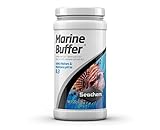
- Can be used safely in reef tanks
- Contains borate for added stability
- Contains magnesium to alleviate precipitation effects
Does raising dKH also raise pH?
Not necessarily. Alkalinity describes water’s capacity to buffer acid; pH is a separate measurement. Sodium bicarbonate has a slight lowering effect on pH, whereas soda ash (sodium carbonate) can raise pH more strongly. Bulk Reef Supply describes this distinction in its guide to raising pH in saltwater aquariums. Choose an additive for the measured problem rather than using a generic “pH buffer” to chase a number.
Independent reader supportYour contribution helps us test, update, and keep practical guides available for everyone.When does a fish-only tank need ongoing alkalinity dosing?
Do not assume routine alkalinity dosing is required just because the aquarium is marine. The reviewed supplier maintenance guidance is primarily reef-oriented; for a fish-only system, monitor the trend and correct only when reliable readings and your chosen target call for it. Water changes with saltwater of a different alkalinity can also affect the result, so test prepared replacement water when diagnosing a change. The University of Florida IFAS marine aquarium project book discusses carbonate-hardness testing in a broader marine-aquarium husbandry context.
Quick Recap
Rank #4

- The calcium buffer system is a two-component liquid supplement system that is easy to use
- Maintains the ionic balance of the aquarium water
- The calcium buffer system will assist in restoring inorganic ions lost
- In addition to supplying highly concentrated calcium and carbonate alkalinity required for calcification, B-Ionic Calcium Buffer System is also formulated to provide all other important major, minor, and trace elements in the proper ratios to duplicate the composition of synthetic seawater.
Rank #3

- MULTIPLE COMPONENTS – Reef Code B is a multi-component automatic buffer that regulates pH. Unlike single-component KH products, it offers a two-part dosing method for calcium and carbonates (alkalinity) for a reef aquarium, mirroring the natural seawater ratios, providing a more stable environment
- CARBONATE & MULTI-MINERAL – When used in equal parts with Reef Code A, it maintains the ionic balance of natural seawater. Concentrations of carbonates, bicarbonates, sulfates, borates, and other anions are maintained with minor, and trace minerals crucial for the growth of reef-building organisms
- STRENGTH ADVANTAGE – Reef Code B ensures a more robust and effective performance in maintaining desired reef aquarium conditions. It contains no phosphate, silicate, or organic material, promoting a clean and healthy reef environment
- DIRECTIONS – Shake well before use and test alkalinity prior to dosing. Add 5 ml of the product per 25 gallons of water every other day or as necessary to maintain alkalinity within the range of 7 to 12 dKH. Each milliliter of Reef Code B will raise the alkalinity in 1 gallon of water by approximately 2.22 dKH
- AMERICAN-MADE EXCELLENCE – Brightwell Aquatics is an industry-leading brand committed to providing innovative and scientifically backed aquatic care products. Made in the USA, we consistently deliver advanced superior quality solutions to elevate the vibrancy and health of your aquarium
Rank #2

- STABILIZES pH IN REEF AQUARIUMS Precision powdered buffer blend increases carbonate hardness and raises pH to a stable 8.3 level.
- PROMOTES ARAGONITE SKELETAL FORMATION Supplies essential carbonates that support coral growth and skeletal development in marine reef aquariums.
- MORE POWERFUL THAN COMPETITORS Over 50% stronger than most KH buffers, works efficiently with fewer doses and no unwanted residues.
- PURE FORMULA FREE OF ADDITIVES Contains no phosphate, silicate, or unnecessary fillers; formulated by marine scientists for reef performance.
- AMERICAN-MADE EXCELLENCE – Brightwell Aquatics is an industry-leading brand committed to providing innovative and scientifically backed aquatic care products. Made in the USA, we consistently deliver advanced superior quality solutions to elevate the vibrancy and health of your aquarium.
Product prices and availability are accurate as of the date/time indicated and are subject to change. Any price and availability information displayed on Amazon at the time of purchase will apply.




