To make a DIY dog agility course, start with three beginner obstacles: a low knock-down bar jump, a short secured open tunnel, and stable weave poles. Put them on level, non-slip ground, inspect them before every session, and teach one obstacle at a time rather than copying a full competition ring.
A small course is easier to adapt to your dog and easier to make safe than a collection of elevated contact obstacles. The instructions below focus on construction choices, layout, training progression, and when buying purpose-built equipment is the better decision.
Key takeaways
- A beginner DIY dog agility course needs only three core obstacles: a low knock-down jump, a short open tunnel, and stable weave poles.
- A jump bar must be lightweight and able to fall when touched; rigid bars and unstable supports create avoidable injury risks.
- A level, non-slip surface is more important than elaborate construction, and every obstacle should be inspected before each session.
- Start at ground level and walking speed, especially with puppies, senior dogs, dogs returning to exercise, or dogs with mobility concerns.
- Homemade A-frames, dog walks, and teeters require substantially more structural and safety knowledge than a beginner course.
What equipment do you need for a backyard dog agility course?
A beginner backyard course needs two stable supports and a lightweight bar for jumping, a short open tunnel, and smooth weave poles in a stable base. You also need a fenced or otherwise controlled training area, rewards, water, and a surface with reliable traction. You do not need to build every competition obstacle to give a dog useful, enjoyable agility practice.
The American Kennel Club’s backyard agility guidance identifies jumps, tunnels, and weave poles as practical starting equipment. Elevated contact obstacles such as A-frames, dog walks, and seesaws are more complicated to build and introduce safely, so leave them out of a first course.
Do these 3 things before closing this tab:
1Clear out junk files and repair common Windows errors2Scan for outdated or missing drivers - takes under a minute3Repair Windows errors before they cause bigger problems#1 Best Overall
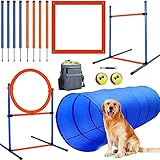
- UNIQUE & HEALTH: Running, jumping, playing, and most of exercising for maximum dog agility. Whether training for competition or just for fun, you should own this dog agility equipment kit to build trust with your pets and keep them healthy!
- PREMIUM & STURDY: This dog agility course is made of ABS material, safe and sturdy that can be used in the park or backyard. Its collapsible tunnel is made of 190T tear-resistant polyester, even if scratched by the paws, there will no large-scale damage!
- LIGHTWEIGHT & EASY INSTALL: The agility training equipment for dogs is easy to set up and take down without tools in just minutes! It is lightweight for carrying to the outdoor or the indoor big stage. The convenient dog treat pouch will easily store training treats and your stuff when training or walking the dog!
- FUN & CREATIVE COMBINATION: Perfect for dogs that sharpen obedience, speed, and dexterity; JMMPOO dog obstacle course has everything supplies you need to get going and is recommended for (small/ Medium/ large) dogs of any age! What a great way to spend time with your pet!
- GREAT GIFT IDEAS: This fantastic doggie agility set is a great gift idea for young and old dog lovers! It included an agility tunnel, 8 weave Poles, adjustable agility hurdle, jump rings, a square pause box, a whistle, 2 pet tennis ball toys,1 dog treat pouch and 2 carrying cases!!
How do you make a DIY dog agility course?
Build the course around three forgiving obstacles, place them on a grippy level surface, and teach one obstacle at a time. The safest DIY design is not the most elaborate design: each obstacle should remain stable during ordinary contact while yielding or forgiving when the dog makes a mistake.
1. Build a low knock-down bar jump
Use two broad, stable supports and a lightweight broom handle, PVC pole, or similar bar. Rest the bar loosely on the supports instead of fastening it rigidly. If the dog clips the bar, the bar should fall away rather than stop the dog’s body.
Household containers, cardboard, paint, and tape can make a simple upcycled jump for supervised, temporary practice; the AKC’s upcycled jump example uses this general approach. For repeated outdoor use, weather-resistant PVC or a purpose-built adjustable jump is easier to clean, modify, and inspect.
Begin with the bar on the ground or only slightly above it. Raise the bar in small increments only when the dog approaches willingly, clears it calmly, and lands with control. The AKC’s warning is important: “What a dog can jump and what they should jump are two different things.” Jumping ability does not determine a safe training height.
What’s actually slowing this PC down?
Pick the symptom - the matching free tool is one click away.
2. Add a short open tunnel
A purpose-built collapsible dog tunnel is the simplest reliable option because the passage is designed to stay open and can be anchored. For scale, an AKC backyard-course example describes an 18-foot tunnel with a 24-inch opening, supplied with stakes and a carrying case; that is an example product specification, not a requirement for a beginner DIY course. See the AKC equipment guide for that example.
A lower-cost substitute can be a short, soft, open passage that cannot collapse around the dog. Do not use exposed wire, sharp edges, unstable furniture, or a covering that could trap the dog. Anchor a commercial tunnel without crushing or narrowing its opening, and inspect the stakes, connectors, fabric, and seams regularly.
Introduce the tunnel as a straight passage. Let the dog investigate the entrance, reward looking at or approaching it, and then reward movement through it with a helper positioned at the far end. Add bends only after the dog is relaxed and confident going straight through.
3. Make stable weave poles
Use smooth, visible poles in a stable base or securely inserted into suitable ground. Tomato stakes or similar poles can provide a simple home version. For practice, the AKC describes 24-inch spacing for a basic weave-pole arrangement in its at-home agility guidance; competition dimensions and training setups can differ, so do not treat 24 inches as a universal regulation requirement.
Rank #2

- RUGGED & STURDY:Our product is durability, the training pole is made of ABS material,which is safe and sturdy,that can be used in the park or backyard. In addition, our u-shaped ground nail ensure that each agile pole remains stable on the ground, providing the best stability even during intense running and jumping processes!
- LIGHTWEIGHT & EASY INSTALL: It can be assembled and removed in just a few minutes without any tools, and there are 2 free storage bags for you to take outdoor or indoor. When you train or walk your dog,and our little toys are all great fun for you and your pet.
- HEALTH & FUN:Running, jumping, playing and crossing obstacles can improve your dog's agility and flexibility, make your dog more active and health, and getting closer between you and your pet. What a great way to spend time with your pet!
- SUITABLE For EVERYONE:This adjustable dog agility training set is suitable for dogs of any age (large/medium/small). The perfect 11-piece obstacle training set allows beginners and experts to freely choose their training mode, to complete their dog's agility training course.
- INDOOR & OUTDOOR USE:Our dog agility kit allows you to use it in any indoor or outdoor setting, such as the living room, hallway,backyard, garden, etc. It is easy and portable, and will not affect the fun of your pet's training and play, regardless of the weather!
Weaving is more technically demanding than stepping over a low bar or walking through a straight tunnel. Start with a single channel or a small number of poles. Guide the dog through the entry and first few poles with a reward, then gradually narrow the channel or add poles as the dog understands the path. Do not expect a novice dog to complete twelve poles at full speed immediately.
DIY materials checklist
- Lightweight PVC, broom handle, or similar breakaway jump bar.
- Two broad jump supports that do not tip easily.
- Smooth PVC or garden stakes for weave poles.
- A stable pole base, or suitable ground for secure insertion.
- A short soft tunnel that stays open and cannot trap the dog.
- Non-slip ground such as grass, turf, dirt, or another surface with dependable traction.
- Training treats or a toy, fresh water, and shade when weather is warm.
- Caps or covers for cut PVC ends, plus tape or another method of removing sharp edges.
Round, cap, or cover every cut PVC end. Remove splinters, exposed screws, nails, staples, rough edges, and loose tape. Mark obstacles clearly enough that the handler and dog can see them without glare or camouflage.
How should you lay out a backyard agility course?
Place obstacles with enough clear space for the dog to approach and slow down after each exercise. Keep the first layout simple: a low jump, a straight tunnel, and a short weave section can be arranged separately rather than packed into a tight sequence.
- Choose a fenced or otherwise safely controlled area where off-leash work is appropriate.
- Use grass, turf, dirt, or another surface with reliable traction.
- Avoid slick concrete, wet boards, polished floors, and loose gravel.
- Clear garden tools, toys, wires, holes, branches, and sharp objects from the run-out areas.
- Keep the jump low and leave generous space after the bar for a controlled landing.
- Anchor tunnels without narrowing or crushing the entrance.
- Store lightweight equipment out of harsh weather and check plastic for cracking, brittleness, and UV damage.
Surface choice is a safety decision, not a cosmetic one. The AKC states, “Don’t practice on a slippery surface or you risk your dog getting injured.” VCA’s guidance on proprioception exercises likewise emphasizes appropriate footing and controlled movement.
Is a homemade dog agility course safe?
A homemade dog agility course can be suitable for supervised beginner practice when the obstacles are stable, forgiving, properly maintained, and matched to the individual dog. No DIY design is automatically safe for every dog: age, health, size, behavior, surface, weather, construction quality, and training progression all matter.
Do not run agility on a slippery surface. Do not use rigid jump bars, unstable chairs, exposed hardware, or objects that can collapse onto the dog. Inspect the course before every session. A Clean Run beginner-equipment instruction sheet states, “Inspect equipment before each use.”
Veterinary clearance is prudent before strenuous agility, particularly for puppies, senior dogs, dogs returning after an injury or inactivity, and dogs with known mobility concerns. A dog’s ability to perform an action does not prove that the action is appropriate for the dog’s joints or current conditioning.
What should you not DIY casually?
Do not casually build an A-frame, dog walk, or teeter unless you understand structural loading, tipping resistance, moving-plank control, safe contact zones, and non-slip surfaces. These obstacles place more demanding forces on the dog and builder than a low jump or straight tunnel.
Crashes, No Sound, or Screen Glitches?
Random freezes, missing sound and display glitches usually trace back to one bad driver. Find and replace yours safely.Free scan · under a minuteWindows Errors? Fix Them Before They Spread
Repair common Windows errors and clear accumulated junk for a smoother, more stable PC - no reinstall needed.Free scan · no reinstallRank #3

- 【✅Note】This dog agility course backyard set comes with 4 U-shaped and L-shaped ground stakes for securing the tunnel. Here's how to use them: Attach the gear's fixed rope loops to the U-shaped stakes /L-shaped stakes and drive the stakes vertically into the ground to ensure a firm connection
- 【Dog Agility Equipment】Set up challenging classes for energetic dogs. Adjust height/distance for Corgi to Chihuahuas—no tools needed. Turns yards into training courses for tail-wagging thrills!
- 【PVC Material】High-quality PVC material, the material is safe, so you don't have to worry about any damage during use. The PVC material allows for multiple uses of the dog agility training equipment
- 【Complete Equipment】The agility training equipment for dogs includes a blind tunnel, tunnel, dog hoop, jumps, pause box, weave poles,training ball(Colors are sent randomly)and flying disc. It can drain the dog's energy
- 【Easy to Assemble】This dog agility training equipment features a portable, quick-assembly design—seamlessly usable in backyards, indoor playrooms, or parks For purchase-related questions, contact us; we provide timely, comprehensive solutions
The seesaw can also frighten an inexperienced dog and requires careful practice with rewards. The AKC’s agility-starting guidance and current AKC agility regulations are useful references if the goal is organized competition, but regulation-oriented equipment should not be confused with a casual household substitute.
A blanket draped over chairs may be used as a brief enrichment game under direct supervision, but it is not equivalent to a stable, anchored agility tunnel. Stop using any improvised obstacle that shifts, snags, collapses, or causes hesitation or fear.
How do you start agility training with your dog at home?
Start with control cues and calm investigation, not speed. The dog should be able to respond to its name and basic cues such as come, stay, and directional or targeting cues around mild distractions. Those skills help the handler prevent a dog from running into equipment or leaving the training area.
- Prepare the area. Remove hazards, check the surface, inspect every obstacle, and have water and rewards ready.
- Let the dog investigate. Reward sniffing, looking at an obstacle, standing near a pole, or calmly placing a paw beside a low target.
- Teach one obstacle. Guide the dog through the short tunnel, over a ground-level bar, or alongside a single weave channel. Keep repetitions brief.
- Build confidence before height or speed. Raise the jump only in small increments and only while the dog remains relaxed and lands cleanly.
- Add short combinations. When individual obstacles are reliable, link two obstacles, then three, and reward after the successful sequence.
- Warm up and cool down. Walk, then gradually jog before vigorous work. Afterward, reverse that progression rather than stopping abruptly.
- End early when quality drops. Stop for limping, an altered gait, pain, repeated refusals, overheating, excessive fatigue, or loss of responsiveness.
VCA explains that “Warming up muscles and joints helps prevent injury and engage the dog’s focus before entering the agility area.” Read the full VCA guidance on warm-up, cool-down, and agility for senior dogs for age-related considerations. Contact a veterinarian if concerning symptoms continue or appear after training.
Recommended Free Tools
Should you build DIY equipment or buy it?
DIY equipment is attractive when you want low cost and custom dimensions, while ready-made equipment is often easier to inspect, store, and replace. Neither option removes the need for supervision or checking the equipment before use.
| Decision factor | DIY course | Ready-made equipment |
|---|---|---|
| Cost | Can be low when household materials are repurposed | Usually higher upfront |
| Adjustability | Easy to customize with PVC and modular connectors | Depends on the product design |
| Stability | Entirely dependent on construction and anchoring | Product-specific; still requires inspection |
| Storage | PVC can be disassembled, but homemade parts may be bulky | Collapsible products may store more easily |
| Safety consistency | Requires deburring, capping, anchoring, and testing by the builder | Still requires checking fit, condition, and suitability |
| Competition use | Must be checked against current rules | “Competition” labeling still needs verification |
For readers who would rather compare equipment than fabricate every obstacle, a dog agility equipment set can cover the basic jump, tunnel, and poles in one purchase. Check the dimensions, surface, anchoring method, weight, breakaway behavior, construction materials, and return policy before buying. Individual products can also make sense when a DIY jump is adequate but a professionally made tunnel is preferable.
As an Amazon Associate I earn from qualifying purchases.
Independent reader supportYour contribution helps us test, update, and keep practical guides available for everyone.How far apart should dog agility weave poles be?
For a simple home-practice setup, 24-inch spacing is an AKC-described example, but weave-pole spacing is not one universal answer for every training goal or competition rule set. Use a small, forgiving arrangement for a novice dog and verify the current AKC regulations separately if you are preparing for an organized event.
Rank #4

- 【Unique 2-In-1 Design】Space & Value Saver ! 6 weave poles【with base】 can be easily switched to 6 ground-nails weave poles【adjustable spacing and stays in wind】.Suitable for indoor and outdoor and various training modes
- 【Complete Agility Training Kit】It includes : 2 adjustable jump hurdles,jump ring, dual modes weave poles(used on grass and hard surface),1 tunnel and 1pause box,a dog treat pouch and 2 toy balls.Suitable for (small/ Medium/ large) dogs of any age
- 【Portable & Easy Storage】Hit the park, yard,with it! This kit comes with 2 heavy-duty carry bags,which is easy for you to store and transport.And the agility training equipment for dogs is easy to set up and take down without tools in just minutes
- 【Safe & Sturdy Construction】Train with confidence!This agility course are made from safe,sturdy and lightweight materials(ABS and PE) . the tunnel use 190T tear-resistant polyester. Built to hold up to energetic training sessions.
- 【Great Backyard Training Partner】Ideal for yards, parks, or indoor spaces! A good choice for beginner dogs and pet owners to build confidence, boost agility, and enjoy bonding time. Help your dog exercise, stay health, burn energy, and have fun
The dog’s entry and understanding matter more than immediately matching a full competition layout. Begin with the first entry and a few poles, reward accuracy, and increase complexity gradually. Avoid forcing the dog through a tight pattern at speed.
How can you use a DIY agility course responsibly?
Keep sessions short, low-impact, and reward-based. A beginner course should provide controlled movement and mental enrichment, not a test of maximum jumping height or speed. Recheck the surface and equipment each time, adapt the obstacles to the dog’s condition, and stop before fatigue changes the dog’s form.
For a first build, the best balance is usually a low breakaway jump, a short secured open tunnel, and a few stable weave poles. That combination is adjustable, inspectable, and teachable without exposing a novice dog to the structural and impact risks of advanced contact obstacles.
Frequently Asked Questions
Is a homemade dog agility course safe?
A DIY dog agility course can be safe for supervised beginner practice if the surface has reliable traction, the jump bar is lightweight and breakaway, the tunnel cannot collapse around the dog, and all equipment is inspected before each session. Safety still depends on the dog’s age, health, size, training, and the quality of construction.
The Tool Desk
Outbyte PC Repair FREEClear out junk files and repair common Windows errorsFree Scan →Outbyte Driver Updater FREEScan for outdated or missing drivers - takes under a minuteDriver Scan →How high should a DIY dog agility jump be?
Start with the bar on the ground or only slightly above it, then raise it gradually only when the dog is relaxed and landing cleanly. Puppies, senior dogs, dogs returning to exercise, and dogs with mobility concerns should remain at low impact levels, and veterinary clearance is prudent before strenuous work.
How far apart should dog agility weave poles be?
A simple home-practice weave-pole arrangement can use 24-inch spacing, an example described by the American Kennel Club. Competition spacing and equipment requirements can differ, so check the current rules if you are training for organized competition.
The Bottom Line
The safest DIY dog agility course is a small beginner course: one low knock-down jump, one secured open tunnel, and stable weave poles on non-slip ground. Build for forgiveness, introduce each obstacle slowly, inspect everything before use, and buy rather than casually improvise advanced obstacles such as A-frames, dog walks, and teeters.
Quick Recap
Product prices and availability are accurate as of the date/time indicated and are subject to change. Any price and availability information displayed on Amazon at the time of purchase will apply.




