
Do these 3 things before closing this tab:
1Fix the driver behind crashes, sound loss and screen glitches2Repair Windows errors before they cause bigger problems3Scan for outdated or missing drivers - takes under a minuteBeagles are bred to use their voices, so barking, baying and howling are normal possibilities—not proof that your dog is disobedient. The workable approach is to identify what happens immediately before the vocalizing, reduce the trigger when you can, meet the dog’s exercise and scent needs, and reward calm behavior. Barking at a window, howling at a siren, boredom, and distress when alone require different plans.
Use the guide below to sort the pattern safely. A sudden change, vocalizing that appears painful, or persistent distress during absences warrants veterinary advice rather than a home-training experiment.
As an Amazon Associate I earn from qualifying purchases.
What beagle barking and howling usually mean
The American Kennel Club describes Beagles as very vocal and notes their need for daily exercise and mental stimulation. VCA’s Beagle guide likewise points to boredom and following a scent as possible reasons for vocalizing. Those are breed tendencies, not a diagnosis for an individual dog. A Beagle that barks at pedestrians may need a window-management and calm-training plan; one that howls only after you leave may need an assessment for separation-related distress.
Listen for the difference between a brief alert, repeated demand barking, a long howl or bay, and vocalizing accompanied by pacing, destruction, elimination, trembling or attempts to escape. Note the time, location, sound or sight present, what your dog’s body is doing, and what ends the episode. The same noise can have different causes, and the cause determines the useful response.
#1 Best Overall

- 【PRODUCT SIZE】10 inch*10 inch*1.3 inch.
- 【3 WAYS TO PLAY, UPGRADE SLOW FEEDER】Our dog mental stimulation toys have a unique squeak button in the middle, which make it easier to attract the attention of dogs and cats. Three different difficulty designs and the 16-hole dog treat dispenser design maximize slow feeding time, even beyond 20 minutes.
- 【FUNNY STIMULATING TOYS】All kinds of dogs and cats love the puzzle game of Spin & Slide and the Seek & Hide with their smell sense and paw skills to find food. Combining circular orbit sliding game and linear orbit sliding game, smart dog and cat must move the slider correctly to get the food reward hidden in the maze.
- 【NON-REMOVABLE PARTS DOG PUZZLE】Our dog treat puzzle is made of non-toxic materials, very durable and suitable for pets to play for a long time. This dog toy has no removable parts because the design has built-in play parts that fold tightly and won't fall off easily.
- 【ANTI-SLIP & EASY TO CLEAN】: The four corners of the bottom are equipped with four anti-skid pads, which can be well fixed during the dog's slow food process; It is easy to clean, also dishwasher safe.
Start with a trigger map
For three to five days, keep a simple log rather than correcting every noise. If safe, make a short recording from a distance. Do not provoke a distressed dog to obtain footage. Include whether you were home, what happened just beforehand, how long the episode lasted, and whether food, access to you, removal of a stimulus or your return stopped it.
| Pattern you observe | What it may indicate | First management move |
|---|---|---|
| Rapid barking at people, dogs, vehicles or wildlife outside a window or door | Alerting, territorial response or arousal to an external trigger | Block or reduce the view and sound where practical; teach settling away from the window. |
| Vocalizing after activity has ended, with searching, restlessness or attempts to initiate play | Boredom or unmet exercise, sniffing or interaction needs | Establish daily walks, scent exploration, play and short training sessions. |
| Howling begins when a siren, musical note or another repeated sound occurs | Sound-triggered howling | Record the context, avoid intentionally replaying the trigger at distressing volume, and use gradual desensitization. |
| Barking or howling starts after departure and continues while the dog paces, damages items or eliminates | Possible separation-related distress | Observe with a camera, keep absences short enough for comfort, and involve a veterinarian or qualified behavior professional if it persists. |
| A new, unusually intense or frequent howl, especially with changes in movement, appetite or comfort | Possible illness, injury or another medical problem | Arrange a veterinary assessment promptly. |
This table is a starting hypothesis, not a way to label your dog. A camera can show whether an episode begins immediately after you leave or only when an outside sound occurs, but it cannot diagnose anxiety.
Meet a Beagle’s activity and scent needs
Exercise does not mean exhausting a dog until it cannot bark. The goal is a predictable outlet for movement, exploration and learning. Build a routine that fits your dog’s age, health and veterinary advice:
- Take daily walks that allow safe sniffing instead of rushing every step.
- Add play and short reward-based training sessions; several brief sessions are often easier to sustain than one long lesson.
- Offer supervised scent games, such as hiding part of the dog’s meal in easy-to-find locations or asking the dog to locate a familiar toy.
- Use a food puzzle or treat-dispensing toy as an optional activity when boredom is plausible. Start with an easy design, observe how your dog uses it, and check that pieces cannot be swallowed.
- Provide quiet rest periods. An over-aroused dog may need help settling, not more stimulation.
Food enrichment can occupy a bored dog, but it is not a treatment for separation anxiety. If the dog ignores food, vocalizes continuously, paces or panics when alone, treat that pattern as a distress problem rather than adding increasingly difficult puzzles.
Rank #2

- 【Upgrade Dog Puzzle】Our dog puzzle toy is moderate level with more challenging ,difficult than level 2, not only easy slide steps, but require your dog's ability to learn sequential steps and combinations to seek hidden treats while keeping mental active .There are easy slide step and harder step in the puzzle box , dogs have to find a right way to move the red round sliders and the center parts for food, higher skills and mind required , great for the smart dogs.
- 【Dog Puzzle Toys for Smart Dogs】 The dog brain game toy is designed bigger size than other dog puzzle toys, multiple steps game designed, specail for smart dogs of puppy cats & other small animals, but also good for small MD dogs that need mental excecise & treat training.
- 【 Mental Excecise & Boredom Buster】 Kinds of dogs and cats love the puzzle game of Spin & Slide and the Seek & Hide with their smell sense and paw skills to find food . Our advanced dog puzzle toy for dogs can keep smart dogs busy to fit it out with more thinking and activities , reducing pet's boredom , encourage dog & cat natural hunting instincts to be more active & healthy , less destructive behaviors at house.
- 【NO REMOVABLE PARTS Dog Puzzles】Our blue round dog puzzle are made with toxic-free materials, very durable for pets long time playing, also easily washed with water or dishwasher. NO REMOVABLE PARTS in this dog toy due to designed with built-in play pieces that fold tightly don't come out easily . Make sure safe playing of without chewing & chocking when your pups are solo playing puzzle toy.
- 【Interactive Treat Puzzle Dog Toys】Dog Puzzle game is interactive and easily for training your dogs in days. You would enjoy the time of dog interactive puzzle game with your pets, greatly improve relations with your pets and get fun during interactive dog games. In daily feeding , good to use it as a food treat-dispenser for pets fun feeding and treat training , and as well use it to be a food puzzle slow feeder to aid your dog’s digestion and prevent bloat by slow down feeding speed.
Teach a calm response before you need it
“Quiet” works best as a trained behavior, not as a shouted interruption. First teach calm when nothing exciting is happening:
- Choose a low-distraction room and have small, safe rewards ready.
- When your Beagle is lying down, standing quietly or looking at you without vocalizing, place a reward on the floor or deliver it calmly. Repeat frequently so quiet behavior predicts good things.
- Add a settle cue such as “bed” or “mat.” Reward the dog for going there, then for remaining there as you take one step away, return, and release.
- When the dog can settle, introduce a mild version of a trigger at a distance or volume that does not cause barking. The instant your dog notices it and remains able to eat or respond, mark the calm moment and reward.
- Increase only one difficulty at a time—distance, duration or trigger intensity. If barking starts repeatedly, make the next repetition easier.
Use a quiet voice and predictable timing. VCA’s barking guidance and the AKC’s nuisance-barking guidance both emphasize rewarding calm behavior, managing access to triggers and avoiding responses that accidentally reinforce barking. If you yell from across the room, your dog may experience that as attention or as an additional alarm. Wait for a moment of quiet, then reward the behavior you want.
Plan for barking at windows, doors and outdoor activity
Manage the environment first
Identify the exact sight or sound: a particular passerby, delivery activity, another dog, a gate or traffic. Close curtains, use a visual barrier, move furniture away from the window, or place the dog in a quieter room during predictable busy periods. Management is not failure; every rehearsal of frantic barking makes calm practice harder.
Quick wins for a faster PC:
Clear out junk files and repair common Windows errorsFree Scan →Fix the driver behind crashes, sound loss and screen glitchesFind Drivers →Repair Windows errors before they cause bigger problemsFix Now →Give the dog an alternative
Teach the dog to move from the window to a mat for a reward. Practice the route when the street is quiet: cue the mat, reward staying there, and release. Later, use a mild real trigger. If the dog alerts, acknowledge it once in a neutral tone, guide the dog away, and reward settling. Do not repeatedly call, scold or physically drag the dog toward the stimulus.
Rank #3

- [Treat Distribution] Our food dispenser has differently sized spheres at both ends. As dogs push the toy, it moves within a fixed area, allowing dogs to continuously chase and play with it. During movement, food is dispensed from the food holes on both sides of the toy.
- [Adjustable Switch] Each of the two spheres with a food dispensing switch, making it suitable for various sizes and types of pet dry food or snack. The switch can be adjusted according to the different sizes of dog food. It also allows control over the amount of food dispensed, extending or shortening the time it takes for pets to obtain food. It is more conducive to a healthy dog diet.
- [Increase Pet Intelligence] This dog treat puzzle toy combines intellectual training with food rewards. When pets push this toy, it will not only be to get delicious food, but it will also stimulate their intelligence and hunting instinct. This design not only meets the needs of pets but also encourages them to learn and grow in the game.
- [Prolonged Play] The dog enrichment toy is designed to limit the amount of treats your dog gets while encouraging more extended playtime. This is intended for effective playtime for dogs and is NOT a chewed toy. It is also dog boredom buster toys and best dog gift to keep them busy when dogs are left home alone, relief anxiety.
- [Attract Dogs' Attention] With barbell shaped design and bright color, the dog puzzle toy ball can attract your dog's attention, stimulate their curiosity and drive them crazy to roll it. Size: 6.1*3.44*3.44in/15.5*8.7*8.7cm.
Increase exposure gradually
Work below the level that causes an explosion. A helper can walk at a distant point, or you can begin with a partially covered window. Reward looking at the trigger and then looking back to you. Reduce distance or uncover more of the window only after several calm repetitions. Fearful or highly reactive dogs may need a qualified professional to set the pace.
Address boredom and under-stimulation
When vocalizing follows long inactive periods and improves after an appropriate walk, sniff session or interaction, review the daily routine. Add activity before the usual barking period rather than waiting for an outburst. Rotate a few safe scent games and toys so they remain novel, and supervise new items until you know they are durable for your dog.
Do not assume every quiet interval after a toy proves boredom was the cause. A toy may simply interrupt the noise temporarily. Continue observing whether the dog can rest, eat and settle when you are present and whether the same behavior occurs during absences. If vocalizing is tied specifically to your departure, follow the alone-time plan below.
Handle howling triggered by sirens and other sounds
Write down which sounds trigger the howl, how close or loud they are, and whether the dog can recover afterward. The ASPCA’s howling guidance recommends looking at the context and using gradual desensitization and counterconditioning when repeated sounds are the trigger.
Rank #4
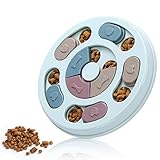
- 【Size】: L9.44" * W9.44"* H1.14" suitable for cats, puppies and small dogs.
- 【Interactive Dog Toys】This is a interactive puppy puzzle , which can easily become the closest companion and toy for your puppies and cats, and will release pressure for dogs. Find food by sliding parts to improve eating pleasure and IQ.
- 【Slow Feed Bowl】This encourages pets to eat at a slower speed, helps to slow down the feeding time to help the dog digest, and can provide your dog with a variety of healthy snacks.
- 【Slow Feede toys】 Use this educational game toy to exercise the dog’s brain, which will help meet the dog’s instinct needs, train the pet’s sense of smell, and let the dog enjoy feeding when using the nose or paw to move the slider, while providing spirit stimulate.
- 【Dog toys】No toy is indestructible. Do not leave toys with unsupervised pets. Remove and replace toy if damaged.
- Start with a recording at the lowest volume at which your dog notices but remains relaxed. If a recording immediately causes distress, stop and seek professional coaching.
- Play it briefly, then deliver high-value food or another reward while the dog stays calm.
- Stop the sound before the dog escalates. Repeat over multiple sessions.
- Increase volume or duration in tiny steps, returning to an easier level if the dog vocalizes, hides, pants or cannot take food.
Never deliberately set off a siren response to “get it over with,” and do not leave a sound playing continuously while the dog is distressed. Real-world sirens may require management—moving the dog to an interior room, closing windows and offering a familiar calm activity—while training progresses.
When barking or howling happens after you leave
Observe the first minutes, not just the aftermath
Use a pet camera or another safe observation method to see what happens after departure. Check whether vocalizing starts immediately, whether the dog can eat, and whether there is pacing, door scratching, destruction, drooling, elimination or escape behavior. The AKC’s alone-time guidance and the ASPCA’s barking guidance distinguish ordinary vocalizing from a pattern that signals distress.
Set up absences below the panic point
- Prepare the dog’s resting area and, if appropriate, offer a safe food toy before stepping out.
- Leave for a duration your camera shows the dog can tolerate—possibly only a few seconds.
- Return while the dog is still comfortable. Keep the departure and return calm.
- Repeat until that duration is consistently easy, then add time in small increments. If distress appears, shorten the next absence rather than pushing through it.
Do not use a food puzzle to conceal severe anxiety. A distressed dog may not eat, and forcing longer absences can worsen the pattern. Arrange veterinary guidance when vocalizing is persistent, severe or accompanied by the signs above. A veterinarian can also discuss whether medication or a structured behavior plan is appropriate; do not give human medication or sedatives without veterinary direction.
PC Slower Than It Used to Be?
A free scan shows the junk files, broken settings and background clutter dragging Windows down - then fixes them in one click.Free scan · Windows 10 & 11Outdated Drivers Are Slowing You Down
One free scan finds every outdated or missing driver and matches the right update for your exact hardware.Free scan · exact hardware matchRule out pain or illness when the pattern changes
Contact a veterinarian if howling starts suddenly, becomes substantially more frequent, sounds painful, or appears with limping, stiffness, sensitivity to touch, appetite or thirst changes, vomiting, diarrhea, confusion, breathing changes or other unusual behavior. Older dogs and dogs with known medical conditions deserve particular care, but any Beagle can develop a problem unrelated to breed vocality.
Best Value

- Four Challenges & Levels 1-3: Multiple games with a flip game and a linear track sliding game, all requiring dogs to learn steps and find treats. This puzzle is designed to be more fun and difficult, with more unique ways to play. It can enhance your dog's IQ and train their sense of smell
- Prolong the Feeding Time: The 14-hole food storage slow feeder has four ways to play, which is effective in slowing down the dog's eating speed. It is also beneficial to the dog's physical and mental health by increasing the time and difficulty of acquiring food, thus avoiding gastrointestinal issues caused by indigestion
- Safe Materials & Cleanable: Furry friends can safely play with this toy, which is made of food-safe and long-lasting materials. Additionally, it is easy to clean with warm water and soap after use
- Six Silicone Anti-Slip Pads: Six silicone anti-slip pads with high resistance ensure a firm grip and prevent the item from sliding to one side during feeding
- Warm Tips: When playing with the puzzle, please keep your dog with you to prevent any possible destruction of the toy. The toy has a tight design of built-in game components, so you don't need to worry about them being easily dislodged and swallowed by your dog
Bring your log or a short, safely obtained video. Tell the veterinarian when the behavior occurs, what stops it, and whether it is limited to being alone or tied to a sound. A medical examination should come before assuming that a new howl is a training issue.
Products: match the tool to the trigger
| Tool | Useful purpose | Limits and safe-use checks |
|---|---|---|
| Food puzzle or treat-dispensing toy | Enrichment for a dog whose vocalizing is plausibly related to boredom or a need for foraging activity. | Choose an appropriate size and difficulty, inspect for pieces that can break off, and supervise initial use. It does not treat separation anxiety. |
| Pet camera or dog monitor | Shows whether vocalizing begins after departure and what the dog does when alone. | Observation only; it cannot diagnose anxiety or replace a veterinary or behavior assessment. |
| Pheromone product | VCA notes that Adaptil may help some dogs calm down and reduce vocalization as an adjunct. | Response varies. Discuss it with your veterinarian and do not treat it as a guaranteed fix or a substitute for trigger management. |
| Qualified behavior support | Helps design gradual exposure, calm training and an alone-time plan for complex or severe cases. | Look for reward-based methods and appropriate credentials; avoid anyone promising instant suppression through fear or pain. |
Buy a product only after the trigger map shows why it is relevant. A monitor is useful when you need information; a puzzle is useful when the dog can comfortably eat and boredom is plausible. Neither item resolves a medical cause or severe panic by itself.
Responses that commonly backfire
- Yelling or punishment: It can add attention to demand barking and may increase fear or anxiety-driven vocalizing. VCA advises against punitive responses, and the ASPCA cautions that punishment can worsen fear-related barking.
- Inconsistent attention: If barking sometimes earns play, food, a door opening or a conversation, the dog has a reason to keep trying. Decide what calm behavior earns and apply it consistently.
- Flooding with the trigger: Holding a dog close to a window, repeatedly playing a siren or forcing a long absence can exceed the dog’s coping ability. Use gradual exposure instead.
- Exercise as the only answer: Activity helps meet needs, but a dog with separation distress, pain or fear needs the corresponding treatment plan.
- Unsupervised equipment or chews: Any item can become a choking, ingestion or entanglement hazard if your dog is not ready for it. Introduce products while you are present.
A practical home sequence
Use this order so that training is built on useful information rather than guesswork:
What’s actually slowing this PC down?
Pick the symptom - the matching free tool is one click away.
- Record the pattern: Log triggers, timing, duration and body language for several days.
- Prevent rehearsals: Block views, close doors or adjust the routine during predictable trigger periods.
- Cover basic needs: Provide daily movement, sniffing, play, short training and adequate rest.
- Teach calm: Reward spontaneous quiet and build a mat or settle behavior in a low-distraction room.
- Practice below threshold: Present a mild trigger, reward calm, and increase difficulty gradually.
- Check alone time separately: Use a camera; do not assume a dog who is quiet with you will be comfortable alone.
- Review progress weekly: Look for shorter episodes, faster recovery and more voluntary settling, not total silence at every moment.
If progress stalls, return to easier setups and seek help rather than escalating corrections. A professional can observe the dog, identify subtle triggers and create a plan that fits your home.
When to bring in a professional
Ask your veterinarian for help when vocalizing is sudden, linked to possible pain or illness, or persistent during absences. For behavior support, relevant options include a qualified reward-based trainer, a Certified Applied Animal Behaviorist or a board-certified veterinary behaviorist. The ASPCA’s howling information and barking guidance both support professional evaluation when distress is substantial.
Bring your trigger log, videos, daily schedule and a list of products or methods already tried. Tell the professional whether the dog can eat, settle, respond to cues and recover after the trigger. Avoid providers who recommend punishment for fear- or anxiety-driven behavior, promise a guaranteed cure, or cannot explain how they will keep the dog below a level of overwhelming distress.
Quick Recap
Product prices and availability are accurate as of the date/time indicated and are subject to change. Any price and availability information displayed on Amazon at the time of purchase will apply.
Recommended Free Tools





Leave a Reply