
A healthy koi pond is a managed life-support system, not simply a hole filled with clear water. Design the pond around the fish load you intend to keep, then size filtration, circulation, aeration, drains, and backup power to handle waste and oxygen demand. Test water instead of judging it by appearance, quarantine every new fish in a separate system, and adjust feeding and maintenance to temperature and measured conditions.
Start with the system, not the fish
Koi health depends on the pond’s capacity to process waste and maintain oxygen. Carrying capacity changes with pond volume, fish size and number, water temperature, sunlight, aeration, and how effectively natural or artificial filtration removes solids and dissolved waste. Oklahoma State University Extension lists all of these factors for water gardens; there is no defensible universal “fish per gallon” rule that applies to every koi pond.
As an Amazon Associate I earn from qualifying purchases.
Plan the intended fish load before buying equipment. A pond that supports a few small koi may not support the same number after several seasons of growth. Warm weather increases metabolic activity while reducing the amount of oxygen water can hold, so a system that appears adequate in spring can become marginal in summer.
Choose a pond configuration
Small ornamental ponds, flow-through systems, and recirculating systems make different compromises in management, cost, and intensity. In a recirculating arrangement, water is pumped through mechanical media that captures particles and biological media that supports organisms processing fish waste such as ammonia. Some installations add ultraviolet sterilizers or chemical filtration, but neither is automatically required for every hobby pond. SRAC’s aquaculture overview explains these functions and the differences among system types: Southern Regional Aquaculture Center guidance.
#1 Best Overall

- HIGH-EFFICIENCY PRESSURE FILTERING: Pressurized pond filter delivers strong bio-mechanical filtration for koi, ornamental, and outdoor ponds; Supports up to 2000-gal ornamental or 1000-gal fish ponds with max 1840 GPH flow to keep water crystal clear
- ADVANCED FILTRATION & CLARIFYING: This pond bio pressure filter uses a reusable system combining two blue 20 PPI and two yellow 25 PPI sponges with bio balls to maintain balanced water, while the 13W clarifying lamp brightens your pond for koi and plants
- EASY CLEANING AND MAINTENANCE: Switch between Filter and Clean modes with one control; Rotate the handle to backflush until water runs clear; Clean weekly or immediately if the red float rise; Modular body and detachable lid make routine maintenance fast and simple
- MULTI-SIZE ADAPTERS FOR COMPATIBILITY: Comes with 3 hose adapters per size — ¾", 1", 1¼" to fit most pond pumps; Clear inlet and outlet labels prevent installation mistakes, and pairing with a larger hose is recommended for more stable, efficient filtration
- DURABLE OUTDOOR CONSTRUCTION: Strengthened ABS housing withstands long-term outdoor use; Weather-resistant design ensures safe, continuous operation in koi ponds and other water features, delivering reliable performance through changing seasons
For a backyard pond, prioritize a layout that lets you remove solids before they break down, maintain steady circulation, provide vigorous gas exchange, and reach every service component without dismantling the pond. A simpler system that can be cleaned reliably is safer than a complicated one that is neglected.
Account for future fish size
Estimate the adult size of the koi you plan to keep and the waste load that mature fish will produce. Keep spare filtration and aeration capacity rather than designing to the exact minimum. If fish numbers increase, water warms, or plant growth and debris reduce flow, that reserve can prevent an oxygen or ammonia crisis.
Core components a koi pond needs
Equipment should be selected as a connected system. Compare each option by pond volume and fish load, solids handling, biological filtration, oxygen delivery, service access, and what happens if a pump or the electrical supply fails.
Bottom drains and solids removal
A bottom drain can move feces and settled debris toward filtration instead of leaving waste to decompose among rocks. Koi Organisation International describes bottom drains as a way to transport koi waste and detritus to filtration. A drain is useful only when pipework, valves, and filters can be accessed and flushed; an inaccessible drain becomes another maintenance problem.
Mechanical and biological filtration
Mechanical stages remove leaves, uneaten food, and suspended particles. Biological stages provide surface area for microbes that convert toxic nitrogen compounds. Inspect both stages for clogging and clean them according to their design. Over-cleaning biological media with untreated tap water can remove beneficial organisms, while allowing mechanical media to block can reduce circulation and oxygen delivery.
Rank #2

- 18W High-Efficiency UV Clarifier – Effectively eliminates green water algae in as little as 3-7 days, keeping your pond crystal clear while being 100% safe for fish and plants.
- Advanced 6-Layer Professional Filtration – 3 layers of premium mechanical filter pads trap debris + 1 layer activated carbon removes odors & impurities + 1 layer lava rock + 1 layer bio balls support billions of beneficial bacteria for superior biological filtration.
- Powerful 42W High-Flow Water Pump – Delivers strong circulation up to 660 GPH, ensuring excellent water movement and oxygenation for ponds up to 1500 gallons.
- 3 Interchangeable Fountain Nozzels – Customize your pond with 3 stunning spray patterns (lotus, bell, and jet), adding beautiful visual effects and extra surface aeration.
- Easy Setup & Long-Lasting Performance – Plug-and-play installation, durable construction, perfect for koi ponds, water gardens, and backyard ponds – enjoy cleaner, healthier water with significantly reduced maintenance.
Pumps and circulation
Flow must turn over the pond often enough to carry solids to the filter and distribute oxygenated water. Actual performance falls when pipe runs, bends, valves, elevation changes, or dirty media add resistance, so do not size a pump from its free-flow label alone. Koi Organisation International recommends two smaller pumps rather than one large pump, because partial redundancy can preserve circulation if one unit stops.
Aeration and oxygen backup
Air pumps, diffusers, waterfalls, and surface agitation all support gas exchange. Aeration is especially important during hot weather, at night when plants no longer produce oxygen, and during power interruptions. Keep backup power focused on aeration first; a short loss of filtration is generally less immediately dangerous than a loss of oxygen.
Ultraviolet and chemical options
Ultraviolet units can reduce free-floating algae and some waterborne organisms when correctly sized and maintained. Chemical media can target particular compounds. These are optional additions, not substitutes for solids removal, biological filtration, water changes, or quarantine.
Water-quality targets and what the numbers mean
Clear water can still contain harmful ammonia, nitrite, or inadequate oxygen. Test routinely and record results with the date, water temperature, recent feeding, and any equipment changes. The figures below come from two different guidance contexts and should not be treated as a single laboratory standard.
| Parameter | Guidance value | Context and source |
|---|---|---|
| Dissolved oxygen | Most pond water can hold about 10–12 mg/L; below about 6 mg/L may begin to harm pond life | Penn State Extension pond guidance: Water-quality concerns for ponds |
| Dissolved oxygen | At least 5 mg/L; koi and goldfish may tolerate much lower levels briefly | SRAC koi and goldfish culture profile: SRAC fact sheet |
| Ammonia-nitrogen | Any measurable level above 0.1 mg/L may be detrimental to pond health | Penn State Extension pond guidance: Water-quality concerns for ponds |
| Un-ionized ammonia and nitrite | Keep below 0.05 mg/L | SRAC species-profile context: SRAC fact sheet |
| pH | Keep as close to 7 (neutral) as possible; koi and goldfish may tolerate 5–9 | SRAC species-profile context: SRAC fact sheet |
| Temperature | About 65–75°F (18–24°C) is the profile’s optimal range | SRAC koi and goldfish culture profile: SRAC fact sheet |
Why warm water deserves special attention
Warm water holds less dissolved oxygen than cold water. At the same time, koi become more active and consume more oxygen and feed more heavily. Increase observation and aeration during hot spells, check that pumps and air lines are flowing, and remove decaying organic matter promptly.
Rank #3
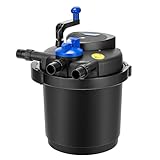
- HIGH-EFFICIENCY PRESSURE FILTERING: Pressurized pond filter delivers strong bio-mechanical filtration for koi, ornamental, and outdoor ponds; Supports up to 1600-gal ornamental or 800-gal fish ponds with max 1580 GPH flow to keep water crystal clear
- ADVANCED FILTRATION & CLARIFYING SYSTEM: This pond bio pressure filter uses a reusable coarse and fine sponge system with two blue 20 PPI sponges and two yellow 25 PPI sponges, supported by an integrated 13W clarifying lamp for cleaner pond water
- EASY CLEANING AND MAINTENANCE: Switch between Filter and Clean modes with one control; Rotate the handle to backflush until water runs clear; Clean weekly or immediately if the red float rise; Modular body and detachable lid make routine maintenance fast and simple
- MULTI-SIZE ADAPTERS FOR COMPATIBILITY: Comes with three hose adapters (3/4", 1", 1-1/4") to fit most pond pumps; Clear inlet and outlet labels prevent installation mistakes, and pairing with a larger hose is recommended for more stable, efficient filtration
- DURABLE OUTDOOR CONSTRUCTION: Strengthened ABS housing withstands long-term outdoor use; Weather-resistant design ensures safe, continuous operation in koi ponds and other water features, delivering reliable performance through changing seasons
Ammonia and nitrite responses
A rising reading means the biological system is not processing the current waste load. Stop or reduce feeding, verify circulation and aeration, remove trapped solids, and perform a carefully matched water change if source water is suitable. Test the replacement water and avoid sudden temperature or chemistry shifts. If readings remain abnormal or fish show distress, consult an aquatic veterinarian or fish-health laboratory.
Free tools Windows power users keep installed
One-click scans. No signup required.
How to build or renovate a koi pond
- Define the fish plan. Decide the approximate adult number and size of koi, whether the pond will receive full sun, and how much time you can devote to cleaning and testing. Design for growth rather than the size of newly purchased fish.
- Select the site. Avoid locations that receive large amounts of leaf litter or contaminated runoff. Provide access to electrical service, drainage for filter cleaning, and enough working space to remove media and inspect pumps.
- Set the hydraulic path. Lay out bottom drains, skimmers if used, pre-filters, mechanical stages, biological media, pump chambers, returns, and aeration points before excavation. Ensure every valve and clean-out can be reached.
- Build for safe, even circulation. Eliminate dead zones where waste settles. Returns should distribute filtered water throughout the pond, while air diffusers or moving water keep the surface exchanging gases.
- Install filtration with spare capacity. Size media and flow for the planned waste load, not merely the pond’s nominal volume. Include a way to bypass or isolate equipment for cleaning without leaving fish without oxygen.
- Provide electrical and power-failure protection. Use weather-appropriate electrical protection and a backup source capable of running aeration. Follow local electrical codes and have a qualified professional handle mains wiring.
- Fill and condition the system. Test source water, treat it as necessary for chlorine or chloramine according to the product label, and run pumps and aeration before adding fish. Confirm that filters prime, drains flow, and overflow routes are safe.
- Cycle and verify. Monitor ammonia, nitrite, pH, temperature, and oxygen while the biological filter establishes. Add fish gradually only when readings are stable and the system can handle the additional waste.
Stocking koi without relying on a magic number
There is no universal stocking count supported by the cited extension guidance. Use a capacity decision instead:
- Volume and depth: More water provides dilution and thermal stability, but volume alone does not remove waste.
- Fish biomass: Count and adult size determine feeding and oxygen demand.
- Temperature and sunlight: Heat and intense sun increase oxygen stress and can accelerate algae growth.
- Aeration: Confirm that air delivery remains adequate at the warmest expected temperature and during darkness.
- Filtration performance: Judge the system by measured ammonia and nitrite, stable flow, and the time required to clean solids media.
- Maintenance capacity: If testing, debris removal, and filter cleaning are already difficult, adding fish increases risk.
When fish repeatedly gasp, congregate at an inflow, or show deteriorating water results, treat those signs as evidence that the current load or equipment capacity is too high. Improve filtration and aeration or reduce biomass; do not add fish to “balance” the pond.
Feeding koi by temperature and condition
Koi metabolism changes with water temperature. Koi Organisation International advises not feeding below 50°F, feeding lightly between 50 and 60°F, and adjusting feeding as temperatures rise. This is hobbyist care guidance rather than a universal veterinary prescription, so watch body condition, appetite, waste, and test results.
Offer only what fish consume promptly. Uneaten food decomposes, adding ammonia demand and consuming oxygen. During a heat event, a cloudy-water episode, or any ammonia or nitrite rise, reduce or pause feeding while correcting the underlying condition. Resume gradually once measurements and fish behavior improve.
Windows Errors? Fix Them Before They Spread
Repair common Windows errors and clear accumulated junk for a smoother, more stable PC - no reinstall needed.Free scan · no reinstallCrashes, No Sound, or Screen Glitches?
Random freezes, missing sound and display glitches usually trace back to one bad driver. Find and replace yours safely.Free scan · under a minuteRank #4

- SUPERIOR PERFORMANCE: This pond filter is designed to filter water in fish ponds, large fish tanks, various ponds, and landscape ponds; VIVOHOME biological pond filter has a maximum flow rate of up to 10000L/H(2630GPH); Ideal for ornamental ponds under 2600 Gallons and fish ponds under 1300 Gallons
- FAST FILTRATION: This pond bio pressure filter features a multi-stage filtration system with two blue 20 PPI sponges, two yellow 25 PPI sponges, and bio balls for enhanced biological filtration; The combination of fine and coarse filter pads superior filtration to maintain crystal-clear water; A built-in 13W lamp with 8000-hour life ratings further improves water clarity and quality, keeping your pond in optimal condition
- DURABLE CONSTRUCTION: Made of strengthened ABS material which features great insulation function, it can resist sunlight, water, and age; UL-certified with a 5M UL-listed power cord and waterproof connections; Perfect for backyard koi ponds, water gardens, or small fish habitats
- EASY OPERATION & MAINTENANCE: The function switch allows you to easily switch between FILTER and CLEAN modes; Rotate the regulating valve to the drain port, then press the button to clean the filter with the internal cleaning rod without opening the container; Clean weekly as part of regular maintenance, or immediately if the red float indicator rises; The modular structure and detachable lid make cleaning a breeze; A separate lamp replacement guide is included for your convenience
- MULTI-SIZE ADAPATERS FOR COMPATIBILITY: Compatible with most pond pumps, the filter includes 4 sizes of hose adapters (3/4", 1", 1 1/4",1 1/2") for flexible installation; Clear inlet/outlet labels prevent installation errors; For better performance and durability, use a larger diameter hose to connect the filter; Use the included glass covers to seal the outlet when not draining
A maintenance schedule that protects water quality
Every day
- Watch breathing, swimming, appetite, and whether fish congregate at aeration points.
- Remove visible leaves, dead insects, and uneaten food.
- Check that pumps, returns, air diffusers, and water levels are operating normally.
- Adjust feeding to temperature and observed consumption.
Each week
- Test temperature, pH, ammonia, nitrite, and dissolved oxygen with a method appropriate for ponds.
- Inspect and clean mechanical pre-filters before flow is restricted.
- Look for blocked skimmers, air-line kinks, unusual foam, or leaks.
- Perform a water change when test results, debris load, or source-water conditions indicate it is needed.
Seasonally
- Before hot weather, test aeration at full load, clean heat-sensitive equipment, and confirm backup power.
- Before autumn leaf fall, increase debris removal and protect intakes without restricting flow.
- After winter, inspect drains, liners, pumps, and electrical equipment before increasing feeding.
- Record temperature and test trends so changes are identified before fish become ill.
Water-change practice
Koi Organisation International describes small daily changes or larger weekly changes and cautions against changing pond temperature by more than 2 degrees at a time. Treat this as a starting practice, not a fixed rule: match the schedule to stocking, evaporation, source-water chemistry, and test results. Measure both pond and replacement-water temperature, add new water gradually, and ensure the incoming water is safe for fish.
Independent reader supportYour contribution helps us test, update, and keep practical guides available for everyone.Quarantine and disease prevention
Quarantine is the most dependable way to prevent pathogens entering an established pond. UF/IFAS recommends a separate system with dedicated nets, buckets, and siphon hoses. Never share wet equipment between the quarantine tank and the main pond without appropriate cleaning and disinfection.
Quarantine duration depends on the disease
UC Davis recommends keeping new koi separate for at least six weeks at temperatures permissive for koi herpesvirus (KHV). UF/IFAS guidance for carp edema virus disease (CEV) describes a minimum 30-day quarantine with water held between 15°C and 25°C. These periods address different pathogens; a single “safe after 30 days” or “safe after six weeks” rule is not valid for every disease.
During quarantine, observe appetite, breathing, skin, fins, gills, feces, and behavior. Test the small system more frequently than the display pond because its water volume and biofilter are less forgiving. Do not release a fish simply because it looks normal; some infections can be present before obvious signs appear.
The Tool Desk
Outbyte PC Repair FREEClear out junk files and repair common Windows errorsFree Scan →Outbyte Driver Updater FREEFix the driver behind crashes, sound loss and screen glitchesFind Drivers →Recognize serious signs
Possible KHV signs include difficulty breathing, abnormal or necrotic gills, skin or fin changes, appetite loss, lethargy, sunken eyes, altered mucus, rough skin, and bleeding. KHV can spread through infected fish, contaminated water, and contaminated husbandry or transport equipment, according to UK government guidance.
Best Value

- DURABLE MATERIAL: This VIVOHOME pond bio pressure filter is made from high-quality ABS material; It is heat-insulated, sun-resistant, and aging-resistant; These features ensure an extended service life, making it a reliable choice for long-term outdoor use; The locking buckle structure and IP44 waterproof rate further enhance its durability, ensuring protection against the elements
- SUPERIOR PERFORMANCE: This pond filter is designed to filter water in fish ponds, large fish tanks, various ponds, and landscape ponds; With a maximum flow rate of 10000L/H (2640 GPH), it is ideal for pumps with a flow rate up to 9000L/H (2380GPH); Suitable for ornamental ponds up to 3170 Gallons and koi ponds up to 1585 Gallons; Note: It is recommended to use a pond pump with a flow rate of around 2000 GPH when the pump head is approximately 10 ft (3 meters)
- EFFICIENT FILTRATION WITH TIMER: This pond bio pressure filter features a sponge filtration system with two blue 20 PPI sponges and three yellow 25 PPI sponges; The fine and coarse pore filter pads provide superior filtration to maintain crystal-clear water; An additional layer of bio-balls at the bottom further boosts biological filtration for stable water quality; The built-in 18W lamp maintains water clarity and quality; The timer settings (0H, 12H, 24H) help extend the lamp's lifespan
- EASY OPERATION & MAINTENANCE: The function switch allows you to easily switch between FILTER and CLEAN modes; In CLEAN mode, the motor automatically rotates to clean the sponges, with a "beep" sound indicating completion; It is recommended to clean the filter sponges once a week to maintain optimal performance; The modular structure and detachable lid make cleaning and maintenance a breeze; A separate lamp replacement guide and an extra lamp are included for your convenience
- MULTI-SIZE ADAPATERS FOR COMPATIBILITY: This pond filter includes two black adapters and one transparent adapter for different hoses; The sizes of the adapters are 3/4", 1", 1¼” and 1½” for various hoses based on your needs; The three adapters are interchangeable; For better performance and durability, the outlet hose should be at least one size larger than the inlet; The clear symbols on the filter inlet and outlet help you clarify and make it a breeze to connect for easy connection
There are currently no treatments for KHV, states UC Davis School of Veterinary Medicine guidance by Amy Young and Dr. Esteban Martinez: KHV guidance. Isolate suspect fish immediately, stop moving water or equipment between systems, and contact an aquatic veterinarian or diagnostic laboratory. UC Davis lists PCR and qPCR among diagnostic methods and recommends professional laboratory testing.
Reporting obligations vary by location. In England and Wales, suspected or confirmed KHV must be reported to the Fish Health Inspectorate; elsewhere, contact the relevant animal-health authority for local rules.
Responding to common pond failures
Fish gasping at the surface
Switch on every available aerator, increase surface agitation, and verify that pumps and air lines are not blocked. Test dissolved oxygen and temperature immediately. Remove decaying debris and stop feeding while investigating. If fish remain distressed, move them only with professional guidance because handling and sudden water changes add stress.
Quick wins for a faster PC:
Repair Windows errors before they cause bigger problemsFix Now →Scan for outdated or missing drivers - takes under a minuteDriver Scan →Cloudy water
Check mechanical filtration, recent disturbance, feeding, fish load, and ammonia or nitrite. A clear-water appearance does not prove safety, and adding clarifying chemicals without finding the cause can hide a developing problem.
A pump stops
Keep aeration running on backup power, inspect the intake and impeller for debris, and confirm water level and priming. If one of two pumps fails, reduce feeding and fish disturbance until normal circulation is restored. Do not restart a dry pump.
Sudden illness after adding fish
Separate the new fish and any visibly affected fish, dedicate equipment to the isolation system, and seek diagnostic advice. Do not share pond water or “treat the whole pond” with a medication selected without a diagnosis.
Choosing equipment by decision criteria
| Decision | What to evaluate |
|---|---|
| Filtration | Solids capture, biological surface area, flow at operating resistance, cleaning access, and safe isolation during service |
| Pump arrangement | Required flow at actual head height, energy use, redundancy, intake protection, and restart behavior after an outage |
| Aeration | Air delivery at pond depth, diffuser placement, noise, weather protection, and backup-power compatibility |
| Water testing | Ability to measure oxygen, ammonia, nitrite, pH, and temperature consistently and record trends |
| Quarantine gear | Separate tank, filter, heater or temperature control where needed, nets, buckets, hoses, and independent aeration |
No product model, price, or independent performance comparison is established here. Choose equipment that matches measured requirements and can be maintained safely rather than selecting by marketing flow rates alone.
When to involve a professional
Consult an aquatic veterinarian or fish-health laboratory for persistent abnormal test results, repeated deaths, severe gill or skin lesions, unexplained neurologic signs, or suspected KHV or CEV. Bring water-test records, temperature history, recent fish additions, photographs, and a description of any treatments already used. For a new installation, a pond designer or qualified installer can review hydraulic layout, electrical safety, drainage, and backup systems before excavation makes changes expensive.
Quick Recap
Product prices and availability are accurate as of the date/time indicated and are subject to change. Any price and availability information displayed on Amazon at the time of purchase will apply.





Leave a Reply