
Some links on this page are affiliate links: if you buy through them we may earn a commission, at no extra cost to you.
The most reliable way to prevent a puppy from becoming overly dependent on another dog is to make independence part of daily life from the beginning. Give each puppy individual training, walks, meals, play, rest, socialization, veterinary handling, and relaxed time with people. Keep companionship safe and supervised, but do not let the puppies become each other’s only source of security or learning.
Use an individual crate or pen for each puppy, introduce separation in tiny successful steps, and increase distance only while both dogs remain calm. If either puppy panics, cannot eat or learn alone, or shows guarding or aggression, stop escalating the separation and involve a qualified trainer or veterinary behaviorist.
As an Amazon Associate I earn from qualifying purchases.
Free tools Windows power users keep installed
One-click scans. No signup required.
What people mean by “littermate syndrome”
The American Kennel Club uses “littermate syndrome” to describe potential behavior problems that can arise when puppies raised together become more dependent on one another than on their owners. It is a descriptive, nonmedical label, not a diagnosis or a guaranteed outcome. Texas A&M’s veterinary school likewise reports that the pattern is not inevitable and is not limited to a particular breed.
Similar dependence can develop in unrelated puppies of a similar age. The useful question is therefore not whether a pair has a syndrome, but whether each puppy can function, learn, rest, and feel safe without the other. Independence is a set of observable skills that can be taught and monitored.
Popular on Amazon

- IDEAL FOR 71-90 LB DOGS: Measures 42.5 x 28.5 x 30.5 inches - perfect for Australian Shepherds, Boxers, Golden Retrievers & similar breeds. For dogs near 90 lbs, consider sizing up to our 48-inch model so they have plenty of room to get comfortable.
- WE DON'T CUT CORNERS, WE PERFECT THEM: Precision welding, rounded corner clips & slide-bolt latch with Paw Block mitigate snags, cuts & escapes. With rigorous safety testing, iCrate provides peace of mind knowing your dog is safe while you're away.
- DURABLE CONSTRUCTION: Sturdy metal wire design with a protective black e-coat finish, the iCrate resists rust and everyday wear. Complete with leak-proof tray, rubber feet, carry handle, and tool-free assembly, it's ready for years of use.
- SUPPORTS CRATE TRAINING: A divider panel lets the crate grow with your dog, from puppy kennel to full-size crate. Large openings and low thresholds ease the crate training process and help your dog feel more at home.
- LIFE GOES BETTER WITH PETS: A family-owned business based in Indiana, MidWest Homes for Pets brings over 100 years of pet product expertise and a commitment to quality, rigorous safety testing, and excellent US-based customer service.
Signs that a puppy needs more individual support
One sign alone does not prove a disorder. A cluster of problems, especially when it interferes with ordinary care, means the puppies need a more deliberate plan and possibly professional assessment.
| Behavior you observe | Why it matters | Immediate response |
|---|---|---|
| Extreme distress when the puppies are separated | The puppy may not yet have learned that calm, brief separation is safe. | Return to an easier separation, reinforce calm behavior, and progress more slowly. |
| Difficulty focusing on training when the companion is present | The other puppy is competing with the handler for attention. | Train individually in a quieter setting before adding distractions. |
| More interest in the other puppy than in the owner | Human bonding and reinforcement may be underdeveloped. | Increase one-on-one play, feeding, walks, and reward-based training. |
| Fearfulness or low confidence when alone | The puppy may rely on the companion as a safety signal. | Use very short, positive separations and avoid flooding the puppy. |
| Delayed social development or poor independence | The puppy may be missing experiences that do not include its housemate. | Provide individual, age-appropriate outings and puppy classes. |
| Excessive reliance in new places or situations | The puppy has not practiced coping with novelty independently. | Introduce new settings one puppy at a time with food and distance from triggers. |
| Competition, tension, guarding, or aggression | Shared access to food, toys, space, or people may be creating conflict. | Separate resources immediately and obtain professional behavior guidance. |
Make independence a daily routine
Independence is built through repeated, ordinary experiences rather than one long separation exercise. Each puppy should have time every day in which the other dog is not participating. Keep early sessions easy enough that the puppy can succeed; add duration, distance, or distractions one variable at a time.
What’s actually slowing this PC down?
Pick the symptom - the matching free tool is one click away.
Give each puppy individual care activities
Rotate through the same basic categories for both puppies:
- Training: Practice name recognition, attention, handling, leash skills, recalls, settling, and household cues with one puppy while the other is safely occupied elsewhere.
- Walks: Take separate walks so each puppy learns to navigate the environment, notice the handler, and recover from unfamiliar sights without using the other dog as a shield.
- Meals: Feed in separate areas. This prevents competition and makes it easier to see whether each puppy is eating normally.
- Play: Use people-directed games such as tug with rules, retrieve, scent searches, and food puzzles. Individual play teaches the puppy that people are rewarding partners.
- Rest: Schedule naps and quiet chewing in each puppy’s own crate, pen, or safe area.
- Socialization: Expose each puppy separately to suitable people, surfaces, sounds, vehicles, grooming, and calm, vaccinated dogs, keeping the experience positive and age-appropriate.
- Owner attention: Offer calm stroking, handling, and simply sitting together without the other puppy present. The goal is not constant entertainment; it is comfortable connection.
Start with short sessions that end while the puppy is still relaxed. If a puppy struggles, make the next repetition easier rather than insisting on a longer separation. The American Kennel Club’s guidance is direct: “To ensure that each puppy reaches their potential, they should spend time apart from their sibling every day.”
Use separate handlers and settings when possible
Two adults can each work with one puppy, but the puppies should also learn to cope when only one person is available. Separate puppy classes are preferable when practical because each puppy must attend to its own instructor and surroundings. Veterinary visits should also be individual when possible. A puppy that only ever enters a clinic beside its companion may find future examinations, vaccinations, or treatment much harder alone.
Also popular on Amazon

- IDEAL FOR 21-40 LB DOGS: Measures 30.5 x 19.25 x 21.5 inches - perfect for French Bulldogs, Welsh Terriers, Dachshunds & similar breeds. For dogs near 40 lbs, consider sizing up to our 36-inch model so they have plenty of room to get comfortable.
- WE DON'T CUT CORNERS, WE PERFECT THEM: Precision welding, rounded corner clips & slide-bolt latch with Paw Block mitigate snags, cuts & escapes. With rigorous safety testing, iCrate provides peace of mind knowing your dog is safe while you're away.
- DURABLE CONSTRUCTION: Sturdy metal wire design with a protective black e-coat finish, the iCrate resists rust and everyday wear. Complete with leak-proof tray, rubber feet, carry handle, and tool-free assembly, it's ready for years of use.
- SUPPORTS CRATE TRAINING: A divider panel lets the crate grow with your dog, from puppy kennel to full-size crate. Large openings and low thresholds ease the crate training process and help your dog feel more at home.
- LIFE GOES BETTER WITH PETS: A family-owned business based in Indiana, MidWest Homes for Pets brings over 100 years of pet product expertise and a commitment to quality, rigorous safety testing, and excellent US-based customer service.
Keep records for each dog rather than treating them as a unit. Note appetite, sleep, training progress, fears, play style, and body condition separately. Individual observations make subtle changes easier to detect.
The Tool Desk
Outbyte Driver Updater FREEScan for outdated or missing drivers - takes under a minuteDriver Scan →Outbyte PC Repair FREERepair Windows errors before they cause bigger problemsFix Now →Provide an individual crate or pen for every puppy
Yes, puppies should have separate crates or comparable safe areas. The American Kennel Club recommends separate crates from the beginning. Crates may stand side by side at first so the puppies can see and smell each other; as they mature and settle, increase the distance or add visual separation if that remains comfortable.
Separate sleeping spaces protect rest, reduce competition, and create a predictable place for each puppy to decompress. A crate is not a punishment or a test of endurance. It is useful only when the puppy has learned that it is a safe place to settle.
Positive crate-training sequence
- Place the crate in a calm area and leave the door open. Let the puppy investigate voluntarily; reward looking at, approaching, or entering the crate.
- Feed meals, scatter treats, or provide a safe chew near the entrance, then gradually move the food farther inside.
- When the puppy enters willingly, briefly close the door while you remain nearby. Open it before the puppy becomes worried.
- Repeat with small variations: you sit, stand, take one step away, and return. Change only one difficulty at a time.
- Practice while the other puppy is calmly occupied in its own area. Later, add modest distance or a visual barrier.
- Increase duration only when the puppy is relaxed. If vocalizing or movement escalates, shorten the next repetition and return to an easier step.
A wire crate with a divider can accommodate a growing puppy while keeping the usable space appropriately sized. Cornell University College of Veterinary Medicine summarizes the benefit this way: “Through positive reinforcement training, when your dog learns that the crate is a safe space for them to settle down and relax, then having a dog crate can be helpful for multiple situations.”
When not to continue a crate separation
Do not force a puppy to remain crated alone while it is excessively vocalizing, pacing, panting, eliminating, or drooling. Those behaviors indicate that the setup is currently too difficult or that another problem needs attention. Move to a larger puppy-proofed area, use a sitter, arrange supervision, or consult a veterinarian or qualified trainer. Releasing a panicked puppy does not “reward” a diagnosis; it prevents rehearsal of overwhelming distress while you redesign the exercise.
Quick wins for a faster PC:
Clear out junk files and repair common Windows errorsFree Scan →Fix the driver behind crashes, sound loss and screen glitchesFind Drivers →Repair Windows errors before they cause bigger problemsFix Now →Also popular on Amazon
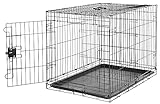
- DURABLE CONSTRUCTION: Amazon Basics metal wire dog crate with manual door locking mechanism provides secure containment for indoor training & rest
- IDEAL DIMENSIONS: Measures 36 x 23 x 25 inches (LxWxH) to accommodate pets under 32 x 21 inches, suitable for breeds like Corgis & Cocker Spaniels
- FOLDABLE DESIGN: Collapsible frame folds flat without tools for easy transport & compact storage; top handle allows comfortable carrying at 20.24 pounds
- EASY CLEANING: Removable plastic base tray slides out for quick cleanup; metal hook at the bottom prevents tray from shifting during daily use
- INCLUDED DIVIDER: Comes with a divider panel to adjust internal space as your puppy grows, allowing customized room within the single-door crate
Allow companionship without making it the only relationship
Shared play is healthy when it is supervised and balanced with individual experiences. Watch for fatigue, body slamming, repeated pinning, avoidance, stiff posture, guarding, or one puppy trying to escape. Interrupt before arousal becomes conflict. Call each puppy away, reward the response, provide water and a quiet break, and resume only if both dogs are loose and willing.
What to do while one puppy works with you
Give the waiting puppy a safe chew, stuffed food toy, scatter feed, or calm resting exercise in its own area. Whenever possible, place that puppy out of sight and ideally out of earshot so it learns to settle rather than monitor every movement. Then switch roles. Keep the waiting activity appropriate for the puppy’s age and chewing habits, and inspect toys for damage.
Manage food, toys, and high-value spaces
Feed separately, collect bowls after meals, and provide prized chews only when the puppies are separated or directly supervised. Do not make them share beds, crates, laps, or narrow doorways. If either puppy stiffens, freezes, hovers, growls, snaps, or rushes to take an item, remove the opportunity for competition and seek behavior advice rather than testing tolerance.
Teach calm separation in graduated steps
Separation practice should resemble physical therapy: small repetitions, careful observation, and gradual progression. The goal is relaxed behavior, not a particular number of minutes.
Find each puppy’s comfortable starting point
Begin at a distance and duration where the puppy can still eat, play, or rest. That might mean a second puppy behind a baby gate, a crate positioned nearby, or a handler taking one puppy just outside the room. Record what happened so you can repeat the successful level.
Also popular on Amazon

- IDEAL FOR 41-70 LB DOGS: Measures 36.5 x 23.25 x 24.75 inches - perfect for Bulldogs, Beagles, Whippets & similar breeds. For dogs near 70 lbs, consider sizing up to our 42-inch model so they have plenty of room to get comfortable.
- WE DON'T CUT CORNERS, WE PERFECT THEM: Precision welding, rounded corner clips & slide-bolt latches with Paw Block mitigate snags, cuts & escapes. With rigorous safety testing, iCrate provides peace of mind knowing your dog is safe while you're away.
- DURABLE CONSTRUCTION: Sturdy metal wire design with a protective black e-coat finish, the iCrate resists rust and everyday wear. Complete with leak-proof tray, rubber feet, carry handle, and tool-free assembly, it's ready for years of use.
- SUPPORTS CRATE TRAINING: A divider panel lets the crate grow with your dog, from puppy kennel to full-size crate. Large openings and low thresholds ease the crate training process and help your dog feel more at home.
- BECAUSE LIFE GOES BETTER WITH PETS: A family-owned business based in Indiana, MidWest Homes for Pets brings over 100 years of pet product expertise and a commitment to quality, rigorous safety testing, and excellent US-based customer service.
Change one variable at a time
Increase either time apart, physical distance, visual blocking, environmental novelty, or the absence of a familiar person. Do not raise all five at once. Keep departures and reunions quiet and predictable. Return before distress rises, then reward calm behavior with food, play, or access to the owner.
Regress at the first sign of escalating distress
Whining that quickly stops is different from sustained panic. If the puppy stops eating, cannot settle, pants heavily, paces, drools, eliminates, or repeatedly throws itself at a barrier, the step is too hard. End the attempt safely, wait for recovery, and resume later at an easier level. Separation alone is not a cure; the puppy must learn a new emotional response through many tolerable repetitions.
If you have not brought home the second puppy yet
Waiting can make the transition substantially easier. The American Kennel Club generally advises adding another puppy when the first dog is about 1–2 years old, well trained, mature, and strongly bonded to you. That timing is guidance, not a universal rule: health, temperament, household capacity, and the resident dog’s behavior all matter.
Before adding a puppy, check whether the resident dog can relax behind a gate, walk politely, respond to cues around distractions, share space without guarding, and accept attention that is not continuous. A dog that is fearful, highly reactive, medically unwell, or already struggling with separation may need support first. Adding a puppy to solve the older dog’s boredom or anxiety usually increases management demands rather than fixing the underlying issue.
Independent reader supportYour contribution helps us test, update, and keep practical guides available for everyone.Raising two puppies now versus adding one later
Both choices can work, but they create different workloads and risks. Use the comparison below to identify the arrangement your household can actually support.
Also popular on Amazon

- IDEAL FOR 71-90 LB DOGS: Measures 42.88 x 28.75 x 30.38 inches - perfect for Australian Shepherds, Boxers, Golden Retrievers & similar breeds. For dogs near 90 lbs, consider sizing up to our 48-inch model so they have plenty of room to get comfortable.
- WE DON'T CUT CORNERS, WE PERFECT THEM: Precision welding, rounded corner clips & slide-bolt latches with Paw Block mitigate snags, cuts & escapes. With rigorous safety testing, iCrate provides peace of mind knowing your dog is safe while you're away.
- DURABLE CONSTRUCTION: Sturdy metal wire design with a protective black e-coat finish, the iCrate resists rust and everyday wear. Complete with leak-proof tray, rubber feet, carry handle, and tool-free assembly, it's ready for years of use.
- SUPPORTS CRATE TRAINING: A divider panel lets the crate grow with your dog, from puppy kennel to full-size crate. Large openings and low thresholds ease the crate training process and help your dog feel more at home.
- LIFE GOES BETTER WITH PETS: A family-owned business based in Indiana, MidWest Homes for Pets brings over 100 years of pet product expertise and a commitment to quality, rigorous safety testing, and excellent US-based customer service.
| Decision factor | Two puppies now | Add a puppy later |
|---|---|---|
| Independent functioning | Must be deliberately taught from the first day through separate routines and frequent short separations. | The resident dog has more opportunity to establish independence before the newcomer arrives. |
| Daily time requirement | Separate training, walks, socialization, feeding, rest, and veterinary handling create roughly doubled management. | The initial puppy workload is concentrated on one dog; later, some routines can be coordinated after foundations are solid. |
| Resident dog’s maturity | There is no established adult role model; both puppies are learning at once. | The resident dog is ideally 1–2 years old, trained, mature, and bonded to the owner. |
| Risk to monitor | Overdependence, competition, delayed individual learning, and distress when separated. | Stress from introducing a puppy to a dog that may not be ready to share resources or attention. |
| Support needed | Reliable separation equipment, time, supervision, and access to professional help if conflict appears. | Assessment of the resident dog’s temperament and a gradual introduction plan. |
Choose the later option if you cannot consistently provide separate daily care or if either dog already shows fear, panic, guarding, or aggression. Choose the immediate two-puppy arrangement only when you can organize individual routines every day and have a realistic backup plan for illness, travel, workdays, and veterinary appointments.
Troubleshoot common situations
| Problem | Likely training adjustment | Escalate for help when |
|---|---|---|
| One puppy screams as soon as a door closes | Move the crates closer, shorten the separation to a tolerable level, and reinforce calm before adding distance. | There is sustained panic, self-injury, heavy panting, drooling, or inability to recover. |
| Neither puppy will train while the other is nearby | Increase distance, use a visual barrier, lower distractions, and reward attention to the handler. | Progress remains absent despite easier setups or fear is increasing. |
| They play roughly and cannot disengage | Use frequent cheerful recalls, brief play intervals, and separate rest periods before arousal peaks. | There are bites, repeated attacks, guarding, or one puppy consistently avoids the other. |
| One puppy refuses food when alone | Return to a shorter, easier separation and offer food in a familiar safe area. | Appetite loss persists, weight changes, or the puppy cannot eat at veterinary visits. |
| A puppy panics during a solo car ride or clinic visit | Practice very short individual trips with rewards and gradual exposure to the building or vehicle. | The puppy cannot be safely examined, transported, or handled. |
When to contact a professional
Seek help from a certified professional dog trainer or a veterinary behaviorist when a puppy cannot settle, eat, train, travel, or receive veterinary care without the companion. Prompt guidance is also warranted when separation causes panic or when guarding, fighting, or aggression appears.
Outdated Drivers Are Slowing You Down
One free scan finds every outdated or missing driver and matches the right update for your exact hardware.Free scan · exact hardware matchWindows Errors? Fix Them Before They Spread
Repair common Windows errors and clear accumulated junk for a smoother, more stable PC - no reinstall needed.Free scan · no reinstallA qualified professional can assess body language, identify whether fear, frustration, pain, or resource conflict is involved, design a manageable progression, and help match the plan to your household. Preventive veterinary behavior guidance emphasizes assessment, trainer credentials, body-language interpretation, and practical multi-dog management. Ask your veterinarian for a referral if you are unsure whom to contact.
Do not wait for a serious fight to “settle the hierarchy,” and do not punish growling. Growling is information that the dog is uncomfortable; punishment can remove the warning without removing the underlying concern.
A practical independence checklist
- Each puppy has an individual crate, pen, or puppy-proofed rest area.
- Each puppy eats separately and can finish a meal without guarding or rushing.
- Every day includes one-on-one training, owner attention, play, rest, and some form of individual exploration.
- At least some walks, socialization outings, classes, and veterinary handling occur separately.
- Shared play is supervised and interrupted for calm breaks.
- During one puppy’s lesson, the other has a safe activity in its own area.
- Separation duration and distance increase only while the puppy remains relaxed and able to eat or engage.
- Distress signs trigger an easier step, not a longer forced confinement.
- Food, chews, beds, crates, and narrow spaces are managed to prevent competition.
- You have identified a certified trainer or veterinary behaviorist before a crisis occurs.
Bottom line
Keep the puppies connected, but never inseparable. Individual routines, positive crate training, separate learning opportunities, and gradual calm separation give each puppy a relationship with people and confidence that does not depend on the other dog. Monitor behavior rather than labels, adapt the pace to the puppy in front of you, and get professional help early when distress or conflict is more than your household can safely manage.





Leave a Reply