
Free tools Windows power users keep installed
One-click scans. No signup required.
Some links on this page are affiliate links: if you buy through them we may earn a commission, at no extra cost to you.
Do not use a hoodie pouch as your cat’s primary restraint for travel. A frightened cat can jump from an open or unstable pouch, and a pouch is not a certified carrier. For a veterinary visit, car ride, public transport, outdoor trip, evacuation or other situation in which your cat could be startled, use a sturdy, secure, ventilated carrier with a stable base. Keep it level, support it from underneath and secure it correctly in the vehicle.
You may be able to let a calm cat sit in a hoodie pouch briefly at home while you remain seated and supervise closely, but that is clothing use—not animal transport. No authoritative veterinary source located for this guidance validates a hoodie pouch for carrying a cat outside the home.
As an Amazon Associate I earn from qualifying purchases.
Do these 3 things before closing this tab:
1Clear out junk files and repair common Windows errors2Scan for outdated or missing drivers - takes under a minute3Repair Windows errors before they cause bigger problemsWhy a hoodie pouch is not a safe transport carrier
A hoodie pouch is designed to hold fabric and personal items against a person’s torso. It is not engineered or tested as an animal restraint. The pouch can gape, shift, collapse or allow a cat to climb out. A sudden noise, unfamiliar person, dog, vehicle movement or attempt to handle the cat at a veterinary clinic can trigger an escape attempt.
The key problem is not the cat’s weight alone. Safe transport requires a structure that stays closed, remains stable when lifted, allows adequate ventilation, resists escape and protects the cat when you move. A hoodie pouch has no documented performance on those carrier criteria, and no published authoritative statistic establishes a universal safe weight, age or time limit for carrying a cat in one.
Popular on Amazon
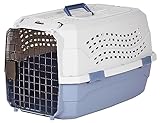
- Hard sided pet carrier with 2 doors for front and top entry; suitable for cat or medium size dog weighing 12 - 20 pounds
- Durable plastic construction with steel wire doors; screws keep the top and bottom sections securely connected
- Spring load latches ensure easy one-handed door opening and closing; top door swings open to the left or right and includes a top carry handle
- Plenty of air ventilation on the sides, top, and back of the carrier
- Note: Be sure to measure the size of the pet when choosing carrier size
Veterinary guidance points to a carrier instead. The Feline Veterinary Medical Association (FelineVMA) describes a hard plastic carrier as “the safest and easiest to clean compared with other carrier types.” VCA Animal Hospitals advises: “To keep both you and your cat safe for the trip to the animal hospital, always place your cat in a cat carrier.” Those recommendations address routine transport, not just emergencies.
Situations in which a pouch should never be the restraint
- Car, taxi or rideshare travel, even for a short distance.
- Cycling, running, climbing stairs quickly or walking near traffic.
- Crowded buses, trains, elevators, markets or events where the cat could be jostled or startled.
- Veterinary appointments, grooming visits or any place where unfamiliar animals and people are present.
- Evacuations, fires, storms, power failures and other emergencies.
- Any outing when the cat is ill, injured, sedated, highly anxious or trying to escape.
Never rely on a hoodie pouch because a cat appears relaxed at home. A quiet cat can react instantly when the environment changes.
What a safer cat carrier must provide
Choose the carrier by function rather than appearance. Your cat should be able to stand, turn around and lie in a natural position without being squeezed, while the carrier remains compact enough to handle securely. The following features address the practical risks of transport.
| Criterion | What to look for | Why it matters |
|---|---|---|
| Structural stability | Rigid sides, a firm base and doors that stay aligned when lifted | Prevents collapse and keeps the cat level while you move |
| Escape resistance | Secure latches and intact seams; no opening large enough for the cat’s head to pass through | Reduces the chance of a frightened cat bolting |
| Ventilation | Openings on multiple sides that cannot be blocked by bedding or a cover | Allows airflow while providing some visual shielding |
| Veterinary access | A large top opening or removable top; a soft-sided option should preferably have doors at both ends | Lets a clinician examine the cat with less forced handling |
| Cleanability | Non-absorbent surfaces that can be washed and disinfected | Helps manage urine, vomit, feces and infectious contamination |
| Acclimation | Enough room for familiar bedding or a toy, with an opening the cat can enter voluntarily | Makes the carrier a predictable resting place instead of a last-minute trap |
| Vehicle safety | Crash-test certification if you intend to use a seat belt | A seat belt can be used only with a carrier designed and certified for that purpose |
Hard-sided versus soft-sided carriers
A hard-sided, top-opening or removable-top carrier is the most straightforward choice for most cats. Its rigid shell supports the body, stays upright and can be cleaned after an accident. This is the type the FelineVMA identifies as safest and easiest to clean.
A soft-sided carrier can work when it has a firm, stable base, reliable fasteners, adequate ventilation and a large top opening. Prefer a design with doors at both ends when available. Inspect zippers and mesh regularly: a cat that claws or pushes at a weak seam can create an escape route. A soft carrier is not automatically crash-safe; use a vehicle seat belt only when the specific carrier has appropriate crash-test certification.
Also popular on Amazon

- Hard sided pet carrier with 1 door for front entry; suitable for a cat, dog, or other small pet
- Durable molded plastic construction; locking door mechanism for secure closure
- Top handle for easy carrying
- Metal wire door and side panels provide ventilation
- Product Dimensions: 23.6 x 15.7 x 13 inches (LxWxH)
How to acclimate your cat before a trip
Carrier training is safer than trying to improvise a restraint when you are already late. Start while your cat is healthy and calm, and progress at the cat’s pace.
Crashes, No Sound, or Screen Glitches?
Random freezes, missing sound and display glitches usually trace back to one bad driver. Find and replace yours safely.Free scan · under a minuteWindows Errors? Fix Them Before They Spread
Repair common Windows errors and clear accumulated junk for a smoother, more stable PC - no reinstall needed.Free scan · no reinstall- Put the open carrier in a familiar room. Remove the door or secure it open if the design permits. Place it where your cat already rests, and make sure it cannot slide or tip.
- Add familiar bedding. Use a washable blanket, towel or toy carrying the cat’s normal scent. Keep enough floor area clear for the cat to stand and turn.
- Reward investigation. Put treats near the entrance, then just inside, and later farther toward the back. Allow the cat to choose whether to enter. Do not chase or drag the cat into the carrier.
- Feed near or inside the carrier. Begin with the food bowl outside, move it gradually inward, and close the door only for a few seconds once the cat is eating comfortably inside. Open it before the cat becomes distressed.
- Build duration gradually. Practice closing the door, then lifting the carrier a few centimetres and setting it down. Increase time and movement in small increments while keeping the carrier level.
- Practice the route. Once your cat tolerates short lifts, carry the closed carrier around the home, then try a brief stationary car session. Stop if fear escalates and return to an easier step later.
A synthetic feline facial pheromone product may be used before a planned trip if its label and your veterinarian’s advice support it. Apply it as directed and allow any sprayed surface to dry as instructed. Pheromone spray is an optional calming aid; it does not replace a closed carrier and does not make a hoodie pouch safe.
How to lift and carry the carrier safely
Even a good carrier becomes hazardous if it swings or tilts. FelineVMA specifically advises: “When carrying your cat in the carrier, do not hold it by the handle alone, but instead hold the carrier underneath to reduce movement and keep it level.”
- Check every latch, zipper, door and seam before opening the carrier near an exit or vehicle.
- Place the cat inside and close all openings before lifting. Keep your fingers clear of the door.
- Use both hands when possible: one hand on the handle or side and the other supporting the underside.
- Keep the carrier level and close to your body. Walk smoothly, avoid swinging, sudden turns and jolts, and do not set it down on an unstable surface.
- Cover part of the carrier with a light, secure cloth if your cat is calmer with less visual stimulation. Never cover ventilation openings or wrap the carrier so heat and air cannot escape.
- Keep the carrier closed until you are in a completely enclosed, secure room. Do not open it outdoors because the cat seems quiet.
Do not carry a closed carrier by a detachable shoulder strap unless the manufacturer specifically rates that method for the loaded carrier. Supporting the base reduces movement and protects the cat from a swinging load.
How to transport a cat in a car
Put the closed carrier on the vehicle floor behind the driver’s or front passenger’s seat. The floor limits sliding and prevents the carrier from becoming a projectile in the passenger compartment. Keep the carrier upright, level and clear of objects that could block ventilation.
Also popular on Amazon
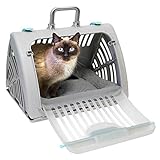
- DESIGNED SPECIFICALLY FOR CATS – PATENTED SIDE-OPENING DOOR - Original SportPet patented wide side-opening door allows cats to walk in naturally reducing fear, stress, and resistance. Ideal for anxious cats, vet visits, grooming, and everyday transport. Veterinarian recommended design for easier handling.
- HARD-SIDED CAT CARRIER WITH COMFORT BED INCLUDED - Includes 1 light gray hard-shell carrier with gray door plus an extra-comfy removable pet bed. Sturdy construction provides a safe, enclosed space cats prefer, while the soft bed adds comfort for travel or waiting rooms.
- TRAVEL-READY & VET VISIT ESSENTIAL - Perfect cat carrier for car travel, road trips, moving, and trips to the veterinarian. Smooth-closing secure door keeps pets safely contained while allowing fast, stress-free loading and unloading.
- EASY TO CLEAN & FOLD-FLAT STORAGE - Wide door opening makes cleaning quick after accidents. Carrier folds down flat for compact storage in closets, cabinets, or vehicles. Machine-washable & dryer-safe bed for hassle-free maintenance.
- IDEAL SIZE FOR LARGE CATS & SMALL PETS - Carrier dimensions: 18.5” L x 15.25” W x 14.25” H. Bed dimensions: 18” L x 13.75” W. Supports pets up to 25 lbs. Works great for large cats, small dogs, and small animals like rabbits, ferrets, and guinea pigs.
Use a seat belt only when the carrier has appropriate crash-test certification and the belt path is approved for that model. Do not assume that threading a belt around any carrier makes it crash-safe. If the carrier is not certified for belt restraint, the floor position is the safer placement described in the 2025 FelineVMA position statement.
- Load the cat before starting the engine and keep doors and windows closed.
- Drive smoothly and avoid loud music, abrupt braking and unnecessary stops.
- Never leave the cat unattended in a parked vehicle. Interior temperatures can become dangerous rapidly, even when the outside air feels mild.
- Keep the carrier closed when moving between the car and the destination. At the clinic, ask staff where you can place it before opening any door.
What to do for veterinary visits and examinations
A top-opening or removable-top carrier can reduce the need to pull a frightened cat through a small front door. At check-in, keep the carrier closed and ask the veterinary team for instructions. Some clinics can examine a calm cat in the bottom half of a hard carrier, which avoids unnecessary lifting.
Tell the veterinary team about any previous escape attempt, severe fear, panting, struggling or motion sickness. They can advise on appointment timing, handling and any medically appropriate pre-visit plan. Do not give a sedative or other medication unless a veterinarian has prescribed and explained it for your cat.
Recognizing distress and deciding when to stop
Minimize the outing if your cat’s fear is escalating. Concerning signs include panting, intense struggling, repeated attempts to escape, frantic scratching, collapse, unusual weakness or other behavior that is clearly different from your cat’s normal response.
Recommended Free Tools
The available guidance supports reducing distress but does not establish universal hoodie-pouch thresholds for weight, duration or a specific number of minutes. Treat any escalating distress as a reason to stop the nonessential outing, move the closed carrier to a quiet secure place and contact a veterinarian for advice. If breathing difficulty, collapse, injury or another apparent emergency occurs, seek urgent veterinary care.
Also popular on Amazon

- Multi-Scenario Safe Travel: Measuring 22.8" L x 14.6" W x 13.4" H, this premium hard shell cat carrier is fully airline approved. It serves perfectly as a cat carrier, dog carrier, cat crate and small dog crate, comfortably holding small pets up to 22 lbs. Suitable for air travel, car rides, vet visits, house moving and daily outdoor outings.
- Full Surround Ventilation: This hard cat carrier is designed with four-sided hollow ventilation to achieve smooth 360° air circulation. The breathable cat carrier hard shell maintains a fresh and cool interior environment, effectively alleviating pets’ travel anxiety and stress during long trips
- Impact Resistant & Durable: Made of high-strength impact-resistant plastic material, this pet carrier features an integral sturdy frame that resists cracking and deformation. It can withstand frequent carrying and bumpy transit, supporting long-term daily and travel use.
- Dual Door & Comfort Handle: Comes with top and front dual-door design, making it convenient to load and unload pets. Equipped with a built-in foldable ergonomic handle for effortless carrying. This portable pet carrier can be stacked neatly to save storage space when not in use.
- Reinforced Secure Lock & Integrated Food Bowl: Adopts reinforced hardware buckles and thickened connection structure to ensure tight closure and prevent accidental separation. This airline approved cat carrier and dog carrier is equipped with an integrated food bowl, great for long-distance travel and outdoor feeding on the go.
If you have no carrier right now
Do not substitute a hoodie pouch for a carrier simply because it is close at hand. For an urgent but non-life-threatening trip, obtain or borrow a proper carrier before leaving. A rigid, clean container with secure ventilation may be used only if a veterinarian or emergency service directs you and the container can be closed without restricting breathing; an improvised open pouch is not equivalent.
For an immediate emergency, call a veterinary hospital or local animal-response service while keeping the cat in the safest enclosed, ventilated container you can secure. Follow their instructions about handling, transport and whether the cat should be moved at all. Keep the container level and supported from underneath.
Can a cat ever sit in a hoodie pouch at home?
Some cats may voluntarily rest in a hoodie pouch while you are seated indoors, but this is a supervised comfort activity, not a transport method. Keep the cat’s face and airway unobstructed, do not tighten or tie the pouch around the neck or chest, and remain ready to support the cat if it shifts. Stop immediately if the cat claws, struggles, pants, tries to climb out or shows other distress.
The Tool Desk
Outbyte Driver Updater FREEScan for outdated or missing drivers - takes under a minuteDriver Scan →Outbyte PC Repair FREEClear out junk files and repair common Windows errorsFree Scan →Do not stand up, walk outside, use stairs, cook, handle hot liquids, carry other heavy objects or perform any activity that could startle or drop the cat while it is in the pouch. Kittens are especially unpredictable and can launch themselves without warning; their small size does not make an open pouch a secure restraint.
A practical pre-trip checklist
- Carrier is the correct size, clean, intact and securely latched.
- Base is firm and lined with washable familiar bedding.
- Ventilation openings are unobstructed.
- Cat has entered voluntarily during prior practice, or a veterinarian has advised on a different safe approach.
- Any optional pheromone product has been used according to its label.
- Route, appointment details and emergency contact information are ready.
- For a car: carrier is on the floor behind a front seat, or a crash-tested carrier is secured with the approved belt path.
- Hands support the underside; the carrier will remain level and closed outdoors.
Bottom line for hoodie-pouch questions
A hoodie pouch is not a safe primary carrier for a cat. It lacks documented escape resistance, structural stability, ventilation design and vehicle-crash protection. Use a sturdy, secure carrier—preferably a hard-sided, top-opening or removable-top model—acclimate your cat gradually, carry it level with support underneath, and place it on the vehicle floor behind a front seat. If your cat becomes severely distressed or appears ill or injured, stop and contact a veterinarian.





Leave a Reply