
Recommended Free Tools
Some links on this page are affiliate links: if you buy through them we may earn a commission, at no extra cost to you.
Do not cut the chain, enter the property, or pick up the puppies. Keep children and pets out of reach, observe from a safe public place, document what you can lawfully see, and contact animal control, a humane society, or a police non-emergency line. If the mother or a puppy is collapsed, bleeding, struggling to breathe, seizing, unable to stand, or facing life-threatening heat or cold, tell dispatch that it is an emergency and contact an emergency veterinary service. Trained responders—not an unplanned citizen rescue—should handle access, capture, transport, and veterinary triage.
Why a chained nursing dog needs prompt attention
A tether can prevent a mother from moving away from danger, reaching shade or water, settling comfortably with her litter, or defending herself when another animal or person approaches. It can also wrap around her neck, legs, a post, or the puppies. A frightened mother may react defensively because she cannot retreat.
As an Amazon Associate I earn from qualifying purchases.
Quick wins for a faster PC:
Clear out junk files and repair common Windows errorsFree Scan →Scan for outdated or missing drivers - takes under a minuteDriver Scan →Repair Windows errors before they cause bigger problemsFix Now →Ontario’s outdoor-animal standards prohibit tethering a dog that is “whelping” or “nursing.” Ontario’s public guidance explains: “Tethering a dog that is whelping or nursing may limit its ability to protect itself and its puppies and provide proper care.” The same standards require any permitted tether to allow safe movement, avoid discomfort or injury, have swivels at both ends, and prevent escape. These are Ontario rules, not a universal code; your local law may differ.
A nursing family needs more than a bowl and a box. The mother needs clean drinking water, species-appropriate food, a dry and weather-protective sleeping area, clean bedding, shade or warmth suited to conditions, parasite control, and prompt veterinary care for illness or injury. UK statutory guidance says each dog needs a clean, comfortable, warm sleeping area free from drafts. It also says puppies should remain with their biological mother for the first eight weeks unless a documented health or welfare reason requires separation. That does not authorize a bystander to move the family; it explains why casual removal of one puppy can create a welfare problem.
Popular on Amazon

- 【Durable Construction】Our dog crate is made of sturdy, rust-resistant metal wire, making it durable and able to handle energetic puppies. Its durable design makes it resistant to deterioration, giving it a dependable option for extended usage.Dog cage dog crate dog kennel
- 【Leak-Proof Plastic Tray】This dog crate features a detachable, leak-proof plastic tray that runs the length of the crate, making cleanup simple in the event of an accident. For dog dishes that won't slip, look for a textured surface.Dog cage dog crate dog kennel
- 【Double Door Convenience】There are two ways to enter our dog crate: the front entrance and the side door. Numerous ways to enter and exit this dog kennel are available. When putting the crate in confined areas where a front door can be blocked or for anxious dogs who might prefer a side entry, this is really useful.Dog cage dog crate dog kennel
- 【Easy To Set Up】Any dog lover should own one of these crates. You don't want to be spending a lot of time while on vacation, therefore it's crucial that our puppy playpen is easy to put together and take down. Metal dog cage canine kennel with handle for dogs.Dog cage dog crate dog kennel
- 【After-Sale Service】Please feel free to contact our customer service if you have any questions or have any issues with the dog crate while using it. We guarantee that you will receive the finest solution and the most expert technical assistance. Dog cage dog crate dog kennel
What to do first: create distance and assess from safety
Keep everyone out of reach
- Move children, visitors, and your own pets away from the fence or property line.
- Stay outside the dog’s reach. Do not reach through a fence, lean over a gate, stare at the mother, shout, or touch the puppies.
- Do not offer food by hand, grab a collar, pull a puppy away, use a catch pole, or test whether the dog is friendly.
- Never trespass, open a gate, release a tether, cut a chain, or cut a padlock unless an authorized responder directs a trained action.
A wagging tail is not a safety guarantee. Pain, injury, sickness, strangers, unfamiliar places, crowds, loud noises, and unexpected touching can trigger aggression. A tether removes the mother’s ability to retreat, increasing the chance that warning behavior becomes a bite.
Look for urgent signs without approaching
From a distance, note whether the chain or collar is tight, embedded, wrapped around an object, or creating a strangulation risk. Look for heavy bleeding, labored breathing, collapse, a seizure, inability to stand, severe weakness, repeated vomiting or diarrhea, extreme thinness, or exposure to dangerous heat or cold. Observe the puppies for cold bodies, separation from the mother, or signs that they are not nursing. You do not need to diagnose the cause; you need to describe what you can see accurately.
How to document the situation lawfully
Good observations help responders decide how quickly to attend and prepare the right equipment. From a public place, record:
- the exact address or location and the date and time;
- the number of adult dogs and puppies;
- weather, temperature conditions as you perceive them, shade, sun, wind, rain, snow, or flooding;
- the chain’s apparent length, what it is attached to, and any visible entanglement;
- whether clean water, food, dry bedding, and weather-protective shelter are visible;
- visible injuries, a tight or embedded collar, extreme thinness, lethargy, or abnormal breathing; and
- anything that creates an immediate hazard, such as traffic, another attacking animal, or a structure that could collapse.
Photographs or video can be useful when taken from a lawful location and without provoking the dogs. Do not trespass for a better angle, enter a yard, call the dogs toward you, rattle the fence, or repeatedly return if doing so escalates the mother’s distress. Preserve the original files and note when and where each was made. Share them with the responding authority rather than posting identifying material publicly.
Also popular on Amazon

- 【Indestructible & Safe】Upgraded 20-gauge steel frame and reinforced 0.5-inch-diameter steel tubes make our metal dog crate much sturdier than others. Double sturdy slide bolt laches can ensure ultimate security. All of these make our dog cage chew-proof and escape-proof. It is perfect for large, strong, and separation anxiety dogs.
- 【Durable & Reliable】Featuring a long-lasting and non-toxic hammer-tone coating that resists rust and corrosion, making the kennel perfect for both indoor and outdoor use. More importantly, because of the non-toxic finish, it is safe for the dog even if the dog bites or licks the cage frame.
- 【Easy To Feed and Clean】Wide Opening Double Doors with low thresholds are not only for easy access but also allow you to interact with and feed the dog conveniently. The removable Dog crate Tray and Leak Proof Plastic Pan will not only make your home clean but also make you clean up simply and quickly.
- 【Easy to Assemble, Store, and Transport】Most of this heavy-duty kennel has been pre-assembled, so you can easily set up the cage by one person within 10 minutes. In addition, 360-degree swivel caster wheels with brakes make it easy and safe to roll around.
- 【MONEY BACK GARNTTEE】We are committed to providing our customers with safe and comfortable products. We are guaranteed one year warranty from the date of purchase and lifetime customer service support for rest assured. If there is any problem with the dog kennel, please contact us directly for a free replacement.
Who to call and what to say
- Contact the local authority with jurisdiction. Start with municipal or county animal control, a humane society that handles cruelty reports, or the police non-emergency line. If you are unsure which agency responds in that area, the police non-emergency operator can usually direct you.
- Lead with the highest-risk fact. Say that a nursing mother and puppies are tethered, then describe any medical emergency, dangerous weather, entanglement, absent water, unsafe shelter, or visible injury.
- Give a precise location and access details. Include the address, a safe observation point, gate or fence information visible from public space, and whether anyone is present.
- Ask for an incident number and next steps. Record the agency, staff member or dispatcher name if provided, time of the call, incident number, and whether you should remain available for photographs or a statement.
- Follow up without confronting the owner. If the danger continues, provide new observations to the same authority. Do not threaten, argue with, or attempt to negotiate a release directly with the owner.
Suspected cruelty can include failure to provide food, water, shelter, or veterinary care. Reporting professionals assist law enforcement; they do not have to prove guilt themselves. Describe observable facts and avoid asserting a legal conclusion you cannot establish.
When the call is an emergency
Tell dispatch immediately if the mother or a puppy is collapsed, bleeding heavily, struggling to breathe, seizing, unable to stand, or otherwise in immediate danger. Life-threatening heat or cold exposure also warrants emergency escalation. Ask the authority to coordinate with an emergency veterinarian when appropriate.
Do not delay a call while trying to free the dog. A bite, a runaway mother, or an entangled puppy can turn one emergency into several. Keep the public area clear so responders can work, and follow their instructions about where to wait.
Why cutting the chain or moving the puppies can make things worse
The mother may defend the litter
Protective behavior can include crouching, a lowered head, lip licking, flattened ears, yawning, turning away, trying to retreat, growling, lunging, snapping, or repeatedly hitting the end of the chain. The quieter signals are warnings, not invitations to approach. If the mother stiffens, growls, snaps, lunges, or repeatedly strikes the end of the tether, increase your distance and call for help.
Also popular on Amazon

- 【 Ultimate Escape-Proof Dual-Lock System】Stop worrying about "prison breaks." Our 2026 Upgraded Heavy Duty Dog Crate features a reinforced anti-tamper locking mechanism that high-intelligence breeds like German Shepherds or Rottweilers simply cannot manipulate. Designed specifically for High Anxiety Dogs, the multi-point deadbolt system ensures the door remains unyielding even against heavy impacts or persistent pawing, providing you with 100% peace of mind.
- 【 Paw-Safe "Zero-Gap" Design】Safety is in the details. Unlike traditional dog crates with wide floor gaps that cause pinched paws or interdigital dermatitis, our dog crate utilizes an optimized narrow-grid floor that supports your pet’s weight evenly. This heavy-duty indoor cage is built to hold up to 300 lbs, offering a stable, comfortable surface that protects joints and prevents injuries for large, powerful breeds.
- 【 Eco-Tech Non-Toxic Nano-Coating】Health is the new luxury. Our crates are finished with a 2026 SGS-Certified Nano-Powder Coating that is completely lead-free and non-toxic, making it safe for aggressive chewers. This rust-resistant finish is not only durable against "power chewers" but also weather-resistant for outdoor use, ensuring the sleek silver or black industrial aesthetic never fades or flakes into your pet's food.
- 【 Silent-Glide Mobility & Deep-Clean Tray System】 Moving a heavy metal dog cage shouldn't be a workout. Equipped with 360° silent-swivel lockable wheels, this crate glides effortlessly across hardwood floors without leaving scratches. The upgraded extra-deep leak-proof tray captures fur, dander, and accidents more effectively than standard trays, allowing for a 30-second cleanup that keeps your home smelling fresh and looking spotless.
- 【 Panoramic Sky-Light & Stress-Reduction Roof】Transform a "cage" into a "den." The unique flip-top panoramic roof allows for easy interaction and top-loading feeding, significantly reducing confinement-induced stress. This modern, furniture-style industrial design blends seamlessly into your living room decor, removing the "jail cell" look while providing your dog with a ventilated, high-visibility safe haven they will actually love to stay in.
A release can create an uncontrolled dog
Cutting a tether may send a frightened mother into traffic, neighboring yards, or a confrontation with another animal. A loose chain can catch on legs or objects. Reaching for a collar can put your hands within bite range, and separating a puppy can trigger a defensive response. Even a well-intentioned person cannot reliably assess disease exposure, postpartum complications, dehydration, or the safest transport arrangement from outside the property.
Do not improvise capture equipment
Catch poles, makeshift loops, blankets, and food lures can injure a dog or intensify panic when used by someone without training. Do not attempt them because a responder is delayed. Give dispatch a new update if the condition changes and wait at a safe distance.
Free tools Windows power users keep installed
One-click scans. No signup required.
How trained responders generally handle removal
Rescue practice described by the ASPCA follows a controlled sequence: document the animals and conditions, obtain clearance for removal, use low-stress handling, and place removed dogs into an appropriately sized kennel for transport. This is a model for trained responders, not a do-it-yourself extraction plan.
When responders arrive, tell them exactly what you observed and show them the lawful photographs or video. Let them decide who enters, how the tether is secured, whether the mother and puppies move together, and what protective equipment is needed. A secure wire crate or transport kennel can support removal only after responders authorize and manage that step. Keep bystanders back and do not crowd the kennel or attempt to comfort the mother during loading.
Also popular on Amazon

- 48-inch dog crate for pets under 46 x 28.5 inches (LxH), like a Bernese, Labrador, Rottweiler, or Great Dane
- Durable metal wire construction with manual door locking mechanism for secure containment ;2 doors (front and side) and a divider for adjusting the internal space
- Sets up quickly and folds down flat for easy transport or compact storage; top handle for comfortable carrying ; Removable plastic base tray for easy cleaning; Fasten the bar buckle in front of the tray after installing the tray
- Metal hook at the bottom of the crate to prevent plastic tray from moving out. Please lock the hook well after installing the tray everytime in daily use
- Product Dimensions: 48 x 30 x 32.5 inches (LxWxH)
Protecting the mother-and-puppy unit
Unless a veterinarian directs separation, the family should be assessed and managed together. Do not give away puppies, take one home “temporarily,” or place them in separate households on your own. The mother and litter need coordinated examination, parasite and infectious-disease assessment, and a clean, safe whelping area.
Separation may be medically necessary in an individual case, but that decision belongs to a veterinarian or authorized welfare professional who can provide warmth, feeding, infection control, and monitoring. Puppies’ first eight weeks with their biological mother are the normal welfare expectation in the UK guidance cited above, subject to a documented health or welfare reason for earlier separation.
What’s actually slowing this PC down?
Pick the symptom - the matching free tool is one click away.
What adequate care looks like while help is pending
You should not enter the property to supply care unless the owner or an authorized responder lawfully asks you to do so. Instead, report each missing element clearly:
| Need | What you can observe from a safe distance | Why it matters |
|---|---|---|
| Water | Whether a clean, reachable container is visible and appears to contain water | Nursing, heat, illness, and exertion can increase dehydration risk. |
| Food | Whether species-appropriate food is present and accessible to the mother | A nursing mother has substantial nutritional demands. |
| Shelter | Dry, stable, weather-protective space with shade or warmth as conditions require | Drafts, precipitation, heat, and cold can endanger both mother and puppies. |
| Bedding | Whether bedding appears clean and dry rather than soaked or heavily soiled | Wet or contaminated bedding increases discomfort and disease concerns. |
| Mobility | Whether the tether permits safe movement without pulling, wrapping, or trapping | Entanglement and pressure injuries can become emergencies. |
| Health | Breathing, posture, alertness, visible wounds, body condition, and puppy nursing | These observations help triage without requiring a diagnosis. |
Responsible-care criteria also include veterinary care, parasite control, exercise, social interaction, hazard reduction, and prompt treatment for illness or injury. Report what is visibly absent or unsafe; do not attempt to provide it by crossing the boundary.
Also popular on Amazon
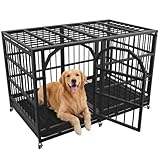
- Heavy Duty Dog Kennel: This xl dog crate is constructed from corrosion-resistant, thickened square tubular steel, featuring a robust rectangular frame structure. The base is reinforced with 6 additional straight tubes, providing load-bearing capacity. Precision welded joints offer extra security, enabling thisbig dog cage to withstand the impact and gnawing of medium to large breeds
- Extra Large Dog Crate Dimensions: External: 47.2''L x 28''W x 31''H (including wheel height); Internal: 46''L x 27''W x 25''H. Spacious interior accommodates medium to large breeds' lying down and turning needs without causing confinement stress
- Dog Crates for Large Dogs: This high anxiety dog crate features a low-threshold front door for easy access to your dog and for you to interact with and feed it anytime. The front door is also equipped with 2 stainless steel anti-collision locks to prevent your dog from escaping
- Large Dog Crate with Wheels: The indestructible dog crate features a foldable design with most components pre-assembled, Simply tighten the parts to complete setup or disassembly effortlessly by one person. The heavy duty dog kennel is equipped with 360° swivel casters for effortless mobility, it includes a locking mechanism to securely lock the wheels for enhanced stability
- Easy to Clean:The impact metal dog crate has two pull-out leak-proof trays underneath the grate on the bottom of the cage to collect dropped dirt. Simply pull out and rinse for quick, effortless cleaning.
Legal rules depend on your location
Tethering law is local. Ontario’s standards prohibit tethering a whelping or nursing dog and specify equipment and movement requirements for permitted outdoor tethering. Massachusetts law limits how long a dog may be chained and requires suitable equipment, clean water, and protective shelter. These examples illustrate why the mother’s nursing status matters, but neither substitutes for the rule in your city, county, state, or province.
| Jurisdictional example | Relevant point | How to use it |
|---|---|---|
| Ontario | Outdoor tethering is prohibited when a dog is whelping or nursing; permitted tethering must allow safe movement, avoid injury, use swivels at both ends, and prevent escape. | Tell Ontario animal-control staff that the dog is nursing and describe any equipment failure or injury. |
| Massachusetts | State law limits chaining duration and requires suitable equipment, clean water, and protective shelter. | Report the duration if known and describe water, shelter, and equipment conditions. |
| Other locations | Requirements, enforcement authority, emergency contacts, shelter capacity, and veterinary protocols vary. | Ask the local animal-control or police dispatcher which standard and agency apply. |
Choosing the safest response
Use these decision factors in order: immediate danger, distance and bite risk, welfare of the mother and puppies, legal authority to enter or remove, veterinary urgency, and the ability to transport securely.
| Option | Appropriate when | Main risk or limitation |
|---|---|---|
| Observe, document, and report | No immediate life-threatening sign is visible and you can remain outside reach. | Requires accurate notes and follow-up while the authority responds. |
| Emergency dispatch and veterinary coordination | Collapse, heavy bleeding, breathing difficulty, seizure, inability to stand, or life-threatening heat or cold is present. | Do not attempt parallel handling; keep the scene clear for responders. |
| Owner conversation | Only when an authority or trained professional has assessed that it is safe and lawful. | Confrontation can escalate risk and does not replace an official welfare response. |
| Citizen release or transport | Not a safe default. | Potential bites, escape, injury, disease exposure, unlawful entry, and separation of the litter. |
In most cases, the safest option is the one that brings trained animal-control or veterinary responders, preserves evidence, and avoids forced handling.
Follow-up after you report
- Keep the incident number and the agency’s instructions.
- Write down any change in weather, water, shelter, entanglement, injuries, or the puppies’ condition.
- Send new evidence through the agency’s requested channel; do not repeatedly approach the property.
- If no response arrives and danger remains, call back with the incident number and state precisely what has changed.
- If a bite occurs, seek medical care and report the bite to the appropriate authority; do not pursue the dog.
No universal rescue procedure can replace an on-site assessment. Disease-control rules, shelter space, emergency contacts, and veterinary availability differ by location, so responders may give instructions that are more specific than this general safety guidance.
Why this problem deserves attention
The ASPCA reported 680 documented animal-welfare violations at USDA-licensed commercial dog-breeding facilities in 2025, in a 2026 report. The reported violations included dogs suffering illness or injury without veterinary care, lack of access to water, and unsanitary conditions. That figure concerns licensed commercial facilities, not every chained dog, but it illustrates why visible water, shelter, sanitation, and veterinary-care failures should be reported rather than dismissed.
The safest next move
Stay outside the tether’s reach, keep others away, record lawful observations, call the authority with jurisdiction, and escalate immediately for medical danger. Do not cut the chain or remove a puppy. Let trained responders secure the mother and litter, arrange veterinary assessment, and decide whether and how they can be moved together.
The Tool Desk
Outbyte PC Repair FREERepair Windows errors before they cause bigger problemsFix Now →Outbyte Driver Updater FREEScan for outdated or missing drivers - takes under a minuteDriver Scan →




Leave a Reply