
Outdated Drivers Are Slowing You Down
One free scan finds every outdated or missing driver and matches the right update for your exact hardware.Free scan · exact hardware matchPC Slower Than It Used to Be?
A free scan shows the junk files, broken settings and background clutter dragging Windows down - then fixes them in one click.Free scan · Windows 10 & 11Some links on this page are affiliate links: if you buy through them we may earn a commission, at no extra cost to you.
Socialize a shy shelter dog through voluntary, low-pressure exposure—not forced greetings. Give the dog a quiet retreat and predictable routine, work below the point where fear appears, pair each manageable sight or sound with small high-value treats, and let the dog decide whether to come closer. Increase difficulty only while the dog remains loose, can eat, and recovers quickly; if fear rises, add distance or end the session.
What socialization should accomplish
Socialization is not making a dog accept every person, dog, place, or touch. It is teaching the dog that unfamiliar experiences are predictable and that they have safe choices. A successful session may be as modest as watching a visitor from behind a gate, eating a treat while a leash lies across the room, or sniffing a quiet sidewalk before returning home. The dog does not need to greet anyone to be learning.
As an Amazon Associate I earn from qualifying purchases.
What’s actually slowing this PC down?
Pick the symptom - the matching free tool is one click away.
Fear reduces a dog’s ability to learn. A frightened dog may freeze, hide, scan, pant, tremble, growl, snap, lunge, or refuse food. At that point, staying near the trigger is not productive exposure. ASPCApro’s practical sequence is to watch body language, begin at a level the dog can handle, toss or drop treats, wait for the dog to seek attention, repeat regularly, and “Never force contact.”
Use the same principle with adults, children, dogs, handling, household noises, car rides, veterinary equipment, and outdoor environments: control the intensity, preserve an escape route, and reward the dog for choosing calm behavior.
Popular on Amazon

- Age Range Description: All Stages
- Included Components: Pet Botanics Training Rewards Bacon
- Made In The Usa
- Made With Real Pork Liver; Healthy And Nutritional
Start with decompression and a safe base
The first days after adoption are for recovery and observation, not a parade of introductions. A shelter dog has experienced transport, kennel noise, unfamiliar handling, and a new home in a short period. Some dogs appear quiet at first and show fear only after they begin to feel secure enough to express it.
Set up one predictable retreat
- Choose a quiet room or a gated section of the home with a bed, water, and safe hiding options.
- Keep the dog’s food, resting place, and bathroom routine as consistent as possible.
- Prevent visitors, rough play, and competing demands while the dog learns the household.
- Allow the dog to leave an interaction. Never block the retreat, reach into a hiding place, or pull the dog out.
- Use a baby gate or exercise pen to create distance from people; it is management and choice, not punishment.
Move calmly and speak softly. Avoid looming over the dog, prolonged staring, sudden reaching, cornering, or trying to coax the dog into your lap. Sit or stand sideways rather than facing the dog head-on. You can read, work, or sit quietly while the dog observes without being addressed.
The Tool Desk
Outbyte PC Repair FREERepair Windows errors before they cause bigger problemsFix Now →Outbyte Driver Updater FREEScan for outdated or missing drivers - takes under a minuteDriver Scan →Keep early routines boring and repeatable
Feed, toilet, rest, and walk at roughly predictable times. Sleep is behavior treatment: an exhausted or constantly interrupted dog has less capacity to cope. Keep the first outings short and quiet. If the dog is not yet comfortable wearing a collar, harness, or leash, practice indoors before expecting a neighborhood walk.
Read the dog’s threshold before adding a challenge
Threshold is the point at which a trigger is strong enough to produce a fear response. Distance, movement, noise, duration, and the number of people all change the intensity. A dog may eat and sniff with one calm adult 30 feet away but freeze when that adult stands up at 15 feet. Plan around the easiest version the dog can handle.
| What you see | What it usually means | What to do |
|---|---|---|
| Loose muscles, normal breathing, soft eyes, sniffing, choosing to look away, taking treats | The dog is within a workable learning range. | Keep the setup the same or make only one tiny change. |
| Turning away, lip licking, yawning, crouching, scanning, moving behind you, slower eating | Stress is increasing, even if there is no growl. | Pause, increase distance, reduce movement or duration, and let the dog recover. |
| Freezing, hiding, trembling, frantic panting, growling, snapping, lunging, or refusing a normally valued treat | The dog is overwhelmed and cannot learn effectively. | Stop the exposure and create distance. Do not punish or insist on contact. |
Treat refusal is useful information, not stubbornness. If a dog that normally eats soft treats will not take one, the trigger may be too close, too intense, or present for too long. Back up until the dog can eat and orient to you again. ASPCA guidance says to back off when fear appears and never force a fearful dog to remain near a trigger.
A step-by-step socialization plan
1. Observe and choose one target
Write down what the dog fears and the easiest version of that trigger. “People” is too broad; “a seated adult in a quiet room” is workable. “Leashes” can be divided into a leash lying still, a person picking it up, the leash moving, touching the harness, and clipping it on. Change one variable at a time.
Also popular on Amazon

- Lots of flavor, not fillers: Just three simple, all-natural ingredients mean low calories and high nutritional value, making a tasty but healthy treat that your pup will actually love
- Ready for training, wherever you are: The best training is consistent training. Our small treats are lightweight and perfectly sized for quick rewards so they are ready to go whenever there is a training opportunity
- Mess free treats: No oily, greasy, crumbly messes here, Pupford treats keep your hands and pouches clean. You can even keep some in your pocket for walks, classes, or mini adventures without worrying about them getting grimy or stale
- Motivate even the pickiest of pups: A wide range of flavors makes it easy to find the perfect fit for your pup’s tastes
- Pupford Promise: We strive to always provide simple, high-quality, healthy pup essentials. If you or your pup aren't happy with a purchase, let us know so we can help find the right fit!
2. Pair the trigger with food without pulling the dog toward it
When the person, object, or sound appears at a safe distance, toss a small, soft, high-value treat away from the trigger. The dog can eat and retreat instead of being lured into a greeting. Repeat only while the dog remains relaxed. If the dog will not eat, make the trigger easier.
3. Reward voluntary attention
Reinforce a glance, orienting toward you, sniffing, relaxed body movement, or a choice to approach. Keep your hands still. Pet only after the dog repeatedly solicits contact by moving toward you, leaning in, nudging, or returning for more. One brief stroke followed by a pause lets the dog opt in again.
4. Build a gradual ladder
List steps from easiest to hardest and practice each step over multiple short sessions. For a visitor, the ladder might be a person outside the home, a person entering and sitting sideways, the person standing, a quiet walk past the gate, and eventually a brief treat toss from closer range. For handling, progress from seeing a brush, to the brush moving, to touching the shoulder, to one stroke, always returning to an easier step if tension appears.
5. Use desensitization and counterconditioning
The American Animal Hospital Association defines desensitization as presenting a trigger below the level that causes the unwanted response and gradually increasing intensity. Counterconditioning pairs that trigger with something positive so the emotional response can change. Both fail when the trigger is suddenly overwhelming. Keep the dog under threshold rather than testing how much fear they can endure.
Free tools Windows power users keep installed
One-click scans. No signup required.
6. End while the dog is still successful
After several calm repetitions, remove the trigger, offer water and rest, and stop. Do not continue because the dog “is doing well” until the dog shuts down. Shelter protocols described by the American Veterinary Society of Animal Behavior combine enrichment, gradual people, leash, and handling work, positive reinforcement, and veterinary oversight; they are principles, not a guaranteed calendar for every adoption.
7. Generalize one variable at a time
A dog comfortable with one quiet adult may not be ready for a group, a child, a busy sidewalk, or a dog park. Change only one of these at once: person, distance, location, movement, sound, or duration. If you move from the living room to a porch, return to an easier distance and shorter session.
Also popular on Amazon

- GRAIN-FREE PUPPY TREATS: These bite-sized, soft puppy training treats are the perfect reward during training sessions or any time you want to thank your dog for good behavior. Puppy bites contain 6 calories per individual treat!
- SUPPORTS BRAIN DEVELOPMENT: Soft dog treats are crafted with salmon, a healthy source of DHA to promote healthy brain development.
- HEALTHY INGREDIENTS: These treats for dogs are made with minimal ingredients focused on quality proteins: made with lamb and salmon, with added vitamins specifically for puppies.
- NO CORN, WHEAT, OR SOY: Treats for dogs do not contain wheat, wheat gluten, corn, soy, or artificial colors.
- MADE IN USA: Our dog treats are quality-assured, made in USA, and crafted from the finest globally-sourced ingredients. Treats are tender, healthy, and bite-sized for small, medium, and large dogs of all lifestages, and activity levels.
How to introduce visitors safely
- Ask visitors to text rather than knock repeatedly. Before they enter, put the dog behind a gate or in the retreat area with water and a chew if the dog can eat calmly.
- Have the visitor sit sideways, avoid eye contact, keep hands still, and ignore the dog. No calling, reaching, photographing at close range, or attempts to pet.
- From a distance, the visitor can toss treats past the dog or to the side, allowing the dog to eat and move away. Do not use food to draw the dog into touching.
- Let the dog choose whether to watch, sniff, or approach. If the dog approaches, the visitor should remain still and wait for repeated solicitation before offering one brief touch.
- End the visit at the first signs of rising stress. For some dogs, observing from behind a gate is the complete session.
Children require stricter management because their movement and voices are difficult for a fearful dog to predict. Keep child and dog separated unless an experienced adult can control distance and the child can follow instructions. Never allow a child to hug, corner, climb on, or take food from a fearful dog.
Leash, handling, and household-sound practice
Leash and harness
Begin with the equipment visible at a distance while treats appear. Next reward looking at it, the person picking it up, moving it, touching the harness, and bringing it near the body. Clip it only when the dog stays comfortable, then remove it and rest. An escape-resistant harness and a long line can support controlled outdoor exposure after the dog is gradually conditioned to wearing them. Equipment prevents accidents; it must never be used to drag a dog toward a person, dog, or object.
Quick wins for a faster PC:
Scan for outdated or missing drivers - takes under a minuteDriver Scan →Clear out junk files and repair common Windows errorsFree Scan →Touch and veterinary handling
Practice one body area at a time. Touch the shoulder for a second, feed, and stop. Later progress to ears, paws, collar, brushing, and lifting only when each earlier step is easy. Do not restrain a panicking dog for routine practice. Tell the veterinary team about the dog’s responses and ask for low-stress handling and an appointment plan.
Noises and movement
Play a household sound at barely audible volume or create the movement at a large distance. Pair it with food, then stop. Increase volume, speed, or proximity in tiny increments on separate days. A vacuum cleaner, dropped object, doorbell, or person standing up can each be trained as its own trigger.
Meeting other dogs and exploring outdoors
Do not begin with a crowded dog park or uncontrolled greetings. Start where the dog can see a calm, compatible dog at a distance and still eat. Walk parallel with ample space, allowing either dog to look away or sniff. Gradually reduce distance only when both remain loose and recover quickly. A neutral dog is a better teacher than an exuberant or highly reactive one, and a professional should guide introductions when either dog has a bite history.
Outdoor progress can be measured in small pieces: standing near the open door, stepping onto a quiet porch, walking to the end of the driveway, and returning home. Keep sessions short. If traffic, people, or dogs make eating impossible, leave and try a quieter time or location. A long line is useful only where legal and safe, with a secure harness and a handler prepared to prevent escape.
Also popular on Amazon
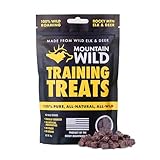
- Wild-Sourced Protein: Our treats are made from all-wild roaming elk and deer protein, sustainably harvested from the Rocky Mountains, offering your dog a unique and premium nutritional experience Wild-Sourced Protein: Our treats are made from all-wild roaming elk and deer protein, sustainably harvested from the Rocky Mountains, offering your dog a unique and premium nutritional experience
- Ideal for Training: With a wild protein source that dogs instinctively crave, these training treats are recognized as an extremely high-value reward, boosting your dog’s attention, focus and motivation
- Pure & Natural: Embrace the wilderness with dog training treats that are all-natural and all-wild, meeting your dog's ancestral dietary needs and cravings for a healthy and active lifestyle
- Eco-Conscious Choice: With every purchase, you support the full utilization of precious wildlife resources along with wildlife conservation and anti-poaching efforts to help maintain strong wildlife populations
- Clean Recipe: Free from nasty fillers, artificial preservatives, and grains, our treats ensure your dog enjoys the healthiest reward. Perfect for dogs of all sizes and puppies too
Useful equipment and how to choose it
| Option | Useful for | Safety and decision points |
|---|---|---|
| Small, soft, high-value treats | Tossing, rewarding voluntary behavior, and counterconditioning. | Use pieces small enough for many repetitions. If the dog will not eat, lower the trigger intensity rather than offering more exciting food. |
| Stuffable food puzzle | Enrichment and pairing a manageable difficult situation with food. | Optional. Highly anxious dogs may not eat; never leave a puzzle as a substitute for reducing fear or providing a retreat. |
| Escape-resistant harness and long line | Controlled outdoor exposure after equipment conditioning. | Check fit and local rules. The dog must be able to increase distance; never pull toward a trigger. |
| Baby gate or exercise pen | Separating dog and visitors while preserving visual access and an exit. | Use as management, not punitive confinement. Ensure the dog has water, bedding, and a hiding option. |
Compare any plan or product by six questions: Can the dog choose distance? Can you deliver reinforcement without reaching? Does it prevent escape and injury? Can you control trigger intensity? Can you stop immediately? Is qualified help available if progress stalls?
How long does trust and socialization take?
There is no universal timeline or success percentage for a shy shelter dog. Fear intensity, past experiences, health, environment, learning history, and household consistency all matter. A dog may show meaningful improvement in days, while another needs many weeks or longer for handling, visitors, or outdoor environments.
Measure change by function rather than a deadline for becoming outgoing. Useful signs include eating in more settings, recovering faster after a surprise, exploring farther, resting openly, sleeping normally, choosing to approach, and returning to a safe behavior after a trigger passes. Keep a brief log of the trigger, distance, body language, whether food was accepted, and recovery time. If two sessions become harder, return to the last easy step rather than pushing through.
Common mistakes that increase fear
- Flooding: bringing the dog into a crowded room, busy street, or group of dogs before the dog has coping skills.
- Forced contact: holding the dog for petting, dragging them toward people, blocking retreat, or using a treat to lure them into a touch they would otherwise avoid.
- Punishing communication: scolding a growl, snap, or bark without changing the trigger. Cornell University College of Veterinary Medicine warns, “Punishment should not be used [with a fearful dog] because it may exacerbate the fear and lead to other behavior issues.” Punishment can suppress warning signals without making the underlying fear safer.
- Changing too much at once: moving closer while adding a new person, a new location, and more movement.
- Practicing past the recovery point: continuing after the dog stops eating, freezes, or hides.
- Assuming a shelter test predicts home behavior: treating one assessment as a permanent personality label.
Use shelter information, but expect behavior to change
Ask shelter staff what they observed with unfamiliar adults, handling, leash pressure, food, other dogs, noises, and veterinary care. Ask whether the dog has lived in a foster home and what situations caused avoidance or recovery. ASPCA guidance recommends gathering as much information as possible while recognizing that a single assessment can be biased or miss subtle fear.
Recommended Free Tools
The shelter setting and the home are different contexts. A dog may appear shut down in a kennel, then become more active after decompression; another may seem social in a quiet meet-and-greet and later react to household sounds or visitors. Treat staff observations as clues for your starting plan, not proof that the dog will respond identically everywhere.
When a veterinarian or behavior professional is needed
Arrange a veterinary examination when fear appears suddenly, the dog cannot eat or sleep, handling is impossible, or behavior changes without an obvious environmental explanation. Pain, illness, sensory loss, and medication effects can contribute to avoidance or irritability.
Also popular on Amazon

- BIG MOTIVATION IN EACH MINI BITE. Each of these 1.5 calorie treats are packed with flavor from pork liver, real bacon, and added botanicals that will keep dogs focused and eager to learn
- TRAIN. ENRICH. TREAT. These low calorie training rewards are great for training sessions, enrichment activities such as puzzle toys and snuffle mats, and every day treating occasions
- GREAT FOR SMALLER DOGS. These bite-sized treats are the perfect size for training and every day treating for smaller dogs. Each 10 oz bag includes approximately 500 treats
- REWARD THE EVERYDAY Pet Botanics healthy training rewards are perfect for training and treating every day in every way. These soft & chewy treats have no artificial flavors, colors or preservatives
- PROUD MEMBER THE CLOUD STAR FAMILY. With Cloud Star products, you can spend less time worrying about what to feed your pet and spend more time Living Life with Your Dog by Your Side
Seek help promptly for severe fear, aggression, self-injury, repeated escape attempts, or stalled progress despite careful management. Appropriate specialists include a certified applied animal behaviorist, a board-certified veterinary behaviorist, or a trainer experienced with fear and reward-based methods. Ask exactly what methods they use; avoid anyone who recommends intimidation, leash corrections, shock, flooding, or dominance-based handling for a fearful dog.
ASPCA and the American Veterinary Society of Animal Behavior describe medication as a veterinary decision that may be combined with enrichment and behavior modification. Medication can lower distress enough for learning, but it is not a stand-alone socialization plan and should never be started, stopped, or adjusted without the prescribing veterinarian.
Do these 3 things before closing this tab:
1Clear out junk files and repair common Windows errors2Fix the driver behind crashes, sound loss and screen glitches3Repair Windows errors before they cause bigger problemsTroubleshooting by symptom
The dog hides whenever someone enters
Keep the dog behind a gate with a retreat, ask the visitor to ignore the dog, and toss food away from the visitor only if the dog can eat. Shorten visits or have visitors remain outside until the dog can observe without hiding. Do not reach into the hiding place.
The dog takes treats but will not approach
That is still progress. Continue rewarding calm observation and voluntary orientation. Increase distance if the dog is stretched forward, darting in and out, or unable to settle. Approaching is optional; eating safely is the current skill.
The dog growls when touched
Stop touching and give distance. A growl is information that the interaction is too difficult or painful. Arrange a veterinary check, then rebuild handling from a visible hand or brief touch paired with food under professional guidance. Never punish the growl.
The dog was calm yesterday but panics today
Check sleep, pain, appetite, weather, noise, trigger distance, and what happened immediately before the session. Fear learning is not linear. Return to an easier step, provide rest, and avoid interpreting one difficult day as failure.
The dog cannot eat outdoors
Move to a quieter location, shorten the outing, increase distance from people or dogs, or practice at the doorway first. If the dog still cannot eat or recover, pause exposure and consult a professional rather than escalating the challenge.





Leave a Reply