If your dog growls, stiffens, or snaps when someone comes near its food bowl, the first priority is safety: keep people and children away from the dog during meals, stop any action that provokes the dog, and get a veterinary check and a qualified behavior professional involved. Prevention exercises can help a dog that is only showing subtle signs of guarding, but they are not a treatment for a dog that is already aggressive.
What food guarding looks like
Food guarding is one form of resource guarding, in which a dog tries to keep exclusive access to something it values. Food is the most common target, but the same pattern can appear around chews, toys, favorite spots, or even people. The Veterinary Centers of America (VCA) describes food-related aggression as aggressive behavior that appears when a dog is approached while eating, and notes that resource guarding more broadly covers any attempt to maintain exclusive possession of something valuable.
Guarding usually starts quietly. The American Veterinary Society of Animal Behavior (AVSAB) describes these early signals:
- Freezing while eating or when a person approaches
- A hard or sidelong stare at the person approaching
- Eating faster than usual
- Lowering the head close over the food
As the dog becomes more uncomfortable, signs escalate to a quivering lip, growling, showing teeth, snapping, and biting. The American Kennel Club (AKC) also lists stiffening, whale eye (the whites of the eyes showing), and lip lifting as warning signs. Any of these deserves attention, because a dog that is growling has already told you it is uneasy. Punishing the growl removes the warning without changing what is making the dog anxious, and it can teach the dog to skip the warning and go straight to a bite.
Free tools Windows power users keep installed
One-click scans. No signup required.
#1 Best Overall
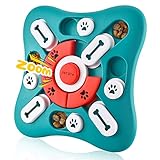
- 【PRODUCT SIZE】10 inch*10 inch*1.3 inch.
- 【3 WAYS TO PLAY, UPGRADE SLOW FEEDER】Our dog mental stimulation toys have a unique squeak button in the middle, which make it easier to attract the attention of dogs and cats. Three different difficulty designs and the 16-hole dog treat dispenser design maximize slow feeding time, even beyond 20 minutes.
- 【FUNNY STIMULATING TOYS】All kinds of dogs and cats love the puzzle game of Spin & Slide and the Seek & Hide with their smell sense and paw skills to find food. Combining circular orbit sliding game and linear orbit sliding game, smart dog and cat must move the slider correctly to get the food reward hidden in the maze.
- 【NON-REMOVABLE PARTS DOG PUZZLE】Our dog treat puzzle is made of non-toxic materials, very durable and suitable for pets to play for a long time. This dog toy has no removable parts because the design has built-in play parts that fold tightly and won't fall off easily.
- 【ANTI-SLIP & EASY TO CLEAN】: The four corners of the bottom are equipped with four anti-skid pads, which can be well fixed during the dog's slow food process; It is easy to clean, also dishwasher safe.
AKC has noted that any dog can be prone to resource guarding. As animal behaviorist and bestselling author Patricia McConnell, Ph.D., put it in the AKC’s guidance: “Any dog can be prone to resource guarding. It’s not specific to one breed.”
Reduce risk today
Until you have professional guidance, manage the environment so the dog does not practice the behavior and nobody gets bitten.
Rank #2

- SLOW DOWN CHOW TIME — Fine-tune the food flow to turn a rushed meal into a rewarding 5-60 minute routine.
- MORE THAN A MAZE BOWL — Patented spin-to-release play lets dogs nudge, think, and earn every bite.
- BEAT BOREDOM AT DINNER — Sniffing, spinning, and searching keep one dog happily busy while another eats in peace.
- KEEPS SMART DOGS ENGAGED — Start easy, then slow the flow to keep clever pups challenged meal after meal.
- ROOM FOR A REAL MEAL — The 4-cup chamber holds generous portions for dogs big or small, not just a handful of treats.
- Feed the dog alone in a quiet, secure place where people and other pets will not walk past. A crate or a separate room works if the dog is comfortable there.
- Keep children away during meals and during chews or treats. AKC’s guidance on serious food aggression recommends this directly.
- Separate the dog when it receives a special chew or treat, especially one it may defend, so that a second dog or person does not become a trigger.
- Do not reach into the bowl or take food away to prove a point.
- Do not deliberately provoke a warning to see how far the dog will go.
Repeatedly removing food is the most common mistake. AVSAB cautions that repeated removal can be read by the dog as competition for its food, and it can teach defensive aggression rather than trust.
When to involve professionals
Get help promptly if the guarding is new, getting worse, or includes a bite or an attempted bite. A medical problem, including pain, can contribute to a sudden behavior change, so a veterinary examination is the first step. VCA advises consulting a veterinarian before starting any program to prevent or reverse food-bowl guarding.
Rank #3

- 2 Levels in 1 Toy: start your pups off with a level 1 puzzle, add some treats in the base compartments and watch your dogs get their tasty reward by nudging the lids. For dogs who have mastered level 1, for added challenge in level 2, just put some treats in the top compartments, teach your dogs to press the top cover to dispense treats down into the base compartments and finally enjoy their reward
- Slow Feeder: The large capacity top transparent granary saves you the hassle to refill dog food frequently. The product can also be used as a slow feeder utensil for your dogs, which promotes healthy ingestion by slowing down eating speed by over 10x. Great for large and small dogs
- Not Easy to Tip Over: 4 non-slip rubber mats and weighted base hold the dog puzzle toy firmly in place when dogs eat and nudge and prevent the toy from tipping over
- We Prioritize Safety: the dog puzzle toys are designed with your pet’s health in mind, made of durable food-grade PP materials. Non-removeable parts make it safe and easy to clean. And you can give puzzles toy to your dog or directly out of the box, just no assembly!!
- Trains Dog’s Intelligence: interactive treat puzzle game challenges your puppies to get their reward of treats, works your dog's mind while reducing boredom and destructive behavior like chewing, digging and excessive barking. Size: 4.2 inch height
After the veterinary check, work with a behavior specialist. AVSAB’s public guidance states: “If your dog is exhibiting aggression, you should contact a Certified Applied Animal Behaviorist or board certified veterinary behaviorist for assistance.” AKC also recommends professional support for behavior changes. Ask any trainer or behaviorist how they handle aggression, whether they use reward-based methods, and whether they will assess the dog before recommending a plan.
Prevention exercises: only for a nonaggressive dog
The AVSAB prevention exercise is designed for a dog that is eating calmly but shows early signs of guarding, or for a puppy or dog being introduced to the idea that people near the bowl bring good things. It is not a fix for a dog that growls, snaps, or bites at food. AVSAB explicitly warns that this procedure may be unsafe for a dog already showing aggression unless a professional coaches and supervises it.
Rank #4

- Four Challenges & Levels 1-3: Multiple games with a flip game and a linear track sliding game, all requiring dogs to learn steps and find treats. This puzzle is designed to be more fun and difficult, with more unique ways to play. It can enhance your dog's IQ and train their sense of smell
- Prolong the Feeding Time: The 14-hole food storage slow feeder has four ways to play, which is effective in slowing down the dog's eating speed. It is also beneficial to the dog's physical and mental health by increasing the time and difficulty of acquiring food, thus avoiding gastrointestinal issues caused by indigestion
- Safe Materials & Cleanable: Furry friends can safely play with this toy, which is made of food-safe and long-lasting materials. Additionally, it is easy to clean with warm water and soap after use
- Six Silicone Anti-Slip Pads: Six silicone anti-slip pads with high resistance ensure a firm grip and prevent the item from sliding to one side during feeding
- Warm Tips: When playing with the puzzle, please keep your dog with you to prevent any possible destruction of the toy. The toy has a tight design of built-in game components, so you don't need to worry about them being easily dislodged and swallowed by your dog
For a nonaggressive dog, the general sequence is:
- Start at a distance. Walk past the dog’s bowl at a distance where the dog stays relaxed.
- Speak in a happy voice. Say the dog’s name cheerfully as you pass.
- Reward the glance. When the dog looks at you, give a more appealing food item, such as a small piece of dog-safe high-value treat.
- Build gradually. Once the dog responds reliably at this distance, gradually ask it to move away from the bowl to receive the reward, then let it return to eat.
- Stop if the dog shows tension. If the dog freezes, stiffens, or growls, increase the distance and make the exercise easier. Do not push through.
Soft training treats are the only product that fits this exercise. Choose small, dog-safe pieces that the dog finds more rewarding than its regular meal, and use them only for this type of preventive work.
Teaching “Leave It”
AVSAB also describes teaching “Leave It” as a general skill. Start with a low-value food item, reward the dog for disengaging from it, and then move to more valuable rewards as the dog improves. This is training guidance for a calm dog. It is not permission to approach a dog that is currently guarding a resource, and it does not replace supervised work for active aggression.
Best Value
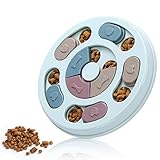
- 【Size】: L9.44" * W9.44"* H1.14" suitable for cats, puppies and small dogs.
- 【Interactive Dog Toys】This is a interactive puppy puzzle , which can easily become the closest companion and toy for your puppies and cats, and will release pressure for dogs. Find food by sliding parts to improve eating pleasure and IQ.
- 【Slow Feed Bowl】This encourages pets to eat at a slower speed, helps to slow down the feeding time to help the dog digest, and can provide your dog with a variety of healthy snacks.
- 【Slow Feede toys】 Use this educational game toy to exercise the dog’s brain, which will help meet the dog’s instinct needs, train the pet’s sense of smell, and let the dog enjoy feeding when using the nose or paw to move the slider, while providing spirit stimulate.
- 【Dog toys】No toy is indestructible. Do not leave toys with unsupervised pets. Remove and replace toy if damaged.
Methods to avoid
Avoid punishment, yelling, hitting, and “dominance” tactics such as alpha rolls or forcing the dog to give up food. AVSAB’s position is that reward-based methods should be used for all dog training, including behavior problems, and that aversive methods should not be used. In a 2025 board statement, AVSAB said it continues to stand behind its 2021 humane-training position as its current authoritative view. AKC’s resource-guarding guidance likewise cautions that punishment can make the behavior worse.
Choosing the right approach
| Situation | Appropriate first step | Key source |
|---|---|---|
| Subtle signs only (freezing, hard stare, eating fast, head lowered over bowl) and no growling or biting | Management plus, if the dog is calm enough, the AVSAB prevention exercise with reward-based training | AVSAB |
| Growling, lip lifting, showing teeth, snapping, or biting around food | Stop provoking the dog, manage the environment, and arrange veterinary assessment and professional coaching before any exercise | AVSAB, VCA, AKC |
| New, escalating, or bite-related guarding | Veterinary examination first, then a qualified behavior professional | VCA, AKC |
| Guarding around chews, toys, or locations | Management (separation for special chews) and reward-based “Leave It” practice when the dog is calm | VCA, AKC, AVSAB |
What the evidence does and does not establish
The guidance above comes from AVSAB, VCA, and AKC. These sources describe management, reward-based training, and professional referral. They do not provide a reliable success rate for any particular exercise, and they do not say how long a plan takes. Progress depends on the individual dog, its history, and whether a professional is supervising. No guaranteed outcome should be expected from a home exercise alone.
Guarding can be a sign of discomfort, and a compassionate plan treats the dog’s stress as the problem to solve, not the growl as the problem to suppress.
Next steps
- Begin management at every meal, starting today.
- Book a veterinary examination if the behavior is new or has included any bite.
- Ask a Certified Applied Animal Behaviorist or board certified veterinary behaviorist to assess the dog if there is any growling, snapping, or biting.
- Only begin a prevention exercise after the dog’s risk level is clear and a professional has approved it.
The aim is a dog that feels safe eating, not a dog that has learned to hide its warnings.
Recommended Free Tools
Quick Recap
Product prices and availability are accurate as of the date/time indicated and are subject to change. Any price and availability information displayed on Amazon at the time of purchase will apply.




