
Recommended Free Tools
Some links on this page are affiliate links: if you buy through them we may earn a commission, at no extra cost to you.
Teach a dispenser as an optional skill, not as your dog’s only source of water. Keep a clean, familiar bowl available while you introduce the appliance at your dog’s pace: first its presence, then its sounds, then a small water flow, and finally drinking from the intended bowl or outlet. Reward calm investigation, keep paws away from buttons, levers, cords and moving parts, and supervise until the routine is reliable. Ice can be safe for many dogs in correctly sized pieces, but it is a choking and dental risk for some dogs and is never a treatment for heatstroke.
What a dog dispenser should—and should not—do
A refrigerator dispenser, countertop unit or pet water fountain can make water convenient, but it is not a veterinary requirement. If your dog already drinks normally from a clean, stable bowl, there is no need to persuade the dog to use running water. Carlo Siracusa, DVM, associate professor of clinical animal behavior and welfare at the University of Pennsylvania, said he is “unaware of evidence supporting the theory that dogs prefer running water.” Individual preferences still matter: some dogs investigate a trickle, while others dislike motor noise, reflections, vibration or the sudden movement of a lever.
As an Amazon Associate I earn from qualifying purchases.
Crashes, No Sound, or Screen Glitches?
Random freezes, missing sound and display glitches usually trace back to one bad driver. Find and replace yours safely.Free scan · under a minuteWindows Errors? Fix Them Before They Spread
Repair common Windows errors and clear accumulated junk for a smoother, more stable PC - no reinstall needed.Free scan · no reinstallUse the dispenser only if it improves your dog’s access to clean water, fits the dog’s physical abilities and can be cleaned consistently. A device that is exciting but unstable, difficult to disassemble or easy to tip can create more problems than it solves. The ordinary bowl remains the dependable backup during training, power interruptions, filter changes, travel and any period when the dog refuses the new equipment.
Check health and equipment before training
Rule out a medical reason for a drinking change
Training cannot fix pain, nausea, swallowing trouble or an abnormal thirst pattern. Arrange veterinary advice if your dog suddenly drinks much less, drinks far more than usual, coughs or gags while drinking, vomits after drinking, repeatedly regurgitates, struggles to swallow, or shows signs of dehydration. Dogs with dental disease, swallowing problems, recurrent vomiting, kidney disease or urinary disease may need an individualized water and ice plan. Do not restrict water to make a dispenser seem more attractive.
Popular on Amazon

- Premium 304 Stainless Steel & Easy Maintenance. Crafted from high-quality 304 stainless steel, this pet fountain offers a durable, premium build. It’s easy to clean — all water-contact parts are top-rack dishwasher safe and completely BPA-free. With a generous 108 oz (3.2 L) capacity, it provides plenty of fresh water while reducing the need for frequent refills.
- Quick Snap-Together Assembly & Large Water Window. Set up in minutes with the intuitive four-step, snap-together design. The large viewing window, enhanced by an optional blue LED light, makes it easy to check water levels and doubles as a soothing night glow — turning hydration time into your pet’s favorite moment of the day.
- Ultra-Quiet Suspended Pump Design. The advanced suspended pump operates at a whisper-quiet 25 dB, ensuring peaceful operation throughout your home. Its innovative design delivers stable, low-noise performance even with continuous, long-term use.
- Multi-Stage Filtration for Cleaner Water. The high-efficiency filter captures hair, food debris, and impurities while helping inhibit biofilm growth to keep water fresh and clean. For best performance, use softened or filtered water. Although the fountain features stainless steel construction, clean the fountain and pump weekly, and replace the filter and pre-filter sponge every 2 weeks.
- Leak-Proof Structure for Peace of Mind. Built with robust materials and a fully sealed construction, this fountain is reliably leak- and spill-proof, protecting your floors from unwanted messes.
Choose a safe training station
- Put the unit on a level, non-slip surface where a dog cannot knock it over or trap a paw.
- Keep the dog’s regular bowl nearby and filled with fresh water.
- Route electrical cords behind furniture or through a protected channel; do not leave a chewing dog alone with a powered cord.
- Keep the outlet, lever and controls away from the dog’s mouth and paws unless you are actively teaching a supervised behavior.
- Use a bowl or catch basin that allows the dog to stand comfortably with four paws on the floor and keep its muzzle clear of edges.
- For a refrigerator dispenser, ensure the dog cannot lean on an open door, climb on a drawer or reach other controls.
Start with a quiet, clean machine
Wash a fountain or dispenser according to its manufacturer’s instructions before the first session. Remove old water, residue and loose filter material. A daily routine should include emptying, rinsing and refilling the water container; disassemble and wash parts as directed rather than allowing biofilm to accumulate. Replace filters on the schedule specified for that model and sooner if they become slimy, clogged or visibly dirty. If you cannot easily reach every water-contact surface, choose a simpler bowl or device.
Step-by-step: teach the dispenser without forcing approach
The sequence below is a practical application of gradual positive introduction and reward-based behavior guidance, not a dispenser-specific clinical protocol. Move forward only when the dog is relaxed at the current step. A high-value food reward can be useful, but the dog should never have to drink to earn a treat.
What’s actually slowing this PC down?
Pick the symptom - the matching free tool is one click away.
- Set up the appliance while it is off. Place it several feet from the normal bowl. Let your dog notice it during an ordinary calm period. Do not carry the dog to it, hold the muzzle near it or block access to the familiar bowl.
- Reward neutral observation. When the dog looks at the unit, sniffs in its direction or takes a relaxed step toward it, quietly mark the behavior with praise or a small treat delivered away from the appliance. The goal is calm investigation, not frantic contact.
- Reduce distance in small increments. Over separate sessions, allow the dog to choose whether to stand closer. If the dog freezes, backs away, hides, barks, pants, startles or refuses food, increase distance and end the session after a calm moment.
- Introduce the sound separately. With the dog at a comfortable distance, activate the pump or dispenser for a brief moment, then stop and reward calm behavior. Repeat short, predictable bursts. Do not run a loud motor continuously while the dog is still afraid of it.
- Add a small amount of water. Once the sound is ordinary, dispense only a little water into the intended bowl or catch area. Let the dog investigate without pressure. Keep the usual bowl available so thirst never forces a choice.
- Shape an approach and pause. Reward standing near the outlet, then standing with all four paws on the floor. If the dog paws, jumps or crowds the mechanism, pause the flow, step back to an easier distance and reward a grounded stance.
- Reward a voluntary sip. When the dog chooses to lower its head and drink, give calm praise after the dog lifts its head. Keep sessions brief and stop while the dog remains comfortable.
- Build duration and normal household conditions. Add a few seconds of operation, a normal refill and ordinary household movement one at a time. Continue to supervise until the dog reliably drinks without climbing, chewing, pawing controls or startling at the sound.
Never withhold the regular bowl overnight, before exercise or during hot weather to accelerate learning. If the dog never elects to use the dispenser after patient, low-pressure introductions, accept that preference and maintain the bowl.
Teach the safe drinking position
The target behavior is simple: the dog approaches voluntarily, keeps four paws on the floor, drinks from the intended bowl or outlet and then moves away without touching controls or cords. Practice when the dog is calm rather than immediately after intense play, when gulping and jumping are more likely.
Also popular on Amazon

- Award-winning product: Veken is proud to be a 2023 Category Winner of the Pet Innovation Awards, an honor given to only the most forward-thinking products within the rapidly expanding Pet industry.
- High-quality: Made of food-grade plastic materials, with all water-contact parts BPA-free. Durable, easy to operate and clean. The water-level window and blue LED light attract pets and make monitoring water levels simple. A convenient switch on the cord lets you easily turn the light on or off.
- Two flow designs: The Veken Pet Fountain has 2 modes: flower waterfall (faucet drinking) and the gentle fountain. The water streaming down the petals of the flower on the fountain will draw your pets attention and encourage animals to drink more often.
- 5 stages filtration system: In addition to circulating water to help keep it fresh, the 5-stage filtration system combines multi-layer filter media, coconut shell activated carbon, and a composite scale inhibitor to improve taste and reduce impurities.
- Ultra-quiet pump: This water fountain uses an ultra-quiet, low-energy pump designed for long-term use. To maintain smooth operation, clean the pump and replace filters every 1-2 weeks. Always keep water in the fountain when running to avoid damaging the pump.
- Stand beside the unit and reward a grounded stance before turning on the flow.
- If the dog jumps or paws, stop dispensing, wait for four paws down and reward that posture; do not reward the jump with water.
- Use a barrier or furniture placement to prevent access to buttons, levers, pump housings and moving refrigerator parts.
- Keep your hands away from the dog’s muzzle while it drinks. A startled dog can bite accidentally, and hand placement can make the dispenser itself seem threatening.
- Watch the first sessions for coughing, gagging, repeated head lifting, water inhalation or vomiting. Stop and seek veterinary advice if these occur.
For a refrigerator dispenser, operate the lever yourself during training unless the appliance is specifically designed for safe pet activation. A dog that learns to press a lever can flood the floor, empty the reservoir, damage the mechanism or gain access to a door and other hazards.
Can dogs safely get ice from a refrigerator dispenser?
The American Kennel Club says ice cubes are generally safe for most dogs, but “generally safe” is not the same as safe for every dog or every cube. Size, hardness, chewing style and health history determine the risk. Dr. Jerry Klein, AKC chief veterinarian, notes that ice cubes can be used to slow the rate at which an overly excited dog drinks water.
When ice may be appropriate
- Offer pieces that are small enough for the individual dog, or use crushed ice when a whole cube would be too large.
- Supervise every ice session, especially with puppies, fast eaters and dogs that swallow treats without chewing.
- Use clean, plain ice. Do not add sweeteners, flavorings, broth containing onion or garlic, or other ingredients that may be unsafe for dogs.
- Use a few pieces as an enrichment option or to pace rapid drinking, not as a substitute for normal access to water.
When to avoid cubes or ask your veterinarian
Hard cubes can fracture teeth, and a piece that is too large can lodge in the throat. Dogs with dental disease, missing or weakened teeth, a history of choking, swallowing dysfunction, jaw problems or recurrent vomiting need individualized advice. A dog that coughs, gags, retches, paws at its mouth, cannot breathe normally or becomes distressed after taking ice needs immediate attention; treat a breathing emergency as an emergency rather than waiting for a training solution.
Teach an ice-taking routine
Do not let the dog lunge at a refrigerator chute. Hold or place one appropriately sized piece in a shallow dish, reward a calm approach and remove the piece if the dog tries to gulp several at once. If you use a dog-safe ice tray, release the pieces into a bowl rather than letting the dog chew directly on a hard tray. Keep fingers clear of the dog’s mouth and never toss ice toward the face.
Also popular on Amazon

- Premium 304 Stainless Steel & Easy Maintenance. Crafted from high-quality 304 stainless steel, this pet fountain offers a durable, premium build. It’s easy to clean — all water-contact parts are top-rack dishwasher safe and completely BPA-free. With a generous 108 oz (3.2 L) capacity, it provides plenty of fresh water while reducing the need for frequent refills.
- Quick Snap-Together Assembly & Large Water Window. Set up in minutes with the intuitive four-step, snap-together design. The large viewing window, enhanced by an optional blue LED light, makes it easy to check water levels and doubles as a soothing night glow — turning hydration time into your pet’s favorite moment of the day.
- Ultra-Quiet Suspended Pump Design. The advanced suspended pump operates at a whisper-quiet 25 dB, ensuring peaceful operation throughout your home. Its innovative design delivers stable, low-noise performance even with continuous, long-term use.
- Multi-Stage Filtration for Cleaner Water. The high-efficiency filter captures hair, food debris, and impurities while helping inhibit biofilm growth to keep water fresh and clean. For best performance, use softened or filtered water. Although the fountain features stainless steel construction, clean the fountain and pump weekly, and replace the filter and pre-filter sponge every 2 weeks.
- Leak-Proof Structure for Peace of Mind. Built with robust materials and a fully sealed construction, this fountain is reliably leak- and spill-proof, protecting your floors from unwanted messes.
Ice is not heatstroke treatment
Never give ice cubes or ice-cold water as the response to suspected heatstroke. A dog with heavy or worsening panting, weakness, confusion, collapse, very red or pale gums, vomiting, diarrhea, seizures or an elevated body temperature needs immediate veterinary care. Move the dog to shade or air conditioning, provide airflow and begin gradual cooling with cool—not ice-cold—water while contacting an emergency veterinarian. Do not delay transport to make the dog drink, and do not force water into a weak, confused or unconscious dog.
How much water should a dog drink?
The AKC gives a general guideline of one ounce of water per pound of body weight per day. It is a starting estimate, not a target that overrides a veterinarian. Activity, diet (especially wet food), weather, panting, pregnancy, age, medication and illness can all change requirements. Measure intake only when a veterinarian asks for it or when you are investigating a change; a fountain’s circulating reservoir can make casual measurement difficult.
Offer fresh water in the bowl and dispenser, check that the dog can reach both, and observe the overall pattern rather than forcing a number. A sustained decrease, a sudden increase, repeated nighttime drinking or a mismatch between thirst and urination warrants veterinary discussion.
Water bowl or fountain: which is safer for your dog?
There is no universal winner. Compare the practical features below for your household and your dog’s behavior.
Also popular on Amazon
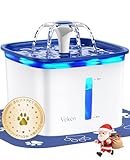
- Award-winning product: Veken is proud to be a 2023 Category Winner of the Pet Innovation Awards, an honor given to only the most forward-thinking products within the rapidly expanding Pet industry.
- High-quality: Made of food-grade materials, with all water-contact parts BPA-free. Durable, easy to operate and clean. The water-level window and blue LED light attract pets and make monitoring water levels simple. A convenient switch on the cord lets you easily turn the light on or off.
- Two flow designs: The Veken Pet Fountain has 2 modes: flower waterfall (faucet drinking) and the gentle fountain. The water streaming down the petals of the flower on the fountain will draw your pets attention and encourage animals to drink more often.
- 5 stages filtration system: In addition to circulating water to help keep it fresh, the 5-stage filtration system combines multi-layer filter media, coconut shell activated carbon, and a composite scale inhibitor to improve taste and reduce impurities.
- Ultra-quiet pump: This water fountain uses an ultra-quiet, low-energy pump designed for long-term use. To maintain smooth operation, clean the pump and replace filters every 1-2 weeks. Always keep water in the fountain when running to avoid damaging the pump.
| Decision factor | Ordinary bowl | Pet water fountain or dispenser |
|---|---|---|
| Preference for running water | Works for dogs that prefer still water; preference varies by individual. | May interest a dog that likes movement, but evidence does not establish that dogs generally prefer running water. |
| Noise and stability | Usually silent; a heavy, wide base reduces tipping. | Pump noise and vibration can frighten some dogs; select a stable unit and introduce the sound gradually. |
| Daily cleaning | Typically quick to empty, wash and refill. | Requires daily emptying, rinsing and refilling plus periodic disassembly of pump, channels and reservoir. |
| Filter burden | No filter replacement. | Filters need replacement on the maker’s schedule and inspection for clogging or slime. |
| Cords and spills | No electrical cord; spills depend on bowl design and placement. | Requires cord protection and a spill-resistant location; a dog may activate a lever or tip the unit. |
| Cost and complexity | Lowest equipment and maintenance complexity. | Higher purchase and replacement-part burden; convenience is worthwhile only if the dog uses it and you can clean it reliably. |
If you choose a fountain, prioritize a quiet, stable, easy-to-clean model with protected electrical parts and a bowl height your dog can use comfortably. Treat “running water” as an option, not a health claim.
Independent reader supportYour contribution helps us test, update, and keep practical guides available for everyone.Daily operating and cleaning checklist
- Confirm the dog can reach a clean backup bowl.
- Check water level, flow and temperature; discard stale or contaminated water.
- Look for slime, hair, food particles or a blocked outlet.
- Inspect the cord, plug, housing and non-slip feet before switching on.
- Wash removable water-contact parts as directed and dry areas that should not remain wet.
- Replace filters when due and record the date if several household members maintain the device.
- Wipe spills promptly to prevent slipping, chewing or electrical contact.
During cleaning, put the ordinary bowl down first. A dog should never have to wait thirsty while a fountain is being serviced.
Do these 3 things before closing this tab:
1Clear out junk files and repair common Windows errors2Scan for outdated or missing drivers - takes under a minute3Repair Windows errors before they cause bigger problemsTroubleshooting common training problems
“My dog is afraid of the motor.”
Turn it off, move it farther away and reward calm behavior around the silent unit. Reintroduce one-second sounds at a distance, increasing either duration or proximity—not both at once. If fear persists, use a bowl; continued exposure while frightened can strengthen the fear.
“My dog paws the dispenser and makes a mess.”
Stop the flow when paws leave the floor, block access to controls and reward a stationary stance. Lower the water volume during practice and place a catch mat underneath. Do not give attention or extra water immediately after pawing.
Also popular on Amazon

- Hydration Data that Goes Deeper: Via Dockstream 2 cat water fountain stainless steel, track your pet's water intake with more precision and accuracy than ever before, cat fountain water bowl with improved scale and 5 Ghz connectivity. See their hydration history, favorite time to drink, and other important trends via cat water fountain, so you can spot changes early in the pet water fountain app.
- Maintenance Made Effortless: The detachable 3-liter tank of stainless steel cat water fountain means more water for them, fewer refills for you. And upgrade cat water dispenser with an enhanced pump-free design that keeps wires out of the water, there are fewer parts with cat water fountain to clean too.
- The Fresh Water They Deserve: 4-layer filtration removes fur, heavy metals, and odors. The cat water fountain stainless steel tray is non-toxic and hygienic. For best performance, we recommend using PETLIBRO official replacement filters designed specifically for this fountain.
- Designed for Pets: Choose continuous or timed water flow modes in the Cat Fountains for Drinking app based on your pet's needs. Stainless steel cat water fountain's anti-knockover design can stand up to curious paws and frisky drinkers. Whisper-quiet operation of pet water fountain means you can even put it where you sleep.
- 2-Year Warranty of Cat Water Fountain: Your cat fountain is covered for 2 years, and you always have access to friendly customer support for petlibro cat water fountain stainless steel.
“My dog ignores the fountain.”
That is an acceptable outcome if the dog drinks from the bowl. Verify that the water is fresh, the outlet is not too high, the pump is not noisy and the surface is stable. Offer the bowl without coaxing and discontinue the fountain if it adds no benefit.
“My dog gulps from the dispenser.”
Use a wide, shallow bowl or a flow setting that reduces the stream, provide brief supervised drinks and consider a few correctly sized ice pieces only if the dog has healthy teeth and can chew safely. Coughing, gagging, vomiting or repeated regurgitation calls for veterinary advice rather than slower equipment.
Free tools Windows power users keep installed
One-click scans. No signup required.
“The dog drinks much more after we installed it.”
Check for leaks, a continuously running pump or inaccurate reservoir readings, then measure intake for a short period if your veterinarian recommends it. A persistent thirst increase can signal illness and should be evaluated, even when the dispenser appears to be working normally.
When to stop training and call a veterinarian
Stop the session and contact a veterinarian for reduced drinking, unusual thirst, coughing or gagging with water, repeated vomiting or regurgitation, signs of pain, inability to chew ice, dental disease, swallowing difficulty or any sudden behavior change around water. Emergency care is warranted for breathing difficulty, collapse, seizures, severe weakness, confusion or suspected heatstroke. A dispenser is a household tool; it cannot diagnose or treat these conditions.





Leave a Reply