
Some links on this page are affiliate links: if you buy through them we may earn a commission, at no extra cost to you.
You can teach most dogs sit, stay, and come without force. Work in brief sessions, begin where your dog can succeed, mark the exact moment the desired behavior happens, and deliver a reward immediately. Increase time, distance, and distractions in small steps rather than asking for everything at once.
These are not merely party tricks. A reliable sit gives you a calm starting behavior, stay builds self-control, and come can help bring your dog back from danger. Positive reinforcement also gives your dog clear information about what to do next.
As an Amazon Associate I earn from qualifying purchases.
The Tool Desk
Outbyte PC Repair FREERepair Windows errors before they cause bigger problemsFix Now →Outbyte Driver Updater FREEFix the driver behind crashes, sound loss and screen glitchesFind Drivers →What positive reinforcement means
Positive reinforcement is a consequence that makes a behavior more likely to happen again. If your dog sits and a piece of chicken follows, and the dog begins sitting more often, the chicken functioned as a reinforcer. Food is not automatically reinforcing simply because you offer it; its value depends on the individual dog and the situation.
A dry biscuit may be enough in a quiet kitchen but not at a busy park where running dogs, scents, and play are competing for attention. Use a reward your dog genuinely values in that context. Rewards can include tiny food treats, a favorite toy, a short game, access to sniffing, or enthusiastic attention, provided that the consequence increases the behavior.
Popular on Amazon

- New communication tool about you and your puppy.
- Pet Dog Training Clickers for Puppy, Cat, Potty, Bird, Horse, Pet, Trainer Training Tools, Behavior Aids
- Just press to mark desired behavior, then reward for faster learning.
- The spring wrist length : 16cm/6.3inches and can strength to 25cm/9.84inches.
- Package include : Black + Blue,each color 1 pcs.
The American Veterinary Society of Animal Behavior (AVSAB) states in its 2021 guidance, “Evidence supports the use of reward based methods for all canine training.” It also says, “There is no evidence that aversive training is necessary for dog training or behavior modification.” Reward-based training teaches a dog what to do and reinforces that choice; it does not depend on pain, fear, intimidation, or physical correction.
Prepare before the first session
Choose the training location
Start in a quiet room with a non-slip surface and few competing smells or sounds. Once your dog responds reliably there, practice in another room, a hallway, a fenced yard, and other safe places. Changing the environment helps your dog learn that the cue applies everywhere, but each new setting should be treated as a new difficulty level.
Use small, valuable rewards
Cut soft treats into pieces no larger than a pea. You will be delivering many rewards, so very small portions let you practice without filling your dog quickly. Reserve especially tasty food or a favorite game for harder environments. If your dog stops eating, cannot focus, or repeatedly fails, the surroundings may be too difficult or the reward may not compete with what is happening around you.
Decide on a marker
A marker tells your dog exactly which action earned the reward. You can use a clicker or a short word such as “yes.” A clicker is optional, but it can be very precise. Before using it to teach a behavior, pair the sound with food several times: click, then immediately give a treat. When your dog looks for the treat after the click, the sound has become a reliable predictor of reinforcement.
During training, mark at the instant the correct behavior occurs and give the reward immediately afterward. The marker identifies the moment; the food, play, or other consequence is the reward. Keep treats in a pocket or a container so you can deliver them without waving a lure continuously.
Keep sessions short and successful
End while your dog is still engaged. Several brief practices spread through the day are more useful than one long session that produces frustration. Stop, offer a break, and meet your dog’s normal needs for sleep, exercise, sniffing, and play. A dog that is tired, hungry, overstimulated, or uncomfortable may need those needs addressed before learning.
Three behaviors at a glance
| Behavior | First setting | Initial goal | How difficulty increases | Reward emphasis |
|---|---|---|---|---|
| Sit | Quiet room | Bottom touches the floor | Add the verbal cue, then practice in new rooms and mild distractions | Reward while the dog remains seated |
| Stay | Dog already sitting | One second of stillness | Increase duration, then distance, then distractions; change one variable at a time | Return to the dog to reward in place and use a release word |
| Come | Indoors or fenced, low-distraction area | Dog reaches you after one cue | Increase distance and environmental difficulty gradually | Use a jackpot and sometimes release the dog back to play |
Teach your dog to sit
1. Capture or lure the movement
Hold a treat close to your dog’s nose. Move it slowly upward and slightly back over the head. As the dog follows the treat, the head usually rises and the bottom lowers. You can also wait for a naturally occurring sit and capture it instead of guiding the movement.
Also popular on Amazon

- ▼Come in 4 pack button clickers with wrist strap in 4 different colors:Black, Green, Orange, Yellow, each color 1 PCS
- ▼Can be used to train the dog basic obedience, small trick, and correct the bad behavior; Scientific method of training your pet safely and easily.
- ▼Stop barking and dog obdeience. Train your dog quiqly just by simply pressing the clicker and command.
- ▼Well constructed and durable, metal clicker will not rust or break.
- ▼Big button for easy clicking and loud sound. Easy to use in any position.
2. Mark the exact instant
The moment the bottom reaches the floor, click or say your marker. Do not wait for the dog to look at you, shift position, or stand again.
3. Reward while the dog is still sitting
Deliver the treat at the dog’s nose or between the front paws while the sit is intact. If you hold the food too long and the dog stands before receiving it, the dog may learn that standing is part of what earns the reward. After the treat, let the dog move normally; you can then set up another repetition.
4. Add the word “sit”
At first, the hand movement is doing most of the teaching. After several successful repetitions, say “sit” just before making the hand signal. When the dog begins responding to the word, make the hand signal smaller and use the verbal cue in different rooms. Avoid repeating “sit” over and over; give the cue once, then help the dog succeed.
Recommended Free Tools
5. Generalize the behavior
Practice on different surfaces and in several quiet locations. Reward promptly each time. Add mild distractions only after the dog can respond reliably in the easier place. If performance falls apart, return to the last level at which your dog was successful and build again.
Teach your dog to stay
Stay is not created by holding a dog in place. It is a behavior built through a history of reinforcement for remaining still until a release cue. Begin with a sit your dog already understands.
1. Start with one second
Ask for sit. Wait for approximately one second of stillness, mark, and place the reward close to the dog so it does not need to move. At this stage, the goal is not a long stay; it is a clear, easy success.
2. Build duration in tiny increments
After repeated successes, add only a little time. You might go from one second to two, then three, rather than jumping to half a minute. Vary the interval occasionally so your dog does not learn to anticipate a single exact timing. If the dog breaks, the next repetition should be easier and the reward should arrive sooner.
Free tools Windows power users keep installed
One-click scans. No signup required.
Also popular on Amazon
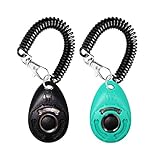
- EASY TO USE - Simple push button with distinct clicking sound.
- Comes with an elastic wrist band so you can leave it on your wrist or clip it to the leash or your pants.
- Not only train the dog but also the cat, bird, chicken, sheep a new behaviors like sit, fetch, roll over, lie down.
- For effective pet training ALWAYS reward with a treat after clicking.
- Can be used to train the dog basic obedience, small trick, and correct the bad behavior; Scientific method of training your pet safely and easily.
3. Add distance after duration is steady
Take one small step away, then immediately return and reward. Do not call the dog toward you to end every repetition; returning to the dog teaches that staying in place is valuable. Add distance gradually, and shorten it again if the dog gets up.
4. Add distractions last
When your dog can remain seated for the planned duration and distance in a quiet place, introduce mild distractions such as a family member walking past. Increase only one challenge at a time. A longer duration, greater distance, and a busy environment together may be too much even for a dog that succeeds at each separately.
5. Teach a release word
Choose a consistent word such as “okay” to tell your dog when the stay is finished. After marking and rewarding the stay, say the release word and invite movement. If the dog leaves before the release, calmly reset with an easier repetition; do not punish the mistake.
Teach your dog to come
Recall deserves especially generous reinforcement because you are asking your dog to leave something interesting and move toward you. Never make “come” predict that all fun ends. In practice, call your dog, reward generously, and sometimes release the dog back to sniff or play.
Do these 3 things before closing this tab:
1Fix the driver behind crashes, sound loss and screen glitches2Clear out junk files and repair common Windows errors3Scan for outdated or missing drivers - takes under a minute1. Begin in a safe, easy place
Start indoors or in a securely fenced, low-distraction area. Say your dog’s name and “come” once in a cheerful voice. Crouch or move backward to encourage the dog to follow. Avoid calling repeatedly; repeated unanswered cues can become background noise.
2. Pay immediately and generously
As soon as the dog reaches you, mark the behavior. Give a jackpot of several tasty treats or a favorite game rather than a single ordinary piece of food. The reward should match the difficulty of the recall and the value of what the dog left behind.
3. Make collar contact part of the exercise
After the first reward, gently touch or hold the collar, then reward again. This prevents the dog from learning that reaching you means you will immediately grab and restrain them. Keep the contact calm and brief.
Also popular on Amazon

- ONE MANUAL AUDIBLE CLICK SOUND: Produces one audible click when manually pressed. This clicker does NOT provide multiple selectable sounds, electronic volume controls, batteries, remote functions, or Electronic Stimulation.
- REVIEW PHYSICAL SIZE BEFORE ORDERING: Customer size preferences may vary. Review the current product images and listed dimensions before purchase rather than relying on general descriptions such as small or compact.
- AUDIBLE CUE ONLY – RESPONSE MAY VARY: The clicker provides a manual sound cue and does not automatically give instructions to the animal. Individual dogs and other animals may respond differently. Introduce the sound gradually and discontinue use if fear or discomfort occurs.
- 5-INCH USER-WORN VELCRO STRAP: Includes an approximately 5-inch adjustable Velcro strap designed to position the clicker on the user's finger or hand. Review the strap configuration before purchase. The strap is NOT intended to be worn by the pet.
- TEAL CLICKER ACCESSORY ONLY: Includes one Teal manual finger clicker and training instructions. Remote transmitter, receiver collar, batteries, and other training-system components are NOT included.
4. Release back to good things
Once you have rewarded and touched the collar, use a release cue and let the dog return to exploring or playing when it is safe. This teaches that coming when called does not always end access to enjoyable activities.
5. Increase distance and distractions slowly
Practice from short distances before moving outdoors. Use a reward that can compete with the environment, and progress from quiet areas to places with more smells, movement, and activity. Continue reinforcing recall in the situations where you need it rather than assuming a home response will transfer automatically to a park.
How to progress without overwhelming your dog
Think of training difficulty as three separate dimensions: duration (how long the dog performs), distance (how far you move away), and distraction (what else is happening). Raise one dimension at a time. For example, lengthen a stay while remaining close, then restore a short duration when you begin stepping away.
- Find the current success level. Choose a version of the behavior your dog can perform reliably, such as a one-second stay or a recall across a room.
- Change one variable slightly. Add a second or one step, or move to a mildly different room—not all three at once.
- Mark and reward early success. Reinforce before the dog becomes likely to fail.
- Repeat until the response is steady. Several successful repetitions create a stronger reinforcement history.
- Reduce difficulty after an error. Shorten the duration, move closer, lower the distraction, or improve the reward.
Generalization takes practice. A cue learned in one room is not automatically fluent in a garden, on a pavement, or near other dogs. Treat every new environment as a chance to teach again at an easier level.
Independent reader supportYour contribution helps us test, update, and keep practical guides available for everyone.Common problems and precise fixes
Your dog ignores the cue
Lower distractions and use a better reward. Check whether the dog actually learned the cue or whether the environment is simply too difficult. Rebuild the reinforcement history with easy repetitions rather than saying the cue louder or more times.
Quick wins for a faster PC:
Clear out junk files and repair common Windows errorsFree Scan →Scan for outdated or missing drivers - takes under a minuteDriver Scan →Repair Windows errors before they cause bigger problemsFix Now →Your dog works only when shown the treat
The visible treat may still be functioning as a lure rather than a reward. Keep the hand signal, put the treat in the other hand or out of sight, and deliver it only after the behavior. Fade the visible lure gradually while preserving the reward that follows success.
Your dog breaks the stay
Make the next attempt easier. Reduce the duration, distance, or distraction and reward sooner. Repeatedly asking for a stay that is beyond the dog’s current ability creates practice at breaking the behavior.
Also popular on Amazon

- Stronger Bark Control with 3X Ultrasonic Emitters: Unlike single-emitter devices, our upgraded dog bark deterrent features three synchronized ultrasonic heads—delivering 3X the coverage to quickly stop barking, biting, and jumping behaviors. Ideal for anti barking training, safer than bark collar, more effective than a dog whistle, offers a humane, high-performance dog training solution
- 6-in-1 Safe & Humane Training Modes:Our dog bark deterrent device features dual ultrasonic frequencies (fixed 25kHz and variable 20-30kHz), combining 4 ultrasonic modes plus an audible beep and LED flashlight for versatile training. Whether for daily training or stubborn, persistent barking, this anti bark device adapts to different dogs providing effective bark control without causing pain or distress. Perfect for training at home or to stop neighbors dog bark that disturbs your peace
- 23 FT Extended Range & Night Safety: Bark Control Anytime, Anywhere: Stop barking and bad behavior from up to 23 feet away with our powerful dog bark deterrent device — perfect for your yard, neighbor’s yard, outdoor walks, and off-leash areas. Whether you're relaxing at home or out for a stroll, enjoy safe, long-distance control to correct disruptions quickly. The built-in LED flashlight adds safety for evening walks, and low-light training
- Fast Charge & Long Battery Life – Always Ready for Training:With a Type-C fast charging port, our dog bark deterrent device reaches a full charge in just 2 hours and provides up to 30 days of regular use on a single charge, along with 180 days of standby time. Whether you're correcting anti barking behavior or training your dog in public places, you’ll always be prepared for any situation. Forget the hassle of frequent charging and enjoy reliable, long-term support
- Ultra-Compact Design for Everyday Convenience:50% smaller than standard dog bark deterrent devices, our anti barking device is ultra-compact and lightweight, fitting effortlessly into your pocket, bag, or hand. Whether you're on daily walks, outdoor adventures, or dealing with unexpected situations in public places, this portable design helps you stop barking and encourage good behavior anywhere, anytime. Say goodbye to constant noise and enjoy a happy experience with your dog
Come works at home but not outside
Outdoor settings contain stronger competing rewards. Return to short distances in a fenced or otherwise secure area, use tastier food or a favorite game, and add distractions in small steps. Continue to reward and occasionally release the dog back to play.
Your dog becomes stressed or fearful
Stop the exercise and increase distance from whatever is causing concern. Do not force the dog to remain near a trigger or correct fear with intimidation. Address exercise, rest, enrichment, and other basic needs, then seek help for persistent problems.
Safety and choosing professional help
Do not use force, pain, intimidation, electronic collars, prong collars, choke chains, leash jerks, or physical punishment for these behaviors. Reward-based methods provide information about the desired action without adding fear or injury. For recall practice outdoors, use a secure enclosed area; a cue is not a substitute for safe fencing or appropriate management.
AVSAB recommends trainers who use food, toys, and play as motivators. A suitable professional should be able to explain what is being taught, why it matters, and how the plan will be adapted to your individual dog. Ask how the trainer handles mistakes, fear, and unwanted behavior. Avoid anyone who relies on pain, fear, physical force, or claims that aversive tools are necessary.
For aggression, severe fear, or an immediate safety concern, involve your veterinarian and seek a credentialed veterinary behavior professional. Medical problems can affect behavior and learning, so a veterinary assessment is appropriate when a sudden change or serious concern appears.
A practical first-week routine
Use this as a flexible outline rather than a rigid timetable. Keep each practice brief and stop while your dog is succeeding.
What’s actually slowing this PC down?
Pick the symptom - the matching free tool is one click away.
- Days 1–2: establish the marker. Pair a click or verbal marker with immediate food. Capture a few natural sits and reward them.
- Days 2–3: build sit. Use the hand lure or capture method, mark the instant the bottom touches the floor, and begin adding the word “sit” before the signal.
- Days 3–4: introduce stay. Ask for sit, wait one second, mark and reward in place, then release. Repeat easy successes before adding a little duration.
- Days 4–5: add one step of distance. Return to the dog to reward the stay. If the dog moves, shorten the distance and try again.
- Days 5–6: start recall. From a short indoor distance, say the name and “come” once, move backward, mark arrival, give a jackpot, touch the collar, and release.
- Day 7 and onward: generalize. Practice each behavior in another quiet location, then introduce one mild distraction. Lower the difficulty whenever success drops.
Keep a simple record of the easiest distance, duration, and distraction level that succeeded. That information helps you choose the next small step instead of guessing or advancing too quickly.





Leave a Reply