
Some links on this page are affiliate links: if you buy through them we may earn a commission, at no extra cost to you.
Train the sighted dog to be a calm, predictable companion—not to pull, push, block, or steer the blind dog. Reward reliable responses to your cues, teach both dogs how to share space voluntarily, and preserve the blind dog’s ability to stop, turn away, and choose a route. Physical guiding between two household dogs is not established as safe by formal guide-dog training; attempt it only under direct supervision from a veterinarian and a qualified behavior professional.
A low-stress plan starts with a veterinary and home-safety check, builds the sighted dog’s self-control away from the blind dog, then introduces brief parallel sessions with generous escape space. At every stage, distance and predictability matter more than speed.
As an Amazon Associate I earn from qualifying purchases.
What “assistance” should mean for a blind dog
A sighted dog can help indirectly by making the home calmer and more predictable. Useful behaviors include walking nearby without crowding, pausing at thresholds, settling on a mat, responding to a recall, and returning to the handler when called. These behaviors give the blind dog information and room to move without creating physical pressure.
Do not assume that a sighted pet can safely perform the work of a trained guide dog. Human guide-dog programs use carefully selected dogs, structured environments, and professional matching; that is not evidence that one pet dog should guide another. Pulling a blind dog on a leash, body-blocking its path, nudging it toward stairs, or steering it by the collar can cause falls, collisions, conflict, or learned dependence. The blind dog must be free to disengage and choose its own direction.
Popular on Amazon

- New communication tool about you and your puppy.
- Pet Dog Training Clickers for Puppy, Cat, Potty, Bird, Horse, Pet, Trainer Training Tools, Behavior Aids
- Just press to mark desired behavior, then reward for faster learning.
- The spring wrist length : 16cm/6.3inches and can strength to 25cm/9.84inches.
- Package include : Black + Blue,each color 1 pcs.
The American Animal Hospital Association (AAHA) notes that sensory-impaired pets may experience extra stress when frequently startled or when navigation is difficult. The American College of Veterinary Ophthalmologists (ACVO) likewise advises speaking to a blind pet before approaching; yelling adds stress rather than useful information.
Start with a veterinary and environmental baseline
Rule out problems that look like “training” issues
Arrange a veterinary examination before intensive behavior work. Pain, progressive eye disease, hearing loss, vestibular disease, or another neurologic problem can change how a blind dog reacts to touch, movement, and sound. Ask the veterinarian what the dog can currently see and hear, whether medication or treatment is needed, and which forms of touch are comfortable.
Free tools Windows power users keep installed
One-click scans. No signup required.
Seek help promptly if the dog suddenly becomes disoriented, collides much more often, cries when handled, or changes appetite, sleep, or mobility. Training cannot compensate for untreated pain or a rapidly changing sensory condition.
Make the house legible and stable
Keep furniture, beds, bowls, and high-use objects in consistent locations. AAHA recommends arranging feeding, exercise, toilet trips, and training on as close to a daily schedule as possible. Predictable timing reduces the number of surprises the blind dog has to process.
- Keep walkways clear, especially routes between the bed, water, door, and toilet area.
- Gate stairs, balconies, pools, and exterior doors. A baby gate can prevent door-dashing and create a controlled transition area.
- Use a gated enrichment zone when the blind dog cannot be monitored, as AAHA recommends.
- Give each dog a separate bed, bowl, and retreat space. Never require the blind dog to pass the sighted dog to reach water or rest.
- Use non-slip surfaces on slick floors and mark abrupt level changes with a consistent tactile or auditory cue.
Do not repeatedly rearrange a room to test the blind dog. If a change is necessary, introduce it while the dog is calm, guide it slowly through the new layout, and reward investigation.
Build the sighted dog’s self-control before shared practice
Train the sighted dog alone in a quiet room. Guide Dogs for the Blind describes reward-based pattern training in which the dog can complete exercises without repeated mistakes. The same low-error principle is useful here: make the correct response easy, reinforce it immediately, and lower the difficulty if the dog becomes frantic or distracted.
Also popular on Amazon

- ▼Come in 4 pack button clickers with wrist strap in 4 different colors:Black, Green, Orange, Yellow, each color 1 PCS
- ▼Can be used to train the dog basic obedience, small trick, and correct the bad behavior; Scientific method of training your pet safely and easily.
- ▼Stop barking and dog obdeience. Train your dog quiqly just by simply pressing the clicker and command.
- ▼Well constructed and durable, metal clicker will not rust or break.
- ▼Big button for easy clicking and loud sound. Easy to use in any position.
Core skills to teach
- Name response: Say the dog’s name once. The instant it turns toward you, mark the behavior with a click or soft verbal marker and deliver a small treat.
- Recall: From a short distance, say your recall cue, move away, and reward the dog for coming all the way to you. Gradually add distance and mild distractions. Do not call only for unpleasant events.
- Wait: Ask for a brief pause before opening a door, placing down a bowl, or crossing a threshold. Release with a separate word such as “free.” Increase duration in tiny increments.
- Leave it: Reward the dog for turning away from a toy, food item, doorway, or the blind dog. Begin with an easy object and keep the reward in your hand until the dog understands the game.
- Hand target or nose touch: Teach the dog to touch your stationary hand with its nose. This gives you a quiet way to move the sighted dog without grabbing its collar.
- Mat settle: Reward lying on a mat, soft body language, and looking away from activity. Add a release cue so the dog learns when it may leave.
- Calm check-in: Reward the sighted dog for looking at the blind dog and then returning attention to you. You want observation followed by disengagement, not fixation.
Use a clicker only if its sound is comfortable for both dogs. Condition it at low volume by clicking once and immediately feeding; stop if either dog startles. A soft marker word works just as well. Keep treats tiny and account for them in the veterinary diet.
Create clear communication for both dogs
Choose a small, consistent cue set
Select one orientation cue for the sighted dog, such as its name, and one or two navigation cues for the blind dog, such as “stop,” “slow,” “wait,” or “step up.” ACVO specifically recommends cues such as “stop” and “step up,” while AAHA recommends tactile cues for blind dogs.
Say the cue once, give the dog time to respond, and reward the response immediately. Repeating a word rapidly teaches the dog that the first several repetitions can be ignored. Keep family members’ wording and hand placement consistent.
Pair sound with touch carefully
For a blind dog, pair a spoken cue with a gentle, predictable touch at a body area the veterinarian has confirmed is comfortable. For example, say “step up,” pause, then touch the shoulder lightly as the front feet approach a low step. Reward orientation or a safe pause, not a forced movement.
Always announce your approach before touching: say the dog’s name or a phrase such as “I’m here,” wait for an orienting response, and then make contact. Do not sneak up, clap near the face, or shout. The ACVO warns that talking louder or yelling “just adds more stress to the situation.”
Introduce the dogs through parallel calm behavior
Begin with distance and a barrier
Start when both dogs are rested and neither is guarding food, toys, or a sleeping place. Position them several feet apart, each behind a gate or on a loose leash held by a separate adult. Give the blind dog a clear route away from the sighted dog.
Also popular on Amazon
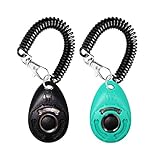
- EASY TO USE - Simple push button with distinct clicking sound.
- Comes with an elastic wrist band so you can leave it on your wrist or clip it to the leash or your pants.
- Not only train the dog but also the cat, bird, chicken, sheep a new behaviors like sit, fetch, roll over, lie down.
- For effective pet training ALWAYS reward with a treat after clicking.
- Can be used to train the dog basic obedience, small trick, and correct the bad behavior; Scientific method of training your pet safely and easily.
- Let the blind dog investigate the area without the sighted dog approaching.
- Bring the sighted dog into view or hearing range and reward a brief look followed by a turn back to the handler.
- Feed the blind dog separately for relaxed exploration, orienting to its person, or choosing to move away.
- End the session while both dogs are still comfortable. Several short sessions are preferable to one prolonged exposure.
Reduce distance only when the blind dog remains loose, exploratory, and able to move away, and the sighted dog can disengage on cue. If either dog becomes tense, increase distance at once.
Progress to loose-leash parallel walking
When barrier sessions are easy, walk the dogs in the same direction with several feet between them. Keep both leashes loose; tight leashes can transmit tension and make sudden movement more likely. Reward the sighted dog for staying beside its handler, pausing at doorways, and returning when called.
What’s actually slowing this PC down?
Pick the symptom - the matching free tool is one click away.
Do not let the sighted dog trail the blind dog by the leash, cut across its path, or rush ahead and pull. If the blind dog changes direction, allow it to do so. The sighted dog’s job is to remain responsive to the human, not to decide where the pair goes.
Practise household transitions
Work on one transition at a time: moving through a doorway, approaching a stair gate, settling near a feeding area, or returning from the yard. Have the sighted dog wait while the blind dog passes, then release the sighted dog. Reverse the order on another repetition so neither dog learns that it owns the route.
Use separate feeding stations and supervise high-value chews. A calm companion should never be allowed to hover over, steal from, or corner the blind dog.
Behaviors that help without physical guiding
| Behavior | What to reward | What to avoid |
|---|---|---|
| Parallel walking | Loose leash, steady pace, and space between dogs | Leash tension, crowding, crossing in front |
| Doorway pause | Waiting for the handler’s release | Blocking the opening or rushing through |
| Stair awareness | Stopping at the gate or first step when cued | Pushing, pulling, or dragging the blind dog |
| Calm proximity | Settling on a mat or resting nearby | Staring, pawing, chasing, or body-checking |
| Recall and disengagement | Turning away from the blind dog and returning to the handler | Ignoring the cue or pursuing the blind dog |
These skills make the sighted dog a reliable environmental partner while preserving the blind dog’s autonomy. They also give the handler a way to interrupt unsafe activity before contact occurs.
Do these 3 things before closing this tab:
1Clear out junk files and repair common Windows errors2Scan for outdated or missing drivers - takes under a minute3Repair Windows errors before they cause bigger problemsAlso popular on Amazon

- ONE MANUAL AUDIBLE CLICK SOUND: Produces one audible click when manually pressed. This clicker does NOT provide multiple selectable sounds, electronic volume controls, batteries, remote functions, or Electronic Stimulation.
- REVIEW PHYSICAL SIZE BEFORE ORDERING: Customer size preferences may vary. Review the current product images and listed dimensions before purchase rather than relying on general descriptions such as small or compact.
- AUDIBLE CUE ONLY – RESPONSE MAY VARY: The clicker provides a manual sound cue and does not automatically give instructions to the animal. Individual dogs and other animals may respond differently. Introduce the sound gradually and discontinue use if fear or discomfort occurs.
- 5-INCH USER-WORN VELCRO STRAP: Includes an approximately 5-inch adjustable Velcro strap designed to position the clicker on the user's finger or hand. Review the strap configuration before purchase. The strap is NOT intended to be worn by the pet.
- TEAL CLICKER ACCESSORY ONLY: Includes one Teal manual finger clicker and training instructions. Remote transmitter, receiver collar, batteries, and other training-system components are NOT included.
Read stress signals and adjust immediately
Stop the exercise and add distance if either dog freezes, hides, pants from anxiety, tucks its tail, repeatedly startles, growls, snaps, or cannot take food. A dog that keeps moving may still be overwhelmed; watch for rapid scanning, stiff posture, pinned ears, lip licking, yawning outside a normal resting context, or attempts to escape.
- Brief startle followed by recovery: pause, speak calmly, offer space, and resume only if the dog returns to loose exploration.
- Repeated startles or collisions: end the session, simplify the environment, and arrange a veterinary review.
- Growling or snapping: separate the dogs safely; do not punish the warning. Obtain professional behavior guidance.
- Panic, hiding, or refusal of food: stop shared practice and return to a quieter setup with more distance.
Cornell University College of Veterinary Medicine advises positive reinforcement for fearful dogs and says punishment may exacerbate fear and create other behavior issues. Do not yell, leash-correct, force contact, or punish the blind dog for bumping into something or reacting defensively.
Troubleshoot common problems
The sighted dog follows or stares constantly
Increase distance and reinforce mat settling, name response, and leave-it away from the blind dog. Provide sniffing, food puzzles, and individual exercise so the sighted dog is not using the blind dog as its sole source of stimulation. Resume proximity only when the dog can look away on cue.
The blind dog avoids the sighted dog
Respect the avoidance. Give the blind dog a protected bed and an unobstructed route to it. Use parallel sessions behind a gate and reward calm orientation without asking the sighted dog to approach. Avoid luring the blind dog toward contact; choice is part of safety.
The Tool Desk
Outbyte Driver Updater FREEScan for outdated or missing drivers - takes under a minuteDriver Scan →Outbyte PC Repair FREERepair Windows errors before they cause bigger problemsFix Now →One dog guards food, toys, or a person
Separate resources and supervise all high-value items. Do not test whether the dogs can “work it out.” A qualified positive-reinforcement professional should assess guarding, especially if there has been a bite or a rapid escalation.
The blind dog collides with furniture or the other dog
Check for medical changes, clear the route, and slow transitions. Add a spoken warning before narrow passages and reward a pause. Do not put the sighted dog in front as a moving barrier; that can turn a collision into a conflict.
Also popular on Amazon

- Stronger Bark Control with 3X Ultrasonic Emitters: Unlike single-emitter devices, our upgraded dog bark deterrent features three synchronized ultrasonic heads—delivering 3X the coverage to quickly stop barking, biting, and jumping behaviors. Ideal for anti barking training, safer than bark collar, more effective than a dog whistle, offers a humane, high-performance dog training solution
- 6-in-1 Safe & Humane Training Modes:Our dog bark deterrent device features dual ultrasonic frequencies (fixed 25kHz and variable 20-30kHz), combining 4 ultrasonic modes plus an audible beep and LED flashlight for versatile training. Whether for daily training or stubborn, persistent barking, this anti bark device adapts to different dogs providing effective bark control without causing pain or distress. Perfect for training at home or to stop neighbors dog bark that disturbs your peace
- 23 FT Extended Range & Night Safety: Bark Control Anytime, Anywhere: Stop barking and bad behavior from up to 23 feet away with our powerful dog bark deterrent device — perfect for your yard, neighbor’s yard, outdoor walks, and off-leash areas. Whether you're relaxing at home or out for a stroll, enjoy safe, long-distance control to correct disruptions quickly. The built-in LED flashlight adds safety for evening walks, and low-light training
- Fast Charge & Long Battery Life – Always Ready for Training:With a Type-C fast charging port, our dog bark deterrent device reaches a full charge in just 2 hours and provides up to 30 days of regular use on a single charge, along with 180 days of standby time. Whether you're correcting anti barking behavior or training your dog in public places, you’ll always be prepared for any situation. Forget the hassle of frequent charging and enjoy reliable, long-term support
- Ultra-Compact Design for Everyday Convenience:50% smaller than standard dog bark deterrent devices, our anti barking device is ultra-compact and lightweight, fitting effortlessly into your pocket, bag, or hand. Whether you're on daily walks, outdoor adventures, or dealing with unexpected situations in public places, this portable design helps you stop barking and encourage good behavior anywhere, anytime. Say goodbye to constant noise and enjoy a happy experience with your dog
The sighted dog cannot disengage outdoors
Return to a quiet indoor setting, use a longer distance, and reinforce recall around mild distractions. Busy parks and unfamiliar public spaces add variables that are inappropriate until the pair is calm at home.
Independent reader supportYour contribution helps us test, update, and keep practical guides available for everyone.When to involve professionals
Ask your veterinarian for a referral to a qualified positive-reinforcement trainer or veterinary behaviorist if fear, aggression, repeated collisions, or panic persists. PetMD recommends a professional experienced with blind dogs. Professional assessment is also appropriate before attempting any behavior that involves physical guiding, tethering, or close body contact.
Quick wins for a faster PC:
Repair Windows errors before they cause bigger problemsFix Now →Fix the driver behind crashes, sound loss and screen glitchesFind Drivers →Bring a short video log if safe to record, noting the location, trigger, distance, each dog’s body language, and recovery time. A professional can then distinguish sensory loss, pain, resource guarding, frustration, and learned behavior. Until the appointment, use barriers and separate routines rather than rehearsing the problem.
Equipment for a low-stress setup
- Clicker or soft verbal marker: AAHA says a traditional clicker can support positive reinforcement for a blind dog. Condition it at low volume and discontinue it if it startles either dog.
- Tiny, high-value treats: Deliver them immediately after the desired response and adjust the dog’s regular meal if necessary.
- Indoor pet or baby gates: Block unsafe exits and create a predictable safe zone.
- Separate beds, bowls, and storage: Reduce competition and preserve escape routes.
- Well-fitted harnesses and ordinary leashes: Use equipment that allows controlled separation without leash corrections or dragging.
Equipment does not replace supervision. Check gates and harnesses regularly, and keep the blind dog’s retreat accessible even when visitors or children are present.
Choosing between training approaches
| Approach | Likely effect | Use for this situation |
|---|---|---|
| Voluntary proximity with rewards | Builds predictable behavior while preserving choice | Preferred foundation |
| Forced physical contact or steering | Can cause startle, falls, conflict, or dependence | Do not attempt without specialist assessment |
| Reward-based, low-error practice | Lets the sighted dog succeed and disengage reliably | Use for all core skills |
| Punishment, yelling, or leash corrections | Can increase fear and other behavior problems | Avoid |
| Predictable home sessions | Limits distractions and makes stress easier to read | Start here |
| Busy public practice | Adds unfamiliar sounds, people, and escape challenges | Delay until home behavior is stable |
| Professional supervision | Provides individualized risk assessment | Essential for aggression, panic, repeated collisions, or proposed guiding |
A practical session checklist
- Confirm both dogs are medically comfortable and have toileted and exercised appropriately.
- Remove food, toys, and obstacles that could create competition or collisions.
- Set up gates, separate beds, and a clear exit route for the blind dog.
- Prepare tiny treats and choose the same cues every handler will use.
- Train the sighted dog’s recall, wait, leave-it, target, and mat settle separately if any skill is unreliable.
- Begin several feet apart with a barrier or loose leashes.
- Reward calm looking, orienting to the handler, and voluntary movement away.
- End at the first sign of accumulating stress; do not wait for a growl or snap.
- Record what distance and duration were successful so the next session starts below that level.
Bottom line
The safest way to train a dog to assist a blind dog is to teach calm companionship, not physical guidance. Stabilize the environment, make routines predictable, train the sighted dog’s self-control separately, then practise short parallel activities in which both dogs can choose distance. Announce your approach, use consistent verbal and tactile cues, reward immediately, and treat fear or aggression as a reason to stop and seek professional help. The blind dog’s freedom to disengage is the measure of success.





Leave a Reply