Outdated Drivers Are Slowing You Down
One free scan finds every outdated or missing driver and matches the right update for your exact hardware.Free scan · exact hardware matchWindows Errors? Fix Them Before They Spread
Repair common Windows errors and clear accumulated junk for a smoother, more stable PC - no reinstall needed.Free scan · no reinstallTeach “drop,” “trade,” or “out” as a safe exchange, not a forced confiscation. Start with a low-value toy, offer something your dog values more, mark the instant the toy leaves the mouth, and reward the release. Once that response is reliable, add the verbal cue, hide the reward until after the cue, and gradually practice with more valuable (but still safe) objects.
When your dog steals something, stay calm and trade for a high-value, dog-safe reward instead of chasing, grabbing, or routinely prying open the mouth. If the dog stiffens, stares, shows whale eye, lifts the lip, growls, or bares teeth, treat the situation as possible resource guarding and get qualified behavior help before practicing around the guarded item.
As an Amazon Associate I earn from qualifying purchases.
What “drop,” “trade,” and “leave it” mean
These cues solve different problems. “Drop,” “trade,” and “out” ask a dog to release something already in its mouth. “Leave it” asks the dog not to pick up or engage with an object in the first place. A dog can understand one cue without understanding the other, so train them separately.
The Tool Desk
Outbyte PC Repair FREEClear out junk files and repair common Windows errorsFree Scan →Outbyte Driver Updater FREEFix the driver behind crashes, sound loss and screen glitchesFind Drivers →A successful trade has three parts: the dog releases the object, you provide a reward, and (when the object is a safe practice toy) the dog gets another chance to play with it. That sequence teaches that a person approaching does not automatically mean permanent loss. The aim is voluntary release, not winning a physical contest.
#1 Best Overall

- New communication tool about you and your puppy.
- Pet Dog Training Clickers for Puppy, Cat, Potty, Bird, Horse, Pet, Trainer Training Tools, Behavior Aids
- Just press to mark desired behavior, then reward for faster learning.
- The spring wrist length : 16cm/6.3inches and can strength to 25cm/9.84inches.
- Package include : Black + Blue,each color 1 pcs.
Prepare the training session
Choose a safe starting toy
Use a toy your dog enjoys but does not guard intensely. A soft toy, ball, or tug toy can work if it is suitable for supervised play and large enough not to be swallowed. Do not begin with food, a stolen household object, or anything that already produces tension.
Choose a stronger reward
Use a dog-safe treat that is more valuable to this individual dog than the practice toy. Value is personal: a small piece of a favored food may outperform an expensive treat your dog ignores. You can also use another toy or a short return to tug as the reward if play is more motivating than food.
Set up the environment
- Practice in a quiet area with enough room for the dog to move away from the toy.
- Have several small treats ready so you do not fumble while the dog waits.
- Keep children and other animals out of the first sessions.
- Use a clicker, a marker word such as “yes,” or calm praise if you want a precise release marker; a marker is optional.
Teach the exchange step by step
1. Let the dog take the toy
Offer the toy and allow a brief hold or play period. Do not repeatedly snatch it away. The dog should be relaxed enough to keep playing without stiffening or guarding.
2. Present the better reward
Bring the treat to the dog’s nose without pushing it into the mouth or waving it frantically. Hold it close enough for the dog to notice. The instant the dog opens its mouth and the toy drops, mark that release with the clicker, marker word, or praise.
3. Pay immediately
Give the treat as soon as the release is marked. Timing matters: the dog should be able to connect the reward with letting go, not with jumping, barking, or grabbing the treat from your hand.
Rank #2

- ▼Come in 4 pack button clickers with wrist strap in 4 different colors:Black, Green, Orange, Yellow, each color 1 PCS
- ▼Can be used to train the dog basic obedience, small trick, and correct the bad behavior; Scientific method of training your pet safely and easily.
- ▼Stop barking and dog obdeience. Train your dog quiqly just by simply pressing the clicker and command.
- ▼Well constructed and durable, metal clicker will not rust or break.
- ▼Big button for easy clicking and loud sound. Easy to use in any position.
4. Retrieve the toy while the dog eats
Pick up the toy calmly while the dog is consuming the reward. Keep your movements matter-of-fact. You are creating a predictable exchange, not sneaking away with a possession.
5. Return a safe toy
When the dog finishes, give the practice toy back and repeat. Returning it makes release worthwhile and reduces the chance that your approach becomes a signal that all fun is ending. Never return an item that is dangerous, toxic, sharp, or forbidden to chew.
6. Keep repetitions easy
Stop while the dog is still eager. Several short repetitions are more useful than a prolonged session that produces frustration. If the dog stops releasing, lower the toy’s value, improve the reward, or give the dog more time to notice the exchange; do not add physical pressure.
Add the verbal cue without creating a bribe
Say the cue after the behavior is predictable
Once the dog reliably releases when the reward is shown, choose one cue—“drop,” “trade,” or “out”—and use it consistently. Say it just before you expect the release, then present the reward and mark the drop. The cue should predict an action the dog already understands, rather than being repeated while the dog ignores it.
Move the cue before the visible reward
Begin saying the cue first, pause briefly, and then show the treat if needed. Over repetitions, the dog learns that the word—not the sight of food—is the signal to release. If the dog does not respond, immediately make the next repetition easier; do not repeat the cue louder or pull on the object.
Rank #3
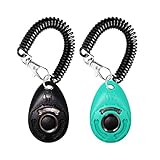
- EASY TO USE - Simple push button with distinct clicking sound.
- Comes with an elastic wrist band so you can leave it on your wrist or clip it to the leash or your pants.
- Not only train the dog but also the cat, bird, chicken, sheep a new behaviors like sit, fetch, roll over, lie down.
- For effective pet training ALWAYS reward with a treat after clicking.
- Can be used to train the dog basic obedience, small trick, and correct the bad behavior; Scientific method of training your pet safely and easily.
Fade the lure
When the dog responds to the cue, keep treats available but stop displaying one before every release. Say the cue, wait for the drop, mark it, and then produce the reward from your pocket or a nearby container. Continue rewarding generously while making the reward less predictable in advance. The dog should not have to see payment before deciding to let go.
Build reliability gradually
Change one difficulty at a time
Increase challenge in small steps: use a slightly more interesting toy, move to another room, add mild background activity, or ask for a release after longer play. Changing the toy, location, and distractions simultaneously makes it hard to know what caused a failure.
Use a second toy as a reward
Some dogs prefer play to food. Present a second toy, say the cue, and resume a favorite game when the first toy is released. For tug, freeze your hands and become boring rather than pulling harder; movement can accidentally turn the exercise into a contest. A brief return to play can be the payment for giving up the first toy.
Create space when necessary
If the dog tends to snatch the object back before you can pick it up, toss several treats to the side after the release. That gives you time to retrieve the original item without racing the dog. Use this as a management aid, not as a reason to chase the dog across the room.
Practice with safe “stolen-item” simulations
Place a permitted object on the floor, allow the dog to pick it up, and then cue the trade. Keep the object only mildly interesting at first. Progress to items that resemble common household temptations, but use dog-safe training props and supervise every repetition. A cue learned with a low-value toy will not automatically work when the dog has a highly valued forbidden object.
Rank #4

- MANUAL AUDIBLE CLICKER: Produces an audible click when manually pressed. The clicker contains no electronics, batteries, remote-control functions, or Electronic Stimulation features.
- INDIVIDUAL RESPONSE TO SOUND MAY VARY: Dogs and other animals may respond differently to audible clicker sounds. Introduce the clicker gradually and discontinue use if the animal shows discomfort or fear.
- COMPACT HANDHELD DESIGN: Small finger-clicker design is intended to be carried and operated by the user. Review the product images and compact size before ordering to confirm it meets your expectations.
- 5-INCH VELCRO FINGER STRAP: Includes an approximately 5-inch adjustable Velcro strap designed to position the clicker on the user's finger or hand. The strap is worn by the user and is NOT intended to be worn by the pet.
- TEAL CLICKER ACCESSORY: Includes one Teal manual finger clicker and training instructions. Remote transmitter, receiver collar, batteries, and other training-system components are NOT included.
What to do when your dog steals something
Pause instead of chasing
Keep your voice and body movements calm. Chasing can turn retrieval into a keep-away game, increase excitement, and encourage the dog to swallow the object. Walk rather than sprint, and avoid cornering the dog.
Offer a high-value exchange
Use a reward that is clearly better than the stolen item when possible: a favored dog-safe treat, a second toy, or a short play opportunity. Give the dog a clear path to move away from the object. Once the dog releases and moves toward the reward, retrieve the item without racing back into the dog’s space.
Do not make forced mouth opening your routine
Routinely prying open the mouth creates bite risk and can teach the dog that people approaching predict pain or loss. Physical intervention may be unavoidable in an immediate life-threatening emergency, but ordinary household retrieval should rely on distance, calm movement, and a well-trained exchange.
Assess the object’s danger
If the dog may have swallowed part or all of the item, or the object could be toxic, sharp, obstructive, or otherwise hazardous, contact a veterinarian promptly for item-specific advice. Training guidance cannot determine whether a particular object requires monitoring, examination, or urgent treatment. Do not wait for a training response if the dog’s health may be at risk.
Recognize resource guarding before you train around it
A dog that simply holds a toy longer is different from a dog warning you away. Possible guarding signs include:
Best Value

- Stronger Bark Control with 3X Ultrasonic Emitters: Unlike single-emitter devices, our upgraded dog bark deterrent features three synchronized ultrasonic heads—delivering 3X the coverage to quickly stop barking, biting, and jumping behaviors. Ideal for anti barking training, safer than bark collar, more effective than a dog whistle, offers a humane, high-performance dog training solution
- 6-in-1 Safe & Humane Training Modes:Our dog bark deterrent device features dual ultrasonic frequencies (fixed 25kHz and variable 20-30kHz), combining 4 ultrasonic modes plus an audible beep and LED flashlight for versatile training. Whether for daily training or stubborn, persistent barking, this anti bark device adapts to different dogs providing effective bark control without causing pain or distress. Perfect for training at home or to stop neighbors dog bark that disturbs your peace
- 23 FT Extended Range & Night Safety: Bark Control Anytime, Anywhere: Stop barking and bad behavior from up to 23 feet away with our powerful dog bark deterrent device — perfect for your yard, neighbor’s yard, outdoor walks, and off-leash areas. Whether you're relaxing at home or out for a stroll, enjoy safe, long-distance control to correct disruptions quickly. The built-in LED flashlight adds safety for evening walks, and low-light training
- Fast Charge & Long Battery Life – Always Ready for Training:With a Type-C fast charging port, our dog bark deterrent device reaches a full charge in just 2 hours and provides up to 30 days of regular use on a single charge, along with 180 days of standby time. Whether you're correcting anti barking behavior or training your dog in public places, you’ll always be prepared for any situation. Forget the hassle of frequent charging and enjoy reliable, long-term barks no more support
- Ultra-Compact Design for Everyday Convenience:50% smaller than standard dog bark deterrent devices, our anti barking device is ultra-compact and lightweight, fitting effortlessly into your pocket, bag, or hand. Whether you're on daily walks, outdoor adventures, or dealing with unexpected situations in public places, this portable design helps you stop barking and encourage good behavior anywhere, anytime. Say goodbye to constant noise and enjoy a barks no more experience with your dog
- Stiffening or freezing over the object.
- A hard stare directed at a person or animal.
- Whale eye, in which the white of the eye is visible.
- Lip lifting, low growling, or bared teeth.
- Escalating tension when someone approaches, reaches, or attempts a trade.
These signals can precede a bite. Do not test the dog by repeatedly reaching for the guarded object, and do not begin ordinary trade drills around it without qualified guidance. An American Kennel Club resource quotes Nicole Costanza, an AKC Canine Good Citizen Evaluator and owner of Big Momma’s Dog Training: “Any dog can be prone to resource guarding. It’s not specific to one breed.” Breed assumptions should never determine whether a warning is taken seriously.
Get the right help
For guarding, aggression, or significant stress, consult a qualified trainer or behavior consultant who uses humane, reward-based methods. Ask for an in-person or remote plan that addresses safety, management, and behavior change. Until then, prevent access to tempting objects, separate the dog from children during meals and chews, and avoid confrontational retrieval.
Independent reader supportYour contribution helps us test, update, and keep practical guides available for everyone.Troubleshoot common training problems
| What you see | Likely reason | Adjustment |
|---|---|---|
| The dog ignores the treat and clamps down. | The toy is too valuable, the reward is too weak, or the dog is over-aroused. | Use a less valuable toy, a more motivating dog-safe reward, shorter play, and a quieter location. |
| The dog drops only when the treat is visible. | The treat has become a lure rather than a consequence. | Say the cue first, wait briefly, then produce the reward after the release. Keep rewarding while fading the visible lure. |
| The dog drops but grabs the toy back immediately. | The release has not created enough space for retrieval. | Toss treats to the side, retrieve calmly, and return the safe toy after the dog finishes. |
| The dog runs away with the item. | Movement has become a chase game or the dog expects confiscation. | Stop chasing, lower your energy, improve the exchange reward, and practice with safe objects in a controlled area. |
| The dog growls or stiffens during practice. | This may be resource guarding, not a simple cue gap. | Stop reaching for the object and seek qualified behavior help; do not punish the warning. |
| The cue works with toys but fails for a stolen object. | The stolen object is much more valuable or the setting is more distracting. | Return to easier practice and build value and distractions gradually. Manage access while training catches up. |
Prevent thefts while the cue develops
- Keep socks, medication, food, batteries, cords, and small chewable objects out of reach.
- Use doors, gates, closed containers, or a pen to limit access when supervision is impossible.
- Provide legal chew and play options so the dog has appropriate items to carry.
- Reward the dog for choosing its own toys and for moving away from household objects when asked.
- Teach “leave it” separately for objects the dog has not yet picked up.
Management is not a substitute for training, but it prevents the dog from rehearsing stealing and prevents you from being forced into risky confrontations.
Quick wins for a faster PC:
Clear out junk files and repair common Windows errorsFree Scan →Fix the driver behind crashes, sound loss and screen glitchesFind Drivers →Repair Windows errors before they cause bigger problemsFix Now →A practical practice plan
Stage 1: Easy releases
Use the least valuable suitable toy and the strongest reward. Mark and pay every release, then return the toy. End before enthusiasm drops.
Stage 2: Cue reliability
Add your chosen word before the expected release. Gradually stop showing the reward first, while continuing to deliver it after the release.
Stage 3: More contexts
Practice in different rooms and with mild distractions. Change only one difficulty at a time and reduce difficulty immediately after a failed repetition.
Stage 4: Realistic but safe objects
Use supervised, dog-safe props that resemble likely temptations. Keep truly dangerous or forbidden items out of reach rather than using them as training equipment.
Recommended Free Tools
Stage 5: Maintain the behavior
Continue occasional food, toy, and play rewards. Return safe practice toys often enough that releasing remains a good prediction, and reserve the cue for situations in which you can follow through with a fair exchange.
Quick Recap
Key safety rules
- Never turn a release into a wrestling match.
- Do not punish growling; it is information that the dog is uncomfortable.
- Do not assume a cue transfers from a low-value toy to a prized or stolen object.
- Do not return dangerous items after a trade.
- Call a veterinarian when ingestion or exposure may have occurred.
- Use qualified behavior help for guarding, aggression, or serious stress.
Product prices and availability are accurate as of the date/time indicated and are subject to change. Any price and availability information displayed on Amazon at the time of purchase will apply.




