Start with the flap held fully open and let your cat decide to approach and walk through. Reward each voluntary passage, lower the flap in stages only after the cat is comfortable at each stage, and never push or pull the cat through. Before any of that, make sure the door fits your cat and opens onto a place you have checked for safety.
Check fit and the destination before you start
Training goes faster when the door is the right size from the beginning. A cat that has to squeeze or scramble through a flap is more likely to hesitate, and a cat that is uncomfortable at the door will learn to avoid it.
- Measure the cat, not the door. PetSafe’s published sizing advice (undated support material, reviewed for this article) says to measure your cat’s widest point and its height, then compare those figures with the sizing chart for the specific door model. Sizing differs between models, so use the chart for the product you actually bought.
- Confirm the installation instructions. Check the manufacturer’s current instructions before you cut or mount anything. Measurements and mounting requirements can change between versions.
- Decide where the door leads. A door that opens into a garage, laundry room, or other enclosed area is a different decision from one that opens to the outdoors. The outdoor risks are covered in the safety section below.
Step-by-step training sequence
The sequence below follows the progression in PetSafe’s training instructions: fully open, then partly open, then hanging normally. Move to the next step only when the cat is relaxed at the current one.
- Prop the flap fully open. Tape the flap up or prop it so the opening is clear. Your cat should be able to see through the gap and pass without having to move the flap. Leave the flap alone and give the cat time to investigate, sniff, and look.
- Invite the cat through. Stand on the far side and call the cat by name, or use a favorite toy or a treat to draw it toward the opening. Let the cat choose to walk through.
- Reward the passage. Give a treat or praise once the cat has gone through. Treats are optional. If your cat is on a restricted diet, use a non-food reward such as a favorite toy or a short play session instead.
- Keep sessions short and spaced. PetSafe’s brand article suggests two 10-minute sessions per day, spaced apart. Its support instructions advise a short break if the cat stays uncomfortable after a 10-minute session. These are manufacturer recommendations rather than a guaranteed schedule, and many cats will need more or fewer sessions.
- Lower the flap partway. Once the cat passes through the open opening without hesitation, lower the flap to a partly open position and repeat the invite-and-reward routine. Stay at this level until passage is relaxed and routine.
- Let the flap hang normally. When the cat walks through a partly open flap calmly, allow the flap to hang in its normal resting position. Keep rewarding passages for several days at this stage, because the flap now moves and makes sound.
If a stage takes a week or more, that is normal for a cautious cat. Moving back one stage for a few sessions is a reasonable response to any sign of stress.
Outdated Drivers Are Slowing You Down
One free scan finds every outdated or missing driver and matches the right update for your exact hardware.Free scan · exact hardware matchWindows Errors? Fix Them Before They Spread
Repair common Windows errors and clear accumulated junk for a smoother, more stable PC - no reinstall needed.Free scan · no reinstall#1 Best Overall

- Private Access for Your Cat: Give your cat unlimited access to her personal spaces even when the human door is closed
- DIY Installation: Easily fits any interior wood, storm, PVC, paneled or metal doors 1/2 - 2 in thick; includes detailed instructions, cutting template and hardware for your convenience
- Options Throughout Your Home: Place multiple cat doors in closet doors, laundry room doors, or cabinets for exclusive access to food or litterbox areas; designed for cats and small dogs up to 7 kg
- Lock and Unlock: The sliding lock lets you choose when to give your furry friend access to their pet area
- Designed for Your Cat: Door is designed for cats up to 15 lb
When the cat hesitates
Hesitation usually comes from one of three things: the flap itself, the sound it makes, or the sensation of pushing through it. Address the cause rather than pressing harder on the training.
- The flap is unfamiliar. Keep the flap open for longer and let the cat inspect the opening from both sides. Each approach should be predictable and rewarded.
- The nervous cat needs an intermediate step. PetMD, in a veterinary guide that quotes Cathy Lund, suggests a partial cloth barrier as an in-between stage for nervous cats before the actual flap is reintroduced. The barrier lets the cat push through something softer and quieter first.
- Locks make access unpredictable. Do not lock the door during early learning. A cat that sometimes finds the flap locked will stop trusting it, and training will take longer.
- Mobility limits matter. Older cats, or cats with stiffness or joint problems, may struggle to step over the threshold or push through the flap. A cat that struggles in this way should be checked by a veterinarian before you assume the problem is training.
Why pushing the cat through backfires
PetMD quotes Brian Glenn Collins, DVM, section chief of Community Practice Service at the Cornell University College of Veterinary Medicine, on this point: “Some cats will just jump right through, especially if they are young and playful. Don’t push the cat through the door, which may just scare them or make them leery of the door, and don’t expect the cat to use the door right away.” Some cats learn within a few sessions. Others need weeks, and a forced passage can set training back well beyond the time it would have taken to go slowly.
Rank #2

- 4 Switching Modes: Depets cat door interior door has four independent models to lock with switches - swing out only, in only, both in and out, and fully locked, easy control of your pet's in and out
- Applications: Outer size: 9.25" x 9.92" x 2.16"(W x H X D), Inner size: 7.08" x 7.48"(W x H), Cut-Out Size: 7.7" x 8.3" (W x H). This cat door exterior door is for cat lighter than 17.64 lb and waist circumference shorter than 23.62"
- Easy To Install: Complete instructions included, you can easily install our doggy door in windows, doors, cupboards etc.
- Thoughtful Design: Transparent flap let pet see through the pet door. Exterior screen is water resistant. Brush strip reduces noise from the door closing
- Assured Quality: Made of ABS plastic, weather-resistant, the surface of this window cat door is smooth and durable
Choose the access control and check the outdoor setting
A cat door is only as safe as the place it opens onto and the access rules it enforces. Decide both before you start training.
Outdoor hazards
PetMD’s veterinary guidance advises avoiding locations with hazards such as a busy street or driveway, an animal that may ambush the cat, predators, or falling ice or snow. Those hazards do not disappear because a door is installed. A pet door changes how the cat gets in and out; it does not make outdoor access safe for every cat or every setting.
Rank #3
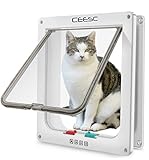
- 4-WAY SWITCH MODE: The pet door can be set to 4 modes using the red and green switches with tabs: Out Only, In Only, Both In & Out, or Fully Locked. Easily control your pet's access.
- SIZE & APPLICATION: Outer size: 9.8"W x 11"H x 2.15"D. Inner opening: 7.9"W x 8.7"H. Cut-out: 8.3"W x 9.5"H. Fits doors 1.26-2.17" thick with adjustable tunnel depth. For cats and small dogs under 25 lbs with waist <24.8". This is our X-Large (Extra Large) size.
- SAFE & THOUGHTFUL DESIGN: Transparent flap lets pets see through. Exterior rain seal provides waterproof protection. Brush strip reduces noise when the door closes.
- EASY TO INSTALL: Step-by-step instructions included. Can be installed in windows, doors, cupboards, panels, and thin walls.
- EXCELLENT QUALITY: Made of ABS material. Durable, weather-resistant, smooth surface, built to last.
Access control options
Some doors restrict who can pass. PetMD cites lockable models, collar-key models that open for a tag, and microchip-reading models that open only for a registered chip. Lock settings matter only after the cat is comfortable with the flap, so keep the door unlocked during training and set access rules once passage is routine.
- Size and clearance: the cat’s measured width and height against the door’s sizing chart.
- Flap resistance and sound: a heavy or noisy flap can be harder for a timid cat to accept.
- Access control: manual lock, collar key, or microchip reading, depending on the model.
- Installation location and compatibility: whether the door fits the wall, door, or panel you plan to use, and whether the manufacturer’s current instructions allow it.
The sources reviewed do not include independent product tests or a comparative performance ranking, so choose by fit, access control, and location rather than by a claimed winner.
Rank #4

- (PATENTED) PRIVACY FOR YOUR KITTY - Meow Manor pet door for cats is a magic portal to your cat's safe haven. With our indoor cat door, your baby can finally have a personal space for their litter box and food while the human door is closed. The best part? It keeps the odor away in the cutest way possible! And the dogs, too.
- EASY DIY INSTALLATION - Most cat doors on the market are put up with flimsy tape. DIYers can set up this pet door for interior doors in minutes. Our patented indoor cat door comes with easy to follow instructions and sturdy screws for a more secure, foolproof installation. Conveniently fits both solid and hollow core doors with 1.25" - 1.75" thickness.
- THE ONLY NO FLAP KITTY DOOR IN THE MARKET - Our cat door interior door is built with you and your feline in mind. Unlike cat doors with flaps that can harm your pet, this large cat door for interior door is safe for your baby's paws. No more getting their paws stuck under the flap and kids or dogs getting close to the litter box.
- NO TRAINING NEEDED - A cat door interior door with a built-in flap requires training to be used and can be bothersome with the annoying flap noise. To put an end to this door trouble, our kitty door for interior door has an option to "close" the opening instead. No training needed. Your cat will get it the same way he did with his litter box! It's THAT easy.
- FOR BIGGER BREEDS - Make cat doors indoor bigger you said. We heard you! Meow Manor measures at 9.25” high and 9” wide and is designed to be a large cat door to fit pets that weigh up to 20 lbs. If your cat weighs 20 lbs or more, we suggest you check out the Meow Manor XL.
What the sources do and do not establish
The training timings above come from manufacturer material rather than from controlled studies. No dated, owner-attributed statistic on how many cats learn to use a pet door, or how quickly, was found in the sources reviewed. The advice here is consistent across the veterinary and manufacturer guidance: fit the door to the cat, start with the flap open, reward voluntary passage, and move slowly. Individual cats will vary, and the cat’s own signals should set the pace.
For search purposes, readers often phrase this topic as “how to train your cat to use a cat door” or “how to train a cat to use a cat flap.” These phrasings describe the same task.
What’s actually slowing this PC down?
Pick the symptom - the matching free tool is one click away.
Quick Recap
Best Value

- ADJUSTABLE PET DOOR: Pet door with 4-way lock for controlling your pet's access to interior and exterior doors or wall spaces, providing convenient indoor and outdoor access
- SMALL SIZE OPENING: Entrance dimensions 5.7" x 5.6" accommodate cats and small dogs; product dimensions 7.5" x 7.4" x 2.24"
- DURABLE PLASTIC CONSTRUCTION: Made from high-quality plastic for lasting durability in various weather conditions
- EASY INSTALLATION: All components and instructions included for straightforward installation on doors or walls
- VERSATILE ACCESS CONTROL: 4-way lock allows you to set in, out, both, or locked mode while maintaining control over indoor and outdoor access points
Product prices and availability are accurate as of the date/time indicated and are subject to change. Any price and availability information displayed on Amazon at the time of purchase will apply.




