
Quick wins for a faster PC:
Fix the driver behind crashes, sound loss and screen glitchesFind Drivers →Clear out junk files and repair common Windows errorsFree Scan →Copper can treat marine ich (Cryptocaryon irritans) and velvet (Amyloodinium ocellatum), but only when the treatment is matched to the diagnosed parasite and the copper concentration is measured with a compatible test. It can harm sensitive fish, invertebrates, plants, and the biological filter. Use a product’s own label—not a dose copied from another copper product—and monitor copper and water quality throughout treatment.
What copper treats—and what it does not
Copper is used against certain external protozoan parasites, notably marine ich and velvet. It is not a general-purpose aquarium medication or a treatment for every parasite. It primarily affects the parasites’ free-swimming infective stages, so diagnosis matters: different parasites and stages call for different treatment plans. The University of Florida IFAS Extension overview and the Merck Veterinary Manual guidance describe copper use in marine systems.
As an Amazon Associate I earn from qualifying purchases.
If you are unsure whether the fish have ich, velvet, or another condition, consult an aquatic veterinarian or fish-health specialist before dosing. The right regimen depends on the diagnosis, fish species, product, and aquarium setup.
Choose the target and test before dosing
In a marine aquarium, the treatment target is a measured concentration of active copper—not simply the amount of product poured into the water. UF/IFAS gives a reference target of 0.15–0.20 mg/L free copper ions (Cu2+) for susceptible parasites. Merck gives 0.18–0.2 mg/L active copper ions for up to three weeks. These are guidance ranges from different contexts, not interchangeable instructions for every formulation. Follow the exact product label and use a test that can measure the copper form that product uses.
#1 Best Overall

- Buffered active copper
- Effective against external parasites
- For marine and freshwater use
Check the test kit’s stated measurement. For example, API says its Copper Test Kit works in fresh and salt water, ranges from 0–4 ppm, and measures total copper (free and chelated). A total-copper result is not necessarily the free-copper reading needed to interpret every product’s target. The API product page describes what that kit measures; confirm compatibility with the medication manufacturer before relying on it.
Do not calculate a dose from nominal tank capacity and assume it guarantees the target. Actual water volume, product concentration, tank materials, water chemistry, and test capability all affect the result. Copper may bind to surfaces or dissolved substances, while changes in water conditions can alter how much remains in solution.
Rank #2

- Package Length: 1.0"L
- Package Width: 1.0"W
- Package Height: 1.0"H
- Country of origin: United States
Prepare the treatment system
Before adding copper, UF/IFAS recommends checking ammonia, nitrite, pH, temperature, alkalinity, and salinity. Review the product label for setup requirements and remove materials or filtration components that bind copper when the label or an aquatic professional advises it. Keep invertebrates out of the treatment system: copper is highly toxic to many invertebrates and plants.
Free tools Windows power users keep installed
One-click scans. No signup required.
Some fish are sensitive to copper even below usual therapeutic concentrations. UF/IFAS reports that some fish may die below 0.15 mg/L and advises specialist guidance during an outbreak. If sensitivity for a species is uncertain, seek fish-health advice; UF/IFAS suggests testing the response in one or a few individuals rather than exposing an entire group without a basis for confidence.
Rank #3

- A Safe effective copper treatment safe for fish
- Used at 2.5 PPM Copper, Nearly 5 times the normal toxic level of copper in sale water
- Copper Power's Higher Concentration Lets you blast away disease
- Item Package Weight: 1.0
Raise copper gradually and monitor it
- Check the medication label. Confirm its target concentration, dosing schedule, treatment duration, compatible test, filtration instructions, and listed interactions. A protocol for one formulation must not be transferred to another.
- Build to the label target gradually. UF/IFAS recommends reaching its reference target over two to three days. Measure after dosing rather than assuming the added volume produced the intended concentration.
- Test frequently. UF/IFAS recommends checking free copper at least twice daily; Merck advises at least daily testing. Use the frequency required by the product label if it is more specific, and ensure the kit reads the product’s copper form.
- Watch fish and water quality. Observe fish for signs of distress and check ammonia and nitrite during treatment. Copper can impair nitrifying bacteria; if water quality deteriorates, get prompt fish-health guidance and take corrective steps that do not undermine the prescribed treatment.
Water chemistry helps explain why readings can shift. UF/IFAS notes that a pH decrease may release previously bound copper and raise dissolved levels; calcium- or magnesium-carbonate materials such as coral, shell, or dolomite can adsorb copper. Live food can bioaccumulate it, and chelated products vary in stability and biological activity. In other words, measure the concentration in the aquarium repeatedly instead of treating the initial dose as a lasting guarantee.
Keep the full, disease-specific treatment period
Because copper chiefly affects free-swimming infective stages, treatment duration depends on the parasite’s life cycle. UF/IFAS’s marine copper article describes generally required periods of at least three to four weeks for Cryptocaryon and ten to fourteen days for Amyloodinium. Its dedicated Cryptocaryon article instead advises treating affected systems for a minimum of three to six weeks and notes that some circumstances may require longer. These are distinct guidance statements; they do not establish one universal course. Follow the regimen appropriate to the diagnosis and product, with fish-health advice where needed.
Rank #4
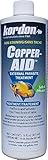
- Aids in general external parasite prevention
- Non staining
- Protects tank for 1 full month
- Just 1 teaspoon per 4 gallons of water,16 oz. Treats 400 gallons
- Treats ich, velvet & protozoan parasites
Protect the biofilter and other livestock
Copper can damage the aquarium’s biological filtration as well as the fish’s parasites. In Roy P. E. Yanong, VMD’s UF/IFAS Extension article, he writes, “Copper is also toxic to the nitrifying bacteria in the biofilter.” Merck warns that copper can adversely affect nitrifying bacteria and that a temporary rise in ammonia or nitrite may persist for weeks to months. UF/IFAS reports inhibition of ammonia and nitrite oxidation at 0.3 mg/L Cu2+; that figure describes an effect, not a treatment target.
What’s actually slowing this PC down?
Pick the symptom - the matching free tool is one click away.
Keep testing ammonia and nitrite during treatment and after it ends. Monitoring kits for these parameters are useful, but the cited guidance does not compare particular brands. Do not return invertebrates while copper remains at a potentially harmful level.
Best Value

- Copper treatment for external parasites
- Active at low concentration (does not precipitate)
- Bound on amine so it is not as toxic to fish
- 100% Removable with carbon or Cuprisorb
Follow the specific product label
Product directions differ in target, dose, duration, compatible tests, and interactions. As one product-specific example, the DailyMed listing for Seachem Cupramine directs users to remove invertebrates, turn off UV, remove chemical filtration, dose in two stages 48 hours apart, and hold its stated concentration for 14 days. It says not to redose without testing, lists reducing agents and other medication to avoid, and gives carbon or CupriSorb as removal options. Those directions apply to that product listing, not to copper products generally; check the current label before use.
The DailyMed listing states: “This drug has not been found by FDA to be safe and effective, and this labeling has not been approved by FDA.” FDA explains that a product intended to treat a fish disease is a drug under federal law, and that approved new animal drugs go through an NADA or ANADA process. Do not assume a product is FDA-approved for a use unless an FDA source confirms both its approval and indicated use. See the FDA Green Book.
Remove copper and verify the system before restocking
UF/IFAS describes high-quality activated carbon as a way to remove dissolved free copper; chelated copper may also require water changes. Follow the product instructions for removal, and measure copper after water has passed through the carbon. UF/IFAS recommends not returning invertebrates until free copper is 0.01 mg/L or lower, ideally zero.
The Tool Desk
Outbyte PC Repair FREEClear out junk files and repair common Windows errorsFree Scan →Outbyte Driver Updater FREEFix the driver behind crashes, sound loss and screen glitchesFind Drivers →Copper can bind to substrate and later return to the water if conditions change. Continue checking levels for weeks, particularly before returning sensitive invertebrates or other livestock. Also monitor ammonia and nitrite after treatment because damage to the biofilter may not resolve immediately.
Quick Recap
Product prices and availability are accurate as of the date/time indicated and are subject to change. Any price and availability information displayed on Amazon at the time of purchase will apply.





Leave a Reply