Quick wins for a faster PC:
Repair Windows errors before they cause bigger problemsFix Now →Fix the driver behind crashes, sound loss and screen glitchesFind Drivers →Clear out junk files and repair common Windows errorsFree Scan →Weather affects fish by changing the conditions around them—especially water temperature, light, oxygen, waves and currents, and where food is available. Fish may shift depth, shelter, feed, or move to another area in response. There is no universal “good fishing weather”: the outcome depends on the species, habitat, season, and how several weather factors change together.
The evidence and practical advice below concern wild fish in lakes, rivers, and coastal waters, not aquarium care. A weather forecast is most useful as a clue about where fish might be; water conditions and visible forage help test that guess.
What changes underwater when the weather changes?
Fish do not respond to a forecast as a single signal. Weather alters the environment they experience, and those changes can influence both their behavior and the location of prey.
- Temperature: Warm or cold conditions can change water temperature, but the effect varies with depth, season, and the water body’s structure.
- Light: Clouds and the angle of the sun affect how much light reaches the water. Lower light can change when predators can approach prey and when prey leave cover.
- Wind and waves: Wind can create surface movement, currents, and wave-driven flow. It can also move drifting food and smaller fish.
- Oxygen: Heat can increase the risk of oxygen depletion. Strong wind and cold rain can mix water layers and redistribute oxygen.
- Runoff and rain: Rain can change local water conditions and, depending on the place and event, affect where food and fish are found. Its effects are not uniform.
These factors often change at once. A fish that moves during a storm, for example, may be responding to waves or currents rather than to the barometer alone.
#1 Best Overall
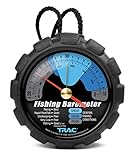
- Fishing Barometer: Helps track barometric pressure for better fishing success
- Easy to Calibrate: Barometer calibrates easily to your local barometric pressure
- Adjustable Pressure Change Indicator: Features a reference marker and color-coded dial that displays conditions for great, good, or poor fishing
- Durable Construction: Housing is made of sure-grip plastic
- Braided Lanyard: Provides convenient hanging or carrying
Does barometric pressure affect fish behavior?
Pressure is not a reliable stand-alone rule for predicting whether fish will bite. Weather systems change pressure alongside wind, waves, temperature, and light, so a change in fish activity does not by itself show that pressure caused it. The cited evidence does not establish a universal pressure threshold or a rule that applies across species and habitats.
In a NOAA-led study of 30 gray triggerfish at a 37-meter study site during two 2017 hurricanes, wave-generated oscillatory flow at the seabed was more strongly correlated with fish movement than barometric pressure or bottom temperature. The study was published in Scientific Reports in 2019. It is evidence about this species and site, not a direct forecast for every fishery.
What happens before and after a front or storm?
A front or storm can change several underwater conditions quickly. Fish may leave an exposed area, shelter, shift depth, or move with prey and currents. The response depends on the storm’s severity and the habitat; a cold front, a summer thunderstorm, and a major coastal storm are not interchangeable.
Rank #2
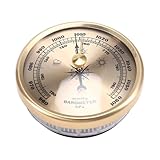
- Easy-to-Read Dial Barometer: This barometer features a clear dial design, functioning as both an air pressure gauge and shine and rain indicator. Perfect as a household barometer or indoor barometer for weather tracking.
- Precision Barometric Readings: Equipped with a high-sensitivity sensor, this barometric pressure gauge ensures accurate measurement for fishing, hiking, or home use. A must-have fishing barometer for anglers.
- Compact & Portable: Lightweight and small barometer designed for easy portability. Ideal as barometers for the home or outdoor adventures like camping and boating.
- Multi-Functional Weather Tool: Combines an air pressure gauge, barometric pressure gauge for fishing, and weather predictor in one device. A versatile multi-use barometer for daily needs.
- Durable & User-Friendly: Built to last with a simple interface, this home barometer is reusable and reliable for both beginners and weather enthusiasts.
Storms can prompt abrupt movement
In the gray triggerfish telemetry study, movement rates were 100% higher and emigration rates 2,550% higher on storm days than on no-storm days. Many of the tracked fish left the 37-meter study area before the storms, then returned within days. NOAA Fisheries reported that many returned within a couple of days and resumed normal swimming behavior. These are measured results from two hurricanes and one study site, not expected percentages for other species.
PC Slower Than It Used to Be?
A free scan shows the junk files, broken settings and background clutter dragging Windows down - then fixes them in one click.Free scan · Windows 10 & 11Crashes, No Sound, or Screen Glitches?
Random freezes, missing sound and display glitches usually trace back to one bad driver. Find and replace yours safely.Free scan · under a minuteAfter a cold front
Missouri Department of Conservation guidance says cold fronts can reduce fish movement or fishing success, while also cautioning that weather does not affect fish in fully predictable ways. Treat a post-front slowdown as a possibility, not a certainty. Check the water temperature, depth, structure, and signs of forage rather than assuming fish have disappeared.
Safety comes first
Do not stay on the water or exposed shore to test a fishing theory during lightning, dangerous waves, or other hazardous conditions. A storm’s potential to move fish is not a reason to fish through unsafe weather.
Rank #3

- Easy-to-Read Dial Barometer: This barometer features a clear dial design, functioning as both an air pressure gauge and shine and rain indicator. Perfect as a household barometer or indoor barometer for weather tracking.
- Precision Barometric Readings: Equipped with a high-sensitivity sensor, this barometric pressure gauge ensures accurate measurement for fishing, hiking, or home use. A must-have fishing barometer for anglers.
- Compact & Portable: Lightweight and small barometer designed for easy portability. Ideal as barometers for the home or outdoor adventures like camping and boating.
- Multi-Functional Weather Tool: Combines an air pressure gauge, barometric pressure gauge for fishing, and weather predictor in one device. A versatile multi-use barometer for daily needs.
- Durable & User-Friendly: Built to last with a simple interface, this home barometer is reusable and reliable for both beginners and weather enthusiasts.
Is fishing better before or after rain?
Neither timing is reliably better everywhere. Gentle rain and light-to-moderate wind can sometimes improve conditions for fishing, according to Missouri conservation guidance, while thunderstorms and cold fronts can reduce movement or success. Rain can also arrive with changes in temperature, light, runoff, and water movement, so the rain itself may not be the decisive factor.
After rain, check what has actually changed at the water: temperature, clarity, current, depth, and visible forage. A heavy storm can produce very different conditions from a gentle shower, and the same rain can affect a small stream differently from a large lake or coastal area.
Do fish bite more when it is cloudy or bright?
Cloud cover changes light, which can change feeding opportunities, but it does not guarantee a stronger bite. Iowa DNR fisheries bureau chief Joe Larscheid says fish are often most active at dawn and dusk, when prey leave cover and predators can take advantage of lower light. That pattern helps explain why lower-light periods can matter; it does not mean every species feeds only at those times.
Rank #4
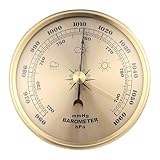
- Monitor atmospheric pressure changes with this reliable analog gauge, ideal for weather forecasting and planning outdoor activities.
- Constructed from durable PP material for long-lasting service and resistance to wear in various environments.
- Versatile tool suitable for home, office, fishing, planting, boating, and shopping malls, both indoors and outdoors.
- Compact 3.54-inch diameter design is space-saving and easy to use, with a sleek aesthetic that complements any space.
- Package includes 1 pressure gauge, ready for immediate use.
- Cloudy or low-light conditions: Consider shallow cover and edges where prey may be exposed. How far fish move into open water depends on species, water clarity, and available cover.
- Bright midday conditions: Look for shade, depth, or other cover, particularly where fish can avoid strong light. Do not assume all fish have moved deep; check the habitat and forage.
- Dawn and dusk: These are useful periods to investigate feeding edges because prey activity and predator opportunity can change with the light.
Does wind help or hurt fishing?
Wind can redistribute food and fish rather than simply making them more or less active. Drifting insects, plankton, or bait may collect along wind-exposed shores, so a windward bank or point can be worth checking when it is safe to do so. Missouri Department of Conservation guidance notes that fish may move toward wind-exposed shorelines where drifting food accumulates.
Wind direction can also matter in ways that are not visible from shore. NOAA work on Alaska pollock found that wind could either retain juvenile fish in nursery habitat or transport them away. NOAA Fisheries biologist Matt Wilson summarized the finding: “Wind is the culprit.” That result concerns juvenile pollock and their nursery habitat; it is not a universal rule about adult fish or other waters.
A 1998 study of European seabass associated wind speeds above 8 meters per second with increased swimming activity in the tested fish. This is a species- and study-specific result, not a recommendation to fish in strong wind. For shore casting into wind, Missouri’s instructor guide recommends heavier lures; the suitable lure weight and style depend on the species and water. Stop if wind, waves, or weather make the location unsafe.
The Tool Desk
Outbyte PC Repair FREEClear out junk files and repair common Windows errorsFree Scan →Outbyte Driver Updater FREEFix the driver behind crashes, sound loss and screen glitchesFind Drivers →Best Value
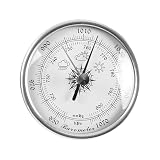
- Early Warning System: The barometer indoor provides barometric pressure monitoring through -sensitivity sensing components, enabling real-time tracking of atmospheric changes to assist in weather forecasting, ensuring users are prepared for potential weather shifts at home or work
- Compact and Reliable: With its 72mm compact structure and shockproof housing, this fishing barometer provides dependable readings while remaining ly portable, allowing seamless integration into any fishing setup without adding bulk or complexity
- Adaptable Environmental Tool: Designed with a robust mechanical transmission system, the barometric pressure meters monitors ventilation and adapts to temperature and humidity shifts, providing reliable performance across diverse settings like greenhouses, nurseries, and industrial spaces
- Outdoor Readings: Designed with rotary dials, the barometer outdoor incorporates a purely mechanical structure without electronic elements, enhancing durability and minimizing breakdowns; its easy-to-reads format supports seamless use by travelers and hikers needing precise atmospheric updates for more secure journeys in remote areas
- Rust-Proof Durability: Featuring a rust-proof coating, the precision barometer resists degradation while maintaining stable functionality, ensuring accurate pressure data collection for marine applications or coastal environments that moisture levels are consistently elevated
How do heat and cold affect fish?
Temperature affects fish through the water, not just the air. A warm day does not tell you the temperature at every depth, and a cold front does not instantly make an entire lake uniformly cold. Season, depth, and mixing determine what conditions fish encounter.
Hot weather and oxygen
UF/IFAS Extension warns that hot weather raises the risk of oxygen depletion. Its 2021 guidance gives a critical dissolved-oxygen range of about 2–4 milligrams per liter, depending on species. That is a species-dependent warning range, not a universal safe target for every fish or water body.
Wind and cold rain can mix a summer water column
In summer, a lake may have layers with different temperatures and oxygen conditions. UF/IFAS explains that heavy wind and cold rain can break up a thermocline and redistribute oxygen. Mixing can change where suitable conditions are found; it does not guarantee that every depth becomes favorable.
How can you use the forecast to choose where to look?
- Use the forecast to form a location hypothesis. Ask what the expected wind, light, temperature, and rain might change in the water, rather than labeling the whole forecast “good” or “bad.”
- Check the actual water and habitat. Consider water temperature, depth, structure, clarity, and any visible forage. These observations can tell you whether the weather-based idea fits the site.
- Match the search to the conditions. In lower light, examine shallow cover and feeding edges. In bright conditions, consider shade, depth, or clearer-water avoidance behavior. If wind is moving food toward a shoreline, inspect exposed points or windward banks when safe.
- Adjust expectations after abrupt weather. Following a cold front or thunderstorm, fish may move or activity may slow. Check more than one depth or piece of structure instead of assuming a single location holds fish.
- Make safety the limit. Lightning, hazardous waves, and dangerous wind outweigh any tactical advantage a weather pattern might offer.
Why weather rules do not work for every fish
Weather effects differ by species, life stage, depth, habitat, and season. The NOAA storm findings concern gray triggerfish; the wind-and-nursery result concerns juvenile Alaska pollock; and the activity observation above 8 meters per second concerns tested European seabass. None should be applied mechanically to every freshwater or marine fish.
What’s actually slowing this PC down?
Pick the symptom - the matching free tool is one click away.
Missouri Department of Conservation captures the practical limit: “Weather certainly affects fish, but not always in predictable ways.” Temperature, pressure, wind, rain, light, and waves can act together, so a useful forecast narrows down where to look—it does not promise a bite.
Quick Recap
Product prices and availability are accurate as of the date/time indicated and are subject to change. Any price and availability information displayed on Amazon at the time of purchase will apply.




