
Crashes, No Sound, or Screen Glitches?
Random freezes, missing sound and display glitches usually trace back to one bad driver. Find and replace yours safely.Free scan · under a minuteWindows Errors? Fix Them Before They Spread
Repair common Windows errors and clear accumulated junk for a smoother, more stable PC - no reinstall needed.Free scan · no reinstallWhat sounds like a laugh is usually a spotted hyena’s giggle call: a high-pitched vocalization used during close social encounters, especially when hyenas feed together or compete around food. It is not evidence that the animal finds something funny or feels amusement in the human sense.
Acoustic research shows that a giggle can contain cues about a hyena’s age, individual identity and place in the dominance hierarchy. Those cues may help listeners judge one another, but scientists have not demonstrated that a giggle is a fully decoded announcement such as “I am subordinate” or “help me.”
As an Amazon Associate I earn from qualifying purchases.
Why a hyena’s giggle sounds like laughter
The familiar sound belongs mainly to the spotted hyena (Crocuta crocuta). Observers describe it as a series of short, high-pitched notes delivered in bouts. To human ears, the rhythm and pitch resemble a nervous chuckle or laugh, which is why the popular name stuck.
“Laugh” is therefore a sound-based nickname, not a diagnosis of an emotion. Human laughter can signal amusement, embarrassment, relief, tension or social bonding. A hyena’s giggle should not automatically be assigned any of those meanings. The reliable starting point is that it is a social call produced in a particular interaction.
#1 Best Overall

- Bring on the laughs and adventures with your soft, huggable, and not so loud Hyena stuffed animal
- Zoo plush toys for kids make excellent playmates during the day, and protectors at night.
- Stuffed animals are the perfect Birthday, Valentine’s or Christmas gift for boys and girls of any age.
- Made of recycled fabric, durable stitching and love, Unique plush animal toys are prepared to be there no matter what life brings your way.
- Every one of our wild onez plush toys are made up of average of 17 plastic bottles.
What the giggle call means in hyena society
It belongs to close-range social encounters
The giggle is discussed in connection with interactions among nearby hyenas. The 2010 acoustic study by Mathevon and colleagues describes giggles as calls often heard while animals feed together. Competition around food is another relevant setting. A giggle can consequently occur during an intense or unequal encounter, not only during relaxed contact.
That context matters because the same sound may be useful to both the caller and the listener. When several hyenas are close together, identifying who is calling and assessing that individual’s social position can affect how the interaction unfolds. The call’s acoustic structure gives listeners information to work with; it does not provide proof of a conscious, sentence-like message.
It carries information about the caller
Analysis of recorded giggles found features associated with three kinds of information:
Recommended Free Tools
- Age: acoustic characteristics varied with the caller’s age.
- Individual identity: the sound contained an individual signature, allowing calls to differ from one hyena to another.
- Dominance or subordinate status: elements of the call were associated with rank relationships.
In communication science, saying that a call “encodes” information means that measurable properties of the sound correlate with those traits. It does not necessarily mean the caller intentionally packages a status announcement, or that a listener always extracts every cue. The safest interpretation is that a giggle can help hyenas assess one another during social contact.
It is not a synonym for happiness
Because giggles are conspicuous and sound comic to people, they are often described as signs that hyenas are happy. The evidence does not support that translation. The key study examined social and competitive situations and identified acoustic information, not a human-like emotion of amusement.
Rank #2

- This plush is approx. 3.5" x 12" x 4.5" in size
- Made from the highest-quality materials so the fun never ends
- This fluffy and loveable Hyena plush makes for a great cuddling partner
- Flopsies are designed to lay resting on its belly for easy, fun play
- To ensure stability and quality, this plush contains bean pellets suitable for all ages
A hyena may vocalize when food access is contested, when it is interacting with a more dominant or subordinate animal, or when several group members are nearby. Without additional behavioral and situational information, the sound alone cannot tell an observer whether the caller is calm, aroused, anxious, excited or attempting to maintain contact.
What the 2010 giggle study actually established
Acoustic patterns, not a dictionary of calls
Mathevon et al. (2010), in the paper What the hyena’s laugh tells: Sex, age, dominance and individual signature in the giggling call of Crocuta crocuta, measured the structure of spotted hyena giggles. The work linked sound characteristics with age, identity and dominant or subordinate status. This is strong evidence that the vocalization contains social information.
Do these 3 things before closing this tab:
1Scan for outdated or missing drivers - takes under a minute2Clear out junk files and repair common Windows errors3Fix the driver behind crashes, sound loss and screen glitchesThe study did not establish a one-to-one translation for every giggle. It also did not show that a receiver consciously labels the caller’s rank and then changes behavior because of that single call. Those are questions about how animals use information, rather than whether the information is present in the recording.
Why the study’s setting limits the conclusion
The animals were housed mostly in pairs, with one trio. Their relationships were therefore easier to characterize than the shifting, multilayered relationships of a large wild clan. A captive dyad can reveal useful acoustic patterns while still failing to represent every circumstance in which free-ranging hyenas call.
The authors explicitly identified the next step: “Experimental studies are now needed to decipher precisely the communication network of this species.” Playback and behavioral experiments are needed to test what listeners do when they hear calls that differ in identity, age or rank cues. Until those tests are available, “may help assess social position” is more accurate than “tells other hyenas exactly who is in charge.”
Rank #3

- Come on and laugh along with this Hyena stuffed animal.
- These zoo stuffed animals are made of high-quality material and are surface washable in case you get the animal plush dirty while hunting outside.
- This animal plush will bring immediate happiness into your household and it makes a great gift for any kid, teen, adult, or animal lover.
- The approximate size of these stuffed toys are 12 inches, allowing your kid to take it with them to school in their backpack.
- Stuffed animals for boy; stuffed animals for girls; Toys for kids; plush toys; kids toy; toys for toddlers; plushies; realistic stuffed animals; stuffed animals for kids; zoo animal toys; zoo animal plush; Africa toys; safari
Giggle versus whoop: two calls with different jobs
Spotted hyenas have several vocalizations. The giggle should not be confused with the whoop, a distinct call used over longer distances. Comparing the two makes the limits of the laugh metaphor clearer.
| Call | Typical distance or context | Information or function supported by studies | How certain is the interpretation? |
|---|---|---|---|
| Giggle | Close social interactions, including feeding together and competition around food | Acoustic cues associated with age, individual identity and dominant or subordinate status | The cues are measurable; experiments are still needed to show exactly how receivers use them |
| Whoop | Long-distance communication | Caller identity, location and requests for support have been described | Playback work supports individual vocal recognition, including mothers responding more strongly to their own cubs’ whoops |
What the whoop studies add
East and Hofer’s 1991 work described whooping contexts and functions that differ from the close-range giggle. A whoop can display identity, indicate where the caller is and be associated with a request for support. It is therefore better suited to maintaining contact across space than the giggle documented around immediate social encounters.
In a 1999 playback study, mothers reacted more vigorously to recordings of their own cubs’ whoops than to control recordings. That result supports individual vocal recognition: a mother can distinguish her cub’s long-distance call from other sounds. It does not convert every hyena vocalization into a human-style word, but it provides experimental evidence that whoops carry usable identity information.
A 2015 study of long-distance communication and cooperation among wild spotted hyenas included calls recorded during simulated conflicts with lions. Its interpretation is appropriately cautious. If a call precedes other animals cooperating, that timing alone does not prove the call recruited help; listeners may have responded to the conflict, the caller’s behavior or other cues. The same principle applies to giggles: sequence and context matter.
How sound works with the rest of hyena communication
Vocalizations are only one part of a hyena’s social signaling. A July 8, 2026 report from the Leibniz Institute for Zoo and Wildlife Research described spotted hyenas using facial expressions alongside vocalizations during play fighting and de-escalation. That finding broadens the picture of hyena communication, but it should not be presented as a discovery about the giggle call specifically.
Rank #4

- Spotted Hyena stuffed animal, approx. 11.81 inches (30 cm): soft plush, orange-red safety eyes and granule filling.
- Approximate dimensions: 11.81 x 4.33 x 8.66 inches (30 x 11 x 22 cm), measured length x width x height. Fur: Acrylic; Filling: polyester fiber and granule filling.
- The fur of the hyena is light brown with black spots. The teeth are made of soft fabric. Orange-red safety eyes complete the design.
- Hand washing is recommended. Please also follow the care instructions attached to the product.
- Part of the Carl Dick Collection, offered by Carl Dick GmbH Import und Export in Garmisch-Partenkirchen, Germany.
For an observer, this means a sound should be interpreted alongside the interaction in which it occurs. Who is nearby? Is food present? Are the animals playing, contesting access or separating after contact? What are their facial displays and movements doing at the same time? The giggle’s acoustic cues can provide information about the caller, while the surrounding behavior helps explain what social problem the animals are managing.
Independent reader supportYour contribution helps us test, update, and keep practical guides available for everyone.How to interpret a “laugh” when you hear one
Start with the species and the setting
The classic laugh-like call is associated with spotted hyenas. If you are watching a recording or a zoo enclosure, first note whether the sound is coming from a spotted hyena and whether other animals are close. A long-distance, sustained call is more likely to be a whoop than the short, high-pitched giggle described in the acoustic study.
Look for a social interaction, not a punchline
Feeding, crowding around food and direct competition are especially relevant contexts for giggling. Treat the call as part of that interaction rather than as an independent emotional label. A sequence of calls during contact may be socially informative even when the animals are not visibly playful.
Do not infer rank from one sound
Research found rank-related acoustic cues, but a single recording cannot reliably tell a casual listener which animal is dominant. Rank in a clan is a relationship, and the captive study’s pair-based setting was simpler than a large wild group. Use the evidence to understand why the call might matter, not to assign a precise hierarchy from an isolated clip.
Avoid provoking calls for entertainment
Imitating a giggle, crowding an enclosure or creating a food dispute to make a hyena vocalize would change the animals’ circumstances and could cause distress or conflict. Responsible observation keeps distance and allows the animals to choose whether to interact. A sound is most informative when it is recorded in a normal social setting rather than forced for a demonstration.
Best Value
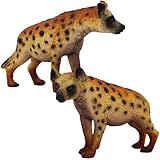
- Realistic Emulational Details: This wildlife toy hyena was made by hand painted with high realistically detailed appearance. Their uniquely molded textures and richly painted details make the animals vivid. All the animal figures stand up very well and do not fall over. Children would like to spend more time to observe and play with them
- Awesome Birthday Gift: Gemini&Genius has such cute and different varieties of animal figures worth collecting, decorating children's bookcase, desk and room. It's an awesome birthday gift or prize for kids, also it would be a good idea to use them as cake toppers and make an animal-themed cake for your children and then as a toy afterwards
- Educational Animals Playset: These are suitable for education purposes, creative play, party favors, school projects, baby shower and crafts. Parents can tell the children stories about the information of the animals or the happy life of the animal family, it will improve the parent-child relationship
- Natural Appearance and Color: This hyena figure is a high quality replica with true-to-life detail, appealing color, and active poses. These models are designed for teachers, children, collectors, animal lovers and pastry cooks everywhere. Suitable for miniature Christmas decorations, landscape scenes, imaginative play, birthday cake topper and safari world party theme decor
- Safe Materials: Animal Figures Playset made by durable ABS plastic, Non-Toxic Paint and Odorless. All by safety materials for kids, all safari figures are solid. Kids love to pretend with them and they love to learn the names of each animal
Common misconceptions about hyena laughter
“Hyenas laugh because they are amused”
No study cited here demonstrates human-like amusement. The call’s resemblance to laughter is an analogy based on sound. Its documented value is social information in close interactions.
“Every laugh means the same thing”
Giggles vary with caller characteristics and occur in more than one social circumstance. Age, identity and rank cues can be present at the same time, while the surrounding interaction changes what a listener may need to assess.
“The giggle is the hyena’s alarm call”
The evidence summarized for this topic does not establish that definition. The giggle is associated with social and competitive encounters. Long-distance contact and support-related communication are more closely associated with the separate whoop.
Quick wins for a faster PC:
Scan for outdated or missing drivers - takes under a minuteDriver Scan →Clear out junk files and repair common Windows errorsFree Scan →“Scientists have fully translated the call”
They have identified acoustic correlates and demonstrated vocal recognition in related whoop research, but they have not decoded a complete giggle vocabulary. Experimental tests of receiver responses remain necessary.
The clearest answer to why hyenas laugh
Hyenas do not laugh because they understand jokes. Spotted hyenas produce a high-pitched giggle call during close social interactions, including feeding and competition. The sound can encode information about the caller’s age, identity and dominance status, potentially helping nearby animals evaluate one another. Its exact meaning depends on context, and the evidence does not justify treating it as a simple expression of joy or a fully translated message.
Quick Recap
Product prices and availability are accurate as of the date/time indicated and are subject to change. Any price and availability information displayed on Amazon at the time of purchase will apply.





Leave a Reply